Transforming Digital Data into Real-World Impact: A Compelling NPI Journey
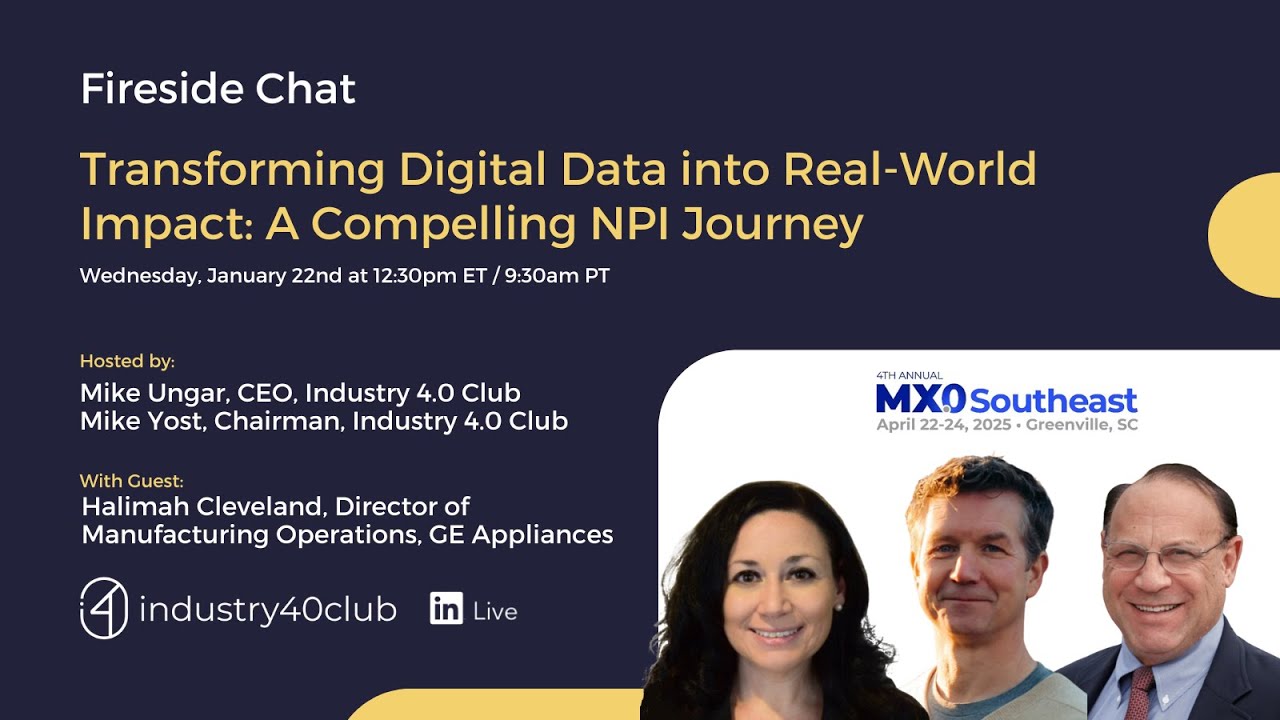
Halima Cleveland, Director of Manufacturing Operations at GE Appliances, walks through launching a new range platform in a 1.4 million-square-foot plant. She explains how digital tools like Brilliant Factory and IQMS give real-time visibility into production, and why the biggest barrier to data-driven manufacturing is culture, not technology.
Chapters
Welcome to the Industry 4.0 Club's fireside chat. The club's purpose is to engage the power of diverse worldwide talent to accelerate the global evolution to Industry 4.0. We accomplish this by hosting and supporting respectful, thoughtful and interdisciplinary open conversations, and creating quality content on wide-ranging Industry 4.0 topics to expand the reach of our community. My name is Mike Ungar, and I am the CEO of the Industry 4.0 Club. I have over 40 years of leadership and management experience, with most of that being in manufacturing at Michelin. I'm joined today by, joined today by my co-host Mike Yost, who's chairman of the club. Mike, could you introduce yourself, please?
Sure, thank you, Mike.
Welcome everybody.
As Mike said, my name is Mike Ghost. I'm the volunteer chairman of the Industry 4.0 Club, one of the co-founders. Been in industry for about 35 years, the first half on the industrial solution provider side and the last half on the industrial nonprofit side. So really looking forward to our conversation here today with Halima.
Yes, Mike, thank you. So we do have the pleasure of speaking with Halima Cleveland. She's the Director of Manufacturing Operations for GE Appliances. She's going to be presenting at the 4th MX.O Southeast event in Greenville, South Carolina on April 22nd. The title of her presentation is Transforming Digital Data into Real-World Impact: A Compelling NPI Journey. So a little bit about the event, the MX.O Southeast event, has become the, the go-to gathering for manufacturers in the region to connect, collaborate, and learn from real-world examples of successful digital transformation, shared straight from, if you will, the manufacturer's mouth. Since 2022, the event has empowered local manufacturers to advance their careers and businesses through valuable knowledge exchange and impactful networking opportunities. A little bit about Halima. Aleema's current role supports GE Appliances' $118 million investment in their new freestanding range models at Roper Corp. in Lafayette, Georgia. She began in 2023 as the materials director and then was appointed as a staff lead to maintain production excellence in all areas while overseeing the total value streams, which includes safety— sorry, which includes assembly, fabrication, finishing materials quality, safety, and people initiatives. Prior, Halima was the senior manager of manufacturing operations at the Camden, South Carolina facility for GE Appliances. She joined GE Appliances in April 2020 from Bosch, where she served as the value stream manager overseeing and expanding the largest value-added services area in Building Technologies Division worldwide, catering to all North and South America markets. Wow, quite an accomplishment already. It's great to hear what you've done. She hails from Greenville, South Carolina, where she earned her associate's degree in industrial electronics from Tri-County Technical College, a bachelor's degree in organizational leadership from Anderson University, and an MBA from— with a focus on international management from California Intercontinental University. So welcome, Halima.
Thank you.
Yes, welcome.
Glad to be here.
Excellent. We just want to remind everybody that we are live, and so if you have questions for Halima or comments to make to contribute to the conversation, go ahead and add that into the comments field and we will respond to them if and as we're able to. Halima, before we get into conversation about your presentation, Which sounds very compelling. I think folks might like to hear about your personal journey a little bit. So can you talk a little bit about what got you interested into industrial electronics and then led you to a career in manufacturing?
Yeah, so this is an interesting story. So this is really a story of divine intervention. In high school, I was always into physics, advanced chemistry. I took all the science classes you could think of. And, um, I actually received a full scholarship to Clemson University, and I was going to originally be a geneticist. Um, the tipping point to the story is I actually do not have family, so at 18 years old, I was supporting myself full-time. So I had to work 40, more like 60 hours a week. Um, so with that being said, trying to do that and go to college full-time at Clemson University where you were actually having to go to plays at night and take tests. It was, it was very overwhelming for me, my 18-year-old self. So I was actually making a job like $6 an hour, and I found a job at a plant making $8 and some change an hour. I thought, it's awesome, right? And so I, um, took a job as a machine operator. And I was still very young. I was still before 19 years old. I was still 18 years old. And I let them know right up front I was very interested in going to school. And so that led me the opportunity to apply for the apprenticeship program. And that is how I got into manufacturing. And it was not on my radar to begin with, but like I said, it's divine intervention because I can't imagine myself like in a lab all day anymore.
And, um, I just—
it carried me throughout, right? And even when I went to get my bachelor's degree, I went to see Doug. He's retired now, the head of the Industrial Electronics Department at Tri-County Tech. And I was like, I'm in management, I want to get, you know, another tech degree. I want to make sure that I can hold on to this. And he's like, Halima, you need your bachelor's degree. And he sent me to Anderson University and got me in touch with the right people. to get my bachelor's. And then of course I went to get my MBA. And to add one more thing to that, when I really, really think about— and this is a little touching, but I remember young self me calling a Christian hotline one time when I was at school for Tri-County Tech. And I was saying, I'm not sure if I should be doing this. I want to make a difference. I want to make sure I'm on the right path. And out of all people in the world I received, I actually received a female technician, which you gotta remember, this is 20 years ago. And so that was really odd, if you want to talk about—
Yeah.
Um, odd. And, um, she's like, Halima, we need people in engineering just like we need doctors, like we need lawyers, like we need missionaries. And If I could look back and see where I'm at today and the people I've helped go to school, um, the operators I've helped, the way I lead it, I would never realize or thought of all that because the way I got management is a whole different story. We won't have time probably go into that, but I originally was gonna be PLC technician. So here I am today though.
What a fantastic background.
Yeah, that's a great story. I think that's interesting. It was a function of wanting to make a little more money and then the opportunity just sort of— you caught the bug, huh?
Yes. I loved it.
That's fantastic. Can I ask you, the title of your talk, there's something in there that says NPI. Can you talk a bit more? Because a lot of folks may not know what that stands for. What does NPI stand for?
NPI is new product introduction, and that is whenever you launch a new product. You can be launching a new facility, and I would say I'm probably the queen of NPIs at this point. Feels like everywhere I ever went, we would go in and bring in some new product. So that's where that space is, and I think a lot of businesses may struggle a little bit with that and how to do it successfully. A lot of times you see a new launch and it's chaos, and you're going to get that with every launch. But really, how do you take the data you have and the resources you have to make it smoother and more successful for your team? So that's what it's about.
Yeah, and that's a really critical part of a lot of companies' businesses, right? Being able to get responsive to the marketplace and get new products out. And things like that. And that's going to be a focal point of your conversation when you present at the event in April. Is that right?
Absolutely right. You have to be agile in this business. You can't be stuck, right? And so change is really important and understanding how do that change and changing with technology right now, especially AI is coming on board and all of that. So how do we use those tools to really get to where we need to go and faster. So that's something we have to embrace if we're going to continue to stay competitive.
What made you choose the topic of new product introduction, let's say, versus something else? What is that, an area that you've got a lot of specific expertise in, or is it just an area of interest for you?
Probably both with that, but actually since this last year, Going through an MPI, I thought it was very prevalent since I had recent experience launching our new Apex platform, which is our new freestanding, and it also includes slide-in now, induction, some other type ranges. And it's very important when I look back at how we overcame so much so quickly, how we used our data to slice and dice and figure out where we need to go attack problems. Because that is only as good as what you put in. I think some people think you're gonna get this magical system that comes to you and it's gonna fix everything, right? And sometimes we get systems and nobody even knows what to do with them. Have you ever seen that where you got a new shiny thing in the plant and everybody's like, oh, ends up collecting dust in the corner, right?
Yes.
So I think it's important for people to understand and share how do you get there quicker and training people and being able to use those resources. And we have multiple ones at GE Appliances.
Well, and it's cross-functional too, right? I mean, just going down the list of what Mike talked about, the areas that you're overseeing, right? Like assembly, fab, finishing, materials, quality, safety, people, right? I mean, all those different initiatives and people and systems and things like that. It's got to be a pretty tough challenge to do all the coordination with those folks.
It was in the beginning, but I think we have it down pat now. It is a 1.4 million square foot facility, and I took the challenge from my boss to practice as plant leader and go and launch the Apex product for all of third shift. So I went as the staff support 2/3. I'm currently still there at this moment, but now we're kind of continuous improvement mode. Thankfully we got through it. But we have 35 presses, we have numerous trailers and dropping in and out material side. And that AY, that assembly yield, is a plant number for success because you cannot get that number unless everybody is doing the right thing at the right time.
Right.
So it is a lot. You do have to use your systems. We have a system called Brilliant Factory where I can actually see what every line is running in the plant at any given time. So if there's a struggle or issue, I go help them. We have a system called IQMS where I can look and see what downtime I have in my presses. Of course, so I am a very present leader too, though. I like to go see, so I'm out on the floor a lot as well.
So when you launched the product for third shift, so it sounds like it went well. Were you able to document some of the best practices and will others now follow that approach?
Yes. So being somebody who's launched a plant previously, actually with the Camden facility, I kind of have my own way of being able to Go in and train people. So I have— I'm using all my brainpower. It's not just me going through all the problems and solving it. And something I have found to be very helpful and useful, particularly with assembly lines, is when you have downtime and you have andons. So we have andons. So every time someone pulls an andon, you can see that that has came up and you could document what it's for. And so training people like the main leaders, the top 3 to look for, and we actually would go and take on one of the challenges, but then giving that to each team leader as well in their section so they could actually look and help solve the problems within their areas too. So it's really about training your whole team how to break it up in small pieces so you're also helping a lot. at one time together. That's the approach that's worked best for me.
Yeah, sounds like a massive change management challenge as well, right? I mean, oftentimes the technology piece, you know, it has its role, it has its place, but, you know, getting people to work together and to understand what their responsibilities are is really, really a challenge. So can you talk a bit about some of the things that you've learned or the practices that you put in place from a change management perspective?
Change management is very crucial if you're going to get people to buy in, especially when they're having to do things that they've never done before. For change management, I have learned over this past year the ADKAR method, which is awareness, desire, knowledge, ability, reinforcement. However, I think the biggest thing for me through different NPIs and launches is Not only having that change communicated over and over, you can't overcommunicate, but having change agents, right? Having people that can help make that change happen, getting buy-in, addressing concerns head-on. And the more pre-work you could do, the better you are. And I'll give one example here. In Camden, we actually made all of our own experts in welding, Enamel, foam. We took the same people that did refrigeration, never did any of these types of applications before, and we trained them and got them the tools they needed and training with the technical college, with the people. And they couldn't see the equipment, right? So I actually taught them and worked with them to do a value stream map to understand how many people they would have, what their process would look like, any videos I could give them. So I think change management takes a lot of effort, but it pays off in the end. It really pays off when you have those people bought in to give their all, try something new.
And how much of that comes from corporate versus you figure out on your own in the plants? I'm just curious. A lot of our listeners are from smaller organizations and stuff. Where does that typically come from?
For me, it comes from me. You know, it starts with us, our leadership, right? It starts with staff. Corporate does have some items for us, like the ADKAR method I shared with you. We did that recently for turnstiles we installed at the facility. And so that was a big thing where we made videos and showed people how to use them before they actually got installed. When I think about actual launches or just in general, when I want to make improvements with the team, right, I think it definitely starts with leadership being open and understanding. Do it with them, not do it to them, right? You got to work with them.
Yeah, that should be encouraging for folks that may be from smaller organizations or even smaller plants inside of larger organizations.
That sounds like a common approach across GE as part of this, and then you're adding your own skills and knowledge to it to really create the result you were trying to achieve. Is that an accurate summary of things?
Absolutely. Yes, it is.
Super. Well, I just want to remind folks who are listening in, if you've got a question or a comment that you'd like to share with With Alema, put it in the comment box, and we'll do our best to get to it during our broadcast this afternoon. So, you know, one of the— we talked about new product introduction and the work you did with change management on the third shift. But you also— the main— one of the main parts of your conversation is about using digital data. Why do you think so many companies are struggling even still today to create strong data-driven cultures?
Well, I think there's 2 things to that. One, back to the training. People have a lot of data, but they don't know how to sift through it or understand how it relates to them. Or we keep it to a few key people instead of sharing that with people who are closer to the action on the floor who can make a bigger impact because they're there and they understand what's really happening in real time. So I think training's one of those things. And another thing is really learning how to be proactive versus reactive. When you're in a manufacturing facility, it's easy to get tied up and just trying to get through the day if you're not careful, right? Like, oh, we had a good day, but we don't know we did have a good day today. Or we had a bad day, but we'll do better tomorrow. So really— Make it that part of your culture as well with those tools to help lead, I think is really important.
Well, it's also how the leaders use that information as well. Doesn't that play a part? You have the information to know that, and are you going to use that to educate people and pick them up, or are you going to use it as a weapon against them or something?
That's a good point. I didn't think about it that way. Yeah, we do not want to use, use it as a weapon. I think that is a big failure from leadership when we blame people versus process. We definitely need to look more at process focus because majority of people, they come in, they want to do a good job.
Right.
And I look at my operators like I start out as an operator, right? Those people, they 100% deserve that attention, that focus. We do not go in and blame them when something doesn't work right. We probably put a process in wrong, or we have unrealistic expectation. It could be the material side of it from a supplier. There's multiple things, which is why your data is important to narrow it down.
And I think that's all fantastic.
advice.
And I certainly encourage everybody to come see your presentation and talk to you and get more in-depth. But I'm curious, as the perspective that you are sharing with us now, have you seen it? You've been to a couple different organizations. You've got experiences in a number of different plants. Do you think the industry is evolving and sort of we're all getting this kind of stuff? Or do you think that— You know, it's just stuff that you've learned personally along the way, or is it more, you know, dependent upon the company? I'm just wondering if you have a sense whether you think, you know, what you're explaining is pretty well understood because we're understanding what it means to become digital nowadays.
I think we all understand, but we do not all know how to get there yet because it's happening fast. You have to remember we had beepers, right? Does anybody remember the beeper? I mean, and now we have iPhones and Siri and it happened fast. It happened fast. So a lot of this is happening very, very fast. I think people are aware, but it may take more time for some businesses versus others to catch up because you do have to put extra effort because it is a lot of new fancy stuff out there, especially with AI here now. It's a game changer.
Yeah.
I think to your point about the culture and the buy-in and the support, if something doesn't work, then the people need to have the incentive to want to fix it as opposed to throwing it out and ignoring inputs that you're getting from these new types of systems. I think the cultural piece you're talking about is Really, really important as well.
Absolutely. I mean, you just think about when robotics first came out, and this is still a struggle for some companies, robotics. And when we're in Camden, even they had one robot before I got there, and they worked around it because nobody understood it or how to troubleshoot it. So you have to really give people their tools and change management. People were scared of that, but now it's one of the most automated facilities in the company. Particularly around welding. And I'm very proud of that. And it's just giving people the tools they need to embrace that and be able to handle that change. And once they get it, they're proud of themselves. So we got to— people is still number one, just because data's here, AI's here. People are still the focus as far as I'm concerned when it comes to what we do in manufacturing space.
Yeah. That's great. So, as we talked about earlier, you're going to be attending the MXO Southeast event in April here in Greenville, South Carolina. What do you hope people will take away from your presentation during that event?
I hope people can see how they can use their own systems to help problem solve to make their work better, which in turn will make their people's work better for them. Yes, it's about data. Yes, it's about how do you fix problems, but also makes the work better and that improves culture. It's a total circle, in my opinion.
Well, that's neat. There's a lot there, a lot to digest.
Yeah, very exciting.
Well, I would certainly encourage people to get to the event. Do we have a link for that, Mike?
We do. I got it right here, as a matter of fact.
Yeah, I think you mentioned this is the 4th year in, in, uh, in Greenville for the event, um, and it keeps getting stronger and stronger. So I would certainly encourage everybody to go and hear Halima speak and spend some time networking and, and, uh, you know, learning from your experiences. So gonna be a good one.
Yeah, so as we get ready to wrap up, uh, we've been talking for the last 25 minutes with Halima Cleveland. From GE Appliances. As we get ready to wrap up, Mike, any final thoughts before we ask Halima for her final thoughts?
Yeah, yeah, lots of them. I think it's the first— we've done a lot of these, Halima. I think it's the first time we've talked about beepers and divine intervention in the same session. So we've covered a pretty wide range of things here. You know, to me, one of the things I think is most important about the work that we do here is trying to show people that it's possible, right? That, you know, we talk about big things, we talk about transformation, you talk about, you know, a compelling data-driven NPI journey, things like that, and oftentimes it seems like it's unattainable. But I think just the more we can get people like yourself available to talk to and relatable, your journey is fantastic. I'm just inspired by where you've come from and where you are. And I think everybody should hear your story. So really, really appreciative of you being here and sharing with us and hope you have a great event at the Greenville event.
Yeah, thank you so much. I enjoy being on here today with both of you and I appreciate your support and I look forward to seeing you at the event as well.
Yeah, Halima, thank you so much for taking the time out of your schedule. To join us and really give you a preview of our of your presentation at MX. Zero Southeast. Again, that's going to be on April 22nd in Greenville, South Carolina, and we hope you'll decide to to join Halima and and really the rest of the manufacturers who will be at the event as well as the Industry 4.0 Club. Again, to register, sign up. Here's the the website. Please take a moment, go to the website. I think you won't be disappointed if you decide to go. The Industry 4.0 Club would like to encourage you to take action to advance the deployment of Industry 4.0. Read an article, attend a workshop or an event like MXO Southeast, or develop a smart manufacturing roadmap or encourage your plant to get started on their journey. We'd like to know what actions you're taking. If you, if you can let us know on your, on our LinkedIn page or at our website at www.industry4.0club.com. We routinely, we routinely host conversations like these on LinkedIn and YouTube. If you would like to join us on a broadcast, reach out to us again at our website or our LinkedIn page to do that. So just to conclude, we hope everybody's enjoyed hearing from Halima and Mike and wish everybody a good rest of the day. Thanks again for your time.
Excellent. Thank you, everybody. Bye-bye.
Thank you.










