Unlocking Tribal Knowledge with AI: The Last Layer of Operational Excellence
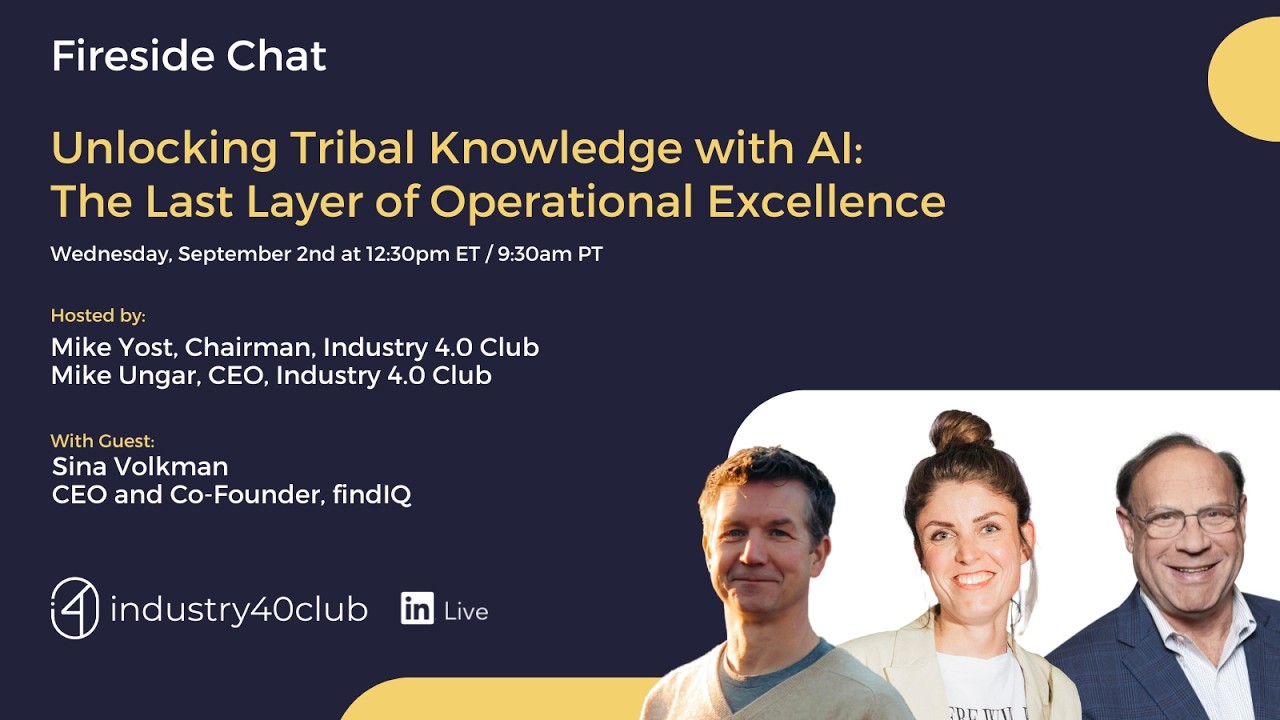
In this Industry 4.0 Club fireside chat (Sep 3 2026) host Michael Ungar and co‑host Mike Yost interview Sina Volkmann, CEO & co‑founder of FindIQ, about the problem of “tribal knowledge” – the tacit, experience‑based expertise of veteran operators that is the final, often missing, layer of operational excellence. Sina explains why sensor data alone cannot replace human judgment, how her team captured that knowledge through interviews, voice‑to‑text, and a structured knowledge base, and why they chose a deterministic, model‑based AI rather than a generative large‑language‑model approach to avoid hallucinations. The conversation covers practical challenges (operator resistance, data quality, filtering unwanted practices), the need for human‑in‑the‑loop validation, and how to quantify ROI by linking knowledge gaps to unplanned downtime costs. Organizational ownership is discussed – HR and workforce development act as promoters, while maintenance and reliability managers fund and deploy the solution. Sina shares change‑management tactics that make operators feel heard and appreciated, and outlines a pragmatic rollout: start with the most critical, high‑impact machine, pilot with a champion user, then expand. The discussion ends with a call to act now, given the looming retirement wave, and emphasizes that capturing tribal knowledge is an endurance effort, not a magical AI fix.
Chapters
Welcome to the Industry 4.0 Club's fireside chat. The club's purpose is to engage the power of diverse worldwide talent to accelerate the global evolution to Industry 4.0. We accomplish this by hosting and supporting respectful, thoughtful, and interdisciplinary open conversations and creating quality content on wide-ranging Industry 4.0 topics to expand the reach of our community. My name is Mike Ungar, and I am the CEO of the Industry 4.0 Club. I have over 40 years of experience in manufacturing and leadership, most of that with Michelin. I'm joined today by my co-host, Mike Yost. Mike is chairman of our club. Mike, would you introduce yourself further, please?
Sure, absolutely. Appreciate it, Mike. Welcome, everybody. As Mike said, my name is Mike Yost. I am one of the co-founders of the club and Mike's co-host here on the fireside chats, um, and, uh, have been in industry a little over 35 years myself. First half of my career on the solution provider side and the last 16-plus years on the nonprofit side. So I enjoy meeting people like our guest today, Sina Volkman, and hearing some of that diverse talent that Mike talked about. So Sina is the CEO and co-founder of FindIQ, and she's going to be talking with us today about unlocking tribal knowledge with AI as the last layer of operational excellence. So Sina is a thought leader in industrial AI and manufacturing innovation and is pioneering ways to transform critical shop floor expertise into scalable operational intelligence. As founder of FindIQ, she combines more than a decade of industrial digitalization experience with expertise in AI, workforce development, and operational performance. A TEDx speaker and active voice in Germany's Industry 4.0 ecosystem, Sina is now bringing her expertise to the US market and advancing how manufacturers unite human knowledge and AI. So for those of you listening on LinkedIn, please feel free to add questions and comments into the comments section, and we will do our best to include them into the conversation with Sina. With that, Sina. Welcome to the club.
Thank you for having me.
Looking forward to it.
Yeah, thanks, Lina. I appreciate you taking time out of your schedule to spend some time with us. So let's just jump right in and maybe kind of dig into this topic. So we know that manufacturers have spent decades, and I know I was part of some of these, pursuing operational excellence through lean automation and digital transformation. Yet, you know, we think about what keeps the plant going and really makes it run is the expertise and the knowledge of our experienced operators and technicians. Why do you see tribal knowledge as, we'll use the word, the last layer of operational excellence? Why has it been so difficult to capture this knowledge?
When I worked in manufacturing and the projects I led, most of the people were trying to get the data from the machines because they were in maintenance, they were in operations, they were data scientists or had any like relation to IT and OT. And what they got was just specific values of a temperature, of a pressure, some, some manuals that told them how to repair parts if they break. But actually, if I was part of these projects and I always had to calculate the return on investment, so the business side of these projects, I was wondering if I could ever fix an issue or diagnose an issue without having the expertise, but being there at night shift having an issue. My answer was no, because just based on data and some visuals and some graphics, I wasn't quite clear where does the issue come from and what to do about it. So I did understand at some point that not necessarily the data from the machines, but potentially the knowledge of the people in front of the machines would be the most powerful database that you could get. And in the research project that we had before I founded the company, we just did interview people. And talking to people seems to be more like complicated or difficult, or I don't know what it was, but— People were afraid of just having interviews with human beings in front of the machines because they were used to connecting sensors with databases. And when we start interviewing the people, they told us everything. Everything from they hear strange noises to something smells wrong. And by the way, if this is like happening both together, probably the root cause is as follows. And then we start capturing the tribal knowledge. And it was a better and more reliable database that you could get compared to any, like, historical data from a CMMS or just like a manual that you would basically ask questions to.
So how was, how was that received internally within the organization? Was that a, was that a shock to leadership, or were the operators happy to contribute their knowledge?
I think the operators, they didn't stop telling me stories about the weirdest issues they had.
Yeah.
Because as soon as you kind of crack them and as soon as they start talking, they just like share 30 years of experience. So I've never come across any hurdle of no one wanted to share information really. So they felt appreciated. They knew that this was gonna be like the institutional knowledge. I think that's what it's called in the US too. they just felt that if they're going to leave the company, this is what stays. The ones that were kind of shocked or didn't believe was the management.
Yeah.
They were like, is this AI? Is this even like state-of-the-art talking to people? So they were like trying to convince me specifically to go back to data collection, extracting information from the manuals. But my superpower was always like, communication skills, not being a technician, but being the business lady at some point. So when they saw me interviewing the people, they did get the clues that they were like, okay, these, these guys speak.
Yeah. That's fantastic.
That's really great. You know, I think the other part that is evident, at least it sounds like from what you described, is They also provide a level of context that the data can't provide. The contextual aspect of that.
Are you still there, Sina?
Yeah, I'm still there.
Well, it looks like we've lost Mike, which I've tried to do for a number of years and never done before, but we'll just go ahead and continue on.
There we go.
Oh, are you back, Mike?
Yeah, sorry about that, guys. The context, the context is what's really important. So, um, that's really good. The, the, um, you know, we've talked a lot, at least in, in the US, about this retirement wave and how hard it is to find new workers for manufacturing. Um, knowledge loss is really becoming quite a significant operational risk for, for manufacturers. And I, um, how can AI help organizations capture not just the documented procedures but this, the experience and the context and the judgment that we're just talking about, the problem solving that people develop over, over years on the shop floor?
So if we talk about, um, knowledge and AI, I think this is gonna like one of the 2 topics that are mixed up all the time that I go on stage and have my keynote which says knowledge is not data and AI is not AI. Um, first, like, very important, um, thing to understand is that data is exactly— it's no context. It's just, this is 7 degrees. Like, is it okay or is it bad that the temperature is above a certain threshold? No clue, no idea. If you have the context of, okay, this is actually bad because it should be below, then you know it's indicating a problem. And that's the context that you only get based on, again, these 30 years of experience. It's not written down anywhere. You could look for potentially like personal notes somewhere, like I'm talking about paper, um, on the desktop of a computer maybe. So it's spread out with different people. This is knowledge. It's not just what is in the manuals. Okay, so you have to talk to people. That was like the first aha. Okay, this is not enough. At some point you have to just talk to them because there is no Bluetooth connection of people, right?
Yeah.
And then second, AI. We were founded about 4 years ago. The whole idea arose or came up when, during the pandemic crisis, when we had to ship knowledge from Germany to the US and back, but couldn't get the people on site. Okay, so there was always the idea of how can we get knowledge to the place where the machine is without the person? And there was no AI hype. No one was talking about ChatGPT, just the real AI experts. They knew that AI is just multiple, it's so diverse, it's different technologies. At the end, it's just an enabler, but there was no ChatGPT hype. Okay. So we tried to understand what is the fastest way to get most, like the most or biggest value out of the tribal knowledge. So we went back to, okay, how can we build a model-based AI? That's what we call it. Transfers the knowledge into something very precise, very reliable, no hallucinations, that would actually help and guide people. And this was far away from so-called large language models or GenAI. This was something very deterministic, very structured, very based on what the requirements of the industry were. So we dig deeper into areas like diagnosing diseases or reacting to— or in a military area, you have to react to very complex situations very quickly in a very robust way. So we just went to different areas and picked the best models that we could get and applied it to the industrial area. So we decided to use AI to transferred the database into a step-by-step assistant, so to say. Now that we can use the GenAI, which is like another field of AI and the more popular probably AI, you could use AI to grab what is written on the notes and very easily, very automated. Still, what you should not necessarily do is just have the idea of a chatbot, an agent going to the raw data directly. Because again, you want to pull the knowledge from different sources, have people even talking to your database and enriching the database, and then have the model-based AI that we provide to convert it into something reliable. We did put something like, I don't remember the exact sentence, but it was like, on the shop floor, you don't want to have an AI being creative.
Yeah.
Right? I mean, it would be my recommendation, but you want to have it reliable and precise.
Reliable.
Exactly. So there's multiple AI models you could use. That's, I guess, the conclusion that we came to. And what is the best way to have is like automated capturing of what is already explicit, adding what is still in the people's heads with some voice-to-text or speech control, and then have a model-based AI approach to provide it in a step-by-step way. And I think that's a good point in time where we are at because there is AI initiatives and there's the retirement wave. So it kind of matches, right, that the tech era we are in, and then also the retirement maybe horizon of, I don't know how many years, 5 that are still left.
Right, right. I just want to take a second here. I'm sorry, Mike, I just wanted to take a second, remind everybody that we're speaking with Sina Volkmann, who is the founder and CEO of FindIQ, and talking about unlocking tribal knowledge with AI as the last layer of operational excellence. So, Mike, I think I was cutting you off.
Yeah, no, something you said, Sina, maybe makes me ask a question. So some of this experience, this may sound funny, but occasionally some of that experience we don't really want to capture. In other words, it's a— maybe it's a practice that we don't want to be replicated, even though most of the practices that we would want to be replicated. If I just let somebody share that in the database, an AI database, how do I filter a little bit what I don't want to be in there? If I just say, hey, tell me what you will tell me, how you approach these things? How have you handled that sort of thing?
What's interesting is if you have different experts in the room, like, it's just a saying, right? You have 5 different experts in the room, and you get 6 opinions, and all of them are correct. So there is something true about it, you would want to have it still in the system and you cannot avoid that there is mistakes. The knowledge base just always is incomplete, not enough, full of small mistakes because people might not remember correctly. So the model that we built is based for a database or made for a database that is not complete and not always correct. We indicate like, hey, by having this knowledge base, you are at 80% accuracy before we publish the data to the operators. So we have some kind of quality check in there showing that there's inconsistencies, for example, there's duplicates in. And eventually, if people start using the system, you get very valuable feedback back from the operators or the technicians in the field, right? Because the knowledge base, like, grows over time. There's more and more things happening. If you'd use a, I would call it more generic AI, you'd have no idea if this is going to improve or into which direction the LLM or the database learns even. This is the so-called black box. This is why we are all afraid of AI. Is AI even attacking another system? Going somewhere where we don't want the model to go? to. So if you have a white box approach, then there's always a human in the loop. So if you don't want to have the experts being busy with answering the phone all the time, they might have some time left to review the data that we get from the people in the field, and then they accept it or they reject it, and then it becomes part of the database. So that's how—
Okay.
How we try to handle this Might be mistakes, might be incomplete.
Thank you.
I'm curious, Sina, I hear a lot of people— you talked a moment ago about sort of the age where we are with the technology and, you know, with the retirement realities that we're dealing with in industry. I hear a lot of people that talk about it and know it's a problem. They will name it as an issue pretty quickly. that they're really scared about it, concerned about it. I haven't really found a lot of people that, like, own it inside the organization or know how to quantify it. Like, do you— what's your experience in talking with companies? Like, do they really have a handle on, like, what the value is of this tribal knowledge, this worker knowledge? And is there a particular, you know, role within the organization that you see that's more in charge of trying to find a solution.
Yeah. When we started the company, I wasn't quite sure, like, how mature is the market. And you have people that search for the issue, and they would probably, if you go online, search for, my technicians are retiring, what can I do about it? Where do I find technicians? So they're very good in describing the problem exactly. Do they know how a solution looks like? Definitely not. So what they're trying to do is they use their CMMS system, they use another system, they use a learning management system, and they tweak it a little bit, um, to make it available when something's happening on the shop floor, which is not the purpose of a learning management system, for example. Or they try to sell a CMMS, um, internally as something that would assist people, but a CMMS is very good in documenting and, and it Again, having the database but not providing it when it's needed. So that's category building. This is being a thought leader, trying to understand what is the topics that people search for, and then also explaining them that knowledge management— we're even thinking about like, what is the system that we're selling? Is it a knowledge management system or is it too static? Um, it's a category. It's a, it's a new category of of software that now plays a role as we have this baby boomers, right? We use the same terminology, are retiring. We are noticing in like both countries, the US and Germany or Europe in general, that it's a whole generation of people that could work in a way being the expert and doing this job for 30 years. But now as this kind of setup changes completely, you have to digitize the knowledge. And now it's going to be like the digital machine expert, the digital assistant. The interesting part is who owns the topic. So as soon as they get, this is a totally different software I have to invest in, it's like, who has the budget?
Right.
And this is always a mixture of HR and workforce development areas. They push it. But eventually it's going to be purchased or it's going to be implemented by maintenance, by the reliability managers, because it's their main job. It's their main job to have the production up and running and to improve their reaction times. I think as soon as this is decided on and they found their way, so HR is a multiplier promoter of the topic and then there's someone in one plant that starts the whole topic. The operators, the workers, they love solutions like these. It's the first time that they feel like, oh, that's intuitive. This is something that actually helps me. And then they start talking about it and then they spread the word. When they go out for smoking, when they have the shift handover. So there's a lot of talking amongst the so-called workers and then they spread the word. They say they like the software, and then it kind of multiplies automatically.
Yeah, well, it's a, it's a great point about, you know, sort of the solutions not necessarily fitting into one particular organizational, you know, category. The HR folks are involved, and you have people considering learning management or knowledge management, but it's the ops teams, it's the maintenance teams, the reliability teams that need to to keep things running, but have the problem to solve. And I think that's really in line with what we see just about companies learning to be digital. That's a great example of that. So you've talked a couple of times and you just brought up the fact that the workers are happy to be engaged. A lot of people would say that their experience is that workers that are nearing retirement age are often skeptical of technology. And, you know, so maybe just talk a little bit about what you've learned directly in your work with the frontline workers, you know, and how do you engage them? Do you do anything to make sure that they understand that this AI is a way to really amplify you know, their impact and, you know, the knowledge that they've gained throughout the years versus diminishing them personally and the knowledge that they've gained.
Yeah, I think the best, the best advice is not selling AI as AI. Being on site, talking to them, have the in-person workshops, It's like, oh, okay, they are actually weird even though it's a tech company. And they might be like a little bit different. They might use different words. They might look a little bit different. Just go visit their production. Try to understand as much as possible about the technologies, about the machines, about their expertise. showing the software as early as possible in the whole buying and implementing process to the operators and have them making the decision if they want to use the software. Also, I must say, a couple of years ago there was no one asking about is the software easy to use, right? They, at least in Germany, and I could imagine it is like similar in the US, at least from what I heard, they just implemented SAP PM most of the time without asking anyone. And this software, and I was, if I'm like that open in the US, people start laughing because this software is not like known for being intuitive.
Right.
Right? I mean, it's the opposite. So now we are in like a situation where everyone knows that, okay, the software, kind of software that comes next, needs to be made for the ones that operate the machines, the ones that are most valuable for industrial productivity. So they have to be the ones that I, I'm going to talk to them in the second meeting.
Yeah, you know, it's a— sorry, I was gonna share, I was gonna share a parallel. You know, it's the same thing we would talk about when we design a piece of equipment and put on the floor. Quite often the engineer designs it to be a really well-functioning machine but doesn't think about the technician or troubleshooter that's got to maintain it. And so they make it very hard to maintain, to replace parts and do preventative maintenance, when in fact it needs to be engineered for both the function of the machine and the reliability. And it's somewhat what you're talking about. When you have a maintenance technician who's involved in that design, it may take a very different approach because things are much easier to get to and And maintain. So I see a very similar parallel to what you described there.
Yeah, I was curious, Sina, have you ever— have you run into any issues where there's a lack of willingness to share the knowledge because the workers look at that as their own asset as opposed to being a corporate asset? Do you ever get into situations where, you know, there's just a hesitation because they feel like you're You're, you know, stealing their intellectual property to the extreme.
Yeah. Okay. One, there was one person in a workshop that I had myself about 3 years ago. It was 9 people or so in one room, and they were waiting for this one guy to talk and to share the knowledge, and he didn't say anything for 3 hours. And I was like, okay, I think his name was Michael or so.
Of course.
Can you quickly share with— of course, of course. Michael, can you quickly share what's on your mind? And then he started talking about it in the break. Doesn't mean that the project stopped, so they are still customers, but he was younger than close to retirement, and he had exactly this fear of, if I'm going to share my knowledge, then I lose my position.
Right.
But this is like the only time I had this objection. I had to handle this objection. Other than that, not really. They feel relieved if they can share the knowledge and then they get less phone calls in the night where they have to get up to just like tell them that it's this specific part that broke. It takes them 10 minutes and then they go back. Everyone is like, okay, if there is a software that could just where I could have one night of sleep more. They like the idea. So yeah.
Understood.
You know, for leaders who are thinking about going down this road and thinking about capturing the knowledge, you know, how do they get started? Where do they start? I mean, you think about the complex product that you might be making. You've got quality issues, you've got maintenance issues, you've got retirees who run the equipment. How do I figure out where to start? Because it's a pretty big— it can be a really big project without an end if you're not careful, huh?
100%. 100%. Okay, so remember, like, when we founded the company, there was this COVID issue, we did have half a year time to get knowledge from A to B. No time, under pressure, limited resources. We couldn't meet each other in the team either. So we started from what we want to accomplish, the outcome. Okay, what is the part of the whole value chain in the industrial sector out there that is most costly? when some— something is not like known or someone has no idea what to do. It's when the product is already manufactured and something goes wrong. If issues happen in the R&D department, okay, just throw away the drawing, start from scratch. It's labor costs and potentially like software license costs that you have, but then you start from new. If something is already in the manufacturing process, you have a lot— you have energy costs. You have the machine that you bought. There's ways. So this is why we started with the troubleshooting angle, by the way. So we didn't talk about how much knowledge can we get into a system and the more the better. We started with like, what is the most or the biggest business impact that we could have? And this is increasing revenue as quickly as possible or reducing costs. So I would always think about what is the most critical machine, like where is no redundancy? Is it packaging? Is it a complex process, is my production set up like in a way that the machines have to work or the setup or the settings have to be correct because I'm in the process industry, I manufacture, I don't know, chemicals, for example. And if you figure out this part of the production where you want to start, it could be the end-of-line test, it could be a quality checkpoint, it could be a machine. This is where I would start. I wouldn't like take the coffee machine or I don't know, a simple one. Start with a simple one and then we see. Start with the most complex one. It's going to show you the biggest impact a software like ours can have. One machine, 20% of the machine park, 80% of the impact. And then second is one person. There is like a video that I'm like, I worked in change project and change management before I founded the company. So for me, it's always about executing and getting a technology implemented because if there is the best technology and the best database, but the software isn't used, the impact is zero. So how do you start a change? It's like by one person getting up and then this video is like dancing, right? Making a crowd watching this one person. You would always think this person is crazy. The first key user, the first mover in a company using a new technology is always like crazy. When we had the first person in our company using Claude, okay, wow. Then what happens is there's a second person joining. If you pick the machine, this one expert, and a second person might be the one that actually needs the knowledge, then you get a movement or a change starting. This is where you just start and then it's all about not magic. Unfortunately, it's not magic. Even though it's AI, it's not magic. Endurance, talking, learning, changing, and then expanding. Maybe last, last point regarding what is the return on investment of knowledge capturing, and it is a broad and very vague topic. Go back to downtime costs. Like, how much does it cost if a machine is down for an hour? And how much is like the impact the fact has that someone just didn't know what's happening?
Yeah.
If you're waiting for a part, okay, that's just logistics. You have to wait until this spare part arrives if you don't have it on stock. If it's the knowledge of the person, might be 10%, might be even 80% of the unplanned downtime costs. The impact can be massive. That's how I would calculate it.
Well, thank you. We've been talking for the last 30-plus minutes with Sina Balkman from— we've been talking about capturing tribal knowledge. As we wrap up, Sina, today, I wanted to ask Mike and you maybe for a final thought for our audience today. Mike, would you start us off? Then Sina, we'll give you the last word.
Yeah, absolutely. I think talking about the worker knowledge as the last layer of operational excellence, I think is really a compelling message for people to glean how important it is. Probably the 2 main takeaways I have from what Sina shared today is her experience in doing this work is that the workers feel that they're heard and that they're appreciated. And so that's a really valuable insight to share. And the point you just made at the end here, that this is about endurance, not magic, I think is a line that I'm going to repeat many, many times. So thank you for that.
You're welcome. So for me, it would be like, even though we have a couple of years' time, start now and think about the ones that actually need the knowledge and not the ones that have the knowledge, because a software and a project on knowledge capturing is for the next generation, and involve them as early as possible.
Perfect, thank you. Well, Sina, I'd love to thank you. So to make sure I get it right, Sina Lokman, she's the CEO and co-founder of FindIQ, and really glad that you took time out of your busy schedule to join us. We know it's a lot of choices you have with your time, so thank you for sharing your insights with our audience. We really appreciate that.
Yeah, thank you.
Thanks for having me.
So just as we wrap up, the Industry 4.0 Club would like to encourage you to take action. So you've heard some information today. I mean, explore more about how you can capture tribal knowledge using AI and explore the FireEye IQ website, see what you can learn. Read a book, attend a workshop, start a— initiate a smart manufacturing roadmap. But we'd love to hear from you about what you're doing to advance Industry 4.0. Drop us a note on our website at www.industry4oclub.com or at our LinkedIn page. We also host conversations like this weekly. So if you'd like to be, uh, to share your thoughts or be part of our broadcast, we'd also love to hear from you. So please drop us a note on our website or LinkedIn page. And with that, again, thanks, Sina. Thanks, Mike, for your time.
Yeah, thank you.
Thank you. Bye-bye.










