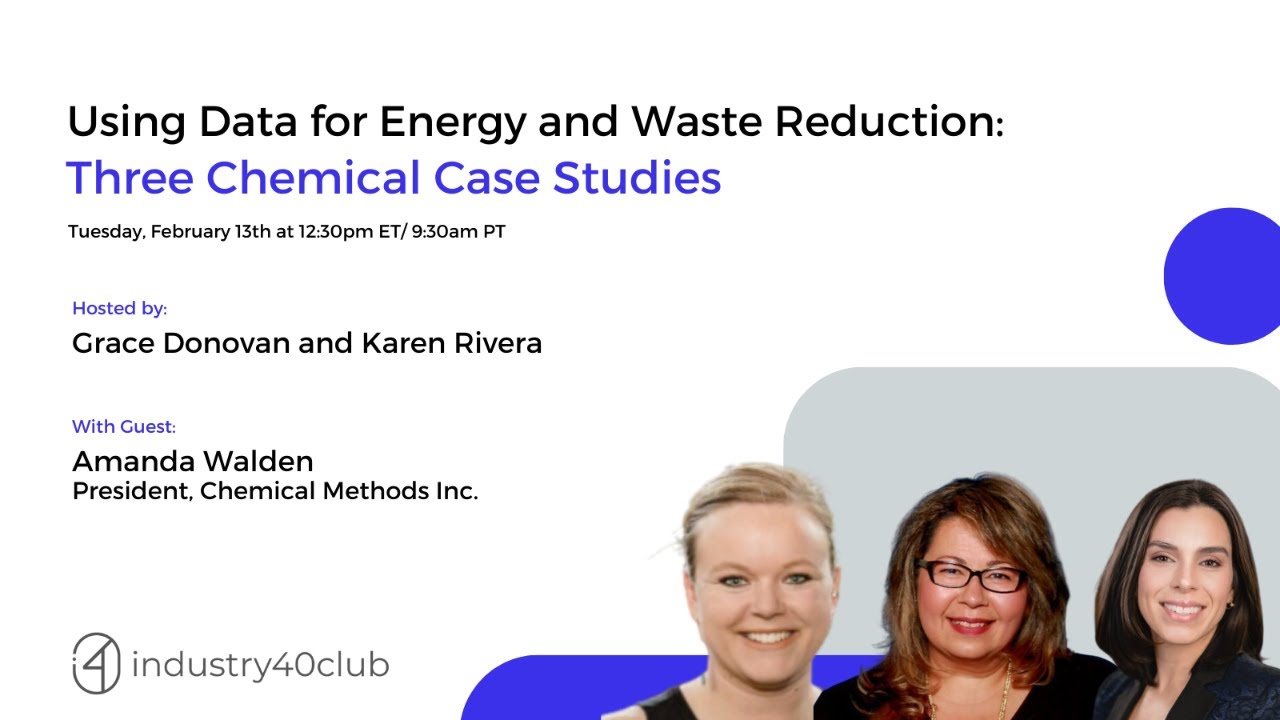
Using Data for Energy and Waste Reduction | Hosted by Grace Donovan and Karen Rivera
Amanda Walden, president of Chemical Methods Incorporated, explains how sensors and real-time data cut energy and water waste in manufacturing pretreatment. One client saved tens of thousands annually by rescheduling heaters; another saved $100K to $1M yearly by blending chemicals on-site instead of shipping bulk water.
Chapters
All right, good morning. Hi, and welcome to the Industry 4.0 Club. For everyone who's tuning in with us, I'd like to wish you a good local time. And before we begin, just give you a quick introduction about today's conversation. So the main purpose of Industry 4.0 Club is to accelerate the evolution to Industry 4.0 by having engaging discussions among innovators, leaders, and manufacturing professionals. We are Women in Manufacturing, and our Tuesday conversations focus on tech and manufacturing. In this space specifically, we touch on the perspectives of women in the industry. And today we are continuing our series on sustainability in manufacturing with Amanda Walden and discussing using data for energy and waste reduction, focusing on 3 chemical case studies. I'm really excited for today, but before we dive in, I'll just give a quick introduction of myself. My name is Grace Donovan. I'm an Industry 4.0 Club co-founder, and I have a background in industrial software sales as well as mining and manufacturing, specifically working with entrepreneurs in that space, and I'm currently serving as the executive director of Rural Engagement and Vitality Center in Northeastern Oregon, making resources from the university more available to the community to promote and foster vibrant rural communities. So that's quite a mouthful, but I will toss it over to co-host and fellow Industry 4.0 Club co-founder Karen. Good morning, Karen.
Hello everyone. First and foremost, happy Galentine's Day. Hey to all of our gal pals out there. So this is a wonderful episode to have today of all days. Uh, my name is Karen Rivera, and the best way to describe what I do is I'm a tech translator. Um, I work with tech and with business teams, and I'm just passionate about bringing those two together so we could have seamless communication. Um, I'm a seasoned Salesforce admin as well as a marketing account engagement strategist. And I get to play around with the platform all day and max out its potential, align with the prerequisites or the requisites of the company. And the company I work for, Cleaver-Brooks, an industrial boiler manufacturer. So all y'all steam geeks out there, much love to the boiler industry. When I'm not exploring all of these endless possibilities with technology, I'm busy helping promote and Support and Inspire Women in Manufacturing as the state chair for the rates. And I'm happy to be here.
Excellent.
Thank you.
And today our guest of honor is Amanda Walden. Amanda is the president of Chemical Methods Incorporated. Amanda, we are so thankful for you joining us today. Why don't you give us a quick introduction and then we'll take it away?
Thank you. I'm really happy to be here today. Like you said, I'm president of Chemical Methods. I have been with the company for 11 years, and I just really love innovation. I love what we're doing for our clients. I'm really passionate about helping our customers save money through innovation and lean practices and just sustainability and all the things we're going to talk about today. And outside of that, I'm passionate with my family. I have a couple young kids, so that's Takes up most of my time outside of work right now.
Well, welcome, Amanda. Thank you for joining us today. Now, I know other people are just as curious as I am. Tell us a little bit more about yourself. I want an idea of like your experience and how your journey was to get you where you are today.
Sure. I think The short story of that is I started with chemical methods while I was in college. I was getting a degree in chemistry, so I do have a bachelor's in chemistry. And I started on that path because I'm raised by an engineer and was just told you got to pick a STEM career and you'll always have a path forward. So I started out with that early on. I probably picked chemistry because of my love of baking. So it kind of lent itself to that. And I found Chemical Methods, then worked here through college, eventually moved into some sales. And then I took a pretty transformative trip with my mother-in-law and my husband's aunt to France, where the aunt was from, and was exposed to some really amazing businesswomen in careers that I had never even thought possible for women. So I came back and marched myself up to my boss and said, you know, I want forward career trajectory. And I asked him if I needed an MBA. At the time, I didn't know that there were some things brewing within our businesses. So we had a sister company at the time. And he said to me, no, you don't need an MBA. But if you wanted to be this woman who operates the sister company, then that would be awesome. And so I just kind of said, you know, what the heck, let's try it. try it. And so I've been on that path for probably 5 years and in my current role for a couple of years now.
Girl after my own heart. That is awesome.
Could you tell us a little bit? I'm very interested because I think making an ask like that is really difficult for a lot of people and like takes guts. And But it also requires a lot of follow-through. So I'm kind of curious what that process was like and then how your boss supported you through that transition.
Yeah. So I think, you know, there was a little bit of good timing at play, but for sure I was nervous to have that conversation. And I actually kind of just asked him, you know, I think I just had to rip the bandaid off and I asked him like in the coffee room one day. He was like walking by and, you know, I didn't know he had a bunch of stuff going on with the other business. And so he wasn't around that much or he was busy, right? He was, he was hard to get to. So I kind of just literally marched up to him, was like, this is what I want. How do I do it? And I'm sure I was terrified in the moment. It's been so long now that it just feels like something that I did. But I think being exposed to those women on the trip in France really opened my eyes to the fact that if you don't ask for things, at a certain point, you're not going to be promoted, the opportunities aren't going to be presented. Because who wants to promote someone who maybe doesn't want to be in these higher-level roles, right? You need someone committed for that. So I think I took that to heart a little bit. And the follow-through after that, I mean, I'm very fortunate to work for someone who's really supportive of my career. And I came in at a time when he wanted to step back, right? So I was kind of some good timing for that. But he's been very supportive of both my professional and personal growth over the last several years, identifying when maybe I need to take a step back and take a break, you know, take a day and do some self-care. I think that's had a major role in the speed at which I've gotten to where I am and my personal growth in understanding how to even be in this role.
I think that's so great to also know that you have, you know, folks that you can kind of ask these questions to as you're, you know, learning to take on a lot of these leadership roles because, you know, no, no one's prepared until you do it. And so, um, yeah, having someone who can, who can be there to kind of coach you through some of the, the new challenges is, is important and really kind of makes you feel secure and set up for success. So that's really great to hear.
Yes, I love that you just went out and asked, because if you don't ask, the answer is always going to be no. And then the follow-through is take the leap, grow wings on the way down.
Yes, for sure. I don't know when I heard that phrase. At some point I, I would have heard, maybe— I don't know if it was from my parents or, you know, some kind of social media or something, but— and it could have been even sales. So I was in some of our sales beforehand, and so it could have been that, that the answer is no if you don't Ask. And so I just, you know, the worst that's going to happen is he's going to say no and whatever.
Figure it out.
Yeah, but then I would do something different.
There you go.
So as someone with a chemistry background, and so you started out, you know, as a chemist and then kind of worked your way up, how does innovation in chemicals and processes play a part in manufacturing sustainability? Could you paint us a picture there?
Yeah, I think in all of the manufacturing facilities that I walk into, there's opportunity for innovation and improvement in every corner of that plant, right? And most people are overlooking the part that the chemicals are actually used in. So the washer, that's the process that we're typically involved in. It's kind of low priority— sorry, my brain's having an issue here. It's low priority most of the time. People focus on paint a lot because it's so much more expensive. And so I can't tell you the number of times that I've come in and found maybe a rinse tank overflowing that shouldn't be, or even a process tank. So somewhere that they're adding chemistry to that's overflowing or shooting into the next tank, and they're just wasting so much chemical and no one has any idea. It's really kind of just a process that hangs out in the back. They know they need it, but someone has to titrate and, you know, they don't really know what they're doing with that information. Maybe they write on a piece of paper and throw it in a drawer and never look at it again. And all the energy and focus is put into the manufacturing of the parts and the paint process. So the chemicals, really not a ton of innovation in that space. We're all kind of doing the same thing there. But it's how you use it and how you improve your process.
So could you, like, look backwards just a little bit for folks, you know, kind of like myself who've had to have come in from outside the industry and are learning a lot about the processes? Could you explain what is the value or what's the important part of pretreatment process? You mentioned a lot of focus goes into paint. So kind of putting finishes, whether that's on automobiles or even like exposed steel beams, I don't know. What is critical about the pretreatment process and what's the value down the line?
Yeah, of course. So basically, if somebody were to have a part go through their pretreatment, or maybe they don't even pretreat, there's some companies who are like sandblasting or doing some other means of pretreatment. If you're putting a part that has any kind of soils or oils left on it, any, you know, could be metallic fines, could be any other kind of solid particles, and then you paint over it, you're gonna be at a lot of risk for finish quality. You could be at risk for delamination of the paint, which means, you know, just giant sheets of paint come off your part. There's a lot of just quality risk involved in that. So your finished good, regardless of whether you're spending $1 million or $100,000 on paint, is only as good as the pretreatment before the paint.
Got it. Thank you. That's very helpful.
Interesting. Amanda, because as I was prepping for this, kind of like what Grace was saying, outside looking in, there's so— you realize how much you don't know. So even the title, it's like, okay, how do these dots connect? And then the more I read into it and listening, it's like, oh, okay. So, and I love how when you start seeing all the dots connecting in terms of chemical processes and then tying it to sustainability. So— long-winded segue into my question. We always ask, um, our speakers or our guests in this series about the re's: reuse, recycle, reduce. It's— sometimes it sounds like a broken record, I'm sad to say, but there's also things like repair, rental, recovery, regenerate.
So which of these means the most to you in what you do Yeah, for us, I would say it's probably a mix of the reduce and reuse. So in the pretreatment process, there's a lot of opportunity to both reuse and to reduce usages. So you can reuse rinse water and backfill your chemical stages or backfill— maybe they have 2 rinses next to each other, so you can backfill them that way. You can reduce usage through the reuse of water and also through intelligent automation and controls. So that's, that's really what Chemical Methods does is we install equipment into these processes that's going to both control how much chemistry is fed in, and we're monitoring and collecting that data. So you have something to go back and look at what was happening, you know, last Tuesday at 2:04 when the this part ran that all the paint fell off of. Yeah, I think, does that answer?
Yes.
Yeah.
Yes, it does.
I also just wanna mention to anyone in the audience, if you have questions as we're having this conversation for Amanda, please go ahead and drop them into the chat box and we'll see them pop up here and we can address those as those come in. So I wanted to kind of reconnect the, you know, you said, mentioned reduce and reuse as your favorites with kind of where the innovation lies kind of in your business. And I know I just, I'll also take this opportunity to plug, like Amanda had a conversation earlier in the, or actually December last year with Mike Ungar and Mike Yost. So please definitely check out that conversation. There's a lot of great things that are discussed there. But chemical methods innovation is very much kind of not only here, we're gonna provide you your chemical inputs, but we're also gonna kind of empower you to look at all of this data so that you can reduce and reuse. Could you tell us a little bit more about like the data aspect of chemical methods?
Sure. So when we come in, we're going to install equipment on all of your process tanks. That includes like your cleaner tank, your rinses, conversions, maybe a sealer. And we're going to monitor all of your KPIs. In addition to monitoring, we'll feed chemical in based on the concentration in those stages or pH or, you know, whatever the parameter may be. And this is really reducing manpower. So someone doesn't have to go back there anymore 6 times a day and check, which, let's be honest, no one's actually doing that. So their systems can skew a lot between titrations. And then it also gives insight and eyes on the process from afar. So the plant manager can pull up a live feed of what's happening in their cleaner stage, for instance. And see what's going on. They'll get alarming. My team gets the alarming. We also have access to those graphs. So if someone were to call me and say, hey Amanda, I feel like we're using a lot of cleaner, can you tell me if you see anything going on? Or that might be prompted even by me getting alarms. So we can do like total volume alarms. And if I get one of those, depending on who I'm— who it's coming from, I might say something's wrong. And so I would go in and take a look at maybe how much cleaner they've used. Is their rinse conductivity rising? So a lot of times those issues are something as small as a nozzle and a riser just pointing into the wrong stage. And while, you know, maybe one nozzle when they have 400 doesn't sound like much, it can shoot over just a ton of product into the next stage. So you're both losing chemical. Then they're continuously feeding water and chemical back into that stage to maintain concentration. And they're just throwing it away in the next stage and maybe ruining their rinse. So now they're carrying down a product into the next process tank. And then we take all of that data. So there's the real-time aspect of it. And then we take all that data and every Monday you get a 7-day look back. We call that a weekly snapshot report. So my team actually gets those. We have a database that automatically produces those and then we go in. And a human looks over your data and then we'll make individual notes. Maybe we'll say something directly to you in those notes. If we know that sometimes you run bigger parts, we might ask, you know, last Wednesday when you used a bunch of product, were you running those high carryover parts? And then along with that, we'll also do 6-month reviews where we sit down with our clients, with any decision makers, and could be maintenance people or quality people. Who can come in and we'll review 6 months worth of data and identify trending. We can identify areas of waste, and then we'll work together to come up with, you know, initially the low-hanging fruit and things that we can improve, and then later on bigger projects that maybe you guys just don't have the manpower to implement some new idea that you have.
My ears perked up the minute you said data. The minute you said that. And then just the, um, the example of that one nozzle, even if you have 400, oh, what difference does it make? And then just listening to the explanation, it's like, yeah, one nozzle can cause all of this. And I'm just a measure type of person, so it's control the geek out, control the geek out.
Let it go. Yeah, a lot of times the biggest issues are the smallest things that they over— someone would overlook for weeks or months.
Yeah, and so I used to work like adjacent to mining and where like, you know, a half percentage point change represented huge numbers because it's such a, you know, labor-intensive, input-intensive process. So I think sometimes people lose track of something like just a small thing can have really, really big impacts depending on things like input. So I think that's really important to highlight. And I also just really love talking about case studies. So now we're kind of gonna kind of dive into the meat and potatoes of this. And so we're gonna focus on 3 case studies today. And I love hearing about this because it's just such a Great way for folks to kind of understand not only the problems that manufacturers are dealing with or the problems that are uncovered in the process, but then what are some ways that you can like impact that, generate a lot of savings, and in this case reduce and reuse a lot of inputs. So we're going to be focusing on energy reduction, reduced wastewater, and on-site blending to essentially reduce water use and kind of other inputs. So We'd like to start with energy reduction. Could you give us a quick recap of this case study from Chemical Methods?
Yeah, so what we've found in multiple cases is that people will come in, and so maybe the first person comes in at 3 o'clock in the morning and they're kind of the guy that turns on all the lights, or woman who turns on all the lights, and part of their job may be to go back to the washer and kick on the heat Which could be either electric or gas. And so say they're doing this at 3 AM and the first part doesn't run for 2 to 4 hours later. So maybe the first part's not coming in through until 6 o'clock in the morning, 7 o'clock in the morning. But this is just how they do things. There's so much waste going on in that space. And I would say probably 15 to 30 minutes is all that those tanks typically need to get to operating temperature. So they're sitting there heated for, you know, 3 hours. On top of that, a lot of times they're not turning on the sprayers at that time so that the nozzles are not spraying in those tanks. And so they can get hot spots in their systems as well, which can have an impact on your heat exchangers. So there's really a lot of impact there. On the other side of the day, if they were to do a study and look at how long their washer retains heat for, most manufacturers will find that they've got probably 2 hours at the end of the day that they can continue to run parts without actually heating the tanks. And they won't lose enough temperature that they're going to be outside of their process parameter. And so we've done this at quite a few accounts. I would say there's maybe a little bit less energy around people turning the heat off in the afternoon, maybe a little bit of fear around that, but it really does retain temperature. And in the morning, just that, that quick change can be thousands or even tens of thousands annual savings to just turn your system on 1 hour or 30 minutes before the park is going to run. Wow.
That's such a simple change.
Well, a lot of these things are very simple.
But when you said that's how we've always done it, it's like, and how many times have we heard that before? Let's talk reduced wastewater, Amanda. For your customers, how big of a priority is that? I'm hoping it's very big, but I want to know. And then I have a follow-up question to that.
Okay, so I would say it's a little bit dependent on the company and also where they're located geographically. So I think everybody has some energy around water reduction. However, those who are in an area where maybe water costs a little bit more or there's more restrictions on water use, there is a bigger push to get their water reduction in. And then, um, huge companies, like say like steel mills, they're using astronomical amounts of water. And so even if they're not in an area that there's such a big push from, you know, the government entities, um, they want to reuse water because they're probably just spending, you know, maybe even hundreds of thousands a year on water use. Um, so recently we've heard I would say in the last 6 or 8 months, I've heard of even bigger excitement around how do we reuse, like we talked about before, to either backfill or even to reuse from once-through processes. Like, can they get the chemistry out of that water and somehow reuse it upstream?
Gotcha. Okay, now back to data. How Do you use your baseline data to set up those customers for success? And especially like the monitoring portion, because we do it on the boiler side. In the monitoring portion, I have to like force myself to look away at the performance levels of the different boilers of our customers. So how do you use that information, the monitoring, with long-term water conservation for your customers.
Yeah, so I have a great example of that, which is not only a water reduction story but also a continuous improvement story for the customer. So I don't know if everybody's familiar with zirconium, but it's a type of pretreatment that is much more testy than some of the kind of older types of pretreatment. So it doesn't like to— say you have an alkaline cleaner, it doesn't like when you mess with the pH in that stage, right? So it's only going to perform within its specific pH range. And so a lot of people— zirconium also is more clean. It's not currently considered hazardous, so it can be drained just to the sewer, which is a big cost reduction for a lot of our companies. And so a lot of people want to go that route, but maybe they don't have the right washer for that. So usually you need 2 rinses between a cleaner and a zirconium tank. We have one customer, we have a couple that we're doing this with, but they had a 5-stage washer and they wanted to go from phosphate to zirconium. So in order to maintain the conductivity in their rinse stage low enough to have a good product, what we did was add a solenoid into their rinse tank and a conductivity probe, and we're feeding in fresh water based on the conductivity. So Say the limit's 1,000, the pump kicks on, it feeds until they get to 700. And also we can take any overflow water and use it to call into the next or the previous stage if the tank level is low. So not only are they reusing the carryover from the previous stage, but they're also not just continuously overflowing, which might be a savings for them, or maybe they were just bad at paying attention and they could have been not overflowing enough and having too much conductivity in that stage and in turn getting bad parts. Wow.
And how happy were they with you?
They love it. I actually have— I should share, like, in the comments on this video, we have data, we have snapshots showing prior to this equipment going in on that particular stage The conductivity, you know, is up and down every day, sometimes really high, and then maybe you'll see they added some water and it shoots down. And then afterwards, they're pretty much steady, just right below that upper limit. And then you can see where the pump kicks on if they go above a little bit, but it's, it's a huge difference in maintaining, and their quality output is greatly increased.
That deserves snaps.
Wow. That is really— and so in, in like in that vein, I know working with doing on-site blending is another way that you guys are helping, um, kind of reduce water. So could you, um, or reduce water use and shipping and costs and everything? So I'll let you, um, say it because it's clearly going to be more eloquent than me trying to describe this. So could you share a little bit about the onsite blending work that you're doing? And then we'll have a couple follow-up questions.
Sure. So onsite blending is something we've been doing for quite a while, and we're starting to put a little bit more energy into it now. Essentially what it is is a unit that Chemical Methods manufactures and owns, and we kind of loan it out to our customer sites. So it'll sit at our client's site, and then we would maintain ownership of it, and we would, you know, therefore repair and help them use it. The way that it works is, say you're purchasing a caustic cleaner for cleaning, you know, well, let's say steel.
Mm-hmm.
That product is most likely 50 to 60% caustic, and then it's probably, you know, 30 to 40% water, and then the last little bit is what we kind of refer to as like the goodies, the stuff that makes your product a cleaner. And so the customers, most of our customers, if you're big enough to have this apply to your operation, then you've already got caustic onsite because you most likely have an onsite wastewater department or division. Obviously everybody has water. And then Chemical Methods would sell a tote of this kind of special blend of things like surfactants and other builders. And the unit will pick, we would, you know, program in the formula for the end product, and the unit will then pull in the right amount of each component. And so the customer is saving on shipping, right? They're saving— they're not shipping water anymore, they're shipping a tote of this kind of concentrated stuff. And one of those totes can be equal to 10 totes or more of their finished product. So maybe they were buying you know, 50 totes a year and now they only need 5. They're not shipping the water. And then the caustic also, they're able to purchase that commodity on their own, less expensive than if we were to buy it, put it in our formula and sell it to them. So there's cost savings on all those fronts.
And kind of when you combine all of those cost savings, what are maybe some typical savings that a client would see?
Yeah, we're seeing usually around $100,000 a year. And so yeah, we have some clients who've saved well over $1 million in the amount of time that they've had these units on site. And that's only just, that's for the product. It doesn't even take into effect the shipping savings.
That's fascinating. Because so what of the, because perhaps doing on-site mixing isn't necessarily like the newest idea. So do you have any insights into why this hasn't kind of caught on a little bit earlier?
Yeah, you know, we haven't encountered any competitors who are doing this. And I mean, I would challenge people that if you're buying enough that $100,000 in savings is possible to ask your supplier if they can do it. You know, I always encourage people, you don't have to use chemical methods for everything or anything, right? Go and see if anyone can do it for you. I think probably some competitors don't want to do it because of course then we're selling— you're selling less of your end product, right?
Mm-hmm.
So maybe if you were selling so many more totes and now you're selling this many. So I would say that's probably part of it. And Chemical Methods at our core is interested in saving our customers money, right? That's what we're all about. is your bottom line is really our kind of biggest interest.
Mm-hmm.
So any issues that they might have, we want to help resolve and we want to help with manpower too. Um, and yeah, I mean, all I can say is I've never seen another one and we've talked to plenty of people about it. A lot of people are interested. Um, I don't see other blender or other, um, chemical companies going down that path, although it would help a lot of end users.
So maybe what was your like aha moment or the epiphany that said, oh, this is something that we can do as a way to deliver savings to our customers' bottom line? What kind of sparked that beautiful and simple idea?
It's a little bit of a hard question because I actually wasn't around when we started doing it. I'm not entirely certain what pushed that, but I would imagine because we are always looking for our customers' best interests and we have a lot of engineers on staff that someone said at one point, well, this is 60% one component, why can't we blend it at their facility? And just knowing how much that would save our client. So I'm sure in the beginning we probably had someone who was buying just a ton of chemical and looking for some savings. And this was kind of the low-hanging fruit to attack that.
And that, again, that also has some really like brilliant externalities, as you mentioned, like you're reducing a lot of shipping costs. So, you know, fewer trips, I think from a sustainability standpoint, you know, that has some really interesting ripple effects as well.
Yeah, they're already buying the caustic, so there probably is not a whole lot of change in that either for them. Like, it's not like they're going to start buying a ton more of that.
Yeah, that's really cool. So you've walked us through— oh, go ahead, Karen.
I'm mesmerized with the beauty of the simplicity. But yet no one else has caught on. It's like—
I don't even know if they haven't caught on or just it's not top priority. You know, like, I don't know why in everything that we do. So we— there are a couple of companies starting to do more monitoring and control, but they're 15 or 20 years behind where we are right now. And it's interesting to me how long it's taken for our industry to value that, right? For other suppliers to say, hey, we should probably be doing that too. It kind of goes back to— I still don't understand why pretreatment is so overlooked, but it is. I guess I do understand it because it's much less costly to operate than something like paint or, you know, where you're sourcing your steel from or lubricants on that side of things. They're using a lot more of those.
Wow.
I'm still trying to process. Great.
You've left Karen speechless. So would you take us through— so we've covered some of these case studies and understand a little bit more about how you're using data to essentially achieve really incredible savings and sustainability outcomes for your clients. What's on your roadmap for 2024 or in the future? So what are some of the new innovations that you're either developing, looking into, or doubling down on in your business? Sure.
So we're currently kind of in the home stretch of our new data center application, CMI 4.0. And so that's where we parse and pull all of our data into from the sensors that I've talked about. So it's a new reporting system. We're looking at building some AI into that, giving our customers some access to maybe previous data or, you know, questions that they might have about usages or spend or, you know, things of that nature. We've thought about adding in some, um, kind of Ask CMI type of information too. So maybe they want to know, you know, why do my parts look spotty, or why do I have some rust? And then that should be rolling out here pretty soon. So we're super excited about that. And we're also building new onsite blending units. So that's going to include some new technology. It's going to have some more communications with our database so we can collect things like how many batches they run, We can send out some alarming. We're going to be looking at things like tank level and inventory so we can alert our customers to when they need to order more of any of those components or, you know, what's made in that final tank. And we're really right now listening to our customers and trying to understand what value do they get most from what we provide and how can we boost that, right? Like, is it We send out text message alarms, we send out email alarms, we can do audible and visual alarms. But we're really interested in hearing what's the most important thing for manufacturers that either we are doing now and we can do better, or we're not yet reporting that information.
Have you encountered trouble or obstacles in getting that feedback Because they're not aware of what's possible?
Um, I don't know that it's because they're not aware. I think we get a lot of new ideas out of our review meetings. Those are the ones we're doing every 6 months, because we get a team of people that we don't tend to get to interact with every time we're on site. And we'll come in with innovations that we think might be good for them or continuous improvements. And then we're also listening to what's going on in their, you know, what's their plan and how can we help them? Maybe there's another piece of data or maybe something that they're already collecting can be tied into our system so we can show them all their information in one place. So we've— I've been in quite a few steel mills recently, and they have some new innovations that they're trying. So for instance, I referred to this before, a once-through process has a very minimal amount of a product in it, but it's a product that if they were to just collect that fluid and then use the water in another process upstream, they could have some issues. So discussing, you know, how could we clean that water so that you can use it upstream? And for them, it seems like water is probably the biggest sustainability project that they have going on right now. It's the most exciting thing for them. It's maybe got the biggest payoff, or, you know, they can tout it to their customers. And so that's what I'm seeing. And we're trying to be more diligent with asking that question directly and, you know, kind of keeping our ears and eyes open when we're on site.
Gotcha. Have you gotten any— so you mentioned you're also going to be rolling out kind of Ask CMI 4.0, so essentially making the data more available to like plant managers, operators, you know, whoever you're giving that access to so that they can say, hey, what's going on with this process or maybe with this chemical mix? Have you seen— maybe how far along is that in terms of its of it being rolled out? And have you seen any kind of great ideas or good savings come out of operators being able to ask the questions directly to your database?
Yeah, so we're not quite ready to roll it out yet. It's, it's kind of one of the AI things that we're interested in. But we do offer an in-person training program. And so kind of the reason that we think this would be really valuable is that we go in and we do what we call washer technician training. So they've got, you know, a person back there who does the titrations who doesn't really know why they're doing them. They don't know, you know, if this parameter is out of spec, how does it affect the end product. And what I've found— I've been doing the trainings for years— and what I've found is once those people have the information to understand why they're doing what they're doing and how it affects the product, and then how would that affect their life down the line, right? Like, If this is not where it should be and then I have to rerun that part, that's not gonna be fun.
Mm-hmm.
Them being empowered with that knowledge really helps both the customer and them, or, you know, the company and them. And so I think having access to that, like anybody can text me, I'll reply, you know, pretty much 24 hours a day. If I'm awake, you can call or text me. And so we get a lot of that. Our customers reach out frequently, whether it's an operator or a plant manager or, You know, supervisor. But having access to that on their own to just say, hey, you know, we're having a lot of timeout alarms, what could be the cause? Or how much chemical did I use last week? If they're having an inkling that maybe things are out of whack.
Yeah, that's really powerful. And we've— so in the sustainability series, we've had some conversations that really go into discussing You know, having data traceability throughout entire systems. But a piece of that too is understanding your individual role in that process. So I think you hit on something that's really important. It's like, I see it almost as a fundamental human need is we need to understand why we are doing this. Like, what is our purpose in this process? And then having that sense of satisfaction that I'm, you know, contributing to like this amount of savings or Making sure that the final customer has a quality part. That's—
Yes.
And we see that tapped into in so many cool ways. Like, I would not have expected that, you know, chemical methods is giving people their why, but I think that's really important.
Yeah, I noticed a big difference in just when I come in then, you know, the next time or subsequent visits after that, the questions that people will come and ask me, the engagement, you know, maybe on the first couple times before they've been trained, they're like, okay, You're here, I'm gonna go away, I don't have to do the titrations right now. Like, I'll be honest, titrating isn't like fun, it's not exciting, but it has to be done, it's necessary. Um, and so yeah, there, there is a big shift once people understand why they're doing what they're doing, and then I notice I get a lot more questions on subsequent interactions.
I mean, this is just a beautiful illustration of You know, the discussions that we always have around Industry 4.0 is, you know, we're advancing technology and data collection, but at the end of the day, it's all about people and how people use and interpret the data. So I think you've summed that up so beautifully for us.
Yeah, thank you.
Because you can have all the data in the world, but if you don't have the people to do anything, it's like, okay. But that explanation of the why and how their role impacts that? Why? I can imagine that when you're doing the tech trainings, those light bulbs are going off, that it's not this arbitrary thing that they just have to do. There's a method to that madness and they can make an impact to the end result.
Yes. Yeah, I think for sure them understanding, especially, you know, a lot of manufacturers are behind or they're kind of treading water in terms of throughput, right? So No one wants to face the wrath of their boss saying like, well, we just made a ton of parts that rusted or the paint fell off, or, you know, like something's wrong. Nobody wants to burn off or throw away parts. Like, I have customers who have a near automotive finish on their parts and they don't rework. 9 times out of 10, they toss the whole thing. So the cost of that is huge, and someone I'm sure is, is getting a talking to if they have a rash of issues. And so I think that that can be really helpful. And also some people are bonused on those things. So for them to be empowered to understand, you know, how does what I'm doing affect the end product, and then, you know, maybe they have something on the line there.
Skin in the game. That, and I wouldn't want to be the person to have to explain.
Yeah, you don't want to.
You have a lot of explaining to do, Lucy. I'm like, yeah, not at all. No, um, I do have We still have a couple more minutes, but, um, I have multiple screens on. Uh, Grace, do we have any questions in the chat?
It does not look like it, but we do just have someone— we have Omar Contreras has popped in to say hello.
Hello, thank you for joining us, Omar.
Okay, now I want—
as we're approaching though, we still have some time. I want to get final thoughts and takeaways. I want to save Amanda for last for the icing on the cake. So I'm gonna start with Grace.
Okay.
Thoughts and takeaways about this conversation.
So I'd say, A, I just, I love the simplicity and beauty and like impact that case studies bring to illustrating, you know, the impacts that, you know, data can have, as well as just the business model of, you know, Chemical Methods and seeing how, you know, what you guys are doing in terms of making data analysis available to your clients is really impacting their day-to-day. 'Cause not only does that illustrate all that can be gained and I think gives people a lot of hope too for process improvement. That's just really exciting. And I think there's something just very satisfactory about that. And I love a good case study. In addition to that, I think just asking, you know, sometimes even simple questions. I think, you know, Amanda, you illustrated that in terms of how that really impacted your career trajectory, you know, how it's helping people relate to the processes and why they're involved. Mm-hmm. And a lot of this to me just comes down to asking good questions because you guys are there on site, you know, asking your customers questions, kind of learning their processes, and then able to deliver a lot of this. And it's such a useful skill, not only personally but also professionally, that I see that as kind of an underpinning theme, you know, in this conversation that was happening below the surface or that, you know, needed to take place before getting to these really you know, excellent and simple case studies. There was a lot of questions that went into why is this happening this way and what can we do about it. So, you know, good learning to ask good questions is, I think, a big takeaway.
Yeah, that's awesome.
Oh goodness, where do I start? You had me at your love of baking. Oh, it's like, that's right, there is chemistry in baking. That is the beauty of baking. And, and just your, your journey, that one question in that one trip to France and how that just changed the whole direction. It's like, oh, I want to have coffee and sit down and learn more about that trip. The support that you had of your boss, that's just so invaluable to have that support, that ally in your corner. Want to learn more about him. And kind of what Grace is saying, the simplicity, but most importantly is how you look at benefits for the customer. It's like they win, we win. And it's such a— I mean, it can sound Pollyanna to some people, or rose-colored glasses, but the case studies, there's your proof. The data doesn't lie. You know, you have a customer saving hundreds of thousands of dollars just with— I don't want to say this simple change because it's so complex, but On-site blending, unless you have $100,000 to throw away. If you do, you could put it in my purse and that way you don't have to throw it away.
Me too.
But, you know, the thinking, getting the feedback, the really involving the customers, so you're always looking at the they win, we win. And that— I wish other companies would have that mentality. They win, we win. They shine, we shine. And the case studies are proof right there. I'm excited to see what happens next, especially how you're using AI. Yeah.
Could I— I'm gonna jump in.
I think this calls for a special part 2. I think Amanda needs to be a repeat offender. I mean, a repeat Yes.
Yeah, we'll keep bringing you back as long as you want. But I wanted to jump in just really quick with one question. And I think it gets to, you know, Karen's point of if you win, we win. I think a lot of companies really do have that intention of, you know, we are building a product that is going to save you, you know, time or money or effort. But sometimes that's lost in translation. I think maybe because there's a perception that you might say that you wanna save me this time and money, but I'm still having to put forth an investment. Like there's still a little bit of risk involved there, which is another reason why case studies are so important. But could you maybe speak to how you've gone about building trust with clients? Because I wanna say this is, it's unique that you've been able to, you know, get to this place where you win, we win, but it's also not in the sense that a lot of companies are. Using that as kind of like, that's a value proposition for a lot of companies, but it might not always impact or output.
Yeah, I think, you know, I get that question even when I go out to, you know, sales meetings and I'm working on prospects. You know, why do you guys give the equipment for free? And it really comes down to, at the end of the day, we're all selling the same types of products, right? It doesn't matter if it's an household name company or a smaller company or, you know, whatever. Chemistry is kind of chemistry. There are some innovations, but not a whole lot of change happening in the last 30 years. And so there has to be a differentiation. And that's our differentiator is that, you know, we're not touting some Ivy League chemists or, you know, 1,200 patents on file. We want to be almost family with our clients, right? Like, we really care. And I, and I can say that honestly, like, I really do care. And I'm a very, um, I wouldn't say I'm extroverted, but I'm definitely— I love people. I love, um, talking to my clients. I get to know them. You know, they send me pictures of their babies and weddings and all that kind of stuff. Um, and so I, I really do care about what's happening. I care about their bottom line. And when you have that relationship, you can afford to give them equipment or advice or help outside of what you normally do because they're probably not going anywhere, right? If the current supplier is putting so much on the table for them that they're gonna have a hard time finding that somewhere else. And the real savings for all of these manufacturers is not a couple cents per gallon on their product. It's in this data collection, it's in how do you analyze the data, it's the fact that our data comes through in a format that it's a report and they can just look at it and it's not a stream of raw data that now somebody has to spend a bunch of man-hours on. And that has a huge impact. The fact that we are looking at the data, that, you know, we have a meeting every week as a team and we're talking about customer issues and we're looking at the data from all the customers and snapshots and what's different and what's off and do they have a lot of alarms. And we're trying to identify those things on our own and then go to our customers and ask for their input on what we're seeing.
A true partnership with your customers. Yes.
Thank you.
And that's—
Yeah.
I had— oh no, Grace.
I'm done. Go ahead.
When you're talking about that relationship with your customers, a particular vendor came to my mind, and he was not the most cost-effective, not by a lot, but I would get asked why this vendor as opposed to this vendor, and it was that beyond, you know, if there's an order that is delayed for whatever reason, he will personally deliver it as soon as it's ready to the door of the company.
Yes.
Whether that's 7 o'clock at night or 7 o'clock in the morning, and, you know, something goes wrong, he is personally involved in getting it fixed. Can you do that? Speaking to another vendor, and the minute I started the Hemming and hawing. It's like, yeah, you just answered my question.
Yeah, I love that. And the owner of our company, right, or the CEO of the company, years ago we had one of our largest customers run out of product on a Saturday, right? So my customer calls me and I answer. I think it was at the science center and my son was a baby. So I'm like, got the baby on me. She could hear him talking and stuff. She runs out of product and it's a major emergency for them. They always run on Saturdays. And he actually— so our, one of our chemists came in and blended 5 gallons of the product in our lab, which is like, you know, blending facilities and stuff, they're not open on the weekend. So we had to do it just in our lab, made like a concentrated version of their product. And then he drove it out there on a Saturday afternoon. met the customer probably halfway. But you don't hear that, right? Like, we are all living and breathing that. It took all 3 of us on a Saturday afternoon to get this done. And that's how we operate all the time. You know, we're trying to monitor our customers' usages so we can see what their inventory is, because that's another huge issue. People are constantly running out of products. So we're always trying to catch that. But If something happens, we're gonna go through, you know, all of the fast man shippers. We're gonna— if we know that you're prone to that, we probably have drums or totes of your product sitting around so we can get it out to you quickly. Um, you know, we, we really want to make sure that our customers don't have an interruption in service because at the end of the day, it's our problem whether it's our problem or not. You know, it doesn't matter.
I can only imagine the order. I can only imagine the loyalty points that you guys gained with that customer.
I think they do still talk about it.
Legendary.
Yeah, but that's normal for us. It's not, it's not abnormal at all. It's not outside of what we would do, and we, we don't even consider it going above and beyond. We just consider it You know, something that we would expect or we would hope from a vendor, and that's how we're going to operate.
I love how it's how you do business. It's not an anomaly. It's not above and beyond. It's just how things are done.
We have another comment. Just any other—
any other—
you're awesome.
Oh, sorry.
Thank you. Oh, I know. Say that again. Thank you, Alexander.
Oh, comment.
Yeah.
Any other takeaways or closing thoughts, Amanda? You're the icing on this cake.
Um, yeah, I want, I want to say thank you for having me on. I really appreciate it. And I appreciate your questions. You guys made me think a little bit and go outside of kind of what I was initially ready for. And I do, I love that. I love Not that I'm caught off guard, but I love being pushed outside of my comfort zone a little bit and asked to really think about what drives our business and what drives me.
I'm glad we are known to push.
And that's lovely feedback for, I think, you know, for us, that it's great. We love having these conversations with You know, women from all facets of industry, and it's really nice to know that, you know, you're having a similar experience.
Yeah, I love it.
Awesome. Um, definitely before we close, love to thank you again, Amanda, for joining us. Um, I didn't geek out too much. Um, maybe fidgeted a little, but it was, it was kept, uh, more in control.
role.
Thank you for joining Coin-Oh Club today. We really appreciate your experience, the knowledge, and everything that you're doing in the chemistry space. It's like, awesome. And then I am actually going to hand it over to partner in crime Grace to close us out.
Yeah, well, if you enjoy having conversations like this, Please follow Industry 4.0 Club on LinkedIn. Amanda, would you— are you open to folks connecting with you and reaching out on LinkedIn or otherwise?
Yes, of course.
Excellent, thank you. So please reach out if you want to get in touch with Amanda, if you have any other questions. Thank you everyone for joining us today. Thank you everyone who joined us in the chat. As I mentioned, please follow Industry 4.0 Club on LinkedIn if you like chats like this. We have Content coming out very regularly, and you can also subscribe to our Substack newsletter, Shaping the Future, and visit our website industry4.0club.com, or 4-0, excuse me, there's no point in there. Thank you all for joining us. Have a wonderful rest of your day, and we'll see you again next week.
Thank you.
Thanks everyone.
Bye everyone.