Who Will Build the Future? Solving Manufacturing's Engineering Talent Challenge
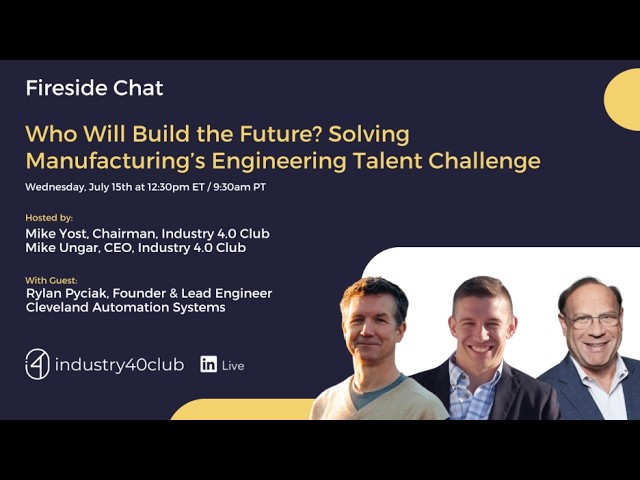
In this Industry 4.0 Club fireside chat, host Michael Ungar (CEO) and co‑host Mike Yost interview Rylan Pyschak, founder and lead engineer of Cleveland Automation Systems. The conversation explores the deep‑seated engineering talent shortage in manufacturing, distinguishing between a lack of entrants, skills mismatches, and shifting expectations of new engineers. Pyschak explains how rapid advances in automation—PLC, IPC, robotics, vision, networking, cybersecurity, and data analytics—have expanded the skill set a modern controls engineer must master, making a single university degree insufficient without extensive hands‑on experience. He highlights education pathways that work best: community‑college labs, vocational programs, internships, co‑ops, and on‑the‑job training, emphasizing that practical exposure is the critical bridge between theory and production. The discussion then moves to Cleveland Automation’s “retrofit‑first” philosophy, where existing equipment is upgraded or augmented rather than replaced, allowing manufacturers to modernize cost‑effectively while up‑skilling their current workforce. Pyschak notes AI is often a buzzword; only firms with modernized control systems can realistically leverage AI for analytics, and most clients are still in the data‑collection stage. Both hosts and guest stress the importance of early exposure to manufacturing (high‑school plant tours, community outreach) and creating clear career ladders that let operators evolve into technicians and engineers. Practical recommendations for manufacturers include conducting internal vulnerability assessments, partnering with local colleges, establishing apprenticeship or aptitude‑assessment programs, and actively promoting the excitement of modern manufacturing to the broader public. The chat concludes with actionable advice for leaders to build a sustainable talent pipeline and a call to the Industry 4.0 community to continue the dialogue.
Chapters
Welcome to the Industry 4.0 Club's fireside chat. The club's purpose is to engage the power of diverse worldwide talent to accelerate the global evolution to Industry 4.0. We accomplish this by hosting and supporting respectful, thoughtful, and interdisciplinary open conversations and creating quality content on wide-ranging Industry 4.0 topics to expand the reach of our community. My name is Mike Ungar, and I am the CEO of the Industry 4.0 Club. I have over 40 years of leadership experience, with most of that in manufacturing at Michelin. I'm joined today by my co-host Mike Yost. Mike is chairman of the club, and Mike, would you introduce yourself further please?
Sure, absolutely.
Welcome everybody.
As Mike said, my name is Mike Yost. I'm one of the founders of the club. I'm Mike's co-host here on these fireside chats. I've been in industry almost 40 years myself, about half of that time on the solution provider side and the last half on the industrial nonprofit side. So as Mike said, we like to have open discussions with interesting people. And so this afternoon, we're really excited that we have the pleasure to speak with Rylan Pyshak, who's the founder and lead engineer at Cleveland Automation Systems. We're going to be talking with Rylan about who will build the future, solving manufacturing's engineering talent challenge. So Rylan helps manufacturers modernize operations through robotics, controls, integration, and retrofit-first automation strategies. His work focuses on solving operational and performance challenges by improving system design, reliability, and communication between leadership, engineering, and the shop floor. Ryland is passionate about workforce development and practical innovation, and he advocates that automation strengthens both production and the people who support it. So welcome, Ryland.
Absolutely. Thanks for having me, Mike.
And we're glad you could take time out of your busy schedule to join us. I know, Ryland, you're on the kind of the forefront of this question about engineering talent, given what you do and how you help companies. What are you seeing firsthand? Is the issue really a lack of people, a lack of skills, skills mismatch, or maybe different expectations from younger engineers? Help us kind of understand the landscape, if you don't mind.
Yeah, you know, Mike, I think it's a really complex problem. We have a few different issues in industry. You know, first and foremost, I think what we often see is from our client side, we're not seeing enough individuals enter the workforce. Oftentimes we talk with our clients, they're looking to hire new engineers, looking for operators, you know, other people that are actually going to work in the facility on the production lines. And typically the feedback we hear is, hey, we're not able to hire anyone. Nobody wants to show up to work. Nobody actually wants to show up and do what we're trying to do here. So, you know, first and foremost, I think the main thing that we see is there's not enough talent entering. But when you start to dig deeper, I think there's some other things that may be presenting and a reason why these people aren't entering the workforce.
Yeah. And so You spend a lot of time, as we said at the top, helping manufacturers modernize their operations, control systems, robotics, et cetera. How has the acceptance of those technologies really sort of changed the type of engineering talent that companies need today? Because if you go back many years, the practice was for organizations to thin out their internal engineering teams and such. And so now obviously they're trying to either stabilize them or build them back up. But how have you seen it change, you know, what's required of being an engineer?
Yeah, I think our customer base is that to varying degrees. You know, we do have clients that are one, maybe 2 internal resources. And then we have other clients that also have a full engineering staff. Really what I'm— what we are seeing from that standpoint though is there's a lot more going into industrial automation and control systems, manufacturing in general, than what there were, you know, maybe 20, 30, 40 years ago. I think some of that is honestly the advent of technology, right? You look at a control system built maybe in the '50s, '60s, '70s, primarily relay logic, you know, No technology, right? Obviously, we progressed. We have PLCs now, we have IPCs, robotics, vision, pretty much you name it, you know, it starts to stack up more and more. So really, we're starting to see the talent pool become very, very diverse in what they can do. Specifically from a controls engineering standpoint, not only are you programming PLCs, updating HMIs, potentially you're doing robotic programming. You may also be responsible for things such as vision, maybe taking process data, moving that into the database, moving into an MES system. In addition to that, I think also now you have things such as security, networking, and honestly where things are going too, a lot of that's continually evolving as well. So I'd say the tools and the skill sets required for those individuals are just compounding almost yearly.
Well, it's— so what you say is it creates an interesting question, I think, because it's, you know, there's no way I can learn, or it's hard for a student to learn all those skills in, in a university, right? So, um, I used to think that if I— if a student came out with a mechanical engineering degree, you could teach them anything else they need to know over their career. Is there something like that that's a building block today that you would say for for automation as well? Or is it still like, go get an ME and, and that's going to serve you well as you learn other things once you get into your first role at the company?
Yeah, I would say, you know, the foundational is definitely great coming from potentially a vocational school, traditional college, you know, whatever your background there is. But certainly, I think there is a ton of information that you're only going to learn once your hands-on. You know, from that standpoint, I think there are various programs that do better than others. We do work with some local community colleges, other things across the nation where they actually take individuals, train them, get them exposure, whether that be, you know, labs where they have maybe a robot and a PLC. Sometimes those, those different groups also work with local manufacturers, so they'll do internships, co-ops. Yeah, I would say ultimately, Mike, really the hands-on experience is something that most individuals, we typically don't see gaining that until they enter the workforce. And really, I think that's another caveat too, that when you look at manufacturing, you look at integrators such as ourselves, you look at end users, there has to be a little bit of leeway. There has to be some gap there to allow this next generation to actually come in and learn. You can't really expect somebody to go from college right into having 15, 20 years of experience and then being able to support the 15 different things we just talked about between programming, networking, you know, IT, OT.
Well, and I guess another area that I would ask about, I get asked a lot about, you know, training on smart manufacturing as an example. And I'm like, well, why don't we start by teaching manufacturing, right? And then we'll add the intelligence to it. So do you see People, you know, in these engineering capacities being able to zoom out and understand, you know, the process that they're working on or the area or, you know, the line that they're working on. You know, it's interconnected with other operations and other systems and, you know, the overall flow of the business. So do you see that being another area heaped on the engineer's shoulders, or is that something that— You don't see them having to address?
Yeah, I think the exposure to the various systems is a phenomenal resource to be able to gain that information and that knowledge. What I will say is typically end users, manufacturers, you do get greater experience there because you are buying 5, 6, 7 different pieces of equipment from various maybe OEMs, integrators. Some stuff may be custom, others are off the shelves. You know, you talk about control systems, right? One might be Rockwell, one might be Siemens. So you do get that exposure to kind of figure out, hey, this is how one system works, this is how another works. I think another great aspect of that as well is you also get exposure on how different individuals as well as companies have developed their systems. So really having that overall, you know, maybe taking a step back and looking at the system more from a high level. Gives you a lot of ability to really, you know, educate yourself on how these various systems work and then continue to get that exposure and that experience.
Well, I think that, you know, your perspective as an integrator and working across companies and such, I think is really valuable and informs what you're saying there. And I think that what's natural to you might not be as well understood to others. I think it's a real gift that you have that you're able to see different processes. Are there particular industries that you focus on specifically, or are you generally seeing these challenges across all industry sectors?
You know, we support pretty much every industry across the board, from general manufacturing to process. So really, you know, I would say we see the same things no matter where we go. Some may be varying degrees, right? You do have some clients that have very rigid, strict ways in which Hey, maybe you specify hardware or software, and then you have the other clients that are basically buying everything and have no internal standards. I will say though, even with that and having good solid internal standards, you do still see a little bit of that flexibility and a little bit of that, I guess, opportunity as well to get exposure to different systems.
You know, yeah, so, Randalyn, I want to go back to something you said at the start, and really we're talking about here that There's not enough talent entering the workforce, not enough engineering talent. So how do we address that? I mean, I think it's really kind of one of the root cause issues here. So I know we can come up with a lot of different ways to train people, and we think about how we build, sort of build onto different skills over time, but how do we get more folks interested in just joining engineering, joining manufacturing for that matter?
You know, I think it really starts with making the industry in general enticing, right? So something that people actually want to come and work in, making our industry something that people find interesting, have curiosity around. And really, I think one of the ways in which to do that is just getting more exposure in front of individuals at an earlier age. You know, I'll be honest, when I started, I knew nothing about manufacturing until I was able to basically go on a plant tour, walked around, I'm like, This is the coolest thing ever. There's robots, there's machinery, equipment. Seeing that hum of manufacturing happen is really what drew me in first and foremost. And I think that's a good way to do it as well, right? Maybe starting with individuals that are currently in high school and/or getting ready to transition out of high school into potentially college or after high school and just allowing them to say, hey, this is what we actually do. This is what we do. This is how we do it. Here are different roles, responsibilities, and things in which you can do in the manufacturing sector. I think it's largely a— I don't want to say a black box, right? But most often people drive right past manufacturing buildings and don't even know what happens in between those walls.
Yeah, I mean, I'm a big advocate that we should be talking about, you know, when you learn these skills and you're part of these teams, think about the things that you're building. Right? Like, like some of the things that, you know, whether it's food products or it's, you know, hypersonics, it's drones. I mean, there are so many things that are, I think, really captivating to all of our imaginations and such. And certainly for a younger audience that, you know, the fact that you have to bend something or blend things or, you know, whatever the actual process is, it's just part of the process towards Being a part of creating such things. Yeah.
Do you— to follow that a little bit further in terms of like attracting folks, talk to me about, do you see an associate's degree to be sufficient for getting started and then go get that practical experience? Or are you really thinking that someone needs a 4-year degree?
You know, Mike, I personally, I think a degree is really subjective. on exactly what you're trying to do. I think having the fundamentals is always great. Understanding how circuits work, understanding electricity, the basics of mechanics, all of those things are wonderful and great to actually bring to the table.
Mm-hmm.
I think from there it does vary, you know, considerably. You can have the traditional 4-year college that may be more on the, you know, fundamentals and theoreticals, whereas maybe more of a vocational school would be more hands-on. Hey, we're actually gonna pick up a teach pendant, We're going to go online with PLC and learn how to program. So really, I think those kind of range, you know, but ultimately it also does come down to the individual. What's their curiosity? What's their willingness to learn? What's their willingness to basically dive in and troubleshoot and figure out complex problems? So I would say getting the exposure is definitely first and foremost, whether that be experience with the internships, with co-ops, you know, just general, hey, maybe going and spending some time in a manufacturing facility. But I don't know if there's really a— it should be or shouldn't be necessarily a traditional 4-year college.
That's great.
Yeah, I hear a lot of those conversations in the workforce circles talking about credentials and microcredentials versus 2-year degrees, 4-year degrees, etc. I just want to take one second and remind everybody that we're talking here With Ryland Peyshek, and we're talking about who will build the future, talking about solving manufacturing engineering talent shortage. So one of the things that we mentioned at the top, Ryland, is that you advocate for a retrofit-first automation and practical innovation. I was wondering if you could explain that, define what, what you mean by retrofit-first automation and practical innovation. And then have some follow-on questions about how your manufacturing clients receive that.
Absolutely. Yeah, really, Mike, what we'd like to do is meet our clients where they're at, right? We design, build custom automation equipment. We do retrofits, we do system upgrades. So ultimately what we want to do is actually enter into one of our client facilities, understand the problem they have, understand their challenges, Look at their existing equipment processes and how they currently manufacture and then meet them there. Oftentimes what we find is when you look at the holistic process, it may not be that they need a brand new piece of equipment or they need to totally, you know, rip out and replace something. So oftentimes that's either looking at an existing piece of equipment, adding on additional functionality, potentially doing system upgrades. Hey, maybe we have an old system that can't connect to our ERP, so we're going to migrate that to something newer. So really it just comes down to working with our clients, going on site, doing site assessments, and truly understanding what their problems are so that way we're providing a sound solution that actually works for what they're trying to solve.
And do you see, um, I guess, is the pendulum on one side versus the other as you have these technology-oriented conversations? Are you You've seen using automation and technology and stuff to take the people that we do have and make them more capable, give them more tools, those sorts of things. Because I can tell you from, I said, almost 40 years in the industry, for a long, long time, the automation discussion was sensitive, to say the least, because people were worried about replacing workers. Now we're talking about not having enough workers. So just I was wondering where you see the pendulum there on, as you're having those more strategic conversations about where companies are, do you see the role of technology being, I guess, more accepted given the realities of the workforce challenges?
Absolutely. Yeah, what we see ultimately is automation is just another tool in the tool belt. To your point exactly, you know, it's traditional automation, right? The 3 big Ds: dirty, dull, and dangerous. That's where we're seeing clients ask for automation is, hey, this is a process that you may be standing beside a very, very hot oven in the middle of summer. No one wants to do it. It's not fun. And you're doing it for 12 hours a day, right? So, you know, we're looking at those processes and that's really where clients are coming to us and going, hey, what can we do here to automate this system or subsystem to basically allow us to utilize the people we do have? And utilize them in a way where they're not just getting beat up day in and day out. So oftentimes, usually when we walk in, we do a risk assessment, site assessment, understanding where the problems are. Typically, we're able to identify those and go, hey, automation may make sense here because right now the individuals, it's just a very, very high turnover spot. It's a challenging spot. It might be something that's just not fun to do and beats people up. So oftentimes we're able to find those and then work with our clients to implement automation solutions that I'm wondering, just one quick follow-on, Mike.
I'm sorry. It's okay.
Go ahead, Mike. I'm wondering, as you're having these conversations and meeting companies where they are, you know, we've gone now almost 20 minutes without mentioning the word AI, right? So are you finding walking into clients that AI is already in their vocabulary and they have either strategies or They're looking for help, or is it still something that's coming but not really impacting day-to-day stuff?
Yeah, I would say AI, in my humble opinion, is a bit of a buzzword in industry. It is used quite often but may not be fully defined. We do have clients that are implementing AI, implementing it very well, and making decisions based off of what they can do with AI. We also have clients that have equipment machinery that was built, you know, between 1950 to 1970, um, where often, you know, there is no technology in there, right? That, that's the— they ran off of relay cabinets and really not a computer or any way to hook up AI to that. So ultimately it's kind of a spectrum on what we're seeing, and, and typically it's having those conversations again with clients to go, hey, you have to be able to crawl before you Right? So working through that process of modernizing control systems, upgrading their processes, their machinery and equipment. So first and foremost, we can actually talk to systems, we can pull data out, we can do analytics, and then from there you can start implementing some of these higher-level solutions such as AI or, you know, other, whatever kind of solutions you want to call it.
Yeah, that tracks. I spent years ago working in the manufacturing intelligence space, which was basically visualization and reporting. And then we would meet people that were in charge of enterprise analytics. And so that's what they went around the world talking about. And at the end of the day, they were doing visualization and reporting. So oftentimes the technology hype and buzz is the leader, and behind the scenes you're being much more practical. You know, as you're talking about with the practical innovation. So sorry to cut you off, Mike.
That's okay, Roland. I want to come back to when you've talked a couple times now about coming in and looking at how you might upgrade or re-automate equipment. Along with that, quite often, is some improved or new technology. Are you spending a lot of time then with the existing engineers and technicians in the facilities Helping them learn how to use this new equipment, this new automation as well?
Absolutely. Yes, that, that is our number one priority, Mike. Ultimately what we want to do, any client we work with, we want our clients to want the system we put in place, to learn, to understand, and own that equipment. So first and foremost, before we even do any kind of engineering whatsoever, we typically do what we like to call a site assessment. And that's sitting down with obviously not only management, engineering, production, but also the operators, the individuals that are standing at these facilities for 8, 10, 12 hours a day actually interacting with the equipment. We actually want to sit down with those individuals, absorb as much knowledge as we can to understand what the challenges are. What are they facing? What are the ergonomics? You know, oftentimes there's a lot of valuable information with those individuals that, you know, as you go up the chain, management may not understand. Hey, I actually have to do this 10 times a day because this other thing happens over here. So really, we want to sit down with those individuals, capture that knowledge, and then make sure we're working that into our engineering process so that when we do deliver an upgrade, deliver a system, the system's functional, it's understanding, and also those individuals know how to operate and run those systems. And to your question, the training is absolutely something we do as well. Not only do we do engineering support, We do onsite support and we also do continual support with our clients.
One of the programs, we were talking about this shortage, one of the programs, I'm curious if you've seen this at other companies as well. One of the programs that I've seen instituted that's quite successful is a program that allows folks that run the equipment to evolve into maintaining the equipment and eventually engineering the equipment. And so that requires a process of aptitude assessment and training. Have you run into that in the companies that you support?
Yes, yes, we have quite a few clients that do the same thing, and I think it's phenomenal, right? It encourages that growth. It allows for that curiosity to actually blossom naturally. I think it's wonderful because, you know, these individuals are— may start out working on the piece of equipment, and then as they go forward, they go, hey, I'm curious about this, I want to learn something more. So having that structure in place with our end users is phenomenal.
Yeah, I think it is. It really creates too— the other thing that happens when you focus on an individual's development is many times you keep that person for a career because that mutual interest is there. And it really, you know, it's one way that you can help solve that talent shortage we've talked about is showing them a vision of how they can go from starting at one place in the company and evolving to another based on their ambition and their capabilities.
Absolutely.
Yeah. So, Rylan, I appreciate your insights, your experience, your willingness to share with us. I guess I'm just curious that if we have manufacturing leaders that are listening to this and would like some advice from you, what would you tell them? What steps would you tell them are important to take in the next year so that they can answer the question about who's building the future and that they can solve this engineering talent challenge?
I would say talk to your team, you know, talk to your team internally, understand what the current challenges are, you know, really sit down and list out where are our vulnerabilities, where are weaknesses, and what do we actually need to do to staff up against that. You know, from there, I think I would also reach out to your local organizations, Talk to your local community colleges, really develop that localized network and even larger networks, you know, across the country and start networking with other individuals so you can have these conversations and figure out where other people are finding resources, finding the opportunities and individuals that are coming into the workforce.
Yeah, as someone who lives in that space, you're talking about the ecosystem to support the manufacturing base. That's, uh, That's certainly what I like to hear. And just one thing I would say to connect with what you're talking about is we don't have any workforce conversations without talking about emerging technologies, and we don't have technology discussions without talking about workforce needs. So they're all very much intertwined.
Absolutely. Yeah. So we've been talking with Rylin now for the last half hour or so, or 25 minutes. And rather, as we get ready to wrap up our conversation, it's been really insightful. I wanted to really ask Mike first, and maybe you just give us a last thought or last comment that you'd like to share with our audience. Mike, would you start us off?
Yeah, sure, sure. I mean, I think, you know, the point— I guess a couple of points. One, as far as, you know, building the future, right, and the importance of engineering talent and whether that talent is in-house or through a partner or, you know, a combination thereof. I think it's really important for people to get their arms around. And then I think the point about— may not necessarily be a specific 4-year degree. It might be a, you know, a 2-year degree plus some experience and some credentials or certificates or things like that that that help you build the workforce talent that you need in-house. So I thought those were very insightful inputs from Ryland. So I appreciate that.
Thanks, Mike. Ryland, how about the last thought from you?
Yeah, honestly, what I would say is have the confidence to talk about our industry positively, right? And go out and really talk to other individuals, maybe not even in your same network. When you're at a picnic, you're at a baseball game with your children, Tell individuals what we do, how exciting it is, and how unique it is. I think having more exposure to this industry just in general and across the board is going to be the only way that we could have more people find it exciting and actually know what it is.
Oh, that's great. Thank you for that. Well, again, Ronlyn, thank you so much for taking the time. Mike, you as well, to join in and share your perspective on how to address this engineering talent shortage. As it comes, you know, it's almost— sometimes you feel like it's too late, but it's never too late to get to work on it and really help it improve. So thanks for your insights there. So the Industry 4.0 Club, we'd like to encourage you to take action. Read an article, attend a workshop, or even advocate for a smart manufacturing roadmap for your factory. Or, you know, talk— as Ryland suggested, talk to another person about A career in manufacturing, a career in engineering. We'd love to hear from what you, what you're trying to do, so drop us a note at our website at www.industry40club.com or on our LinkedIn page. We also hold conversations like this weekly. If you'd like to be a future guest with us, again, drop us a note on our website or our LinkedIn page, and we'd love to hear from you. With that, again, thanks, Mike. Thanks, Ryland. We wish everybody a wonderful rest of the day and week.
Thank you.
Excellent. Thank you, Ryan.










