Your Smart Manufacturing Journey: Begin with the End in Mind
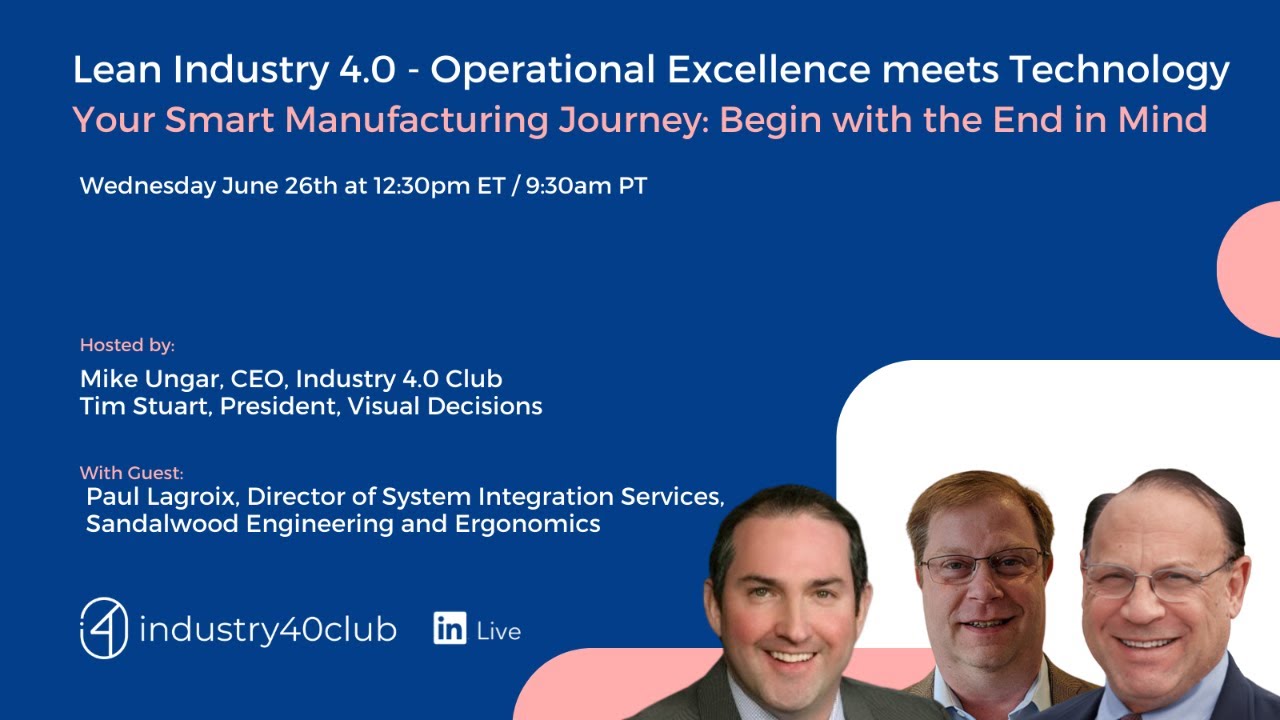
In this Industry 4.0 Club fireside chat, host Michael Ungar (CEO) is joined by Tim Stewart (President, Visual Decisions) and Paul Lacroix (Director of System Integration Services, Sandvik Engineering & Ergonomics) to discuss how manufacturers should start a smart‑manufacturing transformation by first defining the desired future state. The conversation stresses that most companies begin with technology or isolated use‑cases rather than a clear business‑driven vision, leading to stalled projects and high failure rates. Key recommendations include: aligning the transformation with corporate strategy; forming a cross‑functional team that includes operations, IT, quality, and supply‑chain; using structured workshops, the SESAME Smart Manufacturing Assessment Framework, and detailed KPI mapping to capture the end‑state; considering people, process, and cultural change alongside technology; building a unified data architecture (unified namespace, data lake) and standardizing data models to avoid siloed systems; being aware of technological debt and “monuments” created by ad‑hoc implementations; appointing a digital‑transformation lead or governance body; adopting an incremental, iterative approach rather than waiting for a perfect plan; and selecting software that fits the defined processes rather than reshaping processes to fit software. The panel also shares practical tips for organizations already mid‑journey, such as leveraging existing systems as a baseline, conducting gap analyses, and continuously measuring outcomes against pre‑set metrics.
Chapters
Welcome to the Industry 4.0 Club's fireside chat. The club's purpose is to engage the power of diverse worldwide talent to accelerate the global evolution to Industry 4.0. We accomplish this by hosting and supporting respectful, thoughtful, and interdisciplinary open conversations and creating quality content on wide-ranging Industry 4.0 topics to expand the reach of our community. My name is Mike Ungar, and I am the CEO of the Industry 4.0 Club. I have over 40 years of leadership and experience, with most of that time being spent in manufacturing at Michelin. Today we're airing the 7th episode of our series of broadcasts entitled Lean Industry 4.0: Operational Excellence Meets Technology. Hosting this series with me is Tim Stewart. Tim is the president of Visual Decisions. Tim, would you mind introducing yourself further, please?
Sure. I founded Visual Decisions over 20 years ago now to help companies combine lean manufacturing practices with data from the shop floor to drive improvements in their operations. We've utilized a variety of different technologies during that time as things have evolved over the past 20 years, and I have worked across many different industries to improve quality, reduce costs, improve throughput, etc. And happy to be here today to talk about this important topic of beginning with the end in mind.
Thanks, Tim. So as Tim mentioned, the broadcast today is titled Your Smart Manufacturing Journey: Begin with the End in Mind. Our guest today is Paul Lacroix. Paul is the Director of System Integration Services for Sandvik Engineering and Ergonomics. His mission is to help manufacturers achieve smarter and safer operations. Paul has over 25 years of experience with Sandalwood. He leads a great team helping customers on their digital transformation journey. Over the last 25 years, through the completion of hundreds of interesting and challenging projects, Paul and his team have continuously expanded on the scope of their systems integration offerings and expertise. The team's primary focus is helping their clients optimize their productivity and reduce risk with Plant 4 technologies, including machine monitoring, complexity management, and industrial cybersecurity solutions. The relationships that Paul and his team have with their customers are driven by the team's core values around integrity, technical competence, responsiveness, and outstanding value on the client investment. So welcome, Paul. We're glad that you could join us.
Yeah, thank you very much. Very happy to be here talking with you and Tim today.
So Tim, can you get us started a little bit by sharing some background on our topic today?
Sure. Most organizations embarking on an Industry 4.0 journey aren't doing it just because everyone's talking about it. There's usually some particular problem that they're trying to solve. They may be looking to do predictive maintenance on some particularly vexing piece of equipment. Maybe they're looking to improve quality overall, and a few have even developed a multi-year roadmap of different use cases or technologies that they want to put in place. But I've yet to engage with a company that has a complete vision of what the future state looks like that's driven by a detailed business case of how they will drive value. And none of them have detailed the cultural and process changes that will be required in order to take full advantage of those new technology capabilities. And without having this complete vision in place at the start, many of these initiatives have quickly stalled out. There are a variety of studies out there And they're pretty consistent in showing that the majority of companies don't reach their goals with their Industry 4.0 initiatives. And I believe that the lack of a firm plan is a big factor in that, and that's why I think this topic is so important.
Thanks, Tim. So appreciate that sort of that introduction. Paul, let's start, um, with kind of coming back to the title of the broadcast, and it's, um, Beginning with the End in Mind. So can you kind of get us started and talk about how does a manufacturer actually figure out what the end is supposed to look like?
Well, yeah, for sure. First off, the endpoint for every manufacturer is going to be different, right? There's so many different factors, you know, geography, products, industry, right? There's so many factors that'll influence what important to a specific customer. So that's, that's the beauty of what we do in this world, is that every client is different. You're always solving a new challenge and a problem, right? So starting with that, um, there's really no answer sheet, right? So it just takes hard work and process, uh, and discipline. for each company to go through the exercise of mapping out that vision. What do they want their future state to be, right? So, um, so there's companies like ours and, and, and, and other consultants that have, you know, workshop process that can take, that can take clients through this. Some companies have the discipline in-house to, to work through that process. But the point is, Going through that process to map out a clear vision that they can then follow and put a plan against.
How does the— when you talk about that clear vision, talk a little bit about how do they— how does a company marry their business strategy, you know, market evolution and that kind of thing, and their smart manufacturing or Industry 4.0 strategy? How do they come together?
Well, you really need a cross-functional team within your organization. And then that's part of, I guess, knowing what your corporate goals and strategies are impact what that vision is going to be. So getting everyone in the same room and saying, okay, here's, you know, here's where we want to be in 5 years. This is what we're marching to as a company, right? What do we need from a smart manufacturing standpoint to support those goals? So getting it documented, and once you have that information, then it's a lot easier to put your plan together for what you need to get there.
Tim, have you seen— go ahead, Tim, I was going to ask you.
I was going to say I absolutely agree with part of what you said there. Well, I agree with the whole thing. you said, but one thing in particular. I like to start with the goals of the business. What is it that they're trying to achieve? You know, where do they want to be in 3 years, 5 years, whatever timeframe you were looking at there, and work backwards from there? You know, what are the changes that they have to put in place for the business, you know, from a business function point of view, that are going to drive those changes and drive those behaviors and so forth within the organization. Then once we understand that, then we can work backwards into what is the technology that will actually support those changes in the operations.
When you speak about technology, Tim, I think about other elements that also need to go into this picture. What are some of those other things besides technology that needs to be part of this strategy?
Some of the basics in the industry, we've talked about people, process, and technology forever. And, you know, certainly we have to look at what are the current skill sets of the people in the organization? What are they capable of? You know, what do you want them to be capable of? You know, is there training that's required? Are there cultural changes, behavioral changes that you're looking for? For. From a process point of view, you know, how do you do something like root cause analysis today, or do you have a defined problem-solving methodology that you utilize within the company? Are you utilizing lean or other continuous improvement approaches and so forth? And then how do you adapt those to achieve the goals that you're looking for based on adding additional technology capabilities into your organization? So I think that you have to marry all 3 of those different approaches. And then you can also look at different policies of the business and so forth, HR practices, things like that that come into play as well.
And Paul, your experiences with different companies, are there any best practices you've seen that you would add to that in terms of the different elements that go into creating this sort of this picture of the end?
Uh, I think Tim covered a lot of them. I think there's, there's other ones like external regulations too, like not only looking right now, right, but what regulations are coming down the road that you want to plan for. You, you don't want to be building your system for— that's going to be obsolete in 6 months. You want to be thinking what's coming down the road. So trying to future-proof it to the best of your abilities and try to think, you know, not only where your business is now, but where it's going so that you can factor those into your planning. And obviously KPIs, I think, are different across organizations, right? So companies may be using KPIs right now, but as you get smarter in your organization, The ability to get better, you know, more accurate, different KPIs, it opens up more opportunities, right? You have access to real-time data that you might not have had before. And how does that impact your business and allow you to make better decisions down the road?
Yeah, and those measurements really impact the behaviors of the organization too, right? Because as people, what we're measured on, we tend to focus on so that we get good reviews at the end of the year and so forth. Those KPI, those measurements that you're putting in place are critical to driving those behaviors that you're looking for.
Absolutely.
I think both of you hit on something I think is interesting as well. We talked around it, but this idea of having a cross-functional team, Really making sure that you've said it before, but having all elements of the organization engaged in this. We know that it's seldom that any one person sees the whole organization or at both the high level and the depth of the organization. Having a cross-functional team, even different levels of the organization engaged in this can really make a really big difference in terms of the robustness of that picture of what the future should look like. And that's—
let me just jump in there, Mike. And that's not only to collect the input up front, but when you have that cross-functional team involved from the start, the support of the system as you're implementing and use is great. That's where a lot of these systems fail. is it's too narrow, certain people weren't included, it doesn't factor in their requirements or expectations, and so it doesn't get supported once it's in place. That cross-functional team does not only collect the input but build support down the road and improve the chances of the system's success and use once implemented.
A lot of these things are implemented almost like little research projects within You know, one team out on the, you know, shop floor, and you don't get involvement from the different organizations, the different parts of the support staff, and so forth. And, you know, a lot of cases not even from, you know, the floor personnel themselves. And so without that involvement up front, without people having input into this, they have no ownership on the back end.
Absolutely. Well, that, that's really a good point. I mean, we talk about, um, Beginning with the end in mind. In this case, the end is having this ownership and engagement through the whole process. And the only way to do that is to get people involved up front. So it makes a lot of sense. Are there any tools, Paul, any tools or techniques that you've seen that manufacturers could use to define their future state?
Again, it's Various, you know, various integrators, consultants will have their, their process. I think, I think we've got one of the best on the phone, actually. I've seen some of Tim's documents where it's, it's got every metric, KPI, and factor that a manufacturer would want to consider going in. So, so, so using that experience, I think, is very valuable for a manufacturer. As I said, some manufacturers are going to have the discipline in-house to build the team and run through the meetings and, and consider the factors. But, but the point is to have a very detailed process. Make sure you're talking through all those factors as you go in. So, so, so the tool is really the process and the workshop, I guess, from, from, from my standpoint or how I see it.
I will also say that Our 3 organizations actually are 3 of the kind of select few that have all been certified through the SESAME Smart Manufacturing Assessment Framework or Acceleration Framework. And for people not familiar with SESAME, it is the official smart manufacturing institute for the U.S., funded by the Department of Energy. And they've developed kind of a standardized approach to doing this assessment and so forth of how do you do the current state assessment, the future state, and so forth. And all 3 of our organizations have had people go through that process, and it is fairly high level in its approach to this, but it's also That industry standard approach, and it has a lot of good tools within there in order to document that current state and put that future state together.
I think I can't stress enough though, to come back to something we've already talked about is, I think you got to start with a business strategy and then really bring the technology in as tools to help support you in achieving that strategy. I think unfortunately today a lot of folks are— they don't know what they don't know, so they don't necessarily bring in all the— have a handle on everything that's possible to help them achieve their goals, or they're afraid. They're afraid of what the impact of the technology can do on their culture. When in fact, if you understand it well, you're able to then integrate it into your culture, not have it upset your culture, if you will.
Agreed. I think there's actually another piece of that. Sorry, there's another point I wanted to make there. Sorry, Tim, you can jump in. I just lost my train of thought there for a second.
No problem. You caught me. I didn't really have any point to make at this point.
No, that's good. So the— no, you guys are good.
The—
sometimes you can— I think the other challenge that a company faces in trying to think about the end is they can find themselves trying to do too much, you know, not be focused.
Sorry, that's— yes, that's exactly where I was trying to go, Mike, where they get into analysis paralysis and they get stuck, so they never move forward, or they think if they don't get the plan perfect from the start, then there's no way to correct it, right? Where smart manufacturing is an evolution. So if you can start on the journey, at least have a plan, at least know what you want to do, right? But it's not— it doesn't have to be perfect the first time. You can always evolve. You always learn as you go through the different phases, and then you can apply those, those, those learnings. And it's also, if it's, if it's too big, it just becomes overwhelming too. So as you're starting on your journey, You want to start with something that is realistic to accomplish in your phase. You want to win. You can't solve all the world's problems in one shot. So yes, that's the— those are all important factors to consider as you're getting started.
Yeah, I'll add on to something you said there. If we look at this as a transformation, there's really no end. So we titled this Begin with the End in Mind, but what we're really looking at is beginning with a feature state at some point in time. It's not really the end. The end would probably be bad. But we're looking for what are the goals that we're trying to achieve And how do we get from here to there, recognizing that there's more beyond? And so we don't need to, you know, look at perfection as the end state that we're trying to achieve at the end of this process. We're really just trying to get to someplace that's better than where we are today. Yeah.
Yeah, it's a great point. Yeah, I want to kind of delve, take a little bit of a turn here and to talk about data. You know, we already talked about needing to have a clear picture of where we want to go, kind of as we've talked about getting with the end in mind. And we've talked a bit about how to get there. But a lot of companies have, like, as we know today, most companies have a lot more data than they know what to do with. And that can be a little bit overwhelming. How should a manufacturer go about defining the data they need to capture and then how to organize that data in order to get to the end that they're trying to get to or get to that, maybe not end, but milestone they're trying to reach in a couple of years?
Well, as you said, there's many companies that have already started on their journey that have that have been doing this for years and years have a ton of data in many different disparate systems that, that don't talk, right? So that's an existing problem, obviously. And then, and then there's other manufacturers that have done, you know, very little, right? So For the ones that have done very little, I guess I would say starting with your KPIs and minimum requirements is kind of your starting point, right? What do you need to support your base requirements? But you don't want to just think of the minimum, right? So that's where you want to get into the into the future planning, right? You want standardization, right? You want to, you want to develop a data model that can be replicated across machines so you're not going into, into every asset and trying to reinvent the wheel every time, right? You need to get efficiencies. And then sort of the problem we talked about at the start were these these companies have data across all these different systems and it's impossible to do analysis across that. That's where concepts like the unified namespace come in, where it's making data universally accessible to all users across systems. So you no longer have these siloed systems and you're able to do much more with it, right? And so that's, that's where a lot of the modern data collection You know, technologies and storage and analysis, that's where it's going. Really making use of the data that some companies have had for many years but haven't been able to do very much with because of how it's segregated and trying to unify that data.
It sounds like a bit of a daunting task, you know. I mean, it's— have you— even when you do that, I guess it still feels like there's a risk in not getting it right.
How do you—
any hints there from your experience? I'm imagining you've seen situations where companies have attempted to do that, but then they just kind of fell short.
Um, I think it's still an evolution. I mean, kind of the utopia that a lot of our customers are working towards, but, you know, I would say probably no one's there yet, or, or very few are there yet, is where they can, they can bring a machine into the plant, it already follows a standard data model. You know, it's as soon as they put on the plant floor network, it automatically connects up, feeds up to this universal system. I mean, that's sort of the utopia that companies are working towards. But, but I don't think it's I guess I don't think it's there, but if you know that's where you want to get to at some point down the road, then you can start with your plant floor architecture and what systems are you using, right?
Mm-hmm.
In order to push that data up and start sort of thinking through that exercise, right? You're not going to accomplish it today. But, but that's, that's where you want to get to.
When I think about— so I'm gonna go back to 4 years ago or 5 years ago. And things have changed. There's a thing that I remember hearing about called the data lake. Okay. Are they still relevant today? I mean, I don't hear about— I don't hear about data lakes the way I used to. Am I thinking about that wrong or is it just because I'm not in the right space to hear about them?
No, I think that's the part of that unified namespace concept. The data lake is just where that data lives. Instead of your maintenance system having its own database, your quality system, your machine monitoring system, all having their own databases. All that information living in one accessible location. Yeah, I think it's, I think it's very relevant and becoming more and more relevant, Mike, as, as, as these modern systems get implemented.
Yeah, I agree with that. We do some work on the reporting side of things. And within that space, the data lake conversation is still extremely relevant. And if you look at some of the analytics or the AI/ML technologies and so forth, getting information into a single place, into a data lake, is one of the helpful facilitators to that because you end up with both the process information as well as the outcome data that's fully contextualized within that single available source. And so that is still relevant today.
So you really have— then I guess if we're talking beginning with the end in mind, you kind of have to have a sense of that data structure. You mentioned unified naming, but also that includes the structure of the data inside this data lake in order to really understand Or to help set yourself up for the future, if I understand correctly.
Yeah, I don't think you have to have it all specified out, but you have to have a decent understanding of, um, again, what, what are you trying to do, and, uh, work backwards from there to, you know, what are the things that— what are the different, uh, processes that you have to put in place and modify and so forth, and then What are the different data elements that are going to be supporting that and so forth, and have a good understanding of that. And then once you have, then do your gap analysis to what you're going to need in the future and so forth. But I don't know that you have to specify it all the way out down to the field level and everything else of what will be in that data lake, you know, 5 years from now.
Okay, Paul, one of the things that comes to mind, you know, we've been talking about Kind of the, I'll say the ideal scenario that, hey, I'm getting started on my journey. I think about where I want to go and I work my way back from there. And, you know, I come over the unified naming space. But the reality is there are probably a lot of listeners that are already started and maybe haven't thought about the end the way we're talking about it today. What advice do you have for them and how should they proceed to kind of You know, maybe reset or move forward. What are your thoughts?
Yeah, that's very common. And as Tim mentioned earlier, I think there's a lot of customers or there's a lot of manufacturers out there that will have one-off implementations or many one-off implementations in various facilities, you know, across the organization. And those were put in to solve a problem, right? So they're not, they're not bad. It was probably— it's probably a lack of strategy in trying to, in, in trying to, um, you know, make a universal solution, uh, but, but all those solutions are in there for a reason. So I would start with the current state, right? Understand, um, what is existing in place, why is it existing in place? And I think that can be your starting point for your future state discussions. So you don't want to lose functionality. You don't want to take things away that the plants are using in order to manage their operations. You want to factor that in and then you want to make sure you're considering some of the other things that we've talked about as far as future state and standardization and other things where you can bring some commonization to those existing systems and figure out technologies that you may be able to commonize around to support those existing applications. But you don't necessarily need to, you know, start from a blank slate. I think you can use some of those existing systems as your starting point for discussion.
Yeah, I'm guessing you have to— you may have to evolve some of the things that you've done as you think about the end and as you kind of integrate things together if they aren't well integrated at the beginning, like the ideal scenarios that we're talking about.
And that's very common. Almost every manufacturer will have that exact scenario. So yeah, very rarely do you have a blank sheet where you can, you know, you can just design it up front, you know, with no existing considerations.
I think the only time you have that is when it's a brand new plant just being built.
Yeah.
Because otherwise, you know, I've talked to a whole lot of companies about, you know, the data that they have today, and they're like, oh, well, we don't, we don't have existing data. I'm like, yes, you do. You have a lot of data out there today. You know, it just may not be well documented. It may not be accessible to a lot of different people. You may not persist it a lot, but you have data. There's a lot of data out there. And so, you know, I talked with a company all the way back in 2012 about— they wanted a corporate quality dashboard. And I, I talked to the IT department and they said that all the quality data was in SAP. I told them, no, it's not. And in the end, we found a variety of different SPC systems. We found inspection systems, mainly spreadsheets or Access databases. We found testing systems, laboratory systems, and In the end, we found 57 different systems with quality data across the medical plans. And so there's data out there. It's just a question of finding those different data sources, different data elements, and so forth, getting those documented, understanding what systems are being used for what, where you may want to combine different things, and putting that strategy in place for how you want to evolve into the future. future that you want to.
Do people, Paul, have you seen, do companies typically have, I'll call it individual leaders, not necessarily the line managers that help to facilitate all this happening? Have you seen that?
Some do.
Some will have digital transformation leads or organizations that, I mean, they're tasked with thinking about these things all the time. Those fortunate organizations, are in a good situation to, you know, lead their organization through these efforts. But I think in a lot of cases, it's more ad hoc teams, someone from IT, someone from operations, someone from quality, someone from MP&L that all sort of need to work together as their side job, right? When they're trying to, you know, do their—
Yeah.
do their main job, and then they're, and then they're a team that needs to sort of figure all this stuff out, right? So that's, I think that's where it can become a real, it can become a real challenge to, to, to find the time to do it right around everything else they're trying to do at the same time.
You know, I can imagine, it really is probably a best practice to have that digital transformation lead, because you can imagine, running— that people are running in parallel, right? So that they've got the stuff they've already started moving, because that's probably the norm. And, and then they get this other big plan in place, this, uh, with a much more focused end in mind. And they've gotta, you know, incrementally integrate these things together.
Bridging.
And as you mentioned, when people working in silos or working on particular projects, they don't necessarily see the big picture. So having somebody that can help make that integration a reality and bring things into that common naming and that common target towards the end makes a lot of sense, I assume.
Yeah, and I think a lot of them evolved. A lot of those one-off existing systems weren't done as part of a cohesive strategy. It was probably some smart engineer in the plant that knew there was a problem, came up with an idea, pitched it to their manager, And it was approved, right? So I think a lot of the existing systems and infrastructure probably evolved that way. And I think companies are now just sort of getting to that more umbrella strategy, trying to think of things together across the organization. And that's where the benefits of a digital transformation lead or something equivalent to that can be very helpful and start looking at these these individual solutions and where the organization's going to help map out that cohesive strategy. Yeah.
Very good. We've been talking, gosh, now 35 minutes already about our smart manufacturing journey and really thinking about the end, beginning with the end in mind. As we get ready to wrap up, Tim, maybe we can start with you. Any final thoughts for the audience today?
I just reemphasize how important it is to begin with that picture in mind. There's a concept of technological debt where if you put these systems in kind of one at a time and they're not compatible in data structures and so forth, you can end up accumulating this technology— technological debt that just increases the cost for the organization to maintain those systems or move away into something else as you, you know, progress in time. And another useful concept in my mind from a lean manufacturing perspective is a monument. In lean, a monument is post on the shop floor or something like that that you have that's load-bearing, and so you have to work around it. And putting some of these systems in place that are kind of one-offs basically becomes a monument that you then have to work around in the future because you can't move it or do anything with it. And so if you, you know, do things without that overall plan in mind, you're going to build up that technological debt. You're going to Put monuments in place that you then have to work around in the future, and it just makes things more difficult as you go forward. And so it's hard to take the time to, you know, put that plan in place. But I do think it's important before you make investments to— or additional investments— to take that time and put that plan in place and have that vision of what you're trying to achieve.
Yeah, thank you. Paul, your final thoughts for our audience today?
First off, I agree with Tim. That upfront investment is significant. Well, it's— sorry, the ROI on that upfront investment is significant. It's well worth the investment to do that upfront planning. Sometimes it can seem overwhelming or they're getting pushed to get something in You know, as soon as possible. But, but really taking the time to think it through really adds value. Another piece is the metrics. So make sure you have goals, not only in general what you're trying to accomplish, but the metrics to it. We want to increase productivity by 5%. We want to decrease scrap by X. So you can actually go back after you implement your strategy and see how you did against those goals. So actually trying to put some concrete metrics in place as you're, as you're talking through your strategy, I think can be very useful. And then to go back and measure that and see how you're doing and apply lessons learned if you're not quite meeting those, those goals. Another thought, one thing we barely talked about here is software, right? Not once did we talk about, you know, you, you need to figure out a software and then figure out how to apply it to your organization, right? It really needs to come well downstream. Once you know exactly what you want to do, then you can start evaluating the technologies and platforms out there.
Yes.
There's a lot of versatile platforms. That's probably not going to be your problem, right? You shouldn't be adapting your processes and your strategy to the software. It should be vice versa, fitting the software around your needs, right? So I think that's a key point that you probably want to make.
Yeah, that's good. I really appreciate that. Too often we see people that aren't starting with the problem, they're starting with the solution, and I think it's the problem you start with and then you find the right solutions for on that. So thank you for those points. Well, I'd like to thank Tim and Paul for joining us today for this very insightful discussion. It's been really great. And also thank you to everybody who's been listening as well in our audience. The Industry 4.0 Club hosts conversations on Tuesdays and Wednesdays, typically around the 12:30 Eastern timeframe. And we have conversations around women in manufacturing, The future of manufacturing, which is usually a technical topic related to Industry 4.0, fireside chat like this conversation today, and people, process, and culture. We also would invite you to follow us on our LinkedIn page as well as visit our website at www.industry4.0club.com. So on behalf of Tim and Paul, I want to thank everybody and wish everybody a great day.
Thanks again, guys, for Thank you for having me. Appreciate it.










