DAY 17 of Building a $1M Business in 1 Yr
In this vlog, Mike Andes documents day 17 of his "$1 M lawn‑care in 12 months" challenge. He shows the outfitting of three service vans (up‑fitting, ramps, wraps, equipment load‑out) and explains the logic behind vehicle‑to‑technician ratios, equipment sizing, and backup strategies. He outlines the financial model – a $14 k monthly revenue target per van, $100 / hour budgeted labor, $45‑$65 k cap‑ex per setup, and the trade‑offs of cash versus financing. Mike reviews his marketing experiments, distinguishing primary bets (van‑based service model, limited service offering) from secondary bets (Yelp, Angie's, other lead platforms) and contrasts intent‑based Google ads with interruptive social ads, noting the current drought‑driven low search volume. He shares early P&L data showing a $49 k loss in the first month with zero revenue, outlines insurance, payroll, and equipment costs, and projects a multi‑month burn before the spring rush. Operational insights include equipment selection (mower size vs property size), backup gear philosophy, route efficiency, and the importance of “dog‑fooding” the HomeWorks software. Finally, Mike discusses copy‑writing for the brand’s website, USP positioning, target‑customer segmentation, and the team’s daily rhythm. The video blends real‑time problem solving, instructional business advice, and behind‑the‑scenes footage.
Chapters
I traveled across the country— I traveled across the country to build a $1 million lawn care business in 1 year. I believe we could hit this whole challenge in about 8 weeks. The way that you would start this business today is totally different than you would 20 years ago.
You can do the math pretty quickly on how much this setup should make in a month.
You want your property size to dictate what kind of equipment you have and what type of equipment you have to dictate the type of vehicle that you have.
That's $14,000 of monthly revenue that this van
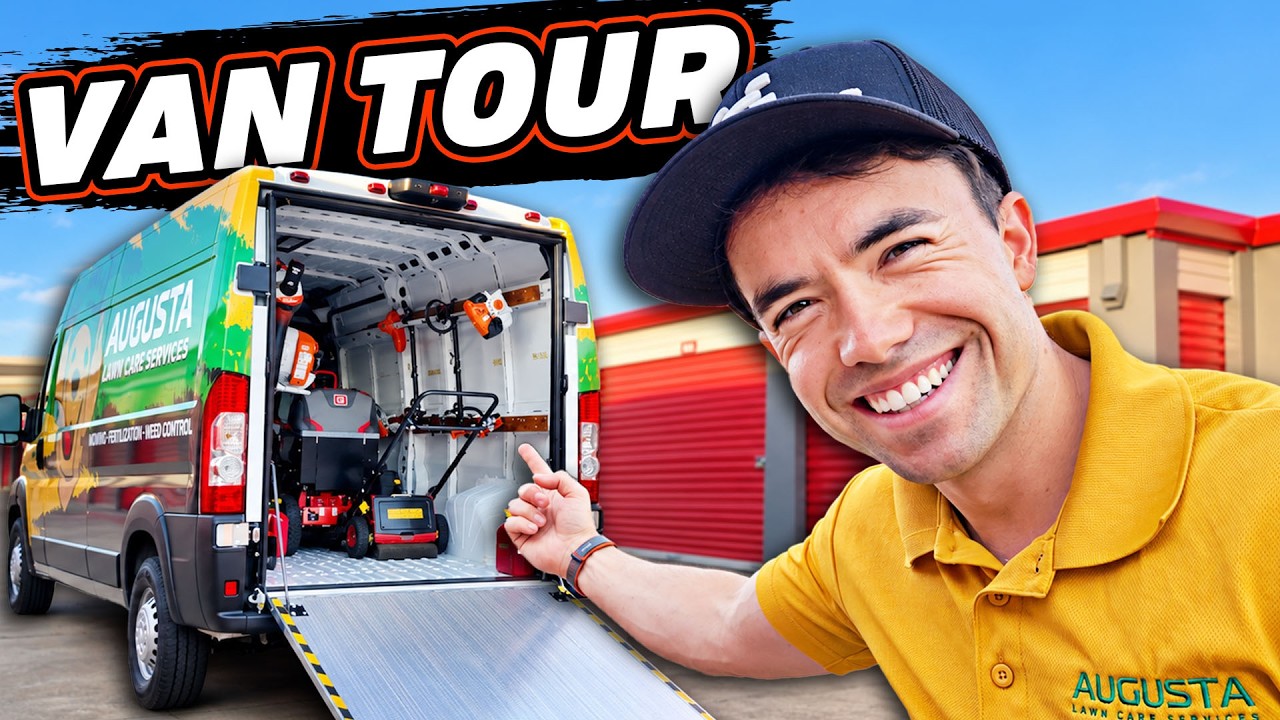
should be able to do. We finally got the first van basically fully set up. Today, I'm going to be getting the second van fully set up, starting off with the essentials: a first aid kit, some jumper cables, and toolbox. Like, we've serviced over 100,000 customers. We were able to say that if I wanted to reduce my initial, I could just finance the vans, finance the equipment. I'm okay with paying a little bit higher price, but when I call you, I want you picking up the phone.
Thank you for calling Augusta. This is Sarah. How can I provide a 10 out of 10 service today?
Yeah, can you tell them I'd like to slash YouTube video?
Oh yes, I can absolutely forward that for you.
Okay, thank you.
All right, you're welcome. Is there anything else I can do for you?
Nope.
All right, awesome. Well, thanks for watching. I like his YouTube videos as well.
Now over here on the back, we did finally get these rubber stoppers. John installed these yesterday on this ramp, and they look really, really clean. We went with the ones that were a little bit larger and meatier. From my other shops, I've experienced you usually gotta replace them every couple years just because they do get worn out. But we're gonna take this bad boy, go fill it up with some equipment, And then we're going to get the third van wrapped today. So the goal this week is just get all the vans ready so that next week we can finally start taking customers. Those look so good. Super happy with those. Now, if you've been following along in the challenge, you know that last week we started— or I guess this week we started running ads. And honestly, there just has not been a great search volume on Google, like not a lot of people searching for our service. And so our cost per lead has not been great. Why isn't it opening? There we go. So instead of spending gobs of money, I'm going to be running a test today, or I should say for the next week or two. And I've ran this test about 3 or 4 times over my career. And that is Yelp ads, Angie ads, and a couple other things. Yeah, so there's— so during the challenge, there's about 10 different things I'm testing for Agustination, and some of them are what I call primary bets and some of them are secondary bets. So a primary bet is like vans instead of pickup trucks. Another primary bet is like the vans going home with the technicians instead Instead of coming into a shop space, those are some primary bets. Another primary very primary bet is only doing two services: mowing and fertilization. Now, I don't have high hopes for them. I don't like these platforms. I have never liked them very long term, and I really don't like when people get addicted to them, especially Thumbtack, and they get on this treadmill of needing the leads. They build infrastructure around just constantly paying for these leads. But given the fact that right now I can't even spend my full budget, like I was hoping to spend $500+ per day on Google and really scale this first month. But there's just not enough traffic. They've gone through a drought, 100 days over 100 degrees, and it's just the grass is not growing very much. Those are some primary bets. Some of the secondary bets, though, are things that I'm like, hey, if I can do this test, awesome. If not, no worries. I was actually planning on not doing this one until like December or January because that's when I know leads will drop off a cliff. In this market during the offseason. I was planning to do some Yelp, et cetera. But given the fact that right now I can't spend my budget, I figure I might as well just go ahead and do this secondary bet now. But I have about 10 of those that I will be testing over the next 6 months, whether it be the dedicated agent program at Command Center, the treatment features that we'll be rolling out at HomeWorks, the dispatch board we're rolling out in a couple weeks. All of these are things that I'm like here to dogfood, test, hopefully make it better. And this is one of those things. I've never been super thrilled with Yelp specifically or Angie's or these other platforms, but I run a test about every 2 to 3 years, send several thousand dollars just to see, and I want to test it for Augusta Nation. And I've done it every 2 to 3 years. Just I will spend $3,000 to $5,000 and I will just be like, okay, where's these? What's the quality of these leads? Where are they coming from? Is it a good cost per lead? That sort of thing, just to see what does the platform do. And I'm really interested because right now ChatGPT does have a relationship with Yelp to pull all of their data over. And so I think they paid something like $330 million as a licensing fee to basically make sure they have all of the business data, mostly because they lack a lot of data that Google has with Google Maps and Google Business Profiles. And so I'm very interested to see if somehow that plays into it. But Realistically, I know I'm in this bubble of AI and stuff and software and there's a very small amount of people that actually use it. So I'm interested to see if anything's changed. It's worth spending some money on it now to test it for Augusta Nation. And also because like right now I'm still spending less than half the budget I would like to. And we can start mowing lawns next week. This week was all about getting the vans ready. Van 1 done, working on van 2. I'm gonna put some V— This is actually V1. So this is going to in the future probably be John's van where he does all of the weed control and fertilization. But let's get this thing labeled up. Let's get this down to the dealer, pick up some equipment, and then get van 3 wrapped today. What's up with this dog food talk? What does that mean? Dog fooding? Dog fooding is like testing things out. It's like, you know, you say like, uh, he needs to have some of his own dog food, or like, um, basically try out the thing that you're making yourself. Kind of like don't trust a skinny cut. Yeah, the dog fooding is just, I believe, one of the unique advantages we have. And that is like, I'm not doing this with just theory or like I did this 20 years ago. I'm still doing it. And so when it comes to, I believe that will come out in the way that we build the product at HomeWorks and the way that we take care of the owners at Augusta. And I want to feel what they feel and not just be like, oh yeah, like 15 years ago, 20 years ago, this industry was totally different. The way that you would start this business today is totally different than you would 20 years ago. And so I believe one of the advantages that we have is that I'm still— I still do this occasionally and get out and make sure that I'm staying connected to how the real world actually operates. 'Cause there's nothing like having some person that like is all talk and you're like, wait a second, that worked great. I'm glad you built an awesome big business 20 years ago, but that's not how the real world works anymore. Knock knock. Yes, who do you have for me? Picking up for Augusta Lawn Care.
Just call me tomorrow and I'll let you know where we're at.
There's a mix-up in information, so the vans aren't ready. Is there anything else we can do on our end? Is it good to go?
No, just gotta finish up these trucks and then let's get them to you.
Yes, ma'am.
Why did they tell us it was ready? They literally called him yesterday and were like, hey, we have one done, you can come pick it up. So it turns out that it is not done. Maybe next time if they call us, just be like, is it completed? Dude, I'm glad the equipment spot is like 2 minutes from here, because if it wasn't and they don't have the van, we drove way down here.
Hey man, uh, did you call Augusti yesterday?
I didn't tell him. I told him I thought one would be ready.
Why? Okay, because they're here.
So it turns out that it is not done. He said maybe today it'll be done. Alrighty.
Sorry about that. All good. Just miscommunication.
Okay. All right.
I gave him my number though, so if y'all want to call me, I will keep you posted.
Okay, awesome. That's crazy. They allow the technician to be like, hey, we're gonna be done tomorrow. So we show up, just kidding. They'll come back after lunch. That's in 3 and a half to 4 hours. Oh my goodness. They're just running on a different time. Dude, they are absolutely running on a different time schedule than us. We'll just have to come back and get those, and hopefully they get both of them done this week, and then I can get those. So that's fine. It's not really fine. We drove so far to get here, but let's make it happen. What are you gonna do? We could bribe them. You know, bribing does work sometimes. I just don't understand why even a technician would be like, yeah, it'll be done tomorrow, and not like the office has no idea what's going on. That's why sometimes even on Field Forces Homeworks, some people are like, we don't want our technicians to contact the customer. Yeah. Like, he sounds like he's a tech out in the garage being like, yeah, we're gonna be done tomorrow. Well, we'll get as much equipment as we can, I guess. Now I got to think, because this is probably then going to be used next week.
Think out loud. How does this power you reorchestrating down here?
Well, now it's just a matter of like, we were hoping to get one more van, but we'll probably just wait for both of the ramps to be done on van 3 and 4 and then come pick them up. It's okay. As long as next week we have one van available for mowing, which will be this one, we'll be okay. So, you know, we're getting used to delays at this location. So add a few more days probably. Yeah. Unfortunately, like, I can't install those ramps and I don't have the equipment here. So I really have to use these upfitters, which is, it's kind of convenient 'cause you can buy it right from the manufacturer. They ship it here, you just bring the vehicle and they install it. Like, I didn't have to like take a pallet or a delivery or anything like that. So it is nice, but you're also working on their time schedule and they're in no massive rush. the 2 major types of ads. One is intent-based ads, or marketing. And the other is what I call interruptive marketing. And so when you think about Google Ads, typical search ads, that someone's looking for my service, LSA, someone looking for my service, they have usually the best conversion rate and the highest quality leads. Because they are literally looking for lawn care. They type the word landscaping or whatever service you're in. They type those words in. The challenging part is if there's not a lot of demand, kinda like right now 'cause of the drought, not a lot of people are searching. So you have to interrupt them. And that's when you go to other platforms like Facebook or other platforms that they're just like, they're scrolling on YouTube, they watch a video. They're scrolling on their Facebook feed and they see your ad. The likelihood of them needing your service is way lower 'cause they didn't search for you. You're interrupting their day and then hoping that they need your service. So usually lower quality leads, usually more expensive. And so right now that's what we're working with, but that's really going to be the story of the off-season. And so my hope is like establish a solid team, a great general manager, make sure everyone knows the systems, and then when we hit spring rush, We will fill these 4 vans like that. And I know that there's going to be people in the comments over the next few months because we're literally going to be going into our offseason that they're going to be like, oh my word, you're not going to make it. You're not going to make it. I believe we could hit this whole challenge in about 8 weeks. It's just a matter of being ready for those 8 weeks. Most people, they're like, well, why didn't you start it in March? Like when it was starting to get busy? Because I'd hit March, I wouldn't have my team set up fully. I won't have all this dialed in. Like these vans, we're making several bets on these. We will probably tune this and adjust this and make this better by the time Spring Rush comes. But by Spring Rush, I'll have a full team ready to go for these 4 vans, a GM, vans will be on lock, marketing will be dialed in finally so that when the demand comes and people are actually searching on Google and there's intent to buy, I'll be there and ready to take all of that extra demand. Anyways, let's get the equipment so that way this van is fully set up and ready to go for next week at the very least. And hopefully van 3 and 4 get done with their ramp by the end of this week.
Can you foreshadow what's to come after you get the equipment, like the type of technicalities we're going to work out?
Well, if like one van set up like this, for example, we— our hourly rate is $100 per hour. That's our budget hourly rate. And so we typically put about 35 budget hours of work on the schedule. Now, if I had all the technicians meeting at a shop space, I usually only put about 30 budget hours of work on their schedule. But due to the fact that they don't have to drive to the shop every day or drive home, we can usually get an extra 5 budget hours worth of work done in the week. And you do the math, that's like an extra $500 a week. That's why having the technicians with the vehicles taking them home starts to make some sense. That being said, you can do the math pretty quickly on how much this setup should make in a month. If you take 35 budget hours a week, If our target hourly rate's $100 per hour, that's $3,500 per week of revenue. And if you're doing $3,500 a week in revenue, just multiply that by 4. That's $14,000 of monthly revenue that this van should be able to do, assuming the technician's working 20 days in the month and isn't having time off. And most importantly, you have an efficient route. And so this, this vehicle until next spring probably will not be hitting $14,000 in monthly revenue because we just won't have tight enough of a route that in a 40-hour work week they get 35 budget hours worth of work completed. But when it's fully set up and running, this setup should make $14,000 in labor revenue. The technician makes 30% of that, and the other 70% covers overhead, marketing costs, and everything else that goes into running the location. And a lot of people, they're like, you're spending hundreds of thousands of dollars to get this location started. Theoretically, I could do it for 80% less budget if I just finance the vehicles. So I could finance this van and let's just call it $800 to $1,000 a month of payments. I could do that and have less upfront and then just expense that over the course of 3, 4, 5 years or whatever you can get in terms of your terms. I just decided to do it with cash though. But you could theoretically do everything I'm doing for, you know, that I spent 300 grand to get started on. You could probably do it for 100 grand or like whatever you're gonna spend on advertising and then just finance the vehicles and you could just get these vehicles spread out more. I'm trying to get it all at the same time so that we are fully set up by spring. Technicians, equipment, vans, everything's wrapped. We don't have problems with ramps showing up and all the rest of it. So I'm obviously, Going a little bit ahead of schedule in terms of spending the money, but you don't have to. You could, you could definitely get this exact location to the performance that I wanted in 12 months by just financing your trucks and your equipment as well as scheduling the vans to be dropped when you actually need them. Like I'm getting 4 vans before we have a customer. You don't have to do that. I'm doing it in the expectation of knowing what the spring rush is going to be and I want to fully be accelerating, not Getting trucks, equipment, and technicians during spring rush. So we've already paid for this equipment. All in for all the 4 zero-turns, 4 push mowers, all the edgers, blowers, trimmers, we're looking at around $48,000, $47,000 that we spent. But we've already picked up a bunch of the equipment. Now we're picking up the next chunk of it here today. How's it going? Good. We're just picking up a little more equipment. Does Toro make 30-inch mowers or not? They do. They do. They're heavy. Are the 30 inches kind of like the XMark 30s?
Uh, yeah, copy and paste.
Really? Only
thing different would probably be
because these feel pretty similar to the XMark 21.
They do. The only thing is the Exmark 21 is lighter. Really? The front wheels, you have to actually take them out. Take them out, right. Gotcha.
Probably just keep them just in case. Because they have quite a bit of certification requirements for irrigation, right? Yeah. Yeah. This one I'm gonna have to move. I'm just not gonna put this one up.
Damn, I could have saved a lot more money with the gas.
Yeah.
In the local areas.
Tough when you're only doing like 2 or 3 too. Because you got to drive out.
Yeah, it'd be different if I had like 15 or 20 on a route. Yeah. What are the expected costs of owning a mower?
Um, the biggest thing I think is like when you put a, let's just call it 500 or 600-pound piece of equipment in the back here, it is reducing your fuel economy on the vehicle. So extra fuel. If you're going to insure it to where if someone stole it or it got caught in a fire or something crazy, Like, are you gonna try to cover it? The other thing I think a lot about is like the bigger the mower, almost always the more maintenance and expenses of maintaining it are, which is fine. But like oil filters, then you got hydro filters, then you got more belts and blades. Like it just gets more and more the bigger the piece of equipment. So you want to make sure, this is how I look at it. You want your property size to dictate what kind of equipment you have and what type of equipment you have to dictate the type of vehicle that you have. And so if we were needing 60-inch mowers and 2 or 3 of them with a crew of 3 people, these vans would not work. If we were out in Florida where you have to gather debris and like, like you just could not use this setup. And so I always look at size of property in my market. And what most people do wrong is they look at the top 5% of size of property and let that dictate what kind of mower they get. Or equipment in general versus, okay, if I can serve 60, 70, 80% of the population, what's the smallest type of mower I can get? And so for us, a 32-inch mower services everyone that's in this area, like 70, 80% of the homes. I am going to lose out on the 2, 3, 4-acre lawns because I don't have a 60-inch mower or 72-inch or like 130. Like, there's some massive mowers. But we're always trying to look at How can we serve the, the bulk of the population with the smallest mower? For us, that was a 32-inch Pro Stance and then a 21-inch backup. Because sometimes even on a small lawn, you'll spend just as long on a zero-turn as if you just push mowed it, simply because there's a whole bunch of flower beds or obstacles, and you're not going to save any more time with a 60-inch mower compared to a 21-inch. So if you have a whole bunch of small properties, sometimes bigger is not better. And then if you're only using a large mower that costs you 10, 15 grand and it's sitting on the truck all but for 2 or 3 jobs out of 10, that's a waste of money. And so if I'm not using that piece of equipment on almost every job, that's when I got to ask myself, can I just reduce the size of property I'm willing to serve and then therefore get a smaller size mower that can be used more frequently throughout the day? Because when that mower is sitting here, And I'm using a small push mower on a property, that's a waste of assets. That's a waste of capital expenditure just sitting on the van. So I'm trying to get the mower that can be used for 80 to 90% of my properties if at all possible.
What's your take on keeping extra equipment around? It looks like you have 4 here, you have 4 vans. So what do you do if one goes down is the second question.
Yeah, like we have a third rack here. It'll probably end up being another trimmer, like 2 trimmers and an edger. And when you're doing high-end properties, typically every market's a little different in terms of how you do edging. Some places you just flip the trimmer over and you rock and roll. For cutting in a new edge, it looks really professional if you have a stick edger. So we do get that. But having backup equipment around trimmers, highly recommend, 'cause you don't want a $500, $600 piece of equipment keeping your guys from starting the day. I'm not gonna buy a backup zero-turn just for funsies. $8,000. But when it comes to smaller pieces of equipment, uh, even when it comes to like supplies like wire, gas cans, I'm usually duplicating them to make sure those aren't the bottlenecks. But I'm not going to buy a second $8,000 mower on this setup when I have one technician guaranteeing that one of them is not being used the entire day. And so determining where's the bottleneck can happen, but then only fixing and deconstraining the ones that are cheap. Because I'm not buying a huge asset that's going to sit on this, this thing and be used maybe once a month in case the other one's not working. I just don't— it's not worth it. So there's always a trade-off. You could also always get like bigger mowers, more backups, but ultimately it's like, how much am I spending per setup? And so that's what I'm always trying to be careful of. So if you take like this full setup, we got, let's call it $40 grand for the, for the van, another $5 grand for the ramp. So $45 grand. You got $3,000 for the wrap, so $48,000. Then you look at like these more the hand tools and the blower, the push mower, let's call it $55,000. And then you got a stand-on mower, let's call it $65,000. Plus we got some like gas cans, etc. So $55,000 for this full setup is not so bad. If I was getting like an F-350, a trailer, 3 zero-turns, and a whole bunch of equipment, and now I got $150,000 in a setup. That's when usually I need a second or third employee on the vehicle because I have so much CapEx in each setup. And I don't think there's any right or wrong. If you're doing bigger properties like commercial or large residential where you're parked for 2 or 3 hours and you got the full crews out mowing the whole time, great, get a bigger setup and put more, more labor on it, i.e., more technicians. But in this setup, what we're doing Lawns that are 15, 20 minutes, we're in and out. I'm trying to minimize the downtime of pieces of equipment that are backup on this one setup so I can reduce the overall cost of copying and pasting another mower, uh, copying and pasting another crew, another setup for the vans. Be glad you don't have a diesel. So cool. Thanks, man. I appreciate it. We'll be back for the 2 zero-turns probably later this week.
Okay, that's fine.
No rush either way. Awesome, you're the man. Thank you so much. All right, brother, I appreciate it.
Yes, sir. You have a good day.
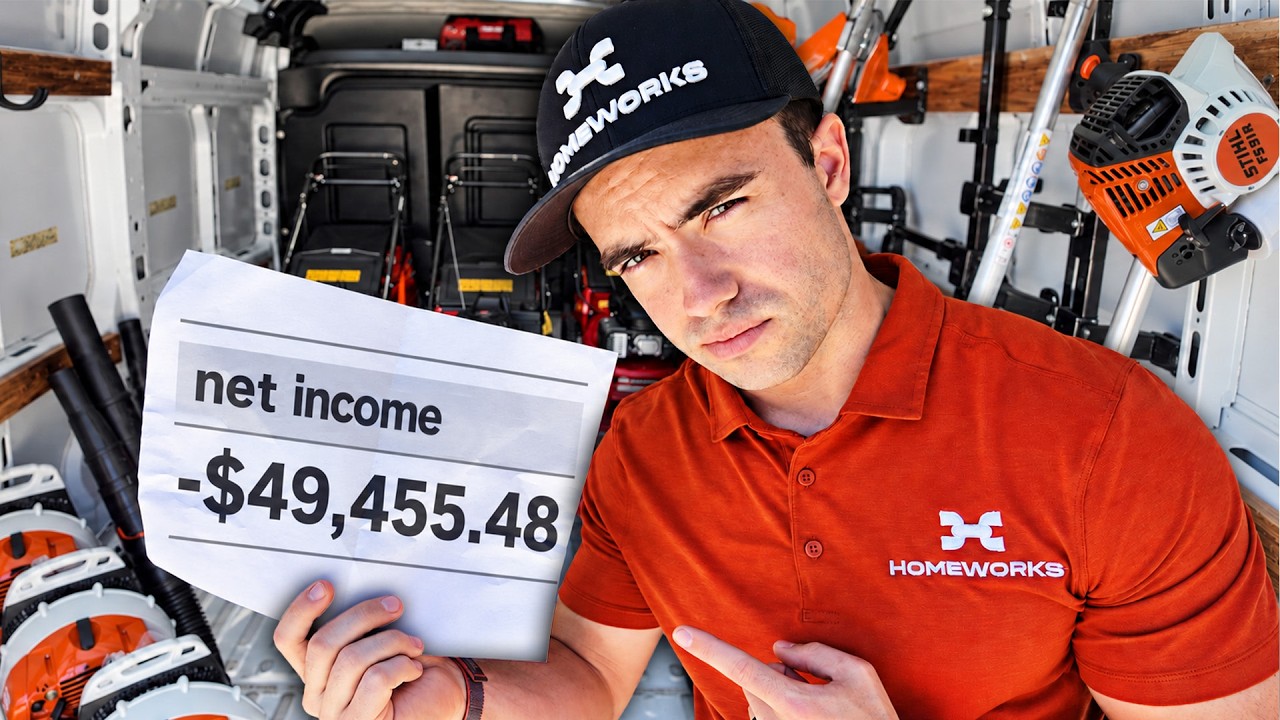
All right, novice mistake. So wrapped up in talking on the video, we forgot to make sure things were secure in the back. Okay, so something's rolling around, but I got that ratchet strap up top. Grab it up there. That should do the trick. All right, we're back in business. Schedule task. All right, we are back at the head office, and I am now eating 5 meals a day because of food prep. So let me show you this incredible goodness. That I need to consume because I'm way behind. I keep having this problem when I just forget to eat in the morning. I'm just not used to eating 5 meals a day, but, uh, I'm usually more of a snack guy. But this is day 2 of meal prepping and my meal plan. So we got almond butter situation, we have chicken, grilled chicken, zucchini, And rice. That's what you call scrumptious. Stupid. If you're really hungry, it's scrumptious. So I just make sure I'm really hungry and then it's not so bad. But as promised, I want to show everyone the profit and loss statement. So it is the first week of October and Command Center The they do all of the bookkeeping and the payroll and run pay for performance and kind of all the backend admin tasks. So they send us this at the beginning of each month for the previous month's PNL. So I've shared my budget before for the startup costs, and all in it was around $297,000 when I put together the vans, all the equipment, the initial startup wages, etc. Well, this is the first month. In operation, even though we were only in operation here locally for about a week. And this includes a lot of the other ancillary costs. So I'll put this up on the screen for you guys too, but you can see there's wages that has mostly to do with the general manager, John, obviously taxes, some fuel is in there. And then there's a lot of little stuff, for example, like equipment repair and maintenance, several things that we got for equipment maintenance, all the little, uh, the first aid kits, the charging stations, the, the tools. Getting all this stuff set up for inside of the vans. That's where all these little fees come in. Hiring and onboarding costs. That was what we spent on Indeed. That is what we spent on several aspects of the training facility that we got for tech training day, the little office space here, and what our wages were for those technicians on that day. We got uniforms in here. So there's a bunch of stuff. And we lost a whopping $49,000. And we collected exactly zero in revenue. So in October, we'll start making revenue for the first time. But for September is our first month in operation. We lost another $49,000. Now, if you remember back to when I started talking about the budget, I said, hey, look, we're spending $297,000 with all the equipment, the vans, the wraps, all the initial setup, all the software. This also— this part here includes insurance for the full first year. So we paid $16,000. That includes all 4 vans for the year, and it also includes all of our liability insurance, general liability. And we also have an umbrella policy. So it's a little more on the pricey side, but we have really, really good coverage to make sure that if anything goes bad, we are covered. And so yeah, we lost $49,000. Now when I did the budget up front, I said, hey, we spent $297,000. I think probably $250,000 of that could have been financed. That's the vans and all the equipment. But I didn't. We just used cash. And I also said I expect to burn another $100,000 to $200,000 before I'm profitable. And you're going to see that over the next several months as I share the profit and loss statements, we're going to lose money. Now, we'll start making income and revenue this month, but we'll be marketing, we'll be growing, we'll be expanding. And so I anticipate it to take till next— early next year in spring before we actually turn a profit. And that's why, even though my initial budget was $297,000, I anticipate us to lose probably between $20,000 and $50,000 per month over the offseason. But once we hit spring rush, fill up all the vans to capacity, are able to raise prices, that's when we'll start seeing profits. And so the reason I share everything here is because I want you to know what it takes to grow as fast as we're talking about. Is like $1 million in a year is no small potatoes. There's a lot of capital. Now, if I wanted to reduce my initial I could just finance the trucks or finance the vans, finance the equipment, and maybe got away with $50,000 to $100,000 of cash outlay upfront. But even once you do that, if you're ramping up quickly and you now have all the equipment, you have all the insurance, you have all this overhead, you have this office space, you have the storage locker, you have a general manager, you hire employees that aren't super efficient yet because you don't have a really dense route, it's going to cost money. And so if you're doing this the most profitable way, you don't go as fast as we have. We don't get 4 vans when we have no customers yet. You know, you get all this equipment, you don't hire people. If you're going very quickly, you want to make sure that when demand spikes, which is during the spring rush, we have plenty of supply, labor, equipment, everything's ready to go. And so again, I fully anticipate the next 3 to 5 months, people will be kind of ridiculing the project. But when the— it gets hot and heavy, and there's leads pouring in, and everyone else turns off their ads, and they don't have enough employees, and they don't have enough equipment, and they haven't prepared, I'll be able to keep doubling down on my marketing, and that's when we'll scale. But I will try to show this to you each month. We get this sent from Command Center. I don't reconcile this. I don't categorize these, so I can't like fudge these numbers. These are numbers all going into Command Center. They are then putting it all together, and I'll try to share more numbers as the the year-long project goes on. Now I will eat my rice in peace.
'Cause I was having to go through it just manually, you know, basically based on time. I'd go in there and take all the cancellations, 'cause the problem with cancellations is sometimes—
Okay, awesome, thank you, Tori. Yeah, I created a Trello board that kinda keeps track of the projects for web-related things, so I appreciate your work on it. In relation to the pages, if it would be easier for me to just do the copywriting for all the service pages, because dynamic, I can do that now, If it's gonna prevent any sort of double work for the team. So one of the big projects we've been working on, that was Tory from the web team at Augusta. He also heads up the whole division for home service web design. And right now it's like we are cranking out sites. Like every single day we're doing 5 to 6 new websites. It's insane. But the website for Augusta Lawn Care, I am personally doing the copywriting. Which is we have always optimized for conversion rate, we have always optimized for speed of the site and like getting people to submit a form, but we've never really thought very deeply about the words being said and how we were selling to customers. And so I've been really in the weeds on that. We did the homepage and it's yielded really good results, and I focused on the first 3 major service pages that constitute like 80+% of traffic, like lawn care, mowing, and property cleanups. But all the other service pages we are wanting to do, and there's like 15 or 20 of them, they're just smaller. So we're just trying to figure out when I need to do all the copywriting and actually like think through what are the words that need to be said that will drive people to convert more and take the person that's on the fence and kick them over the edge. Like we've serviced over 100,000 customers. We were able to say that. And so like that's a really powerful hook. That's why like McDonald's use like billions served. Is it just like it shows that validity? And so the main thing that we're doing with the copywriting is trying to show like, hey, not everyone wants a national brand, but here are the pros of having a national brand versus a local provider. And the confidence, the trust that the brand isn't going anywhere and that there's someone behind the business owner. We're trying to like, what makes you different? And then just like punch that through on the website. And for us, like it's the thing that makes us different is we are a national brand. And we don't shy away from that because most people can't say that. And so for anyone watching, like, take whatever makes you different and just keep pounding that, even if it's only 10, 20, 30% of the market that wants it. If you're the only person that can say it, keep saying it. Don't say what the generic everyone says and like, oh, that's what I should say because everyone else says that. No, that's what's called a red ocean. It's bloody. Everyone's there. Go to a blue ocean where no one else is there. No one else can say what you say. And if that means you're 15 years old and you're starting your lawn care business or you're starting a service business, Say you're 15 and you're saving up for college, 'cause that's your unique selling proposition, your USP. Let's say if you look at all the houses in this market, say 30% of them are premium, right? Let's say though that 60% of them, they kinda like working with their local gardener guy. The guy they know, Billy. Billy knows all their plants. They come and talk to them. They come, you know, they bill by the hour. They do a little invoice underneath their mat at the end of the month. where they charge them on Venmo or something like that. Most people kind of like that. And that's okay. But there's also a segment of the audience that they're like, hey, this is my third house. I want to have a professional company with really good employees and quality equipment to look good in front of all my neighbors and the country club. And I want you coming up every single time at the same exact time. I'm okay with paying a little bit higher price. But when I call you, I want you picking up the phone. I want to have automations. I want to have a card on file. I never want to hear from you again. And if you have an upsell and something needs to be done on the property, I want to know about it. Send me a picture, send me a video, we'll approve it. And so I think just choosing what is the ideal customer profile, getting very clear what is the profile of customer trying to sell to, and realizing that if I'm actually going to go after them, I'm going to say no, or I'm going to potentially be marketing in a way that pushes away some other segment of the population. And if that segment of the population everyone else can serve, I'd rather go after a narrow piece of the market that no one else can serve. Than a broad piece of the market that I have tons of competition. All right. With the move to Texas, we're kind of trying to find our new daily rhythm. So currently it's kind of like I usually spend the first half of the day doing media-related stuff or helping with the local business. But realistically, a lot of it's just for the media.
And then I will work out and kind of have a midday session in the gym. And then afternoon is like software or franchise-related things, masterminds, school community, et cetera. But one thing I completely fell behind on is getting flowers for Brianna. I typically do this pretty much every week, and I have completely forgot the past 2 weeks and just been hectic. So we're trying to find our new rhythm.
I've got to catch back up and be a good husband. And so I got some flowers from the store. I love flowers. We're headed back home. If there is one thing I would change about how we've kind of done the last couple weeks, it'd be the fact that the installer and the equipment dealer are so far away. The thing is, we couldn't really change where the ramp installer was because the manufacturer has preferred installers, and there's a few hundred of them, but the closest one's like an hour away from us, and we just got back from there this morning, and now they're like, oh yeah, it's done now. Both of them, not just one, but both vans are done. I think they felt bad that we came down there this morning, so they just did both of them. So I'm going to take this van back to the, the Regis office so that tomorrow Jon can work on getting this one completely outfitted in the back and ready to go. And then tomorrow we'll take the third van and fourth van from the ramp and installer over to Wrapworks. But the good news is, within a matter of a few days, all 4 vans will be completely finished with all the equipment ready to go, and we'll be able to enter week 3 ready to take work on and actually sell jobs.