Is Psychedelic Therapy the Future of Trauma Healing?
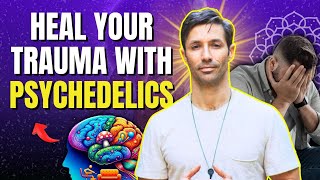
A couple shares how psychedelic-assisted therapy with MDMA, psilocybin, and ketamine helped resolve severe complex PTSD that traditional treatments couldn't touch. After multiple sessions, the wife saw 95% improvement in depression and panic attacks, using the drugs' 2-14 day window of increased neuroplasticity to do deep nervous system work.
Chapters
Well, when we got pregnant in October 2020, in the middle of the pandemic, guess what? All this buried stuff, trauma, complex PTSD, panic attacks, just floods back and she becomes suicidal for 2 and a half years. Like, I'd be on a coaching call, she'd hand me our crying baby and bolt out the house for like hours. And I'd have like 10 coaching clients on the call. I'm coaching with an infant in my lap.
What is trauma? Trauma is your nervous system getting overwhelmed and then it gets stuck. It like gets stuck in your body and it just can't move through until you can safely face it. Well, the, the substances, MDMA, primarily speaking of MDMA, psilocybin, those are the two I've had the most experience with. They essentially double— and ketamine's legally available in most states within ketamine clinics— but basically they double your neuroplasticity. So then your protector part can relax. And so if a guide like myself or someone else— so I don't supply the medicine, so that protects me legally, okay, because there's no laws saying you can't sit with someone while they're going through a journey. So that's, that's my legal protection, thankfully. Your protector part relaxes, which allows me, if I understand what's happening, to go back in safely, heal that traumatic moment, or integrate it in terms of internal family systems or parts therapy from NLP.
If I integrate that, then that stuck energy is now moved through me, and on the other side So I'm a master NLP practitioner and I've done a lot of deep mindset work and help rewire a lot of people on around their mindset. But one of the things that happens for someone that's truly severely trauma affected is those memories are almost stored in your body. That's why they call it PTSD, post-traumatic stress disorder, where this thing happens and activates in a sensory way a non-conscious response. For example, our daughter would cry, which is normal for a baby, would cry. And if she cried longer than 15 or 30 seconds, it would start triggering my wife's nervous system back to her traumatic childhood. And so, for 2.5 years, and basically both in pregnancy, pregnancy was automatic for her. She had a really rough pregnancy, but also all these traumas and fears of her sense of overwhelm. She was the oldest of 11 kids, very abusive upbringing, and there's all this pain that, you know, we thought she had cleared, but honestly it came roaring back. And, and so like I had realized, oh, this is not as simple as just a positive mindset. This is like a deep nervous system reset that is needed. And yeah, we could have, could have SSRIs, but if you look at the research, they don't really— they help people temporarily and they help people cope, but they don't help people heal. And we were very interested in healing and trying a lot of different approaches from neurofeedback, NAD IV, which is— was very, very helpful for healing, somatic psychotherapy. But the biggest kicker was psychedelic-assisted therapy because her, her neuro wiring needed a massive reset and we needed to flood her brain with neuroplasticity. And according to psychedelic research, When you're on a lot of these substances, the psychedelics, done safely and wisely in a safe container, but it floods— it basically doubles your neuroplasticity from anywhere from 2 to 14 days, which allows us to re-pattern and reprogram basically a lot of these subconscious triggers. Duke University is doing studies on survivors of the Holocaust and the previous two gen— or the next two generations of the Holocaust show on their biometric data points that they suffered a severe trauma, even though the children and the grandchildren of survivors of the Holocaust were not alive during that. So there's unconscious signals. So it wasn't, quote, their brain saying— it was their nervous system. It's almost like their body entered into the world with with a coding and a program of like, this is what's going to happen, right? This is how you're going to respond, and this is— you're going to be more susceptible to this disease, or you're going to be more afraid of this, or whatever. As I've done the work with my wife, fortunately she is so much— she's essentially completely cured of depression, uh, 95% cured of her complex PTSD. Panic attacks are gone. We know how to manage all that stuff now and avoid it. And if it— if it— one of them gets activated, boom, we know how to What would take us days we can do in 20 minutes to recalibrate. Right. And even we had an incident last night with her, her abuser, which is in fact her mom. She has a narcissistic abusive mom, showed up at our door at our house at 10:30 PM last night, rang the doorbell. He's not invited. We aren't supposed to see her.
She's—
anyway, so we had an incident where we had to recalibrate my wife's nervous system and all that jazz. And I was, you know, calm and collected overall through the whole thing. But I think what I didn't understand for years, but what I'm now studying like crazy, like just reading books nonstop, listening to podcasts, is if we can rewire our nervous system to like that next level of performance, that next level of love, that next level of heart connection, that next level of joy. Like I have access to levels of emotional joy that I couldn't have imagined touching 2 years ago. And it's because that heart and body and mind connection is there, and I couldn't get it. This book, Healing Trauma, by Dr. Peter Levine, one of the top guys in the world, tells a story of polar bears in the 1980s. All right, this was a huge breakthrough in our understanding of trauma. And why we're so different as humans versus much of the rest of the animal kingdom. Well, in the early 1980s, they're researching like polar bears. Polar bears, they would chase them down with a helicopter, shoot them with a tranquilizer gun, carry them back to the base, measure their vitals, put a little orange tag in their ear, you know, just make sure it's population count, make sure things are good and all that. They'd release them back out in the wild. Well, for decades, researchers were befuddled or deeply confused. Why on earth do these polar bears, as the tranquilizer is wearing off, why do they make frantic movement? And they couldn't figure it out. Like, basically their legs were moving a lot. Well, then one day a researcher in the 1980s played the video in slow motion, and they realized what the polar bear was doing was it was running off the energy. Because last time it was conscious is being chased by this hunky, like this giant metal machine flying through the air that's, you know, polar bears used to be in the top of the kingdom, right? Well, now it wasn't. And so it had actual trauma that it was energetically releasing and its body is programmed to release it.
Wow.
What do we do as humans? We go through something really crappy as a kid. Our parents don't know how to help us self-regulate.
We freeze.
We hold on to it sometimes for the rest of our lives. And then we carry that into our marriage. We carry that into our business. We pass that on to our children. It just affects every area of your life.
The next major season, a big shift for me was in— my wife's a 3-time suicide survivor. But when we got married, you know, that was kind of like good. And she was— she— we didn't have any issues. Like, she was in a good mental state. Well, when we got pregnant in October 2020, in the middle of the pandemic, guess what? All this buried stuff— trauma, complex PTSD, panic attacks— just floods back. And she becomes suicidal for 2 and a half years. And she would have massive panic attacks for, like, uh, you know, 3 or 4 times a week. Like, I'd be on a coaching call, you She hand me our crying baby and bolt out the house for like hours. And then I have like 10 coaching clients on the call. I'm coaching with an infant in my lap because she was just overwhelmed.
Life was—
and she couldn't handle it. And, and, um, I was like, what is going on? How does she shift from being happy and pleasant to overwhelmed, not wanting to be here on Earth, can't see hope, can't see— I was like, there's her— it was like her nervous system was stuck. And I didn't— in my peak performance psychology side, wasn't helping. Pattern interrupts and reframing and all that. I was like, there's something else going on that's much deeper. And that's when I had to— I would literally read trauma books in the middle of the night while my wife was sleeping, while my daughter was sleeping. I'd be on the Kindle, holding the Kindle right in bed, just flipping through, learning about trauma. I was like, oh, she has this massive— her body is just overwhelmed, and it's an unconscious reaction that she cannot control. I was like, oh, okay, so this is a lot deeper than what I had done. And so I had to learn, and I was in the line of fire, and I had to learn about trauma real fast if I was going to save my family, keep my wife alive. And because she did not want to be on earth, she did not want to be a mom, she did not want to be a wife for most of that time period. And she was just— because life was too scary and overwhelming, their nervous system was just boom. Crushing her. We were aware, and, and, but I hadn't really ever studied trauma. I didn't really understand it. I didn't understand that, uh, you know, how her autonomic nervous system was kicking in, how her fight or flight and her amygdala was shutting everything else off, and she was just stuck in the fight or flight mode. Um, which the amygdala is designed to keep you safe, right? And it's, it's the number one— it will overrule every other part of your brain if it thinks there's a threat, which Well, couple COVID, you couple having a baby, couple, you know, we had just gone through a season where I lost $1 million and she had stayed with me through that season. So like, I, you know, she had a lot of courage and a lot of guts to stay with me through my valley of despair. And, and so that's, you know, I was like, I'm not abandoning you. You didn't abandon me in my darkest hour. That I'd be a schmuck if I abandoned you. Right. And then also like I wanted our family to be together because I knew she'd be a great mom once we got to the other side. But her nervous system was just overriding everything. And, and I had to— and until you really— it's kind of like, you know, someone suffering from autoimmune disease or whatever. Until you've really experienced it or been right beside someone suffering a major crisis in their life, if you've never handled that crisis before or never really studied it, you've kind of I didn't even recognize the signs. Took me about a year and a half to really recognize, and her too, recognize she had very severe complex PTSD kicking in.
So what, what happens with MDMA is we, what we end up doing is the medicine like MDMA, what it does is it floods, floods your, your nervous system with serotonin. Serotonin is a neurotransmitter but that also makes your body feel safe. And so now your nervous system is flooded or blanketed with this feeling of safety and safety and love and empathy. And so in that, what happens is I can go in and you're literally, your subconscious will bring to the surface memories or moments in time that were very overwhelming, scary, felt like, ah, life is not worth living I can't handle this, or whatever. And in that moment, then we can go in and access those memories and literally change the meaning or the emotional attachment to that memory, which changes the meaning. So I can go in, the client with the thumper, the 3-year-old, you know, 3-year-old that has her bunny guy. Yeah, yeah, yeah, right? It sounds funny, but it's a real thing for 3-year-olds. Yeah. Absolutely. Yeah, your, your little love of this little tiny bunny dies, and it was with her father too. So guess what? Now she has something against her father starting at 3 years old. Well, anyway, um, we go in and we— she held that little 3-year-old version of her, like, you know, invited that 3-year-old into her lap, loves on her. Gives her warmth and safety, lets her process those feelings. So the feelings that she was feeling that got frozen, you know, at that point, like 35 years ago, then she's holding that version of her to let that inner child heal and that little 3-year-old self let go of those emotions and the emotional weight. And guess what? Then you could literally see in her body where her body goes Just a big relief. Yeah, and her body was in a state of tension before, right? And then we did 2 or 3 other memories after that, and, and so she literally relaxes and her nervous system recalibrates.
More from Michael




9 Powerful Tools to Regulate Your Nervous System (And Stop Living in Fight or Flight)



