Transform Your Mindset for 500% Efficiency With Nick Hiter
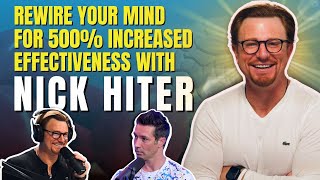
Peak-performance coach Mike Zeller explains how flow state can boost output by 500% through six neurochemicals, and describes using psilocybin-assisted therapy to help his wife reduce PTSD symptoms by roughly 80% after postpartum depression triggered by infant cues.
Chapters
I remember watching the NBA Finals and Kobe Bryant was playing the Celtics, or the Lakers were playing the Celtics, and Kobe Bryant was just exhausted. He missed like 15 out of 16 shots in the second half, right? So some of us, we focus way too much on how do I get more done when really the question should be, how do I get myself in a peak energy state?
Blessings, folks. Welcome back to another episode of The Hit Streak. I'm your man, Nick Heider. And folks, I got an extra special treat for you joining me in the Hit Lab today. Folks, buckle up, strap in, because just introducing this cat, it's going to take a minute, right? So check it out. Um, he has, uh, founded or partnered in over 20 ventures. His businesses have done over $300 million in sales. And that's an old number. It's probably grown a lot more since then. He's been featured in Fox, Forbes, Business Insider, Thrive Global, Huffington Post, MentorBox, among others. He's a mental health and psychedelic medicine advocate. He's a peak performance coach, and he's the author of Genius Within. Folks, my buddy, my pal, my dude, Mike Zeller. What's happening, Mike?
What's up, Nick? So excited to be here, man. And you know what? We got a lot to rock on today. I can't wait to dive in.
We do have a lot to, uh, rock on today. That's the first hit of the day right there, baby. You know what I'm saying?
Let's get some, some zingers today.
All right, man. So, um, the leaders, um, out there in 2024, um, we're going to get right into it. What, as far as peak performance goes, like, what opportunities do you see happening this year, man?
Yeah, the number one thing that I see leaders strike out on is they don't realize the importance of flow state. And so when you're in flow state, you're 500% more productive. You actually release all 6 of those positive neurochemical cocktails: oxytocin, serotonin, dopamine, norepinephrine, and a few others. And what happens is when you're in that state, which you can reverse engineer your workflow, your life, to be able to get there. But when you're in that state, it's when work becomes play and you're unconsciously tapped in. You know, from baseball, when you're in the zone.
Oh yeah.
You can't strike out. The pitcher's in the zone. He's unhittable, right? Well, as, as let's call ourselves business athletes, if we can get ourselves in the zone and remove the blockers to get in the zone or in flow state, man, we can be unstoppable.
You know, it's crazy you said that because as an athlete, you're exactly right. You know, when you, when you are the hottest at the plate, when you can't, when they can't get you out, when everything's going your way, It's not that necessarily your swing's any different. It's literally just a feeling that you have in the box and how comfortable you are.
Yeah. And you're tapped in. It's almost like, you know, Napoleon Hill wrote about in like this mastermind concept when you're almost in this mastermind of unconscious connection, or Carl Jung talked about the unconscious collective. Well, we can do that where you're in harmony. And HeartMath Institute also defines some of it as heart coherence. And, and, but on, on the flow research side, uh, Stephen Kotler writes a lot about it. But it's basically, if you can reverse engineer this, your joy levels in your work, your joy levels in life, your life satisfaction— in fact, the people that have the highest levels of life satisfaction also have the highest amount of flow in their life. And then you look at people who are most productive, most effective Right? Like, and we can go back to— I remember watching the NBA Finals and Kobe Bryant was playing the Celtics, or the Lakers were playing the Celtics, and Kobe Bryant was just exhausted and he missed like 15 out of 16 shots in the second half.
Right.
So some of us, we focus way too much on how do I get more done when really the question should be, how do I get myself in a peak energy state? Like, if you go to Tony Robbins event, He's all about peak energy. Tony's the master. Yeah. Well, on a practical level, if we are leading an organization or we're leading ourselves or leading our family, the difference between people at the highest levels of performance— an Elon Musk, a LeBron James, a Tom Brady— they know how to get in the zone. They know how to get in flow state.
That's right.
And they know how to get their team in the zone. Yeah.
So like, dude, you're all over— you're all over this, what we talk about here a lot, especially these days. And I've said this multiple times. It's something that used to frustrate me with the church. Not the church, the capital C, but the little c, all the people in the church. And it was something that going to Trevecca Nazarene University, it's something that I struggled with as a young man. You know, a lot of people go to church, or many people go to church on Sundays 'cause it's what they do on Sundays. But it's not the reason anymore that they went the first time. They went the first time to be saved, you know, for help, you know what I mean? To grow. And then it turns into just something you do on Sunday and it's lost all its, Meaning if you don't— like, for me, it's like I empty the tank Monday through Saturday, and Sunday's when I go back there to fill it up. Yeah, you know what I mean? So it has a purpose when you go. Dude, can you expand on more like that? This is like— you're all over— this is the difference between elite athletes, elite performers, and really everybody else. It's like Tim Corbin, when he was in here, I was like, dude, you're like the best guy ever, except I wouldn't want to see you on the other— in the other dugout on the other side of the field, because like that when that switch is on, it's— and the rules of engagements are there, he's going to do everything that he can to beat you.
Yeah.
Even though he's one of the best guys on planet Earth.
Yeah, right. Yeah. So, you know, almost if you like, think about how do I reverse engineer myself, engineer my life and myself for peak performance. One of the biggest little-known facts about flow state and peak performance is to achieve flow state or my peak performance where I'm just locked in, my— instead of bored Like when you're talking about that church example, hey, I'm bored, which means I'm disengaged. I can do it in my sleep. Mm-hmm.
Some people are doing it in their sleep.
Yeah, they are, right? Some people are doing their work in their sleep. Yeah, that's right. And, and so you got to have an appropriate level of challenge. So you have your comfort zone, right? And that's a— you look at the little circle, you're in the middle circle, comfort zone, you're a couch potato basically. The next level out is your discomfort zone, and that's typically 10% beyond your comfort zone. So in business, you know, you've got your different entities. As you keep them growing and keep stretching just 10% beyond your comfort zone, but if you go to 20% or more, you start entering the paralysis zone where you start melting down and you hit the overwhelm. Yeah, the goal is to be in that, uh, discomfort zone so you can keep stretching and think of it like big wave surfers. Big wave surfer, if they haven't surfed a 20-foot wave, they're not going to jump on a 50-foot wave or 100-foot wave. But if they've done the 50-foot wave, then they can do a 60-foot wave. Or if they've done a little heli skiing, they can do the next challenge in heli skiing.
Yeah, man.
So, um, and when you're in that in your business or in your relationship— why do a lot of marriages fail? They get bored.
They, yeah, they stop working on it.
Yeah, they keep— quit stretching. Yeah, they quit evolving. They quit being curious.
And my wife and I talk about that a lot and how like, like it's my, it's my duty to, to find ways to fall in love with her over and over and over again every year, multiple times a year. And that keeps things, um, awesome is what it does, you know what I mean? It makes everybody happy. And, um, you know, again, if you're not working on your relationship with your wife, you're working on something else.
Yeah, you're following— you're, you're either progressing or slipping backwards.
There's so many ways to talk about what we're talking about here. But like, so I'm gonna— this may be off path, I don't think so, but like, you know, because mental health is something that's been— those words have been thrown around a ton over the last few years. And, you know, but I think what like the news talks about and what most people talk about is not mental health, it's like mental disease. They're talking about the things that hurt them or make them worse and not better. And You know, that we're always looking for medicinal ways to cure things and not always, you know, natural, natural ways to cure things, whether it be through— I mean, gosh, we've found out a lot of great things when it comes to CBD and psychedelics and hemp and everything else. But like, you know, the same people that are— some of the people that take the most medicine for their mental health are the same ones that like don't pay attention to what they're watching all day long every day. Like, guys, it's called paid programming, right? So that you're literally— like, if you watch the news all day long and it's nothing but scary stuff, you're being programmed to be scared all day long. Yeah, you know what I mean? You got to have some balance in there. Um, talk to me a little bit about, about that. I know you're— this is where your sweet spot, dude, is mental health and, and all the things that we've learned about psychedelic medicine.
Yeah, so, so my wife, uh, you know, she's a suicide survivor. And when, uh, the pandemic hit, we got pregnant, uh, actually 6 months into the pandemic, so October 2020. And it basically started a cascade of her hormones being all out of whack, which I didn't understand. Like, men, if you have a pregnant wife, get her hormones checked, get your own hormones checked before and after pregnancy and all that jazz.
Absolutely.
And because it just— you can just get out of whack. And then secondly, you start creating some PTSD effects. She grew up in crazy abusive narcissistic fundamentalistic upbringing and she suffered a lot of abuse and she was one of 11 kids. So she was like the buffer between her, her parents who were always abusing each other and then abusing her. And so she was the buffer as a toddler. She can remember as an 18-month-old seeing her stepdad choke her mom. Wow. On the floor. That was her first memory, right? And so all this trauma started at that being activated, and especially once we had our daughter. And our daughter would cry and would send her into a nervous system response of shutdown and overwhelm and depression. And I didn't understand at the time. I'm a little stubborn, I guess, slow learner on some things, but I didn't realize she had severe complex PTSD. I wasn't that— I mean, I'm super versed in psychology, but I was not that versed in trauma at all when we had our baby and I started realizing, oh, this is not just a positive mindset. This is not just like, you know, do some meditation, eat right, get some exercise. She was stuck. She was legitimately—
Yeah, it's a real thing to some people.
Yeah.
I don't believe it's a real thing to as many people as they think that it is, you know, but I truly believe it's definitely a thing for some people. And I know my own, my own mother, you know, she's— she had hysterectomy. And so I mean, massive changes to her whole entire body and her hormonal system and everything else. And I know that, you know, keeping the medication balanced and right has been something she changes as she gets older. And it's, it's an ongoing thing and it's real.
Absolutely. Yeah. And so, and obviously my wife had a very severe case, um, of deep depression. Like, basically, as an example, um, my daughter would cry for 30 seconds and would spiral my wife into sometimes a 2, 4, or multiple day depression spiral. And it was just her nervous system would shut down and she's like, I don't want to be a mom, I can't handle this. Because she was just in so much pain. Yeah. And so I'd be reading trauma books. I started reading Peter Levine's Healing Trauma book at night with like our daughter was a newborn and I'd be reading that book on Kindle while my wife was sleeping in bed. I was like, oh, this is— she's got some severe trauma. Yeah. And that's what's showing up. And then I started understanding PTSD and, and she has two— she had two forms of incurable mental health battles. Depression, deep depression, and complex PTSD, which is the most incurable form of PTSD, worse than going to war as a soldier. And, and, and so we didn't want to go the conventional, uh, route because we knew if you look at all the research, it doesn't work.
How do they grade the level of PTSD? Like, how do they— on a scale like 1 to 10, like, how do they do that?
I'm not fully sure how they grade it. But her— we found her a trauma therapist and like she was off the charts on everything. Yeah. And so, and fortunately I found a phenomenal trauma therapist, but like the therapy would help her become more aware and help her process it in the moment, but it wouldn't stop the triggers. Okay. Her nervous system, like, you know, if you're a soldier and you hear a loud— like I had a buddy that was in Afghanistan And if he heard loud sounds, he would like almost want to duck.
Yeah. Yeah.
Because he had a rocket blow up on his leg.
Yeah.
And so, like, he was very sensitive to that. Well, so when we started working on it, we had to say, all right, we got it. Her nervous system is literally hardwired since she was a toddler to respond this way. So it's like, it's not like she's got— think of your, your nervous system. She's got like, oh, a one-lane road. No, she— her nervous system had like a 5-lane Atlanta highway, right, of like, respond this way if this happens. And so we— the little hammers weren't working. The little, you know, improvements weren't nearly enough because we were just for 2 and a half years. And so— but then in 2021, I started researching psychedelics. And because of the capacity, what I found is on the— from neuroscientist side, and now I have some psychedelic neuroscientist friends, basically your neuroplasticity doubles when you're on those substances. So think ketamine, MDMA, LSD, psilocybin, ibogaine, even ayahuasca. They're all forms of psychedelics. And like ketamine, your neuroplasticity doubles for about 2 days.
Okay.
Psilocybin, MDMA, it's about 2 weeks. And what happens is they call that a critical period reopening. It's like your brain is back to the way you were when you were 3 years old. And it can be reprogrammed.
Got it.
It's like you got fresh powder on a ski slope. Now I can make new neural highways so your nervous system can bypass this downslope that it was going down for, you know, 30 years. Now it can go down this other path that a healthier, more adjusted person responding to a crying baby, right, could handle. Right. Like, you know, you think of normal response for a crying baby. Is your— you want to rush and help, which my wife had that, but then she had the overwhelm, right? And her nervous system just shutting down. So now she has that capacity. And as an example, we did a psychedelic therapy session with psilocybin the night before. Our daughter cried for like 30 seconds. Wife is down on the basement steps crying for 2 hours, another 2 hours in the bathtub, just depressed funk. Next day, depressed funk. She has the therapy session the next day, it lasts 5 hours. Thursday, our wife has an 18-minute temper tantrum meltdown of an 18-month-old, you know, what they normally do. My wife laughs. She never laughed, never had the capacity to recognize, oh, she's being a toddler, she's been ridiculous.
Yeah.
Her nervous system had a radical departure and it was like, and I literally felt like That, that moment I was like, oh, it worked. And she would say that day, or the day before when she did the session, she cured her depression. And we would, you know, that's been almost a year now, actually by the time this show comes out it's a year. And then we probably nipped about 80% of the PTSD in the bud. We've got a little bit more, but we'll actually, by the time this show's out, we will have done one or two more sessions and we'll be great.
Well, dude, uh, like, honestly, I just want to say thanks for sharing that. That's very personal stuff, and that's really cool that that you can talk about it. So I appreciate that, I really do.
More from Michael




9 Powerful Tools to Regulate Your Nervous System (And Stop Living in Fight or Flight)



