Ed Sheeran Stood In The Middle of Macklemore and Kraft And Became The Headline
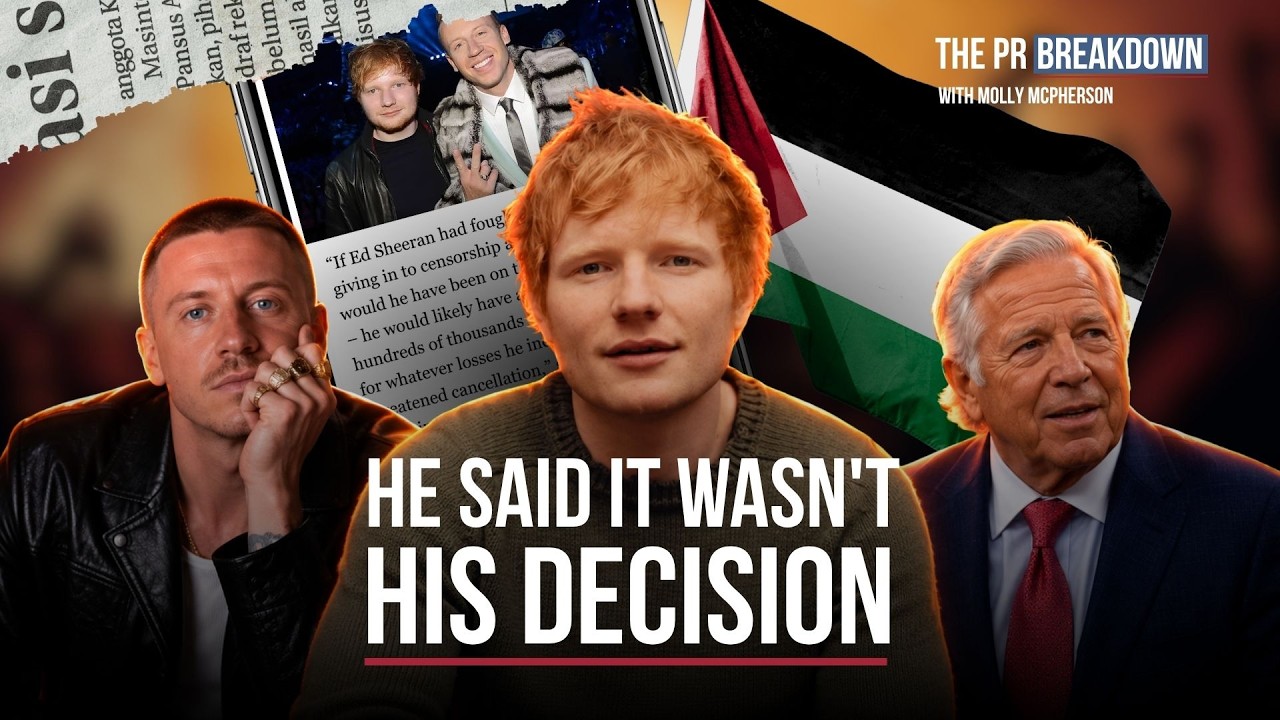
Crisis-communication specialist Molly McPherson breaks down Macklemore's "Free Palestine" protest at Ed Sheeran's Loop Tour, his removal from the lineup, and the three parties' statements. Ed Sheeran got 41% of media coverage. McPherson argues that genuine apologies require personal truth, not lawyer-speak.
Chapters
Macklemore, Ed Sheeran, and Robert Kraft. This is a story that 3 television news networks, including a morning news program, and 2 local Boston affiliates asked me to talk about this week. And I said no to all of them for a few reasons. One, timing, honestly. But 2, this is a hard story. It is a difficult topic to talk about. And it is not something that can be condensed into a soundbite. It deserves a lot more. So what I did instead was go to my Substack community. Every week, typically Wednesdays, 12:00 PM Eastern time, we tackle a topic. And this is one I did not want to shy away from because there is a real communication lesson in it. So in this episode, you're going to hear me say people's names and read some of their comments back. And honestly, I didn't edit it out because these are real members working through a hard story in real time. And honestly, it's some of the things that they say are the best parts of the entire podcast. So if you wanna be in the room next time, definitely join me in the community over on Substack. But this week, this is what we talked about. Here's where I started. Hello, everyone. Welcome to today's live chat. We have a lot to chat about, and it's a, it's a topic I think that is worth chatting about here as well. Let's start here with the Lane. This is a new story that popped up over the last 48 hours or so. And I get a lot of stories that run by me, a lot of stories requested to me. But when I get phone calls or emails or texts from the press, it points me to a story. And I think, okay, this, this is basically, you know, where the, the energy is going into the story, which means the algorithm is going to the story as well. So certainly it's, it's one that I'm going to jump into. But I did see it percolate before that. I wanna welcome all of you into the chat. And feel free to give your take on this as well, because this conversation is focused on the area of expertise that I am in, which is crisis communication and crisis management. So before we start with that, let me say this: people are dead, children are dead. And I am not going to pretend the thing underneath the story with Macklemore, Ed Sheeran, Bob Kraft, is small, and I am not going to litigate it because it isn't my expertise in the least. And you honestly would not be, uh, you'd be right to not to take my opinion on it or my word on it. But what I do know is crisis communication. That's my work. That's what I get called for. And I get called for issues like this, like this story that happens. There is a corporate version of this story. And I get called for it, and that's where I want to focus is on that piece of it. Who spoke in what order and what it cost them? And if you came for a verdict on Gaza, I am not your person, and I'd be suspicious of anyone who has a crisis podcast that doubles as foreign policy. So certainly, that is not what we want to accomplish today. We want to talk about this story because it certainly is one. Now, as I mentioned. Yesterday I received emails, texts, calls from all the networks, local affiliates, to appear on morning television, network news about this. And also a livestream. A former journalist who has a livestream today wanted me to hop on and talk about it. And I don't know, you see me on the press, you see me on press stories a lot, news stories a lot. I'm always willing to jump in. I'm a little bit of a fixer that way. I always feel for producers and Reporters who are on deadlines, so I always wanna help, but this is the one that I don't, I didn't wanna jump in on. And the reason why, it's not because it isn't a good story. It's not because it's not worthy of a conversation. And it's not because I wanted to shy away from the topic, because again, I don't. This is a crisis communication topic. And for a number of years, I've been getting calls, you know, about this topic. But I made an assumption. I don't know as a fact, but it's an assumption here. Mm-hmm. that they all wanted me to speak about it from the same frame, which is where crisis PR falls. And if I put on a news hat, a journalist hat, or a producer hat, well, what am I gonna ask Molly McPherson about this? They wanna know, and this actually came up, I mean, this term came up in more than one request, is this cancel culture? Is it about cancel culture? Is Ed Sheeran A coward, or is it right to be— to stand in the middle? Is Macklemore a hero, or is he a traitor to people? Is he the troublemaker? I think this is a topic that deserves more than a soundbite, and especially a soundbite when it's in someone else's narrative. So news is meant to be unbiased, and I always take reporters and producers at their word for that. And for the most part, it always falls into that for me. Like, there's a trust, there's a mutual trust there, and rarely, rarely Does anyone do me dirty, you know, when it comes to soundbites? But this is a story that has sides. It's a story that has very hard sides. And I did not wanna say anything that would be taken outta context because soundbites, intention or not, has a way of doing that, of being outta context. I wanna look at this from a crisis communication perspective and what we can glean from this. Because there are a lot of corporate entities out there, a lot of people out there, a lot of artists out there. They're looking at Macklemore, looking at Ed Sheeran, seeing a statement that Bob Kraft, Robert Kraft put out from Gillette. And what's the answer? Like, how do you navigate this? And the reason why people get concerned about it naturally, which is really the lane that I work in, is backlash. People don't wanna see the backlash. They don't wanna deal with backlash. I work in backlash. I live in backlash. And today I posted on Instagram, Me talking to Greg about this issue, we've been talking about it for a couple days now, and I've definitely had people chime in on the outside too. I've had friends from both sides, free Palestine side. Also, a number of my Jewish friends have chimed in, and I want to hear it because I respect both sides. I respect because the reason why it's based on the core of what I do and my work and my ethic. Which is truth. Everything comes to the truth, comes down to the truth. You cannot go wrong if you are speaking your truth. But this is an issue where people have their truth, but from a national sentiment perspective, there's different truths out there. And me personally, I respect both of them. I know there's a lot of content creators out there, a lot of people who are on news shows, but their news shows takes Sides. And as Lauren is pointing out here, as a human rights lawyer, this is a complicated issue. It absolutely is. And the complication there, when I see complication, I'm looking for respect. And I'm looking for respect for all sides and for all people's strong opinions there. So now I want to share with you is the learning and where we can find it. Nola said it right here. I think the one thing to do is to commit to learning more and educating yourself about both sides. It is complicated. Yeah, I mean, that is the word. Educating on both sides is so important on this. So let's look at it from the public narrative perspective, because that's, that's, you know, my approach and that's my work. That's what people hire me to do, is to navigate the complexity of it. I never look at backlash as fear-based. I know that it is, and I'm not gonna lie to you, I'm in it too. I put myself in there and I think, ooh, you know, when I hit send, I don't want backlash. And I got backlash today. Even when I talk about this right now, I promise you, there will be in this chat or there'll be on social media, people telling me they're disappointed in me because I'm not taking a side. They're disappointed in me because I just haven't spoken about it. It is a can't win, but because I can't win doesn't mean I don't wanna talk about it. And I don't wanna educate and I don't wanna help people. And I don't wanna learn. And 'cause I wanna learn as well. When I dive into this topic, which I've been doing all morning, I'm also learning myself. I'm always educating myself. That's my whole basis of educating you is I have to educate myself too and revisit things a lot, you know, 'cause things change a lot. Now, one of the lenses that I look at, and this is what I would encourage you, so if I'm gonna impart any advice from a crisis management perspective, how I look at stories. Now I'm looking at this from, from a news angle. Okay, from a news angle story, I am always looking for, and you probably hear me talk about this term a lot, the red herring test. In algorithm-based news stories where algorithm-driven news stories, the news is following the algorithm, what everyone is talking about, so they want to jump in and talk about it as well. I will get TV requests, but I'll also get network news blog requests, and those blog requests will hit Usually behind a paywall when it's when it's an algorithm heavy topic, but algorithm heavy is another way of saying opinion heavy and opening the door for backlash. Certainly, so I'm looking for the red herring test, and this is what it means: If the frame produces the exact same argument with different names, then it's not the story. And this is what I mean by it: Replace Ed Sheeran. With, he was an opening act for when I saw Ed Sheeran, he opened for Taylor Swift. I saw Taylor Swift and Ed Sheeran at Gillette a number of years ago. Let's replace Ed Sheeran with Taylor Swift. Let's replace Gillette, I don't know, with the Target Center. And let's replace, you know, different business owners, you know, someone who owns a stadium there. And then you're gonna replace Macklemore, you know, with another artist. But if you could have all different names, and the narrative would be the same. An artist gets on stage and says, free Palestine, for someone else, and they're opening for this artist. The story's going to be the same. It doesn't matter who the artist is. It doesn't matter. It's still about the topic. So to make it about Palestine and make the narrative free Palestine, antisemitism, Jewish, Israel, Palestine, Gaza, Hamas, That's not the story, but that's what people are going to report on. I am looking at the choices that people made and why they made it. And this is an interesting story because we have so many different statements. And let's look at the statement because the statement tells you the intent all the time. And that's what I want to focus on are the statements. If you focus on the statement, then you're going to get some understanding Of the truth and the sides of the truth. So what actually happened? So let's do this in order right now. So September 4th and 5th, Macklemore opens for Ed Sheeran at MetLife and says free Palestine from the stage. September 14th, Messina Touring Group— they're the promoter— says venues will not allow the concerts to go forward with him in the lineup. So that's the first statement. And it's a corporate statement. Other than what they're saying here, we don't know anything behind it, who pushed it, who didn't, if it's straight from Messina or not. But this statement is coming from them now. Same day, September 14th, Macklemore posts. So let's, let's start here with his post. And again, we are looking at the statement and what's being said. So, and how it's being said and some of the words here. I'm not sure how to start this, so I'm going to speak from the heart and share the truth. Ed Sheeran and his team have made the decision to remove me from the Loop Tour. Okay, right there. So let's just start on that first statement. One, I'm not sure how to start. This is a first-person statement. Macklemore is starting there from the beginning. And real name, Ben Haggerty, stage name Macklemore. He's speaking in first person. It's not from a lawyer. It's not a statement. It's coming from him. Ed Sheeran and his team have made the decision. So he's stating a claim that it was from Ed Sheeran. So now this immediately puts Ed Sheeran in a spot. But before I get into it, I wanna say something that should be obvious. In this moment, I think it matters. I am not a victim. Ed Sheeran is not a victim. Pink is not a victim because Pink is in the conversation as well. We have careers, money, opportunities, safety, and audiences around the world. Whatever consequences any of us face for what we say, We get to go home to our families. So that statement right there, when it's coming from McLemore, it's first person, it's names and specifics. Okay, so now that's McLemore. Now let's go to the other statement, which is Robert Kraft. And Robert Kraft, I am pulling his statements. I saw it on GBH that's in Boston. And, and I had mentioned yesterday that one of the one of the callouts for media was a Boston station, and I was in Boston, and I felt bad because, you know, I was there with my daughter who's a broadcast journalism major, and I thought, this is a learning opportunity here, but parenting prevailed on that one. So let me show you this. So here we have Bob Kraft explains decision to urge ouster of Macklemore from Ed Sheeran tour. I'm gonna go down here, right here. Gillette Stadium has a longstanding commitment to providing a welcoming environment for all guests and ensuring that events held at our venue Do not provide a platform for hate speech. Bob Kraft is making a statement right there about how he viewed what McLemore said from the stage. So when McLemore is saying that Kraft rallied other stadium owners into an ultimatum, but he's saying Ed told him that Kraft had rallied them. So that's McLemore telling you what Sheeran told him about a private phone call. But here's what holds up in that because. He's saying it's Sheeran, but Kraft is saying here— well, before we get to that, I agree with Macklemore. Too many lives have been lost and there has been too much suffering. Okay, that's a comma. But if we do a period right there, how many people on both sides disagree with that statement? Okay, so now that's a type of statement where he's bringing in a Bob Kraft version of empathy and understanding into the statement. Comma. But Only sharing selective information, ignoring the actions of Hamas, is not honest and only advances more divisiveness and hate. Okay, so then he goes into his take on it. And I would welcome the opportunity to sit down with McLemore and discuss the facts, because ultimately our goal is the same: peace for all people, an end to suffering, and an end to all hate. That's a line that I think is one of these unifying lines about there, because I think a lot of people would agree with that. But in his statement too, he is said here— okay, this piece of it— based on Macklemore's recent actions, materials shared from the stage during Ed Sheeran shows in New Jersey. And we know that because we've seen that, that was recent, on the 4th. And a broader history of antisemitic rhetoric and imagery that we believe has been deeply offensive and hurtful to the Jewish community. Now, that's an important piece of it because That's where I've received a lot of commentary, I would say, you know, from people taking positions on both sides. Now, he named a standard there when he was referring to a past concert by Macklemore where he appeared on stage. So we're not getting specific here, but we have to discuss what it was. So in May 2014, I'm not going to show the photo and the imagery of what he looked like. He performed 2 songs as a guest at the— as a surprise guest at Seattle's Experience Music Project. He was wearing a black wig, a prosthetic nose. It was oversized. If you look at the photos, you would not be surprised that it drew criticism, and many people stated that it resembled an antisemitic caricature. The fact that I don't want to share it, I think, says something to that also, if you were to see the photo. Now, this is what he said at the time. He said the costume was a random disguise so he could go get in unnoticed and denied intending to portray Jewish people. He said, quote, the character I dressed up as on Friday had no intended culture, identity, or background. A Jewish stereotype never crossed my mind. And then he said here, he acknowledged the impact. I acknowledge how the costume could, within a context of stereotyping, be ascribed to a Jewish character. Okay, there's wordsmithing there. And then he closed with this: I truly apologize to anybody that I may have offended. Now, it should be said, the Anti-Defamation League accepted his word, agreed that there was no hateful intent, and unreservedly at the time in 2014 accepted that apology. But Robert Kraft is likely referring to that concert. I say likely too because of comments that I received from friends, Jewish friends, who cite that, that incident when it happened. So the dots are there and connected strongly for groups of people. Now, I'm going to come back to that statement there. But back to the Rob— the Robert Kraft statement, when he says this broader history of antisemitic rhetoric and imagery that we believe has been deeply offensive and hurtful to the Jewish community, We determined that his participation in these concerts at Gillette would cross the line. Now, with that, Robert Kraft drew a line in public. He drew a line and said he is not performing here. That line comes with a cost. It's a line that he drew. It comes with a cost. However, in his statement, because he did not cite specifically what he indicated was the broader history of antisemitic rhetoric. What it does is leave a door open that says Free Palestine was the problem, even though Robert Kraft is saying, even in his opening line here, Gillette Stadium has a longstanding commitment to providing a welcoming environment for all guests. And ensuring that events held at our venue do not provide a platform for hate speech. His last line, peace for all people, an end to suffering, and an end to all hate. Geez, it's very easy to get behind that. I get behind that. Let's end suffering. Let's end all hate. But by not mentioning specifically what it was, you are opening the door to Free Palestine people looking at the atrocities happening there, anti-Hamas thinking, and assuming that he's refer— that Bob Kraft is referring to that. And they have a right to feel that way. And this is not because of how Bob Kraft feels, because we don't know how Bob Kraft feels. We are looking at this from the statement. It's what the statement does. When people write statements, sometimes they unknowingly write things that leave door opens Sometimes they do it knowingly. But based on the number of comments that I received from friends and colleagues who are Jewish, they make that connection of what Macklemore did on stage back in 2014 as antisemitic. There's no question of it. And I can see why they feel that way. But Bob Kraft didn't say it here. He just— he chose the word. And believe me, this is not just sitting down Bob Kraft on a phone. This is being redlined. This is being worked with. But by leaving this broader history out there, it's including what happened at Medlife too. So that's why people are going to be upset about it. That's there. So again, we're just focusing on the statements here. So now half the internet believes the banned phrase was free Palestine, and that's why we have what we are. And that comes from Kraft's own statement. That's, that's why we believe that. So now. If we go back to Macklemore and what he said, without a doubt, I think we can all assume he had the weakest commercial hand here. He probably knew he was gonna be yanked from the stage on this. He knew it would cause problems, but he went up there with one of the core testaments, the core doctrines that is in journalism, that is in the ethic of public relations and crisis management. And I will tell you is my core ethic, and that is truth. Everything stems from the truth. You have nothing if you don't have the truth. You have nothing. That's why when you read a canned statement, or when someone says, "I don't want to say anything about this," or you hear nothing, or you hear a lawyer zoo zoo zoo zoo. If anything goes sideways, it's because they're avoiding the truth. They're writing language that avoids the truth, and that's what opens the door to interpretation. Backlemore has a strong narrative here. Because he is first person in his statement, and he is standing by his truth. His truth is free Palestine. That is his truth, and he is speaking to what he believes. And he was willing to say something knowing it would come with the cost. He spoke in the first person, saying, "I'm not sure how to start this. I'm going to speak from the heart and share the truth." There it is, right in the line. That's in his line. Then he turned the lost. Into the proof. He's saying, if these words cost me the stage, it's the most successful tour I've ever been on. That's his truth. And he knows that not everyone agrees with him. So whether you agree with a word of it— and I know half of you do on this live, on this chat, and half of you really do not— but this is a person— Macklemore is a person who knew exactly the transaction he was making. He knew what he was doing when he did it. Messina, who is the promoter of the US leg of the tour, told Rolling Stone that venue owners on the upcoming dates notified them they would not allow a concert to take place with Macklemore in the lineup. Okay, that's transactional. Bob Kraft knew it as well. Now we have this. I wanna share this with you. I only saw this this morning when I was looking at it, even though this was posted on September 3rd. Gillette Stadium special Labor Day offer for a limited time. Get 50% off of 2 tickets to Ed Sheeran at Gillette Stadium on September 25th. Link in bio. So Ed Sheeran's tickets were already going for half price as it, you know, as it is. And now everyone in the— or not everyone, but there's a lot of people in the comments are certainly giving their opinion on this on both sides. People in the Jewish community, community, people, pro-Palestinian community. All sides, people in the middle are commenting on that. This is the transaction of it behind it. Now, here's the part that we want to name, and this is what I want to be very, very clear about, you know, on this. Every single person has a right to whatever they want to say. And this is not a freedom of speech issue because it's not a First Amendment issue. This is personal choice issue. They don't have a First Amendment right to it. It's that They have the right to say what they want with the cost and the benefit that comes from it. So Macklemore knows it. Bob Kraft knows it as well. They are both standing on their side. But here's where the asterisk comes in as well. And so this is where I come in with the crisis management aspect. And when it comes to writing statements, when Macklemore wrote that statement about that 2014 performance, surprise performance, Here is a reason why people, anyone in support of the Jewish side of this, anyone in support of understanding exactly what they thought Macklemore was doing on stage, they can point to his statement here. Even though the Anti-Defamation League accepted his apology, there was language in his apology that I would never write. And when I see it, I redline it and I tell people not to add it in the statement. And this is what he said. Quote, I truly apologize to anybody that I may have offended, end quote. That was a part of the quote. Now, even though the Anti-Defamation League accepted that apology, that he meant no harm by it at all, when you apologize only to the people who you offended, that's an audience apology. That's an apology to help you get through something because you're not apologizing to everyone. You're only apologizing to the people who you offended. What it also does, it names only the people who felt something, not naming what you did. Do you see that? So I'm not talking about Macklemore because you wanna know what? So many people have done this. In my book that I wrote years ago, Shane Gillis, who I actually love Shane Gillis, I gotta be honest, I love Shane Gillis. He was yanked from Saturday Night Live when he was, when he was going to be a featured actor on that program because there was a podcast that came out, episode where he said very anti-Asian American statements. He said the same thing. I apologize to the people who I offended. When you do that, you're just naming the people and you're not naming what you did. That's the problem with it. Now, whether or not Macklemore meant to do that, whether or not Macklemore wrote it, The lawyers wrote it because this is where we get legal language in there as well. This is why I do not like lawyers to be the only people writing statements. You bring your lawyers in to lawyer, to stay in their lane, which is the law lane. But you need to have people who can also write from here, the heart, and understand that words carry meanings and words can hurt. And so I point to that, and that's why any Any Jewish person would think, well, that was anti-Semitic because Macklemore did not apologize to— they did not apologize to the hurt, didn't apologize for the hurt, and didn't name what he did. Because when apology like that functions as a press release, that's why I spot it a mile away. So here's the lesson in parting here: don't do it in your statements. If you're in the room, don't allow that to be in a statement. If the lawyer is the one who gets The most respect in the room. Their word matters more than anyone else. Be the heart and the brains of the outfit, but also the one with the empathy. Always do that with the empathy. If your statement feels like a press release, that's because it is. It's not a statement from the heart. Because what he's pointing at, again, it's not anything that he did wrong. It's how the other people felt. It's not the actor. It's the people who reacted to it. They got offended. It was— It was their fault for getting offended. And think about how often that comes up. Think about it in all the different places where we see it. Think about 2020. Think about the administration. Think about cancel culture. Think about all of it. When statements and people write and think like that, that's the problem. That's the 2-second tell. Like, Macklemore wrote himself out of that apology. He just took himself out of it. Okay, so when the writer writes himself or his lawyer, or the lawyer writes the person out of the PR response, that's the tell. Okay, look for the verb. Ask who it is. If he says, I'm sorry for what I did, if Macklemore would have said that, and maybe he would have. The Macklemore who wrote the statement on Instagram, if his 2014 statement read like this statement on Instagram, then Jewish people would not be probably as offended maybe because he was speaking from the heart because he's naming what he did wrong. It's accountability. I'm sorry to who was offended is their verb. It's anyone who's offended by it. And that is public relations. And that's why people don't like public rela— and that's why people get all spun up about PR. And it's also, that's the asterisk. That's the asterisk, the asterisk that I spot. When you write, don't hedge. Don't write with lawyer language. When you remove the act from the statement, you're removing everything from the sentence. Here's an example from this week. Look at Arch Manning, okay? Quarterback for Texas. Been following his career for a while now. He is Peyton and Eli Manning's nephew. His father, Griffin, he was injured young, so he didn't play sports. So Arch is his son. Arch Manning, in his press conference, there was a post about Holly Rowe, who was the reporter from ESPN. You, you saw it. She tried to get the interview from the head coach of University of Texas in Austin, and he blows her off. Someone created an AI version, you know, where he smacks her. And Arch Manning is sitting in his press conference after the game saying, hey, did you, did you see that post? Did you see that? Oh my God, that was hilarious. That was hilarious. And it wasn't just Arch Manning, which, I mean, that's the kid, right? But how many Arch Mannings do we all know, right? And as a, as a boy mom, every single day I am trying to raise a son with character and to point that things— that, that stuff out. It wasn't just an Arch Manning problem. It was every single male reporter who laughed, and you heard it in that room. That's the problem. It is a bigger problem. It is the Winter Olympics. It is the US women's hockey team type of an issue. And I could name 100 different grievances and things that have happened against women, particularly women in sports. And then of course he comes out with the apology naturally, naturally, because it's not just Arch Manning. Arch Manning is the nephew of Peyton Manning. And remember how we were talking about Peyton Manning 2 weeks ago with the Good Good Golf and why that went all sideways as well? The company, $45 million, part of that multimillion-dollar injection was from Omaha Production, Peyton Manning's company. So he came out with the apology and said, I specifically want to apologize to Holly Rowe. Good. Her name, his verb, and did it within 48 hours. So he, he did it right away. That works. It's still— Arch has some learning to do, so hopefully we won't hear this again. But all the men who laughed in that press conference, boy, would I love to see some of the men in that room come out and say something and apologize for that and speak to the greater issue there. Mom of female athletes, mom, I was an athlete. It It's it's attention point. But what Arch Manning did was name it. He named what he did to Holly Rowe. Now, did he name it to other women in sports? No. But that's the difference there. Kraft, in his statement, named the standard of what he expects from an artist on stage, but didn't name the conduct. And that's why people who are so offended and pro Palestine—that's what. amps it up for them, rightfully, because they think free Palestine is the problem, which it could be, but it creates that hole. All right. So the audience apology. So that's what Kraft did. Kraft had— that's somewhat of an audience apology as well. He wanted to be very broad with it. So same hole, 12 years apart, opposite sides of the same story. And when you leave a hole there, what happens? The audience fills it in, and that's why we have this narrative. That's why we have this very complex conversation and complex issue that is so deep. And it's not something that Ed Sheeran and Macklemore and Bob Kraft are going to fix. It just amplifies it. Now let's focus for a moment on Ed Sheeran. Ed Sheeran, who waited out for a bit on this one. So this is Ed Sheeran's statement. I'm appalled by the conflict between Israel and Palestine. The suffering and pain caused on both sides is a human tragedy. Yes, it is, Ed Sheeran. There's— there are too many wars across the world causing immeasurable pain, none of which should be tolerated. Macklemore asked to join my tour last year, and I agreed because I respect him as an artist. As with all my support acts, I agree they play a setlist of their choosing. So now Ed Sheeran is soft-shoeing away from this issue. After Macklemore's performances at my New Jersey shows, venues on my upcoming tour dates communicated they would pull the shows if he was still supporting. I was informed that this stance was based on how Macklemore conveyed part of his message during his performance rather than on everything that was said. I spoke with the venues at length all week to try and build a bridge. So he now is framing himself as the peacekeeper. He is putting himself as the bridge. He is right in the middle. One of those people was Robert Kraft. I was also involved in direct talks with promoters along with activists on both sides to try and find a mutual resolution for all. I don't know why Ed Sheeran thought that he would be able to do this. We can't do this in, you know, hundreds of thousands of years. Macklemore coming off tour was a promoter's decision. It was not mine. Macklemore's contract for the tour was with the promoter, not me. I've always used my platform to bring people together. I am not complicit. I have my personal views on this devastating conflict. Just because I choose not to speak publicly, it doesn't mean I don't have them, and it doesn't mean I don't care. Nor does it mean I don't support causes in my own personal way. There's a reason I do not use my professional platform for politics. My audience includes young people, often children of all backgrounds. And I've spent this week— I'm paraphrasing here for the sake of time— I've spent this week trying to build bridges to find a solution. Unfortunately, was unable to do so. I know who I am both as a person and as an artist, and those who know my heart know my values too. So that is now how Ed Sheeran is deciding to, to discuss it. Now, Ed Sheeran's statement is all based on, or primarily based on jurisdiction, which is probably true. It wasn't Ed Sheeran's decision. It was promoter's decision, stadium owner's decision. So he's getting into the specifics about it and trying to be as specific as possible, which is good. You want facts where you can have them. But in this case, it protects nothing for Ed Sheeran. And the reason why is because what people are asking of Ed Sheeran now is not whose contract it was. I mean, that's really not the prevailing story here. That's not the above-the-fold story. It's where he stands. And Ed Sheeran as an artist doesn't want to do that. He wants to put himself right in the middle. Surprisingly, seems surprised that the middle is not a safe place to stand on this measure. It never has been, I don't think, for any artist. And he said, you know, he's basically saying here he knows it's polarizing. He also wrote, I am not complicit. So he puts the accusation in his own mouth, in his own statement, in his own handwriting, or what is claimed to be Ed's, you know, statement that he okayed. And he said he stayed to protect the other acts and the crew. And then when we think back to the transactional nature of what's happening here, 4 acts walked away. They walked away from the tour. So again, this is not— and I've seen this in some of the comments and some people writing me about free speech— this is not a First Amendment problem. This is not about the government and, and how they're acting. This is about People's truths, the consequences that come with truth, and who has accepted the consequence. And the 4 support acts who walked away are Finneas, Billie Eilish's brother, Aaron Rowe, Bioga, and Lucas Graham. And again, every one of them named, it was a transaction. They said what they said, they made their choice, and the way I look at it is they picked up the check. They're paying for it. Now, Ed Sheeran spoke out too, but he just didn't want to own anything in his statement. And that's why his statement is getting pulled apart this morning. Uh, Roger Waters from Pink Floyd had a post that was very pointed at, at Ed Sheeran, and a lot of people are coming after him for trying to sit in the middle of it. You know, people want him to take sides, but This entire conversation comes down really to statements and the truth behind the statement. It's 4 different parties, 4 different statements that we looked at and read. And the only thing they all agree on in the statements is the mechanics. The statements are about stadiums and tours and cancellations. Who said what? Who told me this? Ed told me on the phone. Who backed out what? That's where everyone focuses. And, and think about that and how many statements you see. People want to focus on the details because they don't want to focus on the truth of the matter, or whatever it is. It's it's the truth. It's the intent. Macklemore said what he said, and there was intent by that. Bob Kraft said what he said and did what he did, and there's and there's intent behind that on both sides. And and also in all these statements, I think we can all agree. Now what's interesting is I don't get the. Opinion or the impression in any of these statements that anyone's lying. No one's lying. No one's trying to fabricate anything. And each one is speaking to their truth, their cause, and they're also speaking to it like they're the reasonable one. Macklemore did what he did, said what he said, gave the reason for why he said it, and picked up the check. Bob Kraft, same thing. This is What I did, this is what I said, this is what I did about it, and this is the reason why. Those are their reasonable arguments. And isn't that interesting? It's when you do speak your truth and then you add your reason, own it, explain it, promise it, those are the statements that go through because it's their truth that they're speaking. And that's also what attribution looks like. Again, this is from a crisis management point of view. It's not to say— McLemore is right or wrong, or Bob Kraft is right or wrong. It's looking at the statements to glean the intent of why they did it. And both sides, no matter which side you are on and who you support in this side, they both did the same thing. They both used attribution, attribution to their truth. And that's what you want in a statement. You may not— the public may not agree with the sentiment And that's the risk. Your own statement, when you write one, should be about you and how you feel, because it's your truth. You can never run from your truth. And think about it like this. Someone asked, what should Ed Sheeran have done? What should he have done? Well, first let me ask you, and, and I'm gonna look at the chat now 'cause I've been speaking for 45 minutes. What do you think Ed Sheeran should have done? Nola, right here. And this is where I say that Ed could have committed to learning More to educate himself. Instead, he said he had an opinion but was declining to share it. That's why people feel it's cowardly. Carla, I think his statement is pretty good in terms of what his thoughts and opinions are. Yeah, I would agree, Carla. He gave his thoughts and opinions about why he did not want to give his thoughts and opinion. Danielle, so many people demand that people have a side. That's true as well. And I can say this firsthand. I can go to my comments right now and I guarantee you there's gonna be multiple comments saying, Molly, I'm ashamed of you. Molly, I'm disappointed in you that you're not taking a stand. And I get it from both sides because I don't take a stand. Louise, Ed Sheeran might not actually have a side on this and people shouldn't have to publicly take a side if they don't want to. He doesn't have much of a chance, a choice either way. If he either doesn't have a side or doesn't feel comfortable sharing, What side he's on. Carla, Ed will recover from it. Whether or not this tour makes it is another question. Oh, Carla, that's a really good point. Yeah, this tour— well, this tour was struggling before this. Well, at least if we're basing it off of Gillette doing 50% off tickets. Chris, this isn't canceling in that sense. His tour will likely be canceled, but Sheeran will survive in time. So some of you are saying that Ed Sheeran shouldn't have to take a stand on this. He can do what he wants to do. Okay. The sad— Jessica's saying the sad thing is that Ed will be canceled for not taking a side. He shouldn't be forced to take a stand on incredibly complicated situation, and I don't want to hear people say it's easy, it's genocide, because it really isn't. Okay, so we'll, we'll go with that one because I hear it as, as well. And, and again, I'm, I'm going to go back to the beginning on this one too, which is people are dead. People are dead from a Holocaust in the '40s. People are dead From October 7th, people are dead in Gaza. That is a fact. And that is the story underneath of all of it. But is Ed Sheeran gonna be the person who can solve this? Or Bob Kraft or Macklemore? No. But I guess the answer is this. I'm not gonna tell Ed Sheeran what he needs to do or what anybody needs to do. But I, but I will tell you this. Because this is my ethos when it comes to my practice of crisis management and communication. But also my practice in life. This is just my ethic as a person. And this is what I said to my daughter, who's a journalist major, yesterday. And she's in the car with a journalist and a crisis manager and her dog. You never have to hide if you speak your truth. You don't ever have to hide if you speak your truth. And people who speak their truth are willing, often, to live with the consequence. That comes from speaking their truth. When you don't speak your truth and you dodge, or you wordsmith, or your lawyer writes it, or you try to take the easy way out, that also comes with a consequence. Now, I'm not saying any of these people are right or wrong. One, it's not for me to say. It's not for anyone to say. It's their choices. We are just looking at what they said. And we're trying to glean the intent from it. And then you point out the consequence. And I'll leave it with this. And this is a life lesson that I live by and I impart on my kids. And I've said to clients as well. As a matter of fact, I said this to a client yesterday. The easy way out and the easy answer when you're faced with a decision is usually not the right answer. The hard choice is usually the right choice. Easy is easy way out, and people don't respect easy way outs. People don't respect people who shortcut. People don't. And it kind of leads to bigger problems. But the hard choice is usually the right choice. And in this case, it doesn't matter what issue it is. If it's this issue, if it's another issue, there are a lot of third rail topics that a lot of people don't wanna talk about. Religion, politics, geopolitical issues there, life or death matters there, and people just don't wanna talk about it. But for the people who do, they're often just doing it because it's from their truth. And if you speak from your truth, you're usually never wrong because when you do that, you accept consequence. And that's what Macklemore did, and that's what Bob Kraft did. People on this chat are gonna be on both sides. People are on both sides of this issue. It's a complicated issue, but both sides are speaking their truth, and you have to side with people who speak the truth on that. And that's my take on it from a crisis management perspective. I wanna thank all of you for joining me today, and I wanna thank you for all your commentary as well, and your comments and your opinions. This is a channel and a community that is driven by truth and trust and building that and making tough decisions. And sometimes they're not the most popular decisions either. You know, you can get beat up for 'em as well. But show me a person who has their truth. Show me that person, and you're gonna get an understanding from me. Show me a person who's willing To take the hits for their truth. That's usually where I side in all this. But hopefully you learned something here from the strategic management perspective as well, because I know this comes up a lot in my work and it's never ever easy because people are afraid of backlash. And I get it, I get it, I experience it. Believe me, I've been in the middle of it myself and I've been in it with clients. So I, empathize with anyone. If I'm sitting in a room with Ed Sheeran, I'm gonna empathize with Ed Sheeran. I might point Ed Sheeran. I want— I might wanna find out the truth, like Ed's truth. Usually that's what I do. It's like, let's talk about how you really feel. Those are the moments. I had this with a client yesterday. We spent, oh my gosh, 45 minutes talking around an issue until finally they just went, ugh, you know, and they just said it. And I went, there it is. There it is. There's your truth. That's your truth. And with that was clarity. That's what I usually find. Okay, everyone, I wanna thank you. Andrea, yeah, this was a tough one. And thank you for respecting me or sharing your respect for taking it on. Yeah, I don't like taking it on, but I like, you know, because I know there's gonna be backlash and people are gonna come at me and hate me and I get that. But wow, I get really, really passionate about people's truth. I really do. And understanding people's hurt and understanding empathy. You have to have empathy. You have to. That's what crisis management is. 'Cause without it, you're lost. And that's why Ed is experiencing, Ed Sheeran's experiencing what he's experiencing today. Hey everyone, if you want, you can continue it in the chat. That's where the vault lives. I'm gonna go back in there as well today. I wanna thank you for sharing with all your opinions and your thoughts with me as well. All right everyone, have a great day. Bye for now. Ed Sheeran. Now that's the question I got on the live and I only answered Halfway, and it's been sitting with me since. And that question is: What should Ed Sheeran have done? And here's my real answer: Every single party in this story was writing policy in public, likely at night and under fire, in the throes of it all. Robert Kraft had no published venue standard to point at, which a lot of Privately owned arenas don't, which is why he had to describe his line instead of cite it. Also, there have been a number of questions online about publicly owned arenas versus one that that are privately owned as well. So it certainly goes into a bigger area there as it even sits with this story. But Robert Kraft made a decision based on Gillette Stadium, which he owns. Now Ed Sheeran. had no political expression terms for his support acts, you know, so nobody knew the rules until they had already been broken. Messina, they likely had no process, so it announced an outcome and attached no reasoning to it at all. So what I'm saying as a crisis manager here, if you are in a position where you need to understand, well, how do we respond to it? It's not just how you respond. It's also when you respond, but when you decide what your opinion is. Now, one of the people in the story made their decision in peacetime. That's the answer. Decide before you're forced to. Write down what you will do, what you will host, what you will say, or what you'll stand behind. Publish it when nothing is on fire. Then when it lands, You are enforcing a standard instead of inventing one, and you can name the act because you already named the line. That's the bucket already full of water. This story, in my opinion, is for people running for the hose. Now, one more thing, and this is the part that I actually love: the numbers. I pulled muckrake coverage after my live chat, and I want to. share with you the outcome of this story as it hit the press. Now, as you'll see here, Ed Sheeran has 41% of the coverage this week. That's the largest share of the 3 of them. That's double Robert Kraft's. So the man who told us it wasn't his decision and the contract wasn't his is the single most person covered in his own story. And here's another one that got me. If we pull up Robert Kraft's word cloud for the week, The biggest word in it is not Kraft. It's Ed Sheeran. So the lesson here, and this is one for Ed Sheeran, you can't file your way out of a story you're the headline of. Ed Sheeran is the headline. Ed Sheeran is the one who did not come down on either side. He stood in the middle. Now, some people might be comfortable there, but no, no matter which side you're on, it comes with a cost. But you are more willing to support that cost and absorb that cost when it's based on your values. But when your statement is essentially saying, I don't wanna share my values, it makes it more difficult. And with that, you become the headline. That's all for this week. Thanks so much for listening. Bye for now. Bye.








