Hayden Panettiere: Neutrogena Said Nothing. Jay Shetty Said Too Much
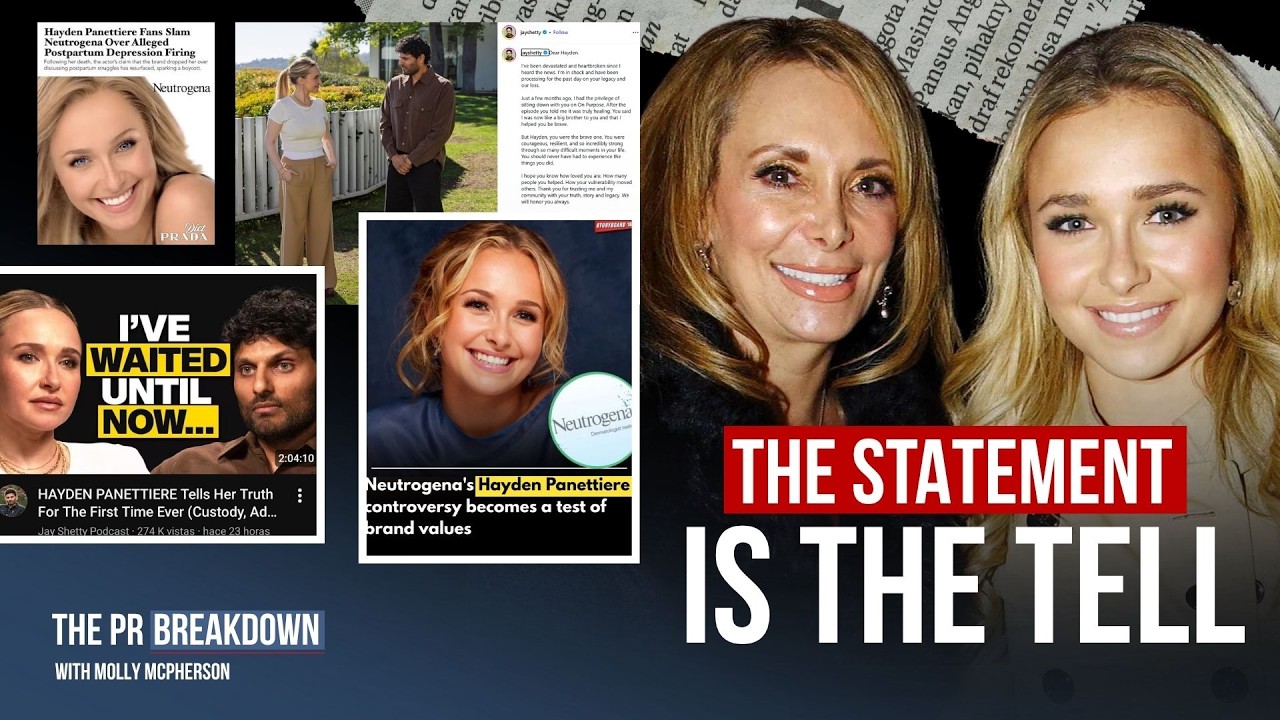
In this podcast episode, host Molly McPherson dissects the media and brand communications that followed the death of actress Hayden Panettiere on August 16, 2026. She examines three primary responses: Neutrogena’s complete silence despite a decade‑long partnership with Panettiere; self‑help influencer Jay Shetty’s highly personal Instagram eulogy that leverages proximity but lacks standing; and Panettiere’s mother Leslie Vogel’s statement, which, while having legitimate standing, focuses on her daughter’s boyfriend rather than the daughter herself. Using data from media‑monitoring partner Muck Rack, McPherson highlights the volume (≈800 articles in four days) and overwhelmingly negative sentiment (79% negative) surrounding Neutrogena’s silence, contrasting it with a prior successful social‑media engagement on a Tate McRae video that generated 18 million views and positive coverage. She introduces the “standing” framework—proximity plus obligation—to evaluate who should speak on behalf of a deceased individual and why. The episode also discusses the modern view of silence as a strategic selection rather than neutrality, emphasizing that silence can be perceived as cowardice and can fuel boycotts. Throughout, McPherson offers concrete crisis‑communication takeaways: brands must act quickly and empathetically, influencers should keep statements about the deceased focused on the person rather than themselves, and families should avoid inserting personal grievances into legacy statements. The analysis blends quantitative media metrics, narrative examples, and strategic guidance for communicators in the 2026 media environment.
Chapters
Last week, a 36-year-old woman died. There was a lot of press surrounding this story. I want to focus on 3 of the responses. One came from the company that worked with the woman for almost a decade. They had absolutely nothing to say, but the press absolutely did. The next response came from a self-help podcaster who wrote a post in a letter form to the woman and referred to himself as her older brother. And then the third came from the woman's mother, who instead of focusing on her daughter and naming her daughter, she spent time talking about a guy named Brian. Now, that guy Brian just happened to pop up on a notification on my phone, New York Times. A boyfriend who served jail time for abusing the actress was with her when she died. He has not been accused of wrongdoing. That's a notification in The New York Times. Brian Hickerson is certainly a part of this story, but also Neutrogena, because they're facing backlash. And that's what happens when stories like this go sideways. Hey there. Welcome back to the podcast. I'm your host, Molly McPherson. Before we get started into the communication aspect of this podcast, I want to be as precise as possible in this episode because it's sensitive, clearly, because of the recent death of this actress. And reports are clearly stating that she did have a troubled life. This is a moving story. I don't want to speculate on anything. Right. I want to be as clear as possible. other than the facts of the case. But I do want to highlight the communication challenges that come from it so we can export some of the lessons. Now, the facts. Hayden Panettiere died on Sunday, August 16th, in Greenville, South Carolina. She was with her boyfriend, Brian Hickerson, on a trip there. At this recording, the cause of death has not been released. The autopsy found no contributing trauma, which matches the notification that I just received here. Police said preliminary investigations showed No signs of foul play or suspicious circumstances, and the investigation is ongoing. That's what is known. We're not going to speculate past it. What I want to look at is the communication surrounding the death of Hayden Panettiere. Working with my media monitoring partner Muck Rack, I was able to pull some numbers so we can chart how the communications informed a lot of the news articles that were coming out about this story, but also why we're seeing the social chatter around this case. Now, the first example that I cited in the response was Neutrogena. Now, yesterday I did an interview with NBC News. I was on Hallie Jackson's program on NBC News Now. They wanted me to specifically speak to the Neutrogena boycott that was popping up on social media. It was a quick hit. I only had time for 2 statements to say, but take a listen to the first soundbite. Well, certainly silence has already cost them the frame in this case. And now what they need to see is action. This is not a time for a press release. I mean, certainly Neutrogena, it's one of these unknown unknowns in crisis management. You could never plan for this, but you can also— you can always plan to be empathetic. Now, Hayden Panettiere was a Neutrogena spokesperson for roughly 10 years, and this coincided with the height of her fame. When you think of the television commercials of Neutrogena and washing the face, I mean, you see Hayden Panettiere's face. So many people of that generation— when I say that generation, I mean the people who grew up with her as an actress, but the generation who more likely than not probably found out about her death via social media, Instagram, TikTok, and Reddit. They jumped into the conversation as opposed to finding out from a news notification or from reading a newspaper like I did on Monday morning. At the time of this recording, Neutrogena still has not made a statement about the boycott or about Hayden Panettiere or what she said in previous interviews. Pause on this for a moment because A number of days before the news came out about Hayden Panettiere, Neutrogena had a massive communication win surrounding a video made by singer Tate McRae. She's been a brand ambassador since 2025. She does a lot of post-concert verticals about using Neutrogena products. One went viral, not for the reason why a brand would want to, She was taking off the makeup and barely touching her face. No surprise it became like one of those viral moments. Yeah. 18 million views. It became almost a parody in and of itself. Neutrogena did not let those 18 million views go to waste because they immediately followed up with a post. They made a joke about the animated white package saying, it's time to come clean. The internet absolutely loved it. And I will be fair here. That is great social media. Now, something that comes up in my work a lot, speaking with communicators and senior leadership, is social media. Often I think social media managers and people responsible for social media and brands, it can be one of the most difficult jobs out there because you are monitoring it all day and they're using platforms and dashboards to monitor, but they have to watch it. Then they have to decide what to respond to, what not to respond to. As someone who currently works with brands, I know that is very, very There are people sitting at the top of the communication chain who worry daily about the social media team. Not that they can't do their job, but that they're doing their job too well. In other words, they're focusing only on the social media because a lot of brands struggle with having a strategic eye overlooking what's happening with social media. This is still an ongoing challenge for brands, but in this case, this is a social media win for a brand. They were nimble, they were quick. Somebody at Neutrogena jumped on those 18 million views, took advantage of it, and came out with their own post. Win-win. The brand's answer became the story, and there are numbers to back that up. 93 articles across 75 outlets covered the Tate McRae situation in a week, and 78 of those articles, and that's the majority of the articles, specifically referenced the response Neutrogena made. The brand's answer became the story, and roughly 7 outta 10 of those responses were positive. Wow. Win-win. So sit with that for a moment. Engaging was the win. Then days later, the Hayden Panettiere story comes out. Naturally, on Monday, when people are reading about her work, her legacy, the fact that she was a longtime brand ambassador for Neutrogena came out. Well, from there, the internet took over. Because that's when people start to call. That's when people start to search and they want to look for all the interviews that they can. Newsrooms do it, but so do people on social media. And this is what they found. Now, back in May, Panettiere sat down for an interview. She was on a book tour, so she was doing a number of interviews. But one of them, she talked publicly about her postpartum depression. And she referred back to an interview that she did in 2015 on Live with Kelly and Michael, which was Michael Strahan back in the day. She said that Neutrogena wanted to end the contract. Not because of something she did where she was worried how she was being seen as a party girl, that she was worried about being seen smoking. But it's that she discussed the challenge that she had, and that was postpartum depression. She then said that her representative said something to Neutrogena. They backed off. But then when it came time to renew the contract, she was dropped. Now, that was in May of this year that she did this interview. And I want to be honest about what May looked like because her memoir did not come out with, you know, a big news bang. You know, May is a big news month. So a lot of coverage there typically is like a ratings month for television news. So people are looking for all different angles of news stories. So that kind of bleeds out into all different areas of content and news outlet. Her memoir coming out created a lot of video moments and interviews, but she wasn't making headlines by any means. Likely Neutrogena was watching. They were watching the conversations. They knew what she said. And we have no idea what was said behind the scenes. We don't know if Neutrogena, the brand, reached out to her or her representatives. We don't know if they said something to her that was comforting and kind or stop talking. We don't know any of that. We just know what we see publicly. But it did give Neutrogena a chance to enter the conversation about post- natal health, postnatal care and compassion. Back in May, they chose to say nothing. Now, can we fully judge? I don't know, because silence is not a fixed object. Usually with brands and companies, when they're weighing silence, sometimes they truly are weighing it. They're looking at numbers, they're looking at chatter, they're looking at risk. What happens if we say something? But a choice to not say anything at that time about such an important topic, in my opinion, is amiss. I'm not someone who just looks at numbers only. I mean, certainly I love numbers and I love evidence because we like to cite evidence, empirical evidence, scientific, non-scientific. But chatter matters because chatter creates sentiment and public sentiment creates news sentiment. You know, what we see in terms of angles of a story, a bias of a story— is it negative? Is it positive? Is it neutral? And you can really capture a moment here, even if it doesn't make a lot of press. All you have to do is go on the record once showing compassion and showing empathy. If I were at Neutrogena and I were looking at the numbers that I think I was looking at based on what I see right now, I would have said something. I would have come out with a statement about postpartum care and health and how much they supported Hayden and thanking her for being ambassador. But that's me. Neutrogena at the time made a different choice. Now let's look at Neutrogena's silence and what the numbers say. So this is between Sunday and Wednesday of this week of this recording, last week of this airing. Roughly 800 articles ran that mentioned Neutrogena and Hayden Panettiere in the same story. More than 400 separate outlets, 4 days. That's a tight window for news. Now watch the shape of it because it's the shape that matters. Sunday was quiet because this was a very late-breaking Sunday story. Most people woke up to the news. So on Sunday, we had about 50 articles. Monday, it detonated. So we had 366 articles. Tuesday, 271. Wednesday, 152. That is not a story that's petering out. That is a story that is lingering. It did peak on Monday. But it still has legs that's, that's carrying the story into the more multiple news cycles. And here's the tone of that coverage. 79% of the scores were negative. Only 3% were positive. Now, let's be very specific on that number. Sentiment scoring comes from a machine. It's scanning for articles. It's not asking humans how they feel. But It's telling you what the temperature of the language in these stories is at the time of publication. The public reads those stories and then they get their sentiment from that. And what the story is telling us at scale is that the tone of these stories are running cold for the brand. It's very negative. Even if the volume is coming down, the tone is not. And so instead of being a part of her legacy that she was a brand ambassador, Now Neutrogena is dealing with the brand that hired her as an ambassador, cut her because she talked about postpartum struggles, and then they are tied into the aftermath of the death and the conversation, which naturally led to a boycott. And here's the number that matters the most: the amount of articles that picked up Neutrogena's statement. Yeah, that would be zero because there was zero statement. But there are 14 stories of people just writing about Neutrogena's lack of response. Now, reporters don't Typically put a whole story together about a company's lack of response. But that shows the power of silence boomeranging and working against you. It becomes a story. Now, I mentioned that I was on NBC, and as I was waiting to go on to have Hallie Jackson interview me, I was listening to the piece. And in there they said that NBC reached out to Kendview, the parent company of Neutrogena, and they received nothing. And that is still the case. And here's a trap, and Neutrogena built it themselves. A couple days earlier, they were as nimble as can be, and they were lightning quick on picking up on a viral trend. They were very human and engaging in social media. 4 days later, silent. So the lesson there, it shows how a brand can get a W in the column for their response by engaging, and how quickly they lose when they don't. And nowadays, silence isn't silence, it's selective. Neutrogena is choosing to remain silent of this matter. And here's where we are in the communication era, 2026. Silence is selection. They're choosing to remain silent. They do not need to comment about a woman's death, but they certainly can comment about things that she said while she was alive, the struggle that she faced while she was alive. And they're choosing Not to. And as I said, as of this time, there's no statement from Ken Buehler or Neutrogena. If there is, I will come back. Okay, now I want you to think about this concept, and that is standing. Who has the right to say something about someone? Think about it again in this era that we're in. The formula is the right for someone to speak about them, proximity plus Obligation. Who do we expect to hear from? Who do we not expect to hear from? And who shouldn't we hear from? A company that worked with a woman for 10 years, that's someone we should hear from. They have real standing with the actress. We should hear something from them. Now, a person who interviewed her once has proximity, but does that mean they should speak about the person? So here's the part that matters in crisis work. Standing is not a feeling. It is a fact about a relationship, and everyone who's watching can measure it. You do not get to reward yourself simply because you knew someone. You see this a lot on social media, uh, particularly with celebrities. People will want to bring their experience. into the conversation. You know, many times, especially if you're looking at the Hayden Panettiere, uh, coverage, it's people just grieving out loud on social media. That's fine because they're just talking about themselves and the grief that they're going through about a person. But this person just used proximity to talk about themselves. Now, if you followed my work, you know I have opinions about self-help people, certain self-help people. Uncredentialed self-help people like, in my opinion, Jay Shetty. This was Jay Shetty's post on Instagram. Okay, I want to be careful here. I do not know what's in Jay Shetty's heart. Neither do you. We don't know if he wrote it or if someone else did. Grief is strange. Grief makes people do strange things, write strange things, but also write very empathetic, sympathetic things. As well, I don't want to take away from the heart of caring about someone, but this was a post written with an audience attached, and that's what I want you to look at from a strategic communication point of view. Who are you writing for? Are you writing for Hayden because she's not reading it, or are you writing for your fans because you're writing about Hayden? There's a difference. As I read it, think about the concept of standing. Think about obligation versus proximity. Dear Hayden, I've been devastated and heartbroken since I heard the news. I'm in shock and have been processing the past day on your legacy and our loss. Just a few months ago, I had the privilege of sitting down with you on On Purpose. Had to put in his podcast. After the episode, you told me it was truly healing. Oh, you had to put in a compliment. You said I was now like a big brother to you and that I helped you be brave. Another compliment. But Hayden, you were the brave one. You were courageous, resilient, and so incredibly strong through so many difficult moments in your life. You should never have had to experience the things you did. I hope you know how loved you are, how many people you helped, how your vulnerability moved others. Thank you for trusting me. And my community with your truth, story, and legacy. We will honor you always. My heart and prayers are with you, your daughter, your family, friends, and fans. Rest in peace, comma, Hayden. That was edited also. We don't know if he wrote that. The person who did write it doesn't write with an Oxford comma. So I could go in here and analyze and see if Jay Shetty typically uses an Oxford comma. It doesn't matter. It's beautifully written. But look at the POV, the point of view of Jay Shetty. He could have chosen to write a post about her appearance and it be in the first person to himself, to followers. I have been devastated and heartbroken since I heard the news about Hayden Panettiere. I'm in shock and I've been processing for the past day. On her legacy and the loss for all. That is a much, much different caption for an Instagram post. Instead, he inserted himself into Hayden's life. You may be a huge Jay Shetty fan and you may love this. You may not like Jay Shetty and think, there's nothing wrong with this. But I can tell you that people don't like this, even though there are 764,000 people who said that they liked it. That's fine. This is a big podcaster. He's going to have a lot of fans. I'm saying as a strategic communicator, the lesson here, this is when you want to watch proximity. People can tell bandwagoning when they see it. People online can smell a death tourist. They can see people who take advantage of it. This, in my opinion, this edited post is Jay Shetty taking advantage of her death. It feels a lot like Neutrogena, but that's just me. We can also use Jay Shetty's post as a comparison. Neutrogena worked with Hayden Panettiere for close to a decade. Jay Shetty had one interview with her during her book tour. Neutrogena had 10 years. Jay Shetty had 90 minutes. Neutrogena said nothing. Jay Shetty claimed her legacy. One party. had standing but chose not to use it. The other party, in my opinion, has very little standing and optimized it to the nth degree. Now, what Jay Shetty did, it's not a crime. It's a eulogy. Everyone is entitled to their own eulogy. It is a gift that you give, but this one feels like a receipt. Now, the third example is one that I just read about today, and it's from her mother, just as I was compiling this episode. I saw that she spoke to NBC News. And again, I want to be slow and careful because a lot of the coverage that I've been seeing and reading about Hayden and her childhood, in particular her relationship with her parents— now, in the statement that came out about her death initially, the only person speaking on her behalf, it was through her representative, was her father, not her mother. In the days since her death was reported There's been a lot of stories about the complications in their relationship, and many of that came straight from Hayden Panettiere. No surprise, a child actress. Her mother was a former actress. Her mother was the manager. Again, I don't want to speculate on that relationship, only what she said. We know that it was complicated. We know that Hayden probably suffered a lot as a child. We just don't know how much the mother comes into play. But we know what happens with a lot of child stars, so we're not surprised by this, but we are saddened by it. So this is what her mother, Leslie Vogel, said to NBC News. Now, what we do know is that they were estranged. Hayden Panettiere, back in May, confirmed this. Now, she's 4 days out from losing her daughter. So she said, and this is her characterization, that, quote, this person in her life that we'd been trying to get rid of for quite some time was with her at her death. And that was Brian Hickerson. She said that Hickerson had, quote, enabled Hayden many times, end quote, and that she and Hayden's father had been concerned about him for a long time. Let's be clear about what Hayden's mother is saying and what she's not saying. She expressed suspicion, anger, and longstanding concern. She did not accuse him of her daughter's death. And the 9— and the record as it stands, Hickerson and his brother were reportedly present And made the 911 call. And as I said from the beginning, the police has said there are no signs of foul play. So I don't want to characterize it at all. But if you look at the shape of the statement from a communication point of view, which is fair, she described her daughter as amazingly talented and said that growing up in entertainment is difficult and that young performers can, quote, sadly find the wrong path. So listen to that. Amazingly talented. Growing up in entertainment, young performers. So those are all very true sentences, but they are a description of a career. I think that statement really captures the relationship that Hayden said she had with her mother. It's very transactional. It was very tied into her work. Hayden said her mother could be hard. You know, my mother was an actress. There was a lot of pressure there. I think the evidence that we have in the statement is that it seems like Hayden was right, what she was talking about. And again, we have to be clear, we don't know the relationship. We can only base it on what we've heard in reports and what Hayden said, because we were not inside of it. Nobody was inside of it except, except for Leslie Vogel and her daughter Hayden. So what I'm noticing as someone who's worked with families In crisis management, not in interpersonal family problems, but when a family problem becomes public and it's in the professional realm, I'm dealing with a lot of family dynamics. And when I'm listening to these conversations and stories, I'm looking for family dynamics because they are definitely there. I think the statement that Vogel put out about her daughter is the tell about the relationship that she had with her daughter. She was explaining her as an actress, not as a daughter. Okay, to my mothers out there, if you have to write a statement about your child, about your child's passing, how much would it be about their grades, about them in school, or about their job? I'm assuming you would say no. If you had to— oh my gosh, tragically, let's hope we never have to do this— you would talk about them, what they meant to you. what they were as a child, what they, what they meant as a person. That's why you go to the family. You want to get the person because so much of the news is about her as the actress. Her mother was just a part of the same narrative, and she had an axe to grind against Brian Hickerson. Now, we don't blame her for that. I mean, we can certainly see why she inserted that, but the statement was about her daughter, the actress, and her daughter choosing poorly by dating Brian Hickerson. So again, so here we have someone who has standing because they have— they had proximity. They have that obligation because it's the mother. But look what she chose to do with that proximity. Talk about a boyfriend and talk about her job as an actress. So here's the real question and the communication lesson in all of this. If you are in a position at a company or personally where you are writing about someone, and this is in the public sphere, the public sphere, think about this first and ask yourself this question: Is this statement about them or about my relationship with them? If you're a fan, or if you're someone who's just observing a story, then your relationship, your parasocial relationship with them is absolutely fine. Because you're talking about your grief. But if you're talking as someone withstanding because you had proximity or there's that obligation there, when you are writing a statement, you write a statement about them. Them. Take your name out of it. The test is simple and brutal. Take your name out of it. Take your podcast out of it. Take the name of your podcast. Out of it. Any ax you have to grind, anything that's your mess, don't put it into a legacy statement about another person. When you have standing, your job is to write about the person. Now, if you're on the other side of it, the Neutrogena side, the silent side, think about your standing. You had proximity. For almost a decade, that is an obligation to say something about the person. So no one at Neutrogena should be surprised that there is a boycott. And a boycott like this may not make a dent in the numbers, but from a brand perspective, a reputation perspective, I promise you there are people out there who will not use Neutrogena again. There are a million other products that they can use. And I will say this from personal experience. Every time I see Neutrogena now, I'm not going to see Jennifer Garner. I'm going to see Hayden, and I'm going to see this boycott. And honestly, I think it's going to affect me. I don't think I'm going to buy the brand. I'm not. Silence is not neutral. Silence in many cases is cowardice. And that's what I think is happening here. I think this is just a brand that's waiting it out. And the news articles that Muck Rack found out there shows That silence comes with a cost. So the next time you go out there and say something about someone who cannot answer, you have to ask yourself this question: who is this statement for? Who ultimately is this about? And whatever you do, don't make it about you. That's all for this week on the podcast. Thanks so much for listening. Bye for now.








