Dr Zach Bush & Mona Sharma - The Roots of Healing
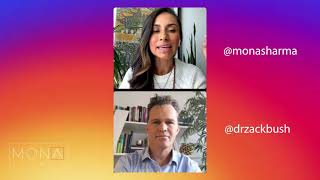
In this hour‑long conversation, host Mona Sharma interviews Dr. Zach Bush, a physician‑scientist who left conventional allopathic practice to explore the deep connections between the human microbiome, soil health, and the modern food system. Mona shares her own journey from corporate life and heart surgery to rediscovering the Sivananda Ashram’s teachings of food as medicine, community, and nature. Zach recounts his early experiences birthing babies in the Philippines, his disillusionment with chemotherapy‑focused oncology, and his pivot to nutrition after realizing that disease is not solved by drugs alone. Together they discuss how industrial agriculture—particularly glyphosate and monoculture—has degraded soil, stripped food of its medicinal qualities, and contributed to the rise of chronic illnesses such as autoimmune disease, obesity, diabetes, autism, and mental health disorders. They explain the microbiome revolution, emphasizing that health is governed by ecosystems of bacteria, fungi, and viruses within and around us, not merely human cells. The dialogue moves to community‑level solutions: building mycelium‑like networks of sharing resources, supporting regenerative farms, engaging in CSA programs, and growing food locally. Zach describes his company’s supplement “Ion,” derived from 60‑million‑year‑old humic soil carbon molecules that act as a liquid circuit board to restore cellular communication. They stress biodiversity in diet, seasonal eating, fermented foods, and reduced reliance on protein. The conversation culminates in a spiritual invitation—breathwork, intention setting, and the practice of hugging—to reconnect with one’s own vibration, neighbor, and the planet. Throughout, the speakers blend scientific insight, personal narrative, and a call for systemic, ecological, and inner transformation.
Chapters
There he is. Hello, Dr. Zak. How are you?
So good to be with everybody. So glad to be on with you. Mona.
Thank you so much. This is just, it's such an honor. I've been following your work for some time now. And you know, as a medical doctor with so many accolades and designations, you have a way of delivering this complexity and science and, you know, hard truths really about health today in a way of just compassion and grace. So thank you for that.
I appreciate that. And thanks for the observation there.
Well, you know, following your work, I was first introduced to you, actually through a place called the Sivananda Ashram. This is the ashram. It's a lineage that I actually grew up with as a little kid. And when I quit the corporate world, this is after suffering from debilitating anxiety, pcos. I was told that I would have a hard time having children. I was on beta blockers for having two heart surgeries. It was in my second heart surgery. I was lying down on the operating table, I was being pumped full of all these medications and I saw my heart on this massive screen with these wires going everywhere. And I just thought to myself, what am I doing? What am I doing here? I have this kind of wisdom in front of behind me, this memory of growing up as a kid in a place of spirit. And for those of you who don't know what an ashram is, it's a spiritual center where they really call in on this idea of food as medicine and living in nature, living amongst community, being outside the power of yoga, the power of meditation. I guess in my 20s, I had to throw that out the window and do the whole corporate thing. But lying there in that moment, I knew that I had to go back to my roots. When I did this and I became a yoga teacher, there was a symposium happening. The symposium was on the future of our health and our relationship to nature. And that's where I heard your name for the first time. And I don't think that it was a coincidence. Yeah. So with that said, I would love for you to just maybe give us an introduction. For those of you who are new to seeing Dr. Zach here. Just the impact on our food system, this connection to nature, and what really made you take that shift from the world of medicine and science.
So good. And hello to the Philippines. You guys are my origin story, aren't you? So thank you for joining. I did take a hard right hand turn into medicine and experience in the Philippines and glad you guys are joining from there. But the Philippines was my introduction through A group of international midwives there that got me looking differently at my career. I was at the very beginning of my undergraduate work, thought I was going into engineering. And when I started birthing babies with these midwives, really realized that there was something miraculous out there that could not be touched in its beauty or complexity by the engineering environment that I thought I wanted to go into. And so really was enthralled by the miracle of life, by birth itself and by this clear drive for life that is within the human spirit that I saw in these infants being born, often severely malnourished and premature, born into, you know, dirt floor, tin shacks, and the squats around the Manila. And I just saw this human spirit and this joy within women and children that was a complete mind blow to me. And so that was my origin into this transition into medicine. And then you fast forward 20 years from there, and it took me a huge arc through the Traditional Medical Doctor, M.D. route Allopathic medicine for me to realize that I was maybe going the wrong direction. And by that time, I had gotten subspecialties in internal medicine, endocrinology, and metabolism. And my research was in chemotherapy development and working with nutrients from food system, from food, specifically vitamin A in that case, that can help kill cancer cells. And so I thought I was very holistic in my mindset because I was thinking around natural nutrients as a killer for cancer and things like that. But as I started working with patients in my first clinical trials with the drug I developed, it turned out that my very first patient in my clinical trial really revealed something profound to me, which was that no matter how good I got at creating chemotherapy, no matter how safe those chemotherapies get, she pointed out that her cancer was not caused by a lack of chemotherapy. And so that was kind of like your moment on that. That bed, looking at your own heart with all these wires. And it's that moment where you're like, hold on a second. What? Where am I going? Maybe technology is not the solution for this miracle that we call life. And so that was a big pivot point for me. My work in nutrients took me into the idea of nutrition, which it was a new idea for me after 20 years in medicine. I had not been taught nutrition, and a great book got released called Neal Barnard's Program for Reversing Diabetes. I trained at the third best endocrine program in the world, and nobody had mentioned that you could reverse diabetes. To me, it's like this amazing aha moment. And so I started, I tried to launch a Nutrition center at the University of Virginia. And ironically, the dietitians there were my main block to success there because my program for a plant based diet that I wanted to implement didn't fit into the food pyramid that had been developed by food industry stakeholders back in the 1970s with absolutely no science behind it. But the it has informed national and international spending around food systems, including our commodities, crops, USDA crop insurance, all kinds of corruption all the way down the road keeping us from making these transitions. So I ultimately left the university in 2010, started a nutrition center out in rural Virginia in one of the most impoverished food deserts in the state. That was my introduction into starting to dive deep into the influence and impact of food systems on human health. And realized very quickly in the first two years of doing that that food that used to be medicinal, kale, Brussels sprouts, broccoli, were no longer having the effect we would expect them to have. In fact, I was seeing a lot of my patients increase their inflammation and dysfunction on these healthy diets. And so that forced us to look much deeper into soil and chemical farming practices to understand this intersection between human disease and food, which always before that was human health and food. Medicine is within your food. 4000 years of belief around that, the ancient Chinese medicine structure saying that 2,000 years ago, Hippocrates and the like. So that all was true until about 1996. And then we polluted the system of food production. And since then food has become a huge harbinger of disease. And that's how I end up here with you today.
I can't tell you the amount of people that come my way who are doing all the right things, eating the right foods, meditating, doing yoga. And they're still coming to me with inflammation, feeling sick. In fact, the majority of the questions that you and I got for today were people suffering from digestive issues and imbalances, sibo, ibs, autoimmune disease, hormone imbalance, and of course anxiety and depression. And. And I really had this hard shift in my work where people would come to me expecting a diet. Just tell me what to eat, just tell me what to eat. And I just noticed very quickly that that wasn't working anymore. And ultimately what had to happen is the removal of fear and this kind of shift in personal vibration first to even allow any of those nutrients to manifest within the body. I think something to really paint the picture for a lot of people here is the farmer's footprint. Your work around this and the documentary. So glyphosate obviously has been the most impactful thing to our soil system and the quality of the food today, which is why the kale and the broccoli isn't working the way that it used to. But maybe this in terms of your work with cancer and the relevance of autoimmune disease that we're seeing today, the rise in obesity, anxiety related disorders and diabetes that's happening right now.
Yeah, it's so interesting. So many of the disorders and diseases that you mentioned, there really were either trace in their prevalence in 1992 or completely unreported. And those include things like chronic regional, regional pain syndromes, fibromyalgia, gluten sensitivity, gluten allergies called celiac disease. These things were really non existent. I didn't get taught that at all in the early 1990s when I was going through all of my training. They just didn't exist. And large whole celiac disease was unheard of. And now you fast forward to well, just that 10 year period between 1996 and 2006 and that 10 years. It wasn't like suddenly there was a new thing, there was a new epidemic. It started to surpass things like back pain, which had always chronically been the number one complaint in any family medicine office, was suddenly chronic fatigue, chronic pain syndromes, major depression, mood disorders, the whole emergence of the attention deficit hyperactivity disorder in the 1990s, the explosion of autism between 1998 and 2008, which accelerated again from 2008 to 2018. So we're seeing this huge collapse of human health. And as I peer deeper and deeper into the biology of that, you find out that it's because humans cannot be healthy on a sick planet. It does not work. We are not an isolated biologic system. And the work of our group and many others around the world now has been demonstrating that the microbiome, the bacteria, the fungi, the protozoa, all of these extraordinary single celled creatures that live within us, far outnumber the human cells within our bodies and in fact do far more work than the human cells do to produce the health. We have to put that in a nutshell. We are in the biggest scientific revolution in history over the last 10 years when we discovered that human health does not center itself upon the human cell. It's so destructive to our concepts of what is cancer, what is heart disease, what is depression, what is acne, from the benign to the killers. We always thought that the human cell and its dysfunction was at the center of disease or health. We find out that's not True. It's the health of the ecosystems within our bodies and the ecosystems around our bodies that dictate either our health or disease state. And so each of you who are suffering with these conditions, I want you to know this is not a personal weakness. This is not something you inherited from your mother and father. This is not something programmed into your genes. This is not a permanent condition for you. You are a revolutionary regenerative machine of health that has been removed from its original biologic system. When we put those systems back inside of you and around you, the revolution begins. And the revolution is one of health and healing. And those are two words that never got taught in medical school or beyond. We do not want doctors to think that people can heal, because if so, then there would be a different avenue than using all these pharmaceuticals and technological interventions. We do not get taught that this is possible. And I get to see it every single day in my clinics in our eight week online program, which is the Intrinsic Health Journey into Intrinsic Health series. It's so exciting to realize that you have access to vitality and it's through education and a bigger understanding of who you are. You are not an isolated system. You are a symptom of your greater environment. And so if you are dysfunctioning today, I want to give you hope. The genetics that you have right now are capable of making 4 million different bodies. 4 million different bodies can result from the epigenetic transformation that you're capable of making. The way you begin that revolution, regeneration, is changing those ecosystems and the landscape within your body. Gut health for sure. But as we start to look at the gut brain axis and the microbiome that's actually in your brain, cerebral spinal fluid, the microbiome that's actually in the healthy human breast to prevent breast cancer, the microbiome that's in your liver, kidneys, bladder, you have normal bacteria and fungi all over your body. And when we start to support these systems, we see this revolution begins.
What you're reminding me of is at the ashram, there is this message of in nature we trust. And in Ayurveda we learn that we not only digest what we eat, it's what we smell, it's what we watch, it's what we touch. It's really our ecosystem. And, you know, it's not about escaping, it's about looking at your own ecosystem, right? Bringing whatever you can invite from a healthy environment into your own home. And the practices that you can really use it ignite your own healing. Right? I always say that it didn't take Me going to the ashram to heal, it took me recognizing the tools that were available at the ashram that I need to bring and educate others in the world. Right. And also the power of food. You know, a quote that I love from the Bhagavad Gita really addresses the fact that it says, let the human community protect their environment, for the environment revolves around their own survival. And when we think about the things that we can just take out of this idea of consumption within our kitchen, our kitchen is our healthcare system, what we're eating, the products that we're using on a day to day basis, and also where our food comes from. Right. I think a lot of us got really overwhelmed this past year, especially with this idea, well, what do I eat, what do I go to, how do I heal, how do I stay ahead? Immune boost, what am I doing to do this? And then recognizing that this idea of food is information, but also knowing where it comes from. Right. And you brought up the point of children now. So children who are now being diagnosed with autism and diabetes and add my niece and nephew fall into that category. And thank God I know that these are things that are reversible. But how do we go as mothers, as consumers? When we're shopping, you know, we're starting to see these glyphosate residue free labels everywhere. But what can we do as consumers in terms of optimizing the food that we're taking in or creating change in the system that often feels really broken.
Yeah, yeah. It's a critical question. I think each of you that are joining here are already doing this in many forms in your life. You're already proactive consumers, you're already proactive agents of education and information management. So you're actually doing it. So I don't you need to reboot or anything like that. But what we need to do is come into community ultimately, because each of us making individual changes can start to move the needle. But it's going to be when we as community decide we're going to actually create a different future, that's when the thing's going to shift. And so that takes communication across socioeconomic, sociopolitical systems and all of that. And so that's really where we've been pushing as a group of companies that I've been spearheading as well as nonprofit space. And so we're really working on what are going to be the infrastructure needed to mimic the mycelial network that we see in nature. How do we create a mycelium network within humanity? How do we start to not only just speak together, but share resources as the mycelium do? They don't just talk across acres, they move nutrients over acres of space to make sure that places that need resources receive resources. People that have excess or areas that have excess, are able to export those effectively to support the rise of the entire farm or ecosystem, not just make sure the corn is the healthiest thing in the monotony of the world. So we need to think about how do we deprogram psychosocials and socioeconomic, sociopolitical structures so that we're no longer basing our reality on slavery. This nation was built not on freedom. This nation was based on stealing territory from first nations people and enslaving them or African American slaves into this space. Obviously just African slaves initially and ultimately their arrival and their naturalization into this space has not resolved. There are not reparations for that process of slavery. And you see it through every economic and sociopolitical environment around us. Our food system today is a slavery based system. We have outsourced the vast majority of abusive behavior, humanitarian crisis to either migrant farm workers in the United States or by and large a much larger percentage of food you eat off of Whole Foods or whatever, to farmers in third world countries that are being paid slave labor type wages or just subsistence level survival kind of environments that they're living within. And so the humanitarian abuse of this system has to be at our foundational understanding of how we're going to move forward. It's not about just taking care of soil and rebuilding a microbiome. We need to rebuild the humanity within us. We have lost our humanitarian roots. We need to start to love one another much richer. We need to start to tap deeply into reverence for human life and realize there is no system that is going to exist in the current economic structure that's going to allow us to create the revolution we absolutely need to prevent our own extinction event in the next couple of decades. And so we have to change at the beginning of respect. And when you find reverence for your fellow human, I believe you'll find reverence for the tree outside. You'll find reverence for the microbiome that you can't see under your feet. You will find reverence for the stars that shine down that you may have not seen in years because of the light pollution in your city. Step out into nature. Get out in the high desert, get up on a mountaintop and have reverence for that moon. Have reverence for those stars. Feel that in your body and Say, what are we going to build differently? And so while our nonprofit is focused on regenerative systems and farmer's footprint and all that got a lot of traction on bringing attention to need for change for human systems. Our new studio, which just relaunched, is called Renourish. And Renourish is taking stakeholders from around the food industry, tech, finance, all the people that are involved in CPG companies, all of this, bring them together and show them the humanitarian crisis within the system and show them that reparations have to be made in the very level of economic justice and technological justice at the grassroots level for us to ever get to the conversation about how soil is going to be treated. We must treat humans with dignity. And that will take us to a reconnection with mother Nature itself.
And just how powerful that is. I mean, if this was part of our day to day conversation rather than this, you know, at surface, how are you? You know, if we were really to deeply connect over the things that we're doing and how we want to be proactive or how we're feeling. You know, I often laugh when you ask somebody how they're feeling. They'll say, oh, I'm stressed, I'm busy. And it's like busy has become this emotion and it's complete void of connection and interaction. And one of the greatest gifts from, you know, growing up at the ashram was we would sit in community, we would sit within nature. Our feet were dug into the ground, there was no electronics or anything. And the power of getting to know somebody and looking them in the eye and really sharing this energy with them. Right? And ultimately this is our, our connection to nature. We've all had that feeling where we've been at the hilltop, at the mountaintop, at the, at the beach, in the park, where we feel this sigh of relief and it's like this wave of relaxation over our entire nervous system. And it's like, my gosh, if you can invite more of that into your life and your connections with other human beings, I feel like that's just like the first thing that you can do before you look at diet and exercise and biohacking and all these tools that are just complicating everyone. People are so confused around what to do for healing and health, when fundamentally it's about going back to nature and our roots and often with diet. I'll even say to people, what did your ancestors eat? Look back. What was their nourishment? Right? Look at how that satiated them, allowed them to have a healthy life without disease, maybe go Back to that first, before you look up which diet to start tomorrow. So thank you. I think that's really powerful. And my ask is that we just, we start to take this out into the world because, my gosh, knowing your neighbor, something as simple as knowing your neighbor, right? And community that way, I think it's just so powerful for healing.
It's so powerful. I had the blessing of traveling with Lynn Twist, who's the founder of Pachamama alliance, back in 1996 with her husband Bill. And they've spent 26 years traveling frequently and bringing huge attention to the crisis of the Amazon River Basin down in South America and the deeper crisis of the abuse and destruction of indigenous peoples down there, as well as complete exploitation and extraction of all of their resources. China and all the oil, gas industry there is famous for it. But as I was down there, I was shocked to find out that wind energy is destroying the Amazon as fast as anything ever had, because we're actually harvesting all the balsa trees out of the deep Amazon to become the windmill propellers for wind energy. And we've done more decimation of that rainforest through windmill raw materials. And then there's all this, you know, trace mineral mining going on down through South America and Africa for solar panels. And the solar panel trace minerals are so toxic that it's actually legal to dump solar panels in the U.S. and so we actually take those back to Africa and dump them in completely unregulated spaces to poison the people there. And so it's just these systems, when you start to look at them, were built on a lack of reverence for Mother Earth, for peoples and all that. And so your statement, it begins with knowing your neighbor, that we have to take that very to heart. It's going to start there. We're going to have to look at one another. And in that classic golden rule of love your neighbor as yourself, we learn something deeper, which is we are not loving ourselves enough to even love our neighbors. And so, you know, if I really loved my neighbors as much as myself, they'd have a pretty short stick. Fortunately for my neighbors, I tend to love them more than I love myself. And I get a little further down the road, but I'll never love my neighbor fully until I actually find out that I am a sovereign, sacred, miraculous being full of light energy, showing up here at the tipping point of all things, to be on purpose, to be part of a global community, to create a vision of beauty with everybody here. If I don't see myself as such, I will not love My neighbor effectively. And so each of you turn off the inputs at some point in the day and just be silent. Let your new mantra, instead of I am busy, let your mantra be I am listening. If you start listening to your core voice, there's a soft voice inside of you. There is an intuition that knows how to solve all of this. Because you showed up right now. If you'd showed up 2,000 years ago, you may not have been part of the solution. You showed up right now to be part of this solution. Because I believe we are not just an ingenious and industrious species. We are a spiritual species. We have a spiritual awareness that is going to save us from our own destruction that we have really put into place. We've engineered the destruction of the planet. We are in the sixth great extinction. We'll lose a species every 20 minutes currently to extinction. We will join that parade of extinct species in about 60 to 80 years, depending on the, you know, the current trajectory. I believe in 350 years, something that soon we could have the most vibrant ecosystems on the planet. Because in the next eight years, humanity decided to do everything differently. And we revolutionized, not just food systems, we revolutionized sociopolitical systems, socioeconomic structures. We started to value correctly, and that changed our monetary system, because we started to value life. The life of the human, the life of the bacteria, the life of the tree became the basis for our entire economic financial structure. So that's a lot of what our companies are working on right now, is what is that going to look like in application? And so we'll keep pushing this out to you all as we bring. We have so many brilliant people thinking on this now. What is that going to functionally look like? What is it going to ignite in us when we see the opportunity? As a bit of an aside, I'm going to take this down to the basic science level, because right now I'm in this abstract world with you. I want to make it concrete with you. What we see in our laboratory over the last 10 years is the ability of communication between human cells as the entire revolution of regenerative health and healing. What we do is we take communication network from bacteria and fungi that were deep in the soil systems of the Earth 60 million years ago, 55 million years ago, we had the big extinction event. Dinosaurs, famously. But we lost 90, 95% of life on Earth in a very short period of time on the planet because an asteroid hit and choked out our entire topsoil system. We lost the breathing capacity of soil. We acidified the air in the oceans and the life collapsed. We are now 50 years into the destruction of all of our topsoils. We have 97% of the arable land globally now depleted or severely depleted. We are choking out the lungs of the planet once again. And we see acidification and greenhouse gases in the air. And we see the acidifications and warming of the oceans just as it did 55 million years ago. But fascinatingly, by the grace of Mother Earth herself, we find out that planted in those soils 60 million years ago was an antidote to the whole system of failure that we've engineered here in the last 50 years. That antidote has to do with the way in which bacteria and multicellular organisms like humans communicate. And so we specialize in extracting the communication network, the wireless communication network that allows cells to talk to one another. And what we get to see as soon as you put this on human cells. Interestingly, the soil systems of the Earth today never recovered to the same level after that last great extinction. So we've never actually seen the full capacity for communication in the human experience because we've only been here for 200,000 years. That's a blink in time compared to 55 million since the last extinction. 200,000 years. We just showed up. And we've never seen the full capacity of biology on Earth because the soil systems didn't have a co creator. We were struggling back for 55 million years to create soil systems and then we destroyed it in the last 50 years. If we become co creators, and this is what all of our regenerative farmers are becoming. They are becoming co creators with Mother Earth to create rich biologic systems. But right now we're dependent on this fossil record of the potential of life. And so we extract from these fossil soils a communication network and we put that into a liquid supplement to put across gut membranes, blood, brain barrier, kidney tubules. Every single cell in the body responds the same way. It responds by accelerating regeneration. Unbelievable. A communication network from 60 million years ago put into play on this nascent Homo sapien. And you see this explosion of life potential, and that's where I want to encourage you guys, is when you do communication. Well, the result is more life. Life as how we got here. How did mammals show up? It's a story of the virome. Viruses have engineered the capacity for life to go into an incredible capacity for diversification, biodiversity, and ultimately an incredible capacity for adaptation. That's how life has occurred on the planet in these recent years. We have steadily put ourselves into opposition with the capacity for adaptation and biodiversity of this planet. We have killed 97% of the soils and 97% of the indigenous peoples that manage those biologic systems for tens of thousands of years. The Oshawa tribe that I was with with Lynn and her team down in the Amazon a couple months ago, they have lived there for 40,000 years. That tribe has been self sufficient for 40,000 years in the same million acres of rainforest. And it have never damaged the rainforest. The rainforest instead has provided insistently for them. And they do not have in their cooking environments, in each of their homes, they build these huge homes, these huge grass roofs homes. They can be a couple thousand square feet, open air, beautiful homes. And in their cooking section, in their kitchen, if you will, there's a fire pit. And that is remarkable for the reason that there is no refrigeration and not a single cupboard, because there is no reason for storage. Because they simply get up in the morning and the rainforest provides again. For 40,000 years the rainforest provided again. And they do not have a fear of scarcity, for they've only known abundance for 40,000 years. It takes a company to come in and try to own something and take dominion over nature. That creates the scarcity, that would create something like the food system we see today. So how do we start to solve for this? We need to start to reconnect at the micro level, our own behavior to this state of abundance. And it's going to happen when you grow out and grow a single plant in your backyard and find out that creates so many tomatoes on that one plant, you can't keep up with it when it's in its, its prime. And so you're starting to share tomatoes with your neighbors and you find out that one of your neighbors is growing zucchini. And pretty soon we can get back to 1945. We're growing 40% of the entire food system in our backyard victory gardens. Today we grow less than 0.1% of our food in our backyard gardens. We lost the capacity to share in the abundance of mother nature. You can start with a single tomato plant.
I'm so turned on lately at this idea of learning how to grow things. The fact that this isn't part of our culture, that this is not within our school systems to educate people and to imagine a day where we're not relying on transporting food from the other side of the world and then have it sprayed with chemicals. And I think you've really nailed in that word. Scarcity is something that's become common Languaging and a common belief, right? And the more that we indulge and engage with these companies and media who are perpetuating this, the more that we will stay stuck there. Right? I had this dream of, you know, soaking my hands into soil and being part of the earth. And I hear all these children around me, and this has become a dream for me because a lot of the school systems here, you know, these kids are given boxes of fake food at the end of the day. On one hand, we feel grateful because they're being given food for families who just don't have access to. But on the other hand, we just see, well, no, this is part of the greater problem. How can we go out into the world and just thinking about, what if we were all just to plant one thing on our balconies or in our backyard and take that to our school system every single week? These small, small things that we can do in community together to create such big impact around the world.
I love it. It is so right at our fingertips. Nature has laid out her template for us. We know how to participate. We have the technology to align with her instead of against her. But we're gonna have to make that decision that we're gonna trust her. It's the fear and guilt that we have in interacting around systems like this. The basis of scarcity creates those two emotions of fear and guilt. You're afraid you're not gonna have enough, your family's not gonna have enough. And so you start to sequester more than you need because you believe that there's some future for that. And so your fear that Mother Nature doesn't know how to provide for you is part of your trap that you and I are in. So we need to back out of that and begin to trust the nature that worked for four billion years. A billion is a thousand million to four thousand million years. This planet has been baking up the capacity through the virome and the capacity for biologic adaptation and biodiversification to support the emergence of mammals in these last short million years and Homo sapiens in this brief second of 200,000 years, we just showed up and we're destroying everything about Earth. We just showed up, and in our highest state of consciousness that this planet perhaps has ever allowed, we have decided to believe in scarcity. We have developed a genetics of fear and guilt. If we lose the fear and guilt and we start to move towards abundance, and we start to understand that beauty is the fabric of everything. And the experience of seeing beauty never needs to be Taught the experience of seeing beauty results in love. If you feel unloved, you simply haven't stopped long enough to listen and see your own beauty. You will fall in love with yourself again. And in that, you will have the capacity to fall in love with your neighbors again. You will have the capacity to fall in love with your own family again. And so you need to stop long enough to see the beauty. If we do that, we're going to reconnect to a much more fundamental truth about who we are and what we showed up here to do.
I agree. I think we all have our stories, we have our journeys, we have our trauma, we have our pain. And one of the most profound things that we can do is to address that. Even going back to my heart, not one doctor at the time asked me about my heartache, how I was feeling, the things that I was experiencing, or my emotions at that time. I really respect the doctors for wanting to take my pain away by giving me medication and take me into surgery. But I would say that the healing came when I recognized compassion for myself and self love, which I'm really not sure that I had ever felt prior to just the fact that I had to love myself enough to heal, love myself enough to go out into the world and make the choices that were going to fuel the cells in my body instead of deplete them and also fall in love and catch myself. The voice in my head, right, that was listening to a lot of this common, you know, scarcity lingo, which was everywhere at that time, and turning that down. So being really mindful of the environment that I was keeping, not only within my home, but within my body and compassion, I think, wouldn't it be a beautiful world if we could just have more of this? Right, that's true.
Yeah. Yeah. There's this huge body of work in the course of miracles that's, you know, been famously, you know, created out there. And the very last sentence, I believe, or at least the last observation within the course of miracles, and its final statement is, the last thing that I will do in this body is let go of judgment. We need to begin to let go of judgment of one another. This hyperpolarization of our society right now is symptomatic of the collapse of the civilization. We need to come to terms with that and we need to lose the polarization. We need to lose the judgment on ourselves, on one another. We need to start to be unable, as Confucius famously said, there, see no evil, hear no evil. We need to get to that point. Where we realize it's all the same thing. We're all barking up the same tree of scarcity, fear, guilt. We need to let go of the belief of good and evil, darkness and light. And we need to understand balance. There has got to be a balance in every conversation. There needs to be a yin and yang. If you aren't engaged with enough diverse community to hear something different than what you're thinking already, then you're wasting your time. You're not living. Being alive means you're listening to new ideas. You're listening to other people's creative input. You're excited to find out what everybody else is passionate about in the room, not trying to bludgeon everybody with what you're passionate about in the room. And so it's time for us to take on that listening aspect and take on this opportunity to lose that fear and guilt at the genetic level. And if we do, we could hold more light energy at the cellular level. And that's a trick of the microbiome. When you reduce the stress of an organism, it can hold more light energy. And that light energy is released by the relationship between bacteria in your gut and beyond and the mitochondria, which are tiny little bacteria that live inside your cells. And the conversation between the plant, the bacteria and the mitochondria is one of liberating light energy from the carbon molecules, the carbohydrates, and the fats that were in your food. Those were put together by Sunshine, combining with CO2 in a plant plastic that gets digested by a bacteria in your gut, then passed on to your mitochondria to release light energy that release the sunshine within every single cell of your body. 70 trillion cells within your body are releasing sunshine. You have a whole system of fiber optic cables running between each of your 70 trillion cells to passage that light energy from cell to cell so that you know who you are. Because that light energy has a wavelength to it and it carries information. And the information that you wake up with and you know who you are this morning is your vibration of light energy. You are an angel among us. If you're listening to this and you are alive, you are a light being vibrating at the vibration of you. That is pretty exciting. And if you want to know what life feels like, what being alive feels like, I want you to give somebody a 45 second hug. Hold on to one another and you will feel the light energy pulsing out of that human being. You have not listened to the vibration of your partner. You have not listened to the vibration of Your child, you have not listened to the vibration of your neighbor. If you've not held on to that hug, hold onto that hug. Stop the chatter in your head long enough to listen with your body and feel the vibration of another human being and be in awe. It is phenomenal reality that we live in. We scratch the surface when we believe we know somebody. You know nobody, because nobody's given the opportunity to see them completely, because they haven't paused long enough for a long hug. So hug the hell out of each other and find heaven in one another.
Absolutely. The heartbeat is a vibration in and of itself. Right. Two heartbeats coming together to be able to feel that and another human being that alone. The feeling, the thought of the feeling brings a sense of joy going back to vibration within our microbiome and light and energy and nourishment that we feed ourselves. I try to teach my kids about the vibration of food and understanding that things that come from boxes are lack or void of sunlight and vibration and the nutrients from Mother Nature and the foods that they can, essentially, with this tagline that's so popular, building the rainbow, feeding your flora and stuff like that so that they really get the impact of food. So when you speak to this, outside of us, walking away today and focusing on the sunlight and the food and the energy that we are growing, antioxidants and phytochemicals and phytonutrients. Can you speak a little bit about the flora, feeding your flora, prebiotics and the science that you've seen really behind this?
Yeah. Biodiversity is key. We are so reductionist in our belief systems about gut health, just as we are in economics and politics and everything else. The reductionist belief about gut health is that a probiotic will fix you. A probiotic is three to seven species. Your healthy gut flora we now know through the American gut project and the work of Jeff Leach over in Africa. Is that indigenous?
There you are.
Point of energetic fervor where you blow out any electronic interface you're working with.
It's okay. We set intentions, we breathe, we open our hearts and set intention for compassion. So perfect timing.
Well done, team. Well done. Keep it going. You probably didn't need me to come back then. You guys already did all the hard work.
Well, welcome back. So we were talking about vibration and energy through food and biodiversity, the importance of our diet that way. So I'll let you take that over.
I love it. Yeah. So the opportunity for shifting this reductionist approach with the work of the microbiome, looking at the optimal gut having somewhere around 30,000 species. So when we take three or seven species of a probiotic and say, we've got gut health, we end up planting the same monocrop that we did across all the arable lands in the world when we planted corn, soybean and wheat. And so we went at the same time of doing that and we planted three species of bacillus or Lactobacillus and said, hey, you've got gut health. And we kept in this reductionist belief system that you could take a pill to replace this nutrition system that had allowed for the biodiversity to occur in the first place. And so, in that ever present desire for a simple fix or for convenience, we dial ourselves away from nature. Nature wants inner engagement. Nature does not allow you to cheat. She wants to be part of you. She wants to be integrated into your life. And she has offered an enormous amount of opportunity in the form of our diet. So as we start to look at what is beyond probiotics, we need to lose the concept of probiotics and quickly move to an understanding of nutrient density and nutrient variety. And to do that, we need to really recreate the food system which starts in your backyard to grow that tomato. One of my colleagues that works at my company, he's got this explosive garden in the desert of New Mexico, like just ludicrous sized tomato plants, like they look like tree trunks growing out of the soil system that he's developed. And when you taste one of these tomatoes, it blows your freaking mind. You've never tasted anything literally so sweet and layers of umami and just like mind blowing tomato, because nature integrated all of her facets of complexity into it through the microbiome of that soil, through the macro ecosystem of the soil, the earthworms, the nematodes, everything else in there, creating this opportunity. So even before you ask what variety of food, you do want to ask what soil was it grown in. And that's where you need to know your farmer. And so get engaged. Before I tell you what to eat, I want you to know who grew it. And so know your farmer. If it's not your neighbor, it's not your backyard. Know your csa. Know your community supported agriculture project nearby that allows you to buy an enormous box of produce that you're going to have hard time keeping up with over the course of the week before that next big box arrives. You want to know that farmer, know how they're having reverence for their soil systems, how they're growing their business in a humanitarian fashion, how the farmer becomes the epicenter of that economics again. So CSA is a powerful tool that all of you have at your availability. Now, there's no community in the US that doesn't have access, at least seasonally, to a csa. You've got things like green polka dot box and lots of other ones that go year round. There's a lot of debate as to whether those are, you know, as good as they could be. I don't really care at this point. It's better than not knowing anything. And so it's a step in the right direction. And so get engaged, know your farmer. If you're in a csa, go to the volunteer days and get your kids out, or get your community out onto that garden and know that soil yourself. The smell of humus, the moisture of that top layer of soil, is addictive. Once you've smelled that, you realize that is literally what I've been missing for my life. You'll get your feet in there, you'll get your hands in there. Take the gloves off and touch the soil. Allow the electrical energy within the soil systems to reduce your inflammation, reconnect you right there. So start this energetic process of getting engaged with food. Then you want to know, how do you support the microbiome through this biodiverse experience of food itself? And the answer is again, adaptation and biodiversity. And so to adapt, the rule of adaptation and nutrition is eat seasonally, and so do not eat the same damn thing every day all year round. You're going to get trapped in a reductionist approach to your microbiome. Your microbiome will be stuck in the same rut you are. And so you need to break out of that and move towards a seasonal expression. In the early spring, you're going to be eating sprouts, you're going to be eating a lot of greens. In the later summer, you're going to be eating a lot more of the squash, tomatoes, a lot of those durable cruciferous vegetables which will take you into fall, more cruciferous vegetables. And then the root vegetables, sweet potatoes, turnips, beets, the big daikon radish. These are the powerhouse of the microbiome, coming in and fall to prepare you for the wintertime. And never forget the fermented foods in there. The fermented foods were used through all the agricultural food production systems, through all human history, until we invented the refrigerator and we all got lazy. And so get back in touch with fermented foods. It only takes a tablespoon or two with every meal to radically change your relationship to the microbiome. And its diversity. So tons more fiber in the root vegetables and cruciferous vegetables, all of that and beyond. Ludicrously easy to change the trajectory of your human health. There's a study showing the effect of just two doses a week of organically grown, nutrient dense Brussels sprouts on males between the ages of 45 and 75. There was a 45% reduction in prostate cancer. With 2 servings of Brussels sprouts a week, it's pathetically easy to radically change human health. We have a cancer epidemic going, not just because of the chemicals in the food, but because we're not even eating real food. And so we got to get back to this process of that biodiversity on the plate. More vegetables, more fruit, more fiber in both. That's going to be your foundation. Less protein. Protein is not a fuel. Protein is a building block for some cellular activity. But the right dose of protein is probably below 20 grams a day, which is a fraction of what the American diet currently has. We're eating around 180 to 280% too much protein in the typical American diet, which all turns into acid and pushes you down an inflammatory pathway. I'm so frustrated at the protein industry for making us believe that it's the most important macronutrient. It's the least important macronutrient. Complex carbohydrates, healthy fatty acids from your food, fruits and vegetables. Those are the sources that your mitochondria, which are bacteria. Somebody was asking in your question stream earlier, like what they're bacteria, Mitochondria archaea, which is a very ancient form of bacteria that absorbed a methane producing a bacterium, you know, a few hundred million years ago and allowed for multicellular life to emerge a couple billion years ago. And so you've got this, this microbial system that works out of complex carbohydrates and fatty acids. That's what fuels the light energy in you. You do not release light from protein. You do not. If you want to be a light energy force, you're going to eat complex carbs and healthy fatty acids all of the time. And so get in touch with that nutrition system and you will light the torch again. That's burning in you.
Thank you. I get that protein question daily. And I also just wanted to hear from a scientific brain that these foods are actually impactful, that you see the results and the difference from changing your diet that way, Even though you might not feel it, I think that there's an over supplementation that's happening to make up for it or because of Things that you're seeing advertised in the media, you're self prescribing, when really it just goes back to looking at what you're consuming and what you're eating. And with that said, I have to speak to Ion. So the intelligence of nature. I've been on this for about 12 months now and I speak to all my clients about it. This is a product that comes from Dr. Zach Bush and his incredible team who I have to shout out for just being so amazing and translating education to my clients and projects that I've worked on. But how this can build foundational gut health for me. I've definitely noticed an increase in my energy, but more so my digestion. I have so much less bloating and I owe it all to this. So thank you. Thank you. You thank. Thank you. Tell us about humic acid and the development of ion.
So this is the product that was describing earlier. This is the 60 million year old dirt as a raw material for us. And we extract the carbon molecules that are the communication network between the bacteria and fungi. The layer of soil that's fossilized is called humic. It then has a number of different extraction points that we can take these carbon molecules from in regards to the size of the molecules. And so we've come to be able to extract at high volumes these very small carbon molecules that function to carry oxygen and hydrogen to create basically a liquid circuit board across your biology. So if you imagine a liquid circuit board passing information or electrons, think of your intel processor in your laptop or whatever. The way in which that functions is by passing electricity through a series of switches, on off switches. And through that series of switches it can move information from to and fro and create patterns of information that become typewriter, document or whatever the heck you're building. And so in the same way, your body just needs the stream of light energy that's being liberated from your food to be channeled through an intelligent liquid circuit board. And so we are giving you back the liquid circuit board with the supplement. The exciting thing about this is it's only revealing your own power of regeneration. I believe this is one of the very first supplements ever to be on the market that does absolutely nothing in and of itself. Because the intel processor in your computer has never written a term paper, it has never filed your tax returns. That intel processor is taking the information and turning it into a mobilized action. And so what this supplement is doing for you, Mona, what you're revealing to yourself is you were not a dysfunctional bowel system. You were A functional bowel system waiting to have enough information. And so when we gave you back communication network, we unleashed Mona. And that is the beauty of this product that gets me so excited, is I'm not making anybody healthy. This product is not making anybody healthy. Humans are inherently healthy because you are made of an intelligence of nature that is irresistible and inescapable. You are an intelligent system waiting to happen, and you just need that liquid circuit board put back in play, that wireless communication network to happen. And you do function. And so repair and regeneration, whether it be in your gut or the soil, systems that we work with farmers on repair at a logarithmically faster rate in which they were injured. And that, I believe, is the definition of grace. Nature has baked in a regenerative healing process that is 10x or 100x faster than your rate of disrepair. And so I'm excited for all of you, because when you touch that bottle of Ion, everybody I've ever handed one of those bottles, too, I get goosebumps because humans have never seen this level of biologic intelligence. And so when I hand that bottle to somebody and they pop that cap and they squirt some in their mouth, for the first time in Homo sapien history, we are seeing the full potential of soil intelligence. And so that gets me excited is this is the template for farming behavior of the future. And the future farms will bake that kind of intelligence into every vegetable they produce when they learn how to take care of their soils. So with the revenue we were making from our supplement company, we started our nonprofit, which included farmer's footprint and the impact of all of this.
Got it. I have tears in my eyes just over the languaging that you're giving around our belief system and using a product that's actually meant to reconnect our system into believing that we can heal. Right. And I will share all of this. So for everyone watching, yes, this product is a game changer. My kids take it also every day they have for children, for our sinuses, and a new launch for our skin, which I also am in love with. So I'll link out all of these products. And I'm also creating something just in terms of how I felt and how I use them with my kids as well. So I'm really excited to share that. Dr. Zak, I'm so conscious of your time. I wanted to thank you again for this energy that you've shared with us today. It's a feeling of just optimism and something that I've seen you do a few Times is collectively tuning into the power of intention. And I was hoping that maybe in closing today, you can lead us through a bit of a guided intention or breathwork exercise. Because I really believe that through intention in the future, we really have the capacity to change together. And you do this oh, so well.
No pressure. Let's do it. Let's jump in together. So everybody sit up in your chair or stand up straight, however you may be. Go ahead and drop your shoulders away from your ears. Let those relax. Push your chest out gently. Open up to that heart chakra. Close those eyes and let your attention travel into the sensation of being alive. Right now. You are a miraculous being. You were born of the light energy from sun and soil coming together in the plants that would have fueled your mother and father into the health and vitality that allowed them to reproduce. They became a portal for a soul that is ancient. You jumped into a human body that was mechanized by the simplicity of biology, expressing the complexity of physics. It is light energy manifested in its particle state in a body. And you are vibrating right now. So I want you to tune into your own vibration right now. Where do you feel a buzz? Where do you feel a sense of flow? That vibration is who you are. You have the potential to hear yourself. So tune in right now, and I want a gentle smile to spread across your face to realize that you are real. Our lives have become so abstract. We are distracted by such abstract concepts. Fears, emotional trauma, physical trauma, sexual trauma, spiritual trauma. I want you to realize in that pure vibration that you're feeling within you, there is no memory of any of that trauma. The vibration of your soul is intact, unharmed, and ready to express itself fully. To be able to embody that. You're going to have to let go of the past. So I want you to surrender your experiences yesterday, your experiences this morning. I want you to surrender the beliefs of who you are and the health that you have or the disease that may be expressing itself. That is all part of a historic record. It is not now. The only thing that is truly right now is my soul talking to your soul. The bodies we express are temporal, and they are completely transformed by the way in which we show up in our vibration at that soul level. So listen in. Find that vibration. Bring your attention and your intention in line with that vibration and surrender the expectations of the beauty that you're going to express. Just be you are enough. You are and I am. There has been no mistakes or failures in your journey. Every closed door, every blocked pathway was there to change your direction, to bring you to this moment to realize we were living a very small version of our full potential. And so align with that vibration and get ready for acceleration. As you stand still, learn to listen. Peace to all of you. I love you. I'm honored to be a part of your community.
Thank you so much. My soul is releasing tears. That was very beautiful. Thank you so much for sharing your energy to everyone here. I will share all of the links and Rupa's questions, but more importantly, remember all the lessons and the gifts from today. Connect with your neighbor, trust in nature, trust in your own nature, and go and hug your neighbor. Amen. Amen. All right. Thank you so much. Namaste. Thank you so, so much.
Namaste.
More from Mona

Why Women Need to Stop Normalizing Period Pain | Seed Cycling Explained with Kaya Purohit and Yasmin


How Distraction Becomes the Destruction of Your Health with Justin Roethlingshoefer

Why Normal Test Results Do Not Always Mean Your Heart Is Healthy with Dr. Abid Husain



From Ancient Healing to Microdosing: How Mushrooms Went Mainstream with Alli Schaper

The Missing Layer in Healing: Fascia, Trauma, and Why Pain Comes Back with Jason van Blerk

The Missing Link Behind Fatigue, Anxiety, and Inflammation with Dr. Tania Dempsey

