Mona Sharma IG Live with Julianne Hough
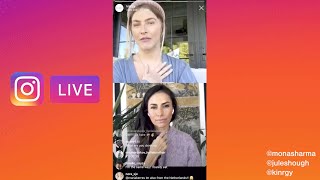
Julianne Hough and Mona Sharma talk about nutrition, wellness, and ashram living. Recorded during quarantine in April 2020, they discuss intentional eating, movement, and mindfulness as paths to healing.
Chapters
Well, you helped me create that, so I'm excited to one talk about that and what I am on personally and my regiment for what I felt like I needed, especially during this time. But before we get there, I just want to introduce Mona and just give you a little background. So Mona is an expert nutritionist, educator and entrepreneur in the health and wellness industry. And she is the founder of of Jicama Life and brings her extensive research on the gut microbiome and its impact on our health and happiness to clients all over the world. I don't know if you guys have seen Red Table Talk, but she works with the Smith family. Mona works with me and so many other people around the world. And we are so excited that she is so generously offered her time and her energy and commitment to helping people's. People's perception of what nutrition and health really is about and bringing it back to the soul level. So thank you, Mona. Welcome, Mona.
Thank you, my love. Thank you so much.
So tell us a little bit about how your story, how you got into nutrition and wellness and how you made your shift.
Yeah, so I think a lot of people, when they start working with me, they expect me to start talking about food right away, right? What diet, what food? I don't think we talked about food until our second or third conversation even. Right. And this has to do because I lived this process, so I have to flashback and share a little bit growing up. So my dad is East Indian, my mom is Danish, but my mom has only ever suffered from severe debilitating autoimmune disease, so rheumatoid arthritis. My dad being Indian and having this foresight, you know, of Ayurveda and healing the body, would take us to live at an ashram every summer. For those of you who don't know ashram living basically is a spiritual center that you can go to. And it's a place where they really, really focus on, you know, how you think, positive thinking, movement, meditation, the quality of your food, being, you know, in a positive environment, being in community. And it was there that I saw firsthand the healing power of food. But of course, like, as a kid, I was told to meditate at 5:30 in the morning. Like, who wanted to do that? I didn't get it right. So flash forward. In my 20s, I started working the typical corporate job scenario. I worked for a handful of luxury cosmetic companies and on paper it sounded amazing. I was able to do makeup for fashion shows, work with celebrities and travel the world and train people that worked in all these glamorous places, but I was 40 pounds heavier. I had two heart surgeries at that time for this electrical issue. Not one doctor, by the way, at that time asked me about my stress, my diet, my life. I had debilitating anxiety. I suffered from lack of fulfillment, like, you name it, right? I was burnt out completely. And that's when I decided to really like, throw in the towel. I took off. I went back to my roots because I remembered seeing, you know, I know about this place, right? And it was at the ashram. I became a yoga teacher, a meditation teacher, but I was forced into the kitchen. And that's where I really saw the power of food. And when I describe ashram living, honestly, you guys, it's really about if you have like a computer web browser open, you're essentially going through each tab that's open in your mind, right? We all have these tabs open in our mind that are consuming us and shutting down every single tab. And what that means. Yeah, it's like this ultimate return to self, self compassion, self love. You're forced to tune in to listen to the what the body is trying to tell you. And. And you know, I think that even in our conversation, how many of us have lived with these symptoms, or I call them whispers, right? And those whispers get louder and louder and louder. For me, it turned into a massive scream and I got sick and I had to completely change my life. So since then, this is how I work with my clients. But I was also very much, you know, in the understanding. People would come to me for weight loss, right? But they wouldn't necessarily be happy on the other end. The celebrities that I worked with, right, you know, they had complete disconnection with food on their bodies and how it made them feel. So I knew that there was something more to it. I ended up becoming an NLP neuro linguistic programming practitioner. So this is really to just get to the root cause of imbalance.
I love that we all do have.
The same choices, right? But the choice is ours that we just have to decide in the same way that you decided one day that it's time to make a change. And once you make the decision, you really already start the process for aligning for this idea, this higher version of yourself. And when you do that, you awaken health that already exists within you, right? So I really think that it's about turning down the noise. It's really about, you know, using self care. It's about using your kitchen, using food as medicine. It's not food is like medicine. Food is Medicine, you know, and, you know, optimizing sleep, thinking about your community, everything that you're creating at Kinergy is all part of this. This, like, full spectrum that has to be looked at to really optimize health for good. Right. It's really a way of being for the rest of your life as opposed to trying a thing for a fad, because we know that they don't work. Right?
Yeah. You know, one thing that has been different about this quarantine time as well is that in the past, I was working, and I wouldn't prioritize the amount of time that I would take to actually eat. I'd be running out the door and grabbing something, or I would be booking meetings during lunch because I never even had a lunch. I would just work through lunch because I'm also just like that. Like, the more I keep going, the more I'm creating energy. And so what's been really interesting about this time is, and I get it, I have a luxury that I am, you know, I am able to work from home, and a lot of people don't have that right now, but. And are still out there working really hard to, you know, be on the front lines for us. But one thing that I've noticed this week, especially in those last couple weeks, is I've actually, like, planned an hour for lunch that I'm actually making my lunch. During that time, I put my phone away and I'm like, really being intentional with how I'm cutting it and not for the beauty. I mean, I love the beauty of everything anyway, the presentation. But I'm doing it as like a, wow, this is real food. And I am going to put this in my body, and I want to be intentional about how I'm processing it and that I'm not just shoving it in my mouth to continue on with the rest of the day. And so I've actually asked, you know, my team, hey, I'm going to take an hour for lunch and I'm going to completely check out. I'm going to. Or check in. I always say plug in and, like, plug out and check in with myself. And. And so that's what been. What's been really interesting, too, is that when this is all over, how do we. How do we maintain this space that we've had to. To let those voices come up and listen and take the time to actually appreciate our food.
You know, imagine if you could get up every single day aligning with your higher self. Right. So really, this work, it tends to be about vibration. I help My clients elevate their vibration. Get out of the thoughts and the feelings that are low, right? Anxiety, worry, tension, fear, and align with the vibration of happiness and joy and peace. That's where healing happens, right? And we know you cannot heal a body that you do not love. So there was no surprise that I wasn't getting better. I was getting sicker, right? So first thing in the morning, try this exercise. You know, think back to a moment when you felt good. And it might have been for, you know, a split second. It could have been on vacation. It could be a picture of yourself when you were a little kid. And you see yourself just like with this joy over your mind and your body. But when you align with that feeling, your body doesn't know the difference between it happening in the present moment versus it happening in the past. So just like that, you've realigned with an emotion going to help you heal, right? And then over time, when I work with my clients, we elaborate on this. It goes from being a snapshot. So like a selfie going off in your mind, a picture that you can go to every morning, just feel that gratitude and that joy. And then we turn it into a movie reel. And the movie reel is think about many moments, think about many things. Think about what you want to create, Think about the feeling that you want. So if you're losing. If you're wanting to lose £20, if you're wanting to get the six pack, if you're wanting to all be happy when, start to think about the feeling of what it will be like at that moment. When you align with the feeling, then it becomes real. I had to align with health and athleticism. I had to align with that in my head first before I could make it a reality. So that's the first thing. If visualization is hard for you, then you've got to move, right? The three pillars that I really take from the ashram are one. First and foremost, obviously, food is medicine, but movement is therapy. It's energy in motion. When I did a kinergy class, I had a complete meltdown right there just in front of everybody else. And it was a release of emotions. People have the same experience when they're on the yoga mat, right? They just get up. It's emotion being released in the body. So move your body first thing in the morning. And if that doesn't align with you, then really go to mindfulness, because mindfulness is the therapy. Mindfulness is what brings us back to the journey every time we get out of alignment. And this could look like, you know, a gratitude practice journaling. Journaling looks like something that you love and you're spreading the awareness around that. And it could just be I have.
So many different things. I love that person of variety. So I have all the different things and I switch it up constantly because I do listen, because if I do the same thing constantly, I get a little bored and so I switch it up. But then I always come back and I always make sure that I'm balanced in a way where I find the equal expression within each of these things that work for me.
You've built a tool set, right? A whole toolbox of things that you can go into when you need them. And I think that's important, right? We are emotional beings, and I think that we're called to doing different things at different moments. And it's really about finding a system that works for you.
More from Mona

Why Women Need to Stop Normalizing Period Pain | Seed Cycling Explained with Kaya Purohit and Yasmin


How Distraction Becomes the Destruction of Your Health with Justin Roethlingshoefer

Why Normal Test Results Do Not Always Mean Your Heart Is Healthy with Dr. Abid Husain



From Ancient Healing to Microdosing: How Mushrooms Went Mainstream with Alli Schaper

The Missing Layer in Healing: Fascia, Trauma, and Why Pain Comes Back with Jason van Blerk

The Missing Link Behind Fatigue, Anxiety, and Inflammation with Dr. Tania Dempsey

