Weight Loss Without Restriction: The Ayurvedic Approach
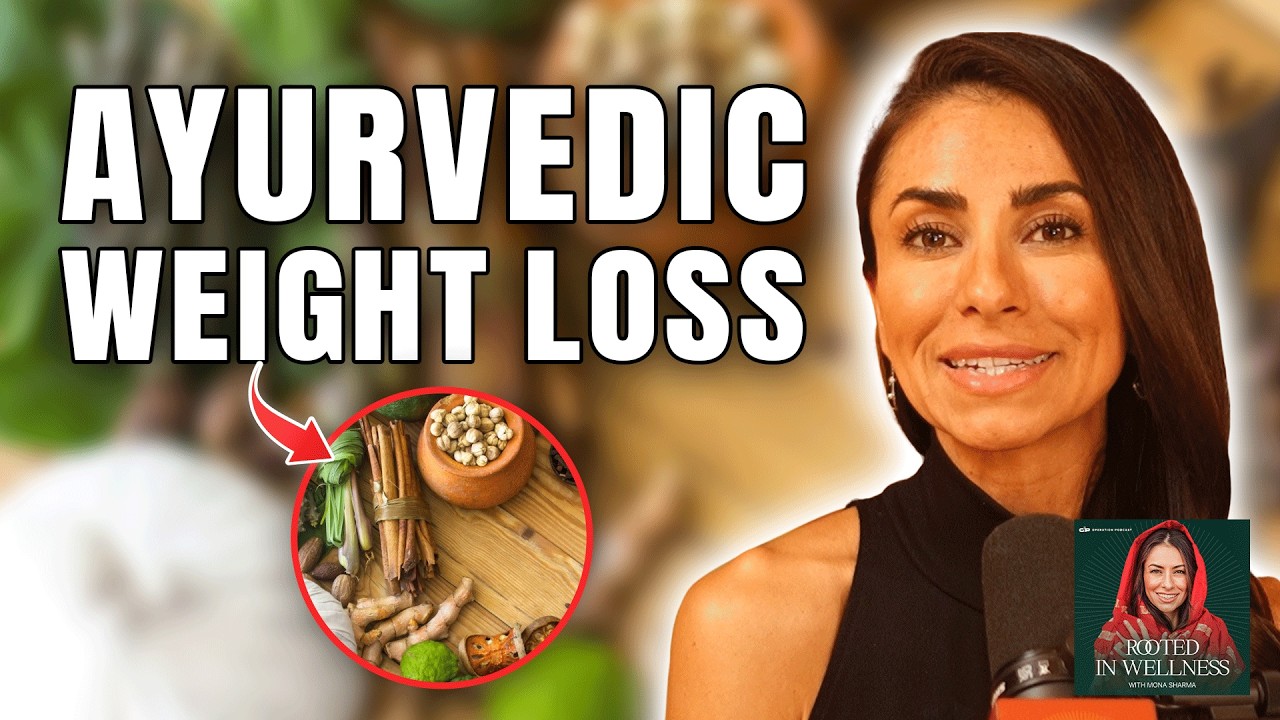
In this episode of the Rooted in Wellness series, host Mona Sharma challenges the conventional "calories‑in, calories‑out" weight‑loss narrative by explaining how chronic stress, elevated cortisol, disrupted sleep, and hormonal imbalances drive cravings, fat storage, and aging. She introduces the Ayurvedic concept of Agni (digestive fire) and argues that weight loss is less about restricting calories and more about supporting digestion, sleep, stress management, and inflammation. After critiquing a TikTok clip that glorifies hunger as a badge of honor, Mona outlines five evidence‑backed Ayurvedic practices: (1) establishing a consistent daily rhythm (dinacharya) to align circadian biology, (2) making lunch the main, nourishing meal, (3) eating at least one warm, cooked meal per day, (4) adding digestive spices (ginger, cumin, coriander, fennel, turmeric, cinnamon) to every meal, and (5) reducing systemic inflammation by supporting Agni and addressing ama (undigested residue). She provides practical weekly steps, a quick “over‑/underrated” rating of common diet tactics, and encourages listeners to personalize one practice at a time, monitor digestion, cravings, energy, and sleep, and treat their bodies with compassion rather than restriction. The episode ends with a call to action to subscribe, share, and connect on social media.
Chapters
Research shows that chronically elevated cortisol, it alters our appetite cues, it shifts your fat storage processes, and it drives cravings for really calorie-dense, mostly ultra-processed foods, right? Things that are fast and easy to grab. And that basically reinforces that stress-related eating pattern over and over again. You might feel poor sleep, which we know chronic stress directly causes, right? And that's going to increase your ghrelin, it's going to decrease your leptin, and that's going to reduce your insulin sensitivity and create a hormonal environment that's primed for fat Storage, but also primed for aging. Hey everyone, welcome back to Rooted in Wellness. I'm so excited to be with you today. I want to start off with a topic that most of us were taught, and honestly, it's something that the wellness industry still reinforces constantly. Weight loss is about one thing: you're supposed to eat less, move more, calories in, calories out. And if it's not working, you are just not disciplined enough. And like, come on, I really want to challenge that. Not to dismiss it entirely, right? Because it works for some people in a certain time, in a certain place. But to ask, is that really the full picture? And does that bring a sense of happiness with what true vitality even means? Because here's what I've seen working with real people and what the research is increasingly confirming: quantity matters. I'm not going to pretend that it doesn't, but it's one piece of a much larger puzzle. The science of Ayurveda asks a completely different set of questions. Not just how much you're eating, but how well you're actually digesting, what your stress looks like, how are you sleeping, and is there chronic inflammation in your body? Are you actually nourishing yourself, or are you just feeling full every single day? They're questions that you need to tune in to about yourself and your physiology. And here's something that really illustrates this. Two people can eat the exact same meal, the same ingredients, the same portions, and have completely different experiences. One is gonna feel light and energized, and the other one's gonna feel bloated and heavy. Why? It's because digestion doesn't happen in a vacuum. It's shaped by the strength of your digestive fire, the quality of your sleep, your stress levels, your hormones, and of course, whatever your daily rituals are in this season of your life. This is where Ayurveda introduces Agni. I'm sure you've heard about this before—your digestive fire. When Agni is really, really strong and burning, your body breaks down food efficiently and it's able to absorb nutrients well. When Agni is weak, which is really common these days for so many of us, the body feels sluggish, bloated. You might feel a little bit more inflamed. You feel heavy after a meal, and it kind of feels like your body is stuck, and you might be feeling like you're doing all of the right things. And when the body feels that way, it doesn't mean that your body is failing you. It's signaling to you. This episode is not a list of foods that you should or shouldn't eat because it's different for all of us. It's about building daily practices that make the body feel safe and nourished and truly supported because that is actually where lasting change comes from. So before we get into the 5 practices that I wanna share with you, I wanna play a video that I came across on TikTok recently. Because it really captures a belief that I think needs to be addressed head-on when it comes to weight loss.
Everybody wants to be skinny, but no one wants to be hungry. That tummy's growling, that's a good thing. That means you're losing weight. Sit in the discomfort. Learn to sit with the discomfort. You want to be skinny? Summer's coming. Lock in, sis. You're hungry?
Go to bed. All right, so I want to be fair. I understand what she's going for, and there's definitely something to be said about distinguishing from real hunger from eating out of boredom or even habit. But the core message that hunger is a discomfort that you push through and that's the price for the body that you want, that framing really concerns me deeply because for so many people it doesn't lead to discipline. It leads to a cycle where you white-knuckle your way through hunger, you eventually break, you feel like you failed, and then you start all over again every single time. I say this to my clients all the time. I hate the expression falling off the wagon. There There is no wagon. And if you're constantly restricting yourself or going hardcore, it's inevitable that your body is just going to scream for attention and healing and nourishment and love, and you're going to give in, right? It's a system that is broken. And here's what the science actually shows. When the body is in a state of restriction and stress, cortisol, your primary stress hormone, it's always gonna stay elevated. And chronically elevated cortisol, which we now know doesn't just affect your mood, Research shows that it actively increases your appetite. It drives cravings for calorie-dense foods and promotes fat storage, particularly around the abdomen, maybe the hips and the thighs too. Your body perceives hunger and restriction as a threat, and it responds accordingly. We've all been there. It does not feel good. And when you get those cravings, gosh, for some of us, Maybe you were like me in the past, it led to something that was like a binge cycle, and then you would binge and you would feel even worse, only to lead you back to the same cycle that was broken to begin with. So, no, you do not have to learn to sit with hunger. You do not have to learn to constantly sit with the discomfort. What Ayurveda offers, and what helped me heal, is something completely different entirely. You can lose weight while feeling nourished. You can make progress without your body feeling like it's under siege. And when the body feels safe and supported and calm, that's actually when it stops holding on. It's actually when your body can feel a sense of peace, so it's not constantly grasping for things that are going to try to make it feel better. And that's what this episode is all about. So let's get into it. 5 Ayurvedic practices that support weight loss. In a really grounded way that is sustainable and connected to how the body actually works. Think of these not as rules, but as invitations. Give them a go, and honestly, just promise me you're gonna tune into what feels good for you. This is always how I help my clients personalize the rituals for them that are going to last. The first practice is rhythm, and I know that might sound completely underwhelming compared to the dramatic protocols that you usually hear about, but Stay with me on this one. Ayurveda has a concept called dinacharya, and this means daily rituals or daily routine. The whole premise is this: your body's actually not designed to guess what's coming next all the time throughout the day. It's designed to anticipate, to prepare, and then respond. In modern chronobiology, the science of biological timing completely backs this up. Research published in Nature Reviews Gastroenterology confirms that the circadian rhythm controls rhythms in digestion, hormones, gut motility, and even metabolism. So the body prepares itself for predictable environmental changes, including the availability of nutrients during its normal feeding window. When those rhythms are disrupted, the downstream effects are significant. Disruptions to circadian rhythms lead to increased adiposity and cardiometabolic risk factors. So think about what an inconsistent day actually looks like for you. Maybe no real breakfast. You got super busy, so you're grazing in the afternoon. You were so hungry at the end of the day, so you ended up having a really large dinner at like 9 o'clock. That caused you to stay up too late. You were scrolling. That caused you to then wake up the next day feeling tired and then running to caffeine and then genuinely wondering why cravings feel out of control or digestion feels unpredictable, even if it was a healthy meal the day before. This has nothing to do with a body that is broken. It just means that the body is dysregulated. It doesn't know when food is coming or when rest is coming or when you're going to feel restored or when you're going to feel nourished. And when the body is uncertain, it holds on and it compensates and it craves despite your best effort. So this means that daily rhythm changes all of that. Stable meal timing supports our blood sugar. A consistent sleep schedule every single night supports our body's ability to to repair. A calm morning supports our nervous system before the demands of a really busy day. So I'm not asking you to overhaul your life. I know life can be really busy and abundant, and especially in this modern-day world that we live in, sometimes it's hard to keep up. It certainly is for me some days too. But what I'm asking you to choose is just one anchor. Could you choose one anchor, like a consistent wake-up time or going-to-bed time this week? Or maybe you're going to schedule your lunches. I do this with clients all the time. Schedule your meals, or one meal if that feels like too much. Maybe you're going to have a morning practice before you go onto your phone because you know that blue light and whatever you're looking at is going to disrupt your morning calm. Or maybe you're going to grab a loved one in your house and decide that this is the week you're going to have a wind-down ritual before bed and connect and feel gratitude or love, something to root you back in, you know, and what you know is the feeling that helps you feel good. All right, so one anchor, just one week, and notice the shifts. Remember, tune in. What if healing your body or making shifts to your physiology could be that easy? It's worth a try. I've seen it over and over again. Once we create the rhythm in our body, the next place Ayurveda looks is meal timing, because when you can eat a meal is just as important as the meal you eat. Practice number 2: make lunch your most nourishing meal. This one surprises people. Especially those who have spent years saying that they save their appetite for dinner. It's often a meal that we look forward to, especially if you have a social life. It's always easier to go out for a bigger dinner. But in Ayurveda, we really understand that our digestive fire, it follows the arc of the sun. So what does that mean? It builds in the morning, it peaks at midday, and then it slowly winds down in the evening. And interestingly, the The science on this is also really compelling. In a randomized clinical trial, they found that eating 2 larger meals a day, a hearty breakfast and lunch, improved insulin sensitivity and promoted greater weight loss than 6 smaller meals a day, even when the total caloric intake was absolutely identical. And the lead researcher, he summarized it by saying an old proverb: eat breakfast like a king Lunch like a prince and dinner like a pauper. That's essentially Ayurvedic wisdom confirmed in a clinical setting, right? And it kind of makes sense. Think about it. In my world as a nutritionist, I teach people about the power of food to be information and energy. Energy for every single cell in your body. When do we need the most energy? First thing in the morning when we wake up, of course, when we have to be on, focused and productive throughout the day. And then that really drifts off at night. We don't need energy to wind down and go to bed. So it just makes sense. So yeah, most of us, and even from a society standpoint, we're taught to do the complete opposite. Have a really light breakfast or skip it, uh, have a rushed, uh, lunch at your desk, have caffeine in the afternoon, and then a large dinner right before you sleep. And we wonder why we're bloated or sleeping poorly or waking up multiple times throughout the night or feeling bloated or heavy. And of course, craving sugar by 3:00 PM or caffeine. These things aren't random. It's a pattern that we can recognize from trends that aren't serving us. So it really affects our sleep and our morning appetite and our energy and our cravings for the entire next day. And these are rituals that we get used to over time, rituals that we affirm. It's the way that we become. It feels so normal that doing anything else feels incredibly different or really challenging. So considering this, everything is downstream of everything else. So the experiment again, for one week, make lunch your most complete and satisfying meal. Prioritize a clean quality protein, cooked veggies, healthy fats, fiber, some warming spices. This isn't a diet plate. This is a real grounding meal. And then let dinner be something lighter, maybe a little bit earlier, possibly something that you can pay attention to and schedule. I think that you're going to be surprised at the results. Over some time, it took me some retraining. I used to eat dinner from these really big dinner platters, but now at dinner I actually eat my dinner from a bowl, and I feel really full after. I feel satiated. And if I do have to go back for more, then I trust my body. But more often than not, I don't need more energy at night. Okay, so now after meal timing, Ayurveda looks at the quality and the temperature of what you're eating, because we all know not all healthy food is easy for your body to process. Practice number 3: Choose warm, cooked, easy-to-digest meals. What are some of the things that we're used to? Iced cold smoothies, giant raw salads, iced matcha, iced coffee. They've become the visual language of eating healthy. They look super clean, they're light and virtuous. But here's what Ayurveda would say, and what makes a lot of intuitive sense, honestly. So when you think about it, cold raw foods are not always the most supportive choice for everybody. Or every season. Raw foods, you felt it, they take significantly more digestive effort, right? Cold temperatures we know can dampen that digestive fire, and if agni is already struggling because of stress, poor sleep, or your lifestyle demands, now you're asking for a low flame to cook something and heat something up that needs to fully burn for— in order for it to break down and move through the rest of your system. This shows up in recognizable ways. Ask yourself if you've ever felt bloated after meals, if you get constipation, if you feel heavy or scatterbrained or even fatigue, or maybe you have cravings that don't actually match how much you've eaten, right? It could also manifest as a feeling of like, I'm full, but I'm so not satisfied, right? You just, you want something else. When we think about foods that are warm and cooked, they're a lot easier to digest, right? What happens when we get sick or when our body needs to heal? We go for warm soups and stews and maybe some roasted veggies or sautéed greens with warm spices or warm beautiful grain bowls. These are all deeply nourishing and less demanding on your system. Maybe the grains not for everyone, but warm bowls, right? So even swapping iced water for warm water or room temperature water or herbal teas during meals can actually make a meaningful difference for a lot of people with sensitive digestion. So I'll coach my clients on avoiding any ice drinks at the table, and instead, maybe before a meal, or the first thing that you do when you sit down at a restaurant, is to order some hot water with lemon. Maybe you're traveling with some ginger tea for yourself so that you can start to ignite that fire. And this isn't about never eating a salad again. I love salads, but I feel better digesting them at certain times of year, and certainly when I'm not under stress, right? So it's really about So, asking what your body needs. If you're somebody who's suffering with digestive symptoms, then gosh, tune in. Why not give your body the things that it could use to genuinely feel supportive, to take a little less stress off of whatever's happening within the system? So think about this: one swap. Replace one cold meal per day with something that's warm and cooked for 7 days. That's the whole ask. That's it. Swap out something cold for something warm. And even with the most beautiful, warm, nourishing meal, there's one more layer that we have to address, and that's what you add to that meal. Practice number 4: add digestive spices to every meal. This is probably my favorite practice to talk about because it completely reframes this conversation. We have been taught and so conditioned to think about weight loss in terms of removal, everything that you can take away, all the restriction, cutting all the carbohydrates, restrict the calories, eliminate the sugar, and everything's about taking away, right? But Ayurveda asks a different question entirely: what can we add to better support the body to work better? Such a different approach. It feels a lot better just by saying that, right? One of the most powerful answers that any Ayurvedic practitioner will say is the power of spices.. In Ayurveda, spices are not decorative, they are intentional medicine. I always say that it's nature's pharmacy, right? Everything that's grown from medicinal spices that you can store in your cabinet can really support your body. And traditionally, these herbs and spices were actually used to support your digestion, to support your circulation, to support your body's blood sugar balance, to create warmth maybe in a cold or damp system, and the body's capacity to actually absorb what you're feeding it, right? You want to be able to digest, absorb, and assimilate all of the nutrients that you take in, right? You have to make sure that digestion is primed, and using ingredients like herbs and spices are so supportive. And again, look, the research supports this— not that we need any more clinical trials to prove what ancient wisdom has known all along. There are so many trials that have found things like curcumin, which I know that you've heard of. It's the active compound in turmeric. It showed massive benefit uh, with the most evidence in metabolic health and inflammatory conditions, right? A lot of people will use a curcumin supplement to lower inflammation to the body. Turmeric has been used for thousands of years in Ayurvedic medicine to treat digestive disorders, joint pain, and inflammatory conditions. And modern research is really beginning to confirm all of these properties. So if I were to start working with you one-on-one right now, one of the things I'd coach you on is to build a spice cabinet that you absolutely love. So here's a quick guide to the ones that I reach for most. Ginger. If you love it like me, ginger is warming, it's stimulating, it's excellent before or during your meals. You can add it to warm water first thing in the morning, you can make ginger tea, you can chop it up finely and add it to stir-fries or curries or dressings.— it's incredibly therapeutic for the system. Cumin. This one's my mom's favorite. One of the most digestive, supportive spices that there is. Toss it onto veggies, stir it into your one-pan meals, stir it into soups, add it to your eggs or to lentil dishes. It's really yummy heated up with a little bit of ghee or some olive oil in a pan. Adding cumin seeds also can be therapeutic if you're adding it to things like rices or dressings. Coriander is something that's also therapeutic. Coriander is a little bit different. It has more of a cooling and digestive effect, and it's especially useful if you tend to run hot or if you feel inflamed. Coriander tea is something that I'll use for a lot of my clients who run really hot, or if they're going through a period of a lot of inflammation. First thing in the morning, you just take some seeds and you pour some hot water on top, but it's actually really great to cook with as well. Fennel or fennel seeds. This one was my dad's favorites, and it's particularly helpful after meals. Maybe you're somebody who notices that bloating or gas is a recurring pattern for you. What you could do is just take a small pinch or a small teaspoon of fennel seeds, and you can actually chew them. This is a ritual that you'll see at a lot of traditional Indian restaurants. As you walk out of the restaurant, you take a teaspoon of fennel seeds and you chew them in your mouth If that's too much for you, you can add fennel seeds to some hot water and steep it as a really yummy tea. Feels super nourishing. I also give fennel seed tea to my kiddos if they've got a sore belly. Turmeric, of course, as I mentioned, pair it with black pepper and a healthy fat for optimal absorption. Turmeric is amazing. You can add it to, to anything. You can cook it with veggies. It works really well in an omelet. Stir it in and heat it up with some ghee or some olive oil as well. You don't need a lot of to be supportive. There are really amazing turmeric teas out there also, so maybe you're going to merge that with a hot meal that includes some good quality fats in it and some pepper. Cinnamon— one more of my favorites. Maybe you've seen me post over and over about my cinnamon bark tea, because when you boil cinnamon bark, it actually tastes really sweet. It goes this beautiful caramel color. Cinnamon is really great for blood sugar support, so amazing after a meal to help curb a sweet tooth, but also to give you that blood glucose balance, merge that maybe on a walk at night after your big meals. And of course you can add it to the things that you bake. Maybe you can sauté some warm apples first thing in the morning with some cinnamon, some ghee on top, or even a morning tea. They all work. And look, you don't need all of this at once. If you're not accustomed to using herbs and spices, just pick one out of the ones that I just listed. Ginger tea, maybe before breakfast. Cumin, on your lunch, fennel seeds or fennel tea after dinner. Make it super simple. Put it in an area that's accessible. Maybe get some glass jars in your, your house that you love looking at. You can put them at eye level so that you're reminded to use this nature as medicine within you. And once we are supporting digestion from the inside, the final layer is one that trips up most people because it's the layer that no one talks about. Inflammation, or the why behind inflammation. Practice 5: Reduce inflammation by supporting agni. This practice is for everyone who feels like they're doing everything right, but maybe your body's just not responding, or not responding the way that it used to. When weight loss feels stuck, the instinct is to do more, to restrict more, to push harder, to follow a stricter plan or go hardcore. That used to be my blueprint. Gosh, even moving into perimenopause, I thought that in order to see changes again, I had to push harder or restrict the way that I did when I was a lot younger. The body doesn't respond to that. It just, it doesn't. And we know that if it does respond, it doesn't respond for long until you're looking for another solution. Ayurveda, again, it pauses and it asks, is the body inflamed? Is it depleted? Is it constipated? Is it stressed? Or is digestion overwhelmed? Because if it is, then more restriction adds load to a system that is already struggling. Let that just land for a second, okay? If you know that maybe you're in a season that feels stressful to you or overwhelming, and your body's feeling more inflamed, and you could be like me, A-type, and you tend to commit to doing a lot of things, and you think, "Well, I'm just going to commit to doing this hardcore," or commit to doing a really challenging fast or a diet or whatever it is, When the body has that inflammation from stress, and then you go in and you have practices that add more stress to it, you're only going to burn out. There's a concept in Ayurveda called ama. Ama means essentially undigested residue, undigested residue within, right? And we think about the concept of ama accumulating over time. So think about metabolic waste that accumulates when your digestion isn't working efficiently. And ama, by the way, it's not just about food. It's the byproduct of a system that has taken on more than it can actually process. So whether that is the food that you're consuming, the stress or the workload that you're taking on, the emotional intensity that's happening around you— gosh, it could be the accumulation of just like too much anxiety from, you know, things that you're visually ingesting through social media and the news. Basically, ama just shows up as overload. It shows up as heaviness. It can feel like brain fog, sluggish elimination. Maybe you get persistent bloating and fatigue that doesn't resolve with rest, even after an 8-hour night of sleep. You might notice in the morning—and I hope you look at your tongue—a coated tongue of white first thing in the morning, a face that feels puffy or inflamed. For me, I instantly know When I have this accumulation or stress within my body, my joints get really tight and sore first thing in the morning when I wake up. I move my hands and it's the first thing that I, that I feel. Think about what your symptom is of your body showing you that there's inflammation within. That feeling of being stuck there no matter what you're doing, and maybe you were trying to eat really well or trying to move your body and you feel like you're doing all the right things. The point is, is that that is not the signal for you to start pushing harder. Pushing harder does not clear ama, but supporting your agni, again, does. And this is where stress really becomes impossible to ignore. Research shows that chronically elevated cortisol, it alters our appetite cues, it shifts your fat storage processes, and it drives cravings for really calorie-dense mostly ultra-processed foods, right? Things that are fast and easy to grab. And that basically reinforces that stress-related eating pattern over and over again. You might feel poor sleep, which we know chronic stress directly causes, right? And that's going to increase your ghrelin, it's going to decrease your leptin, and that's going to reduce your insulin sensitivity and create a hormonal environment that's primed for, for fat storage but also primed for aging. Right? Whenever I'm speaking at conferences, and I've shared this story before, I always ask, like, on a scale of 1 to 10, this is something I ask my clients every day, what is the number of stress that you feel? 10 being really high. And more often than not, you know, a lot of people put their hands up at 7, 8, or 9, and it's followed by laughter. And I totally get it. Here we are, oh my gosh, we're all so stressed. We're acknowledging that we're all stressed. When I'm working with someone one-on-one, I ask a follow-up question. Now I say to them, and I want you to answer that question for yourself, so on a scale of 1 to 10, what's the number of stress that you feel consistently? Be honest. And now, if I were to look you in the eye and say, all right, if I were to step into your body, would I feel that same number of stress, or would I feel like, oh my God, she feels like this is like a level 10 stress? I feel like my, my body is plugged into an electrical outlet because you have become so accustomed to living with that level of stress for so long. And when I say that to clients, sadly, more often than not, I'm met with tears because for so many of us, and myself included, living with stress, it's almost like our threshold grows and we have adapted to living with higher stress levels than ever before. So how can we expect our diet and our movement to working for us when the inner environment is calling for help? It's sending out an SOS. It's so inflamed, and it might not be coming from food. It's coming from lifestyle, from poor sleep, from feeling like you're constantly at war with your body, or like you can't feel, or like you feel like you, uh, can't keep up with your life, right? Inflammation. So ask yourself, what can you cut out? What are the sources of inflammation within your life? And when we put this through the lens of digestion, if I was your nutritionist working with you right now, Take me through your kitchen. Take me through your cabinet. Take me through your pantry. What wouldn't you want me to see as something that you're consuming regularly that you know is causing you to feel more inflamed, that you know isn't serving your health, that you know isn't fueling the version of you that you're desiring to feel every single day? And maybe you simply start with acknowledging that you're gonna start adding in some digestive spices to put out that fire within. Maybe you you are going to decide that you are going to eat dinner earlier with your family or with a friend, or you're going to make a commitment within your household to go for a walk after meal, or you're going to add some warm ginger or cumin coriander fennel seed tea, right? CCF tea is something I prescribe to a lot of my clients. You can consume it at the bookends of your day. Cumin seeds, coriander seeds, fennel seeds boiled and steeped in some water morning and night could feel incredibly supportive for you. Take the pressure off and go with whatever suggestion that I've given you so far that feels like, "Yeah, I could try that. I could do that." Supporting your digestion and all of the rewards that come with that— it's not a diet, it's not a tactic, it's actually the deepest act of self-love. Before the protocol, let's do a quick overrated or underrated round on the weight loss tactics that I see most online. And upfront, very few of these are actually purely good or bad. The question that actually matters is, is this supporting your digestion, your hormones, your blood sugar, your nervous system, or is it adding more stress to a body that is already running on fumes, running on empty? All right, the first one: 30 grams of protein at breakfast. Underrated. Genuinely supported, actually. So we know protein at breakfast, it stabilizes your blood sugar and it reduces your cravings later on in the day. You're actually going to feel more satiety throughout the day. There is an Ayurvedic nuance, of course. How you get there matters. A warm egg scramble with lots of spices lands very differently than an ice-cold protein shake, right? Just feel how that would feel inside your body. It's a no-brainer. These could both have the same macros and grams of protein, but very different digestive experience within. So choose wisely. Fiber maxing. Underrated in principle, overrated in execution though. So fiber is so important for elimination, so important for our blood sugars, so important for our gut health, so important for diversifying the microbes and all the incredible bacteria within you. I often say that fiber is the future. However, there's a caveat. If digestion— if your digestion is already compromised, aggressively increasing raw fiber or fiber supplement can actually worsen You're bloating significantly. So when you think about building your fiber, you want to do this slowly and over time. If I was working with you, I would make sure that the fiber that you're consuming to increase is going to be cooked, is going to be blended, is going to be turned into soups or stews, or it's going to be drank through a soup. Take your time building up your fiber goals. When you do, you're going to notice a massive shift in your bowel movements, which is going to feel so rewarding. The fiber will pay off. You will feel more full and satiated too. Next, berberine as nature's Ozempic. Overrated as a standalone fix, right? There's definitely real research behind berberine for blood sugar and metabolic support, but calling it nature's Ozempic is just— it's marketing. It's not medicine. No one supplement is going to replace foundational habits around healthy eating and healthy digestion. Apple cider vinegar before meals, slightly underrated, with caveats again. All right, so some evidence supports, um, that taking apple cider vinegar before your meals is going to support your blood sugar response. In an Ayurvedic lens, the sour taste can actually support you in even stimulating your digestive fire. But if you have acid sensitivity or digestive inflammation, it can also aggravate things, right? Like, just think about it, vinegar is intense. It burns your throat. So if you're trying apple cider vinegar, I'll often do an apple cider vinegar test with a lot of my clients to see if they actually have acid reflux or not, uh, to see if it gives them acid reflux. And what I've noticed over 16 years is that most people don't have a problem creating excess acid. They're not making enough. So you can do an apple cider vinegar test for sure. But promise me you're going to dilute it and have a chaser of water ready afterwards to soothe and rinse everything down so it also doesn't impact the enamel of your teeth. And this definitely isn't a habit that you want to do long-term. All right, eating veggies before carbohydrates, totally underrated. All right, this is your go-to. It's so simple, it's well supported, it's a low barrier when you think about optimizing, um, how full you're gonna feel, your cravings, and even the types of foods that you're going to reach for. So when you start your meals with fiber before carbohydrates, so let's say you're gonna go out to dinner, I would prescribe to you to order the sides of veggies as your starter. Tell them to skip the bread basket, skip the, uh, appetizer menu, just order the veggies. So maybe roasted cauliflower or broccoli or asparagus, whatever veggie that you want, order those to start before you order your meal. And if you're not doing an appetizer, then start by eating the veggies on your plate before the potatoes or the pasta or the rice. All right, starting with fiber before carbohydrates, it does actually blunt the spike of blood sugar, and that's worth building in, right? So definitely start with ordering veggies and consuming your fiber before your starches. All right, 100 grams of protein per day. Ugh, this is so context dependent. In my community, I've been so kind of against against the, the protein maxing because it really depends on the person. This can be totally supportive for some bodies, but not all bodies. It can feel obsessive for a lot of people too, and like disordered eating for a lot of people when they're so protein-focused that they're not enjoying their meal. They're constantly focused on, on macros. If that feels stressful, then it's certainly not for you. All right, so if you're hitting those protein numbers already and you're doing tons of cold protein shakes. Protein powder is an ultra-processed food, right? It's a supplement, actually. It's not a real food. Just remember that. Maybe you're doing ultra-processed protein bars, and even the healthy ones, you have to think about that too. How are you getting the source of protein? Um, the overall quality of your diet really has to be the, the question. Look at the sources of protein that you're consuming. Does eating more protein make you feel good? Is it serving your health goals? And most importantly, are you having regular bowel movements, because if you're not— I know that this is really gross to think about— just think about how much animal protein that you could be eating in a day. If you don't have a bowel movement the next day, or even 2 days, all of those dead animals are just putrefying in your system. All right, so be cautious with that. Make sure that this protein thing— yes, it's important, yes, it's essential for longevity, but we've got to do it mindfully. Next Next, volume eating with huge salads. This is overrated for so many people, especially for anyone with sluggish digestion or hormonal imbalances. Large volumes of cold, raw, low-calorie foods can really leave your body feeling depleted, unsatisfied, even after like these massive, enormous portions. I remember when my health was at its worst, I was on the Atkins diet and I was often hitting up, um, like massive salad bars and just taking absolutely everything. I was constantly bloated, constantly gassy, constantly craving foods, never feeling satisfied. So the fullness was not nourishment. Those are two completely different things, right? So again, be mindful. Does it feel good for your constitution? Cutting out seed oils. Oh, this is a good one. This one's definitely overrated. As the singular villain, it's worth being mindful of how many seed oils that you're consuming and how they've been processed in excess, right? The fearmongering that's happening right now is completely disproportionate. Focus on overall fat quality, all right? So good quality sources of fat, things like extra virgin cold-pressed olive oil, maybe some clarified ghee, avocado, avocado oil, nuts and seeds. Let's not blame the seed oils as the entire conversation. The problem is more so is how many processed foods in a day are you eating with those seed oils that have been heated to such high temperatures that they could cause more oxidative stress within. There's lots of studies and sciences out there, but again, just because you hear about something in the media doesn't mean that it's 100% true. So many of our ancestors use seed oils every single day. And they were therapeutic because they were used raw and cold-pressed, where there was higher medicinal value to them. Low carbohydrate or no carbohydrate meal plans— this one's definitely overrated as a universal solution, okay? It could be helpful for some, and it could also just be helpful for some during a certain period of time. But from an Ayurvedic perspective, carbohydrates are not the enemy. And when I lost my 45 pounds after my heart surgeries and beta blockers and I went to live at Mona Sharma, I was eating a high-carbohydrate diet. I was shocked, and I really had to go through like the reframe of carbohydrates were not the enemy. I had to retrain my body on like loving them and feeling the nourishment from them. Long-term elimination— this goes for any food category, right? It can actually deplete you. And when we think about long-term elimination from carbohydrates, this could deplete your energy, it could disrupt your hormones, it could impact your nervous system, it could cause cause poor quality sleep. And these are things that would cause more reactivity and inflammation within the body. So get to know the carbohydrates that make you feel good. Notice the carbohydrates that actually fuel your energy versus depleting you. Meal prepping the same meals every single day— this one's underrated for consistency, overrated for sustainability, right? I think that for so many people I work with, reducing that decision fatigue, it really like I said, we are all so busy, so busy, busier than ever before. But eating the identical food every single day can actually disconnect you from what your body is actually asking for. It can distract you from what intuitive eating is, and it can also deplete the diversity within the gut microbiome. So with my clients, I try to teach them variety and diversity, variety and diversity of specifically the plant fiber types of foods that you're consuming every single week. And when you go grocery shopping, just try to avoid being a creature of habit. I often coach people to buy what's on sale that week because it forces you to buy, buy new foods. And those new plant fiber foods will be grown in different parts of the world in different soil where you're actually getting the microbes and the benefits from, from the soils as well. So try to build in flexibility If you were working with me, then I would love to see more variety, and it might cause some digestive discomfort to begin with as your body takes in new nutrients, but remember, you're taking in new nutrients for your body to thrive. Replacing meals with smoothies or shakes. Ugh. I love smoothies, I'm not gonna lie. So what's my answer? It's overrated long-term. Liquid meals don't register the same way as whole foods do for for satiety, right? Chewing—that initiates your digestive process chemically, not just mechanically. And if we're having cold blended meals that are also some of the hardest to digest on a sensitive system or a stressed-out system, then you might be doing more harm than good. Eating only whole foods for 30 days—pfft! Underrated reset, if the framing is right for you, okay? So, coming back to real simple food is genuinely supportive. If I could go through your kitchen and your cabinets and really look for all the foods with either no ingredient labels or minimal ingredients, like 1, 2, or 3 things—water, tomatoes, salt, that kind of thing—then they could be so much more supportive for you, right? It's less for your body to have to assimilate and organize. But when you're approaching Whole30 with rigidity, with an end date, with restriction, with intensity, maybe during a really stressful period of your life, life, that's gonna lead you right back to old patterns on day 31. If I were working with you, I just don't want you to go on any type of a diet that you feel like you need to cheat from. All right? Build something sustainable, not something to survive. And maybe incorporating some parts of Whole30 on certain days of the week could be a really nice entry point until you get used to it. All right. Now that I've walked you through all 5 practices, here's how I would actually like you to put them together into something that you can start start this week. All right, step number 1: start the morning warm. Before the coffee, before you look at your phone, start with something warm. This could be just warm water, warm water with lemon, a pinch of sea salt. Could be ginger tea, or that simple cumin coriander fennel seed tea that I taught you. This signals hydration and digestive warmth first thing in the morning. It's also going to support your elimination. Never rely on coffee to give you your bowel movement should happen with simple hydration and waking up by aligning your circadian rhythm. All right, and it really gives your nervous system a grounded opening before the day demands so much of you, and of course before that caffeine might kick your cortisol into overdrive. Step number 2: make lunch your main meal. Give it a go. Build a real lunch— good quality protein, high quality veggies, there's your fiber, healthy fat, and a spice to. Something genuinely satisfying. Think about the things that you love. Step away from your screen, even for like 15 minutes if you can. Let your body actually receive the food. This is your main nourishment event of the day, so treat it that way. Recently at a retreat, we would stop and actually look at our food, right? Take in the colors. Look at the nourishment. Think about how many steps it took before that food got onto your plate, or is going to keep you alive and help you thrive. Live. Take that in free of distraction. Digestion takes a tremendous amount of energy, so put your body in a relaxed state so that you can actually digest your food. Step 3 is one warm cooked meal a day. If you're someone who's relying heavily on smoothies, if it's a deeply rooted ritual that you don't think you can break away from, or maybe you're someone who likes cold snack plates or raw salads the way that I try to swap out just one meal for something that feels warm. That's something that's cooked, that feels easier to digest. Think about a bowl of soup that you love, a stew, sautéed veggies, maybe with some eggs on top, a simple bowl that you can add some grains to with some roasted veggies and spices, but just one swap, a warm nourishing meal. To really personalize this one for my clients, I ask them to think about something nostalgic. So think about something that your mom or dad or grandfather or grandmother would've made, something traditional, maybe from your ancestry. And it's that one warm, slow-cooked meal that tends to bring a smile to your face, that makes you feel super nourished. Step number 4, 3 breaths before you eat. That's the entire practice. So at the retreat, we stopped, we looked at the food, we put ourselves into gratitude, and we took 3 3 breaths before we ate. It helps to shift your nervous system out of fight or flight into rest and digest. These 3 breaths for at least 1 meal, just 1, is enough to shift your nervous system out of that go, go, go, go, go where you cannot digest food. Your body has to be in a state of rest to be able to do its job. And look, it's just 3 breaths. It is so simple to do before you eat. It's just a muscle that you've got to practice so that you build in a new ritual. Well, step number 5, close your kitchen earlier. Aim for a lighter, earlier dinner when life allows it. Leave 2 to 3 hours between your last meal and when you go to bed. Give your body the space to finish digesting before your overnight repair begins. When we eat too close to going to bed, while we're supposed to be going into that deep sleep, your body's still digesting food, which means it's working. It cannot go into that deep restorative sleep. Sleep. And that's going to result in morning bloating, uh, it's going to prevent you from waking up feeling rested, and that's going to reinforce like the whole system that we talked about at the start. So early meal, early bed is the ultimate reset. And when we think about doing any of these suggestions, remember it's never about perfection. All right, unlearn that you have to be perfect with healthy living and the way that you eat and the way that you drink and what's on your plate. Just unlearn that. This is life. Life is It's supposed to go just like this, all right? But just start tuning in. Tune into the quality of your digestion. Tune into the real cravings your body's actually having. Tune into your energy after you eat, how you're sleeping, if you're sleeping well, how you wake up first thing in the morning, your mood with others. I promise you that over time with practice, when you feel into the body, when you align your circadian rhythm the way that it should be for you, with warmth and real support, that's all the data that you'll ever need. And when you're in tune with your own body's data, you don't need everyone else's science and recommendations. You personalize so that you become the CEO of your own body. All right, before we close, I want to leave you with something to carry into this week. Weight loss can become such a heavy and exhausting mental battle. I live it. With so many of my clients because I've been there myself. The greatest gift for me was going to the ashram and working with an Ayurvedic practitioner who's there to help me unlearn what wasn't working for my body. And what Ayurveda keeps asking us to do is to keep coming back, back into the body, back into the partnership with ourselves. The fact that our body's communicating with us every second of every single day, it's communicating It's not about creating war against ourselves or criticizing ourselves or constantly wishing that we were different. Our body is such a gift. So this week, hold on to this: your body does not need to be punished into balance. It needs to be listened to and nourished and really supported at a cellular level with consistency. I've said it a thousand times: eat, live, and breathe like you love yourself. And it sounds insanely selfish, but when you treat yourself this way, way, you're able to pour into life and to those you love so much more. So, before each meal this week, ask yourself one question: How can I make this meal both more enjoyable and more nourishing? More enjoyable and more nourishing. Not perfect, not compliant, not clean enough, right? Not something that's Instagram-worthy, but just enjoyable and nourishing. Both at the same time, because that is what sustainability actually feels like from the inside. So, what does that feel like again? What are those 5 practices? Daily rhythm, meal timing, warm cooked meals, digestive spices that you love, and supporting your digestive agni to reduce inflammation. These are not hacks, they're not trends, these are real time-tested, body-honoring practices that work because they work with your physiology and not against it. You don't need to implement all 5 at once. That's not what this is about. Pick one that feels the best, try it for 5 days, and pay attention to your digestion, your craving, your energies, and the way that you feel in your body when you stop fighting it and start supporting it. That is the shift. That is when my clients step in, uh, step away from dieting into becoming healthy living. If this episode resonated with you, please go and follow or subscribe on Apple Podcasts or Spotify so that you never miss an episode. All right, everyone. If this episode resonated with you, please follow or subscribe on Apple Podcasts or Spotify so that you never miss an episode. And if this felt like something or someone you love needed to hear, then go ahead and share it with them. Leaving a rating or a review, if you're feeling generous, of course, it really helps more people find the show and genuinely means everything to me. Thank you so much for being here. Please drop me a note, send me a note on social, so that I connect with you there.
More from Mona

Why Women Need to Stop Normalizing Period Pain | Seed Cycling Explained with Kaya Purohit and Yasmin


How Distraction Becomes the Destruction of Your Health with Justin Roethlingshoefer

Why Normal Test Results Do Not Always Mean Your Heart Is Healthy with Dr. Abid Husain



From Ancient Healing to Microdosing: How Mushrooms Went Mainstream with Alli Schaper

The Missing Layer in Healing: Fascia, Trauma, and Why Pain Comes Back with Jason van Blerk

The Missing Link Behind Fatigue, Anxiety, and Inflammation with Dr. Tania Dempsey

