Digital Technology and Women in Academic Publishing: Bracing Challenges and Opportunities
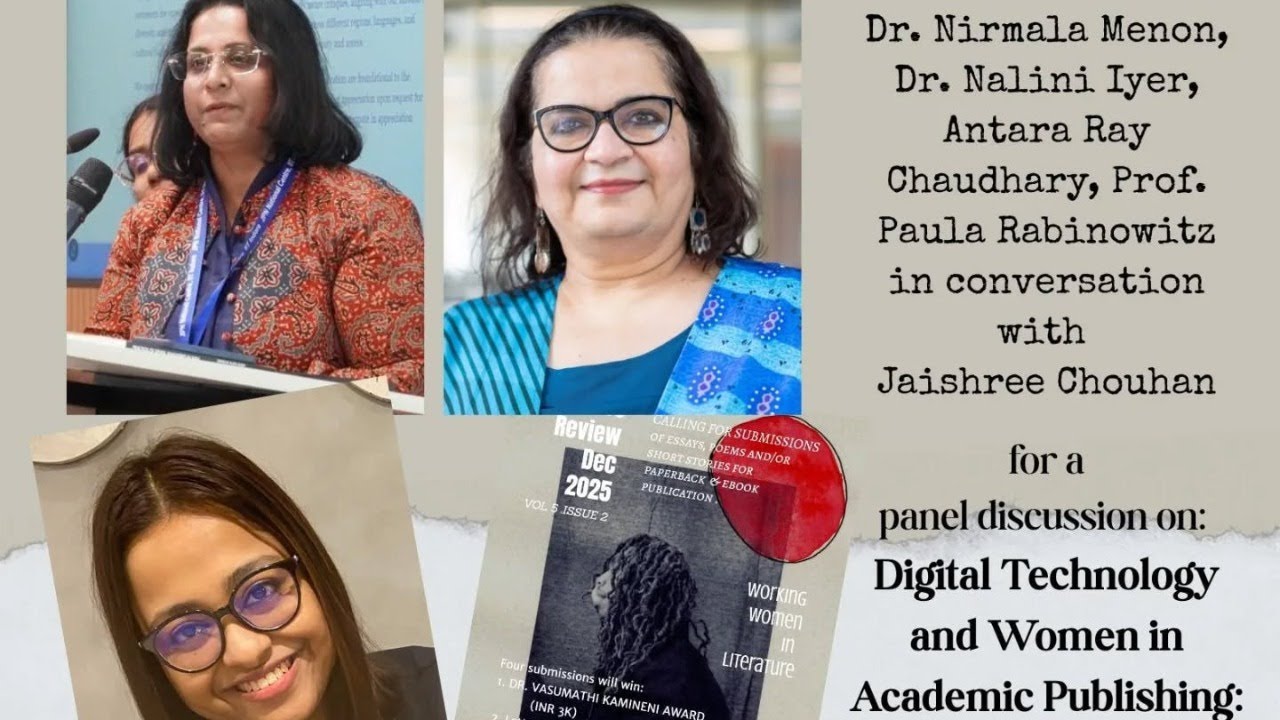
The recorded panel, moderated by Jayashree (University of Rajasthan), convened four scholars—Prof. Paula Rabinowitz, Prof. Nalini Iyer, Prof. Nirmala Menon, and editor Antara Ray Chowdhury—to examine how digital technologies are reshaping academic publishing for women scholars in the humanities. The discussion traced the material history of publishing from mimeographs and Xerox to online platforms, highlighting how each technological shift opened new avenues for visibility while also creating new barriers. Participants described concrete transformations in their own work: Rabinowitz recounted a career that moved from hand‑typed flyers to fully online encyclopedias; Iyer detailed the digitisation and indexing of South Asian Review, the surge in submissions, pay‑wall dilemmas, and nascent AI concerns; Menon outlined efforts to build multilingual, open‑access infrastructures in India, the scarcity of university presses, and the promise of digital humanities labs; Chowdhury explained Routledge’s back‑list revival, the role of search‑engine optimisation, and gender‑bias risks in AI‑driven publishing. The panel also fielded audience questions about the future of post‑colonial scholarship, Anglophone hegemony, and advice for early‑career women researchers. Throughout, the speakers emphasized both the democratising potential of digital tools and the persistent structural inequities that women face in academia and publishing.
Chapters
Fellow at the Department of English, University of Rajasthan. Uh, I welcome you to the TMYS Review project series on working women. TMYS Review December 2025 will explore, uh, the theme of working women in literature. We're calling for the submission of essays, poems, interviews, and short stories under the project. To know more about, uh, the submission guidelines and the project architecture, please visit www.tellmeyourstories.biz. This evening, I consider myself very, very privileged to be in company of our esteemed panelists, uh, Professor, uh, Paula Rabinowitz, Professor Nimla Menon, Professor Nalini Iyer, and Miss Antara Ray Chaudhuri, uh, who will shortly share their views with us and insights with us. Uh, the topic for today's discussion is digital technology and women in academic publishing, bracing challenges and opportunities. We will try understand how women professionals in academia and publishing associated with academia are adapting to the new challenges and opportunities thrown by the new media transcending in working fields in terms of their socio-cultural stations and professional positioning. Before we begin, I would like to introduce our guest speakers. This is a formal introduction of everyone. So first speaker for the session is Professor Paula Rabinowitz. She has been a professor emerita of English, you know, English at the University of Minnesota and was founding editor-in-chief chief of the Oxford Research Encyclopedia of Literature. She authored 4 monographs on 20th century American political and popular cultures, including, uh, for— including the award-winning American Pulp: How Paperbacks Brought Modernism to Main Street. Professor Ebenowitz also co-edited 7 books such as Habits of Being series, uh, series and Writing Red. Her essays appear widely. She received a Mellon Postdoctoral Fellowship 2 Rockefeller residencies, and 2 distinguished Fulbright professorships in Rome and Shanghai. She resides in Queens in New York. We are so delighted to have you on this panel, ma'am. Thank you so much for joining us today.
Thank you for that lovely introduction.
Oh, ma'am, we are privileged to give this introduction. So our next panel for the session is Professor Nalini Iyer. Nalini Iyer is Professor of English at Seattle University. She teaches courses in postcolonial South Asian and African writing, diaspora studies, transnational feminism. She is the author-editor of 5 books on South Asian studies. She has also published articles in Ariel, South Asian Review, and Tulsa Studies in Women's Literature. She's the chief editor of South Asian Review. Welcome on board, Professor Iyer. It is our absolute privilege to have you here.
Thank you for the invitation.
The next speaker for the session is none other than Professor Nirmala Menon. Professor Menon, Professor of English at IIT Indore, leads the Digital Humanities and Publishing Research Group, chairs the Jayaprakash Narayan Centre, a National Centre of Excellence in the Humanities. Her interdisciplinary research focuses on postcolonial studies, digital humanities, multilingual publishing, and decolonizing knowledge infrastructure. She authored Migrant Identities of Creole Cosmopolitans: Cosmopolitans and Remapping the Postcolonial Canon, co-edited India's first multilingual electronic literature volume, is editor-in-chief for Digital Humanities Intersections. She serves on editorial boards including Digital Humanities Quarterly and Routledge Series, founding president of Dharati, that is the group, and former Centernet VP. She also serves as an executive and advisory boards and leads major funded research projects. We are truly excited to have you here among us, Professor Menon, and looking forward to have an engaging and insightful session with you. Our next speaker is Ms. Antara Ray Chowdhury. Ms. Antara is an editor with over 12 years of experience in academic publishing industry. And currently she works on Routledge Revivals program, where she reissues out-of-print and unavailable titles from Routledge's rich heritage backlist in the humanities and social sciences. She holds an MPhil and MA in political science. from Jawaharlal Nehru University, New Delhi, and currently, currently she is residing in Mumbai. We are pleased to have you here, Miss Antra. Thank you so much for joining us. And, uh, after this formal introduction, I've taken much of your time, we'll now open the forum. And, uh, I would request you first, Professor Paula, to share your insights with us. Over to you, ma'am.
Okay, well, thank you so much, um, for inviting me. I am the dinosaur here. And so, I'm going to give a little recounting of feminist publishing and just using me as an example from my first publication, 2 poems in Moving Out, which is the— one of the first journals of feminist literary and arts journal from Detroit, Michigan. Started in 1975. I joined the editorial collective in 1978. and published 2 poems in it at the time. And this is a picture of Doris Lessing that Gwen Google, an etching artist, had done for the COVID And it is, as you can see, it's on cardboard. It's typed up, and then we would mimeograph it and staple it. So, that is the original technology that we used, uh, to publish things. A couple of years later, I was a participant in the first so-called feminar organized by graduate students at Northwestern University on feminist film theory. Um, so the first one was about literature and poetry and arts. This one was— we were beginning to move into theorizing again. Cardboard cover, perfect binding, a little fancier. And, uh, what's interesting about this from 1982 publication is that almost everybody who published in it— who we were like nobodies, just graduate students— went on to quite illustrious careers. Um, Julie Lesage, Barbara Hammer, 2 filmmakers, Jane Gaines, she's the head of the film program at Columbia. Wendy Desoritz, Gina Marchetti, she's the dean at Pratt, Judith Main. I mean, I can go on and on. Lauren Rabinowitz, Janet Walker, many, many, Michael Renov, basically, you know, anybody who became anybody in film studies, in feminist film theory particularly, and we were all graduate students at the time. And then my final piece of show and tell here is the Reprint, the digital, the reprint from the UMI dissertation service. This is back when you actually had a dissertation that was on paper, and you could order a little paperback edition, again cardboard, and it's just the reproduction of my typewritten pages of my dissertation. I actually had hired a typist because I was not a good typist to type it. And back then you had to go to Rackham— was the graduate school at University of Michigan. The Rackham ladies, of whom we lived in fear, had a little template and they placed it on every single piece of your dissertation, every page, to make sure that nothing went out of the borders. Um, and then they checked every chapter heading and subheading and so forth to make sure they were exactly the same. You didn't say the in the table of contents and a in the, in the, you know, body of the text. Um, so I really began, uh, publishing in the era when, you know, this was pretty much— I mean, feminism, we were sort of inventing feminism and women's studies, and publishing was really still in a very primitive state. Um, my first book that I co-edited with Charlotte Nicola that we started when we were graduate students, Writing Red, uh, which was an anthology of women's writings from the 1930s, was, uh, put together by Feminist Press. Oh well, we put it together. I'm sorry, they, they just published it. So we were in archives looking up writings by women in the 1930s. Uh, these were published in obscure magazines. union pamphlets, um, some in larger magazines like the New Masses. Uh, we worked out a deal with them where we Xeroxed everything because they wanted us to type everything up, and we were like, you're crazy, we can't do that. So we worked out a deal where we, we Xeroxed everything, we cut each column of whatever newspaper and pasted it on an individual piece of paper. I had my son helping me do the pasting in Ann Arbor. She had her daughter helping her do the pasting in New York, and we were putting them together. And then we actually— that book actually was probably the last book that— it was the last year when it came out in 1987, so we were doing the copy editing in '86, where we had true galleys, where, you know, the rolls of paper that Jack Kerouac wrote. uh, on the road on. So literally the, the book showed up in a giant scroll and you went through the whole roll, uh, copy editing it. Um, but interestingly, in 2022, Haymarket Press, uh, based in Chicago, wanted to reprint it for, as they said, a new generation of feminist socialist feminists. And, uh, so they, they, their, their sort of upgrade was to basically, uh, Um, just digit, you know, use a camera to copy everything and then mimic the, the typeface that was on there and change, and change the COVID And then just a couple weeks ago, I was contacted by Sage Publication to let me know that an article that I had published in 1998 in Science and Society for the 30th anniversary of 1968 was being digitized and being published in their digital series. So I guess I've run the gamut of this all, and in between that, I was the editor of the Oxford Online, as was mentioned, the Oxford Research Encyclopedia of Literature, and that was conceived of as entirely online, although we were going— we did put out a number of volumes in print. Uh, that were culled from essays there. And, uh, I think I— between when I started doing it in 2014 and, and left it in 2021, um, uh, I edited maybe 1,000 articles. And, you know, what's interesting is I spent a lot of time copy editing these things, and the Oxford University Press copy edited things, and yet various people have contacted me and said there are so many mistakes in there. So, you know, it's, it's sort of like you think that you've improved the world, but you may not have necessarily. Um, uh, I guess in some ways what I'm trying to say is that my career as a feminist scholar is sort of linked up to the history of the, you know, various technologies of publishing, going from, you know, mimeographing flyers and so forth, and then Xeroxing when, you know, when technology improved, to, um, to publishing things online. Um, and, uh, I would never have been invited to this panel likely had there not been a digital world, because how would you have known about me? Um, but I can't say that it's def— it's necessarily better. Um, I recently, uh, saw— I don't know if you've seen it— the Jia Zhangke film Caught by the Tides. It's, um, based on 25 years of him shooting, uh, his various films, and so it's somewhat documentary, but it's a fiction film about these 2 characters who are ongoing actors in many of his films. You know, he did Platform. And one of the things that struck me vis-à-vis this session was that in addition to tracking the changes in China and the changes in these actors, what they look like, and the changes in their relationship, it's very much about the changes in technology. So, in the beginning of the film, in order to make a phone call, The characters have to go into a special phone booth, state phone booths, and contact— there's contact a central operator who would then, you know, transmit the call. Then they get a flip— then they get a phone like this, then they get a flip phone, and by the end they've got their cell phones and they're making TikTok videos and putting them out online. So— Um, So, you know, his film is a kind of document of the changes in China, but it's also about the document of the changes in technology. And, of course, it's quite a feminist film because in the end, the woman who's been basically messed over by her boyfriend all these years, and he shows up again and wants her to take care of him now that he's, you know, an old guy coming out of jail, and she's not interested. She puts on her— jogging clothes and runs away, runs off with a group of people at the end. So, but it very much spoke to me about the ways in which our lives were inexplicably and also inadvertently tied up not only with the politics that we were dealing with from the '70s until now, But with the technologies and the changes that are going on. And just to conclude, in 1972, I helped my friend and colleague Elizabeth Phillips, Liz Phillips, who's a sound installation artist, put on a piece for the New York Avant-Garde Art Festival called Electric Spaghetti, which I— for which I cooked 200 pounds of spaghetti donated by Ronzoni Spaghetti Company. And she put sensors under the table. We just made a big blob of it. And people just picked it out with their hands and made music. We were, you know, it was all tuned. And it is being redone as a kind of memorial show this summer. In New York. So, and I realized that that was more than 50 years ago that we did this. So I am a dinosaur. I have absolutely probably nothing that I can contribute to this conversation except to say I'm glad everybody is still publishing. But to tell you the truth, I'm sort of fond of, of this. Okay, thank you.
Right, thank you, Professor Paula, and thank you for taking us through a time capsule kind of a thing from the very beginning and from your career and till now. And as it occurred to me, we don't realize as we are living with the time that how exceptional the change is for everyone, because we are living with the time and we don't realize it as such much. But thank you for pointing this out. And we'll move to our next speaker, and we'll come back to you with our questions because we have so many. Though because of time constraint, we have kept it to such limited questions, but we'll come back to you, ma'am, with more questions. Now I'll move to Professor Nalini Iyer. Ma'am, over to you.
Thank you very much. Like Paula, I'm going to take a trip down memory lane. When I started graduate school at Purdue in 1986, and those were the days when we actually had a computer lab and we used to use— I was taught to use a 5¼-inch disk for the DOS software. You pull it out, then you put your data storage disk. I thought it was wonderful because I didn't have to write out all my stuff that I was typing on a typewriter. And just before I left India, my father said you should learn typing and sent me to a typing school. So I'm grateful that I have touch typing skills. I owe him that much. But so in my career, I've seen this sort of boom of digital technology. And for the most part, I, like many humanities people, I have adapted to digital technologies as far as they support my work. Unlike, say, Nirmala Menon, who studies the discourse and the context, I don't have that depth. My introduction to publication came when I was in graduate school and I was an editorial assistant for Modern Fiction Studies, which was Purdue's flagship journal. And I worked under the distinguished editor William— the late William T. Stafford, who taught me— I could— I can— you can still wake me up in the middle of the night and I can tell you how to do MLA format. So this is the, the level of training he gave us. Unlike Paula, I— we corresponded with authors by US mail. People submitted multiple typescripts. We connected with reviewers by snail mail, and there were 2 graduate assistants. And I remember those scrolled galleys and cut and paste being literally cut and paste. When that translated into Microsoft Word, I was so excited. Similarly, as a scholar, I mean, when I was starting out in graduate school, MLA International Bibliography was each year there was a fat volume. You sat in the library and, and went through with index cards. And then when it went on CD-ROM, when I was doing my dissertation and I could search better, I thought I was in heaven. Little did I know how much more was forthcoming, right? So fast forward, as I started my job in a tenure-track line and so forth, World Wide Web, internet, Those things made— I work for a private undergraduate Jesuit Catholic university in Seattle, and I'm the only postcolonialist in the department. So coming from an R1 school where there are like 5, 6 postcolonialists and a horde of grad students, I suddenly found myself very isolated. So having email, having internet contact with scholars just made connections for me, right? So I was able to know about conferences. Send off things. And I began to appreciate as a scholar the ability to email manuscripts and get email feedback. So many years later, I became very active with South Asian Literary Association, which is an allied organization of the MLA, and their journal is South Asian Review. Now South Asian Review is in its 46th year now. And For many years, it was as Paula described, you know, the individual editors at different universities literally mimeographing and stapling the early versions of the journal and so on. And so in 2017-18, when I was an officer of SALA, we started hearing from a lot of our younger scholars that while South Asian Review was distinguished in its ability to publish exclusively on South Asian writing, the lack of distribution and the lack of indexing meant that many of them didn't want to submit to us. And they felt that, you know, they were being measured on impact factors and so forth, and they weren't going to submit to us. So John Hawley, who was then president, and I was vice president, we started exploring digital options and reached out to multiple organizations. And Taylor& Francis, the parent company of Routledge, was where we struck a deal. And That was the point at which I was also chosen to be the chief editor of the journal, first woman in its 40-some years, because my predecessor was also retiring from academia and didn't want to deal with this new platform. It was just far beyond him, and I understand that. So it was, um, it was a trial by fire to make that transition because we had to, as an editorial team, we had to first pull the archives which were in like literally in other people's bookshelves, work with Taylor& Francis to create that online archive which has been amazing for scholars to access 40-some years of the journal. There are gaps in the archive, we're still trying to fill it, but it's remarkable. The second thing was having access to their submission portal which made my work and my work— the work of my editorial team so much easier. You could track manuscripts, Taylor& Francis does the tech check to make sure it's the right fit and that the journal articles are anonymized, all of that. So tracking peer review, having access to Taylor& Francis's connections to other South Asian postcolonial journals means we find it easier to find peer reviewers. It just makes— there's a vast amount of information and a much smoother process. It took me a while to get a handle on it. My managing editor Robin Field is amazing at this work and really kept the production connection between editorial stuff, production, and keeps the communication with our contributors and peer reviewers flowing really smoothly. She is my expert on editorial management platform. It was not until last year or 2 years ago when I edited a special issue of the journal that I actually stepped into this role of our contributors and others to understand the platform from within. So it's been great from an editorial process standpoint. It's been wonderful in terms of circulation. Our print circulation used to be like 200 copies. Now we get 30,000+ views and downloads. Uh, we got listed with Scopus and we're a Q1 journal, and Taylor& Francis managed that whole thing. We have a wonderful journal liaison person, Becky Guest, who really does that. Plus Taylor& Francis's social media marketing, the way they are able to bundle our journal with similar journals for other institutions means that our subscriptions have gone up substantially. So all of these things have been really, really wonderful. So for the authors, the advantages as soon as an article gets accepted and they do the proofreading and things, it's published online with the DOI. That means even before it is incorporated, maybe a year or 18 months down the line, into an issue with a volume number and page number, they can get credit for their tenure and promotion processes and so forth. So there, there are some advantages. Now, what are the challenges? Huge submission increase. When I started in 2018, we maybe we were scrambling with our existing things to put an issue together. By the end of the year, we started getting like 100 submissions. I thought that was great. This morning I've been doing desk reviews and we are at 440, and it's not even July for this calendar year. Last year we were at 450 in December. I'm like, where am I going to land? Uh, it is a lot of work because I do the first round of desk reviews myself. I'm a very hands-on editor that way. And so the submission increase is both a good thing and a bad thing. It tells me that there is humongous pressure amongst scholars across the globe, but it's also, as a postcolonial feminist, one of the things for me has been about breaking the hegemony of Euro-American knowledge production. So I'm very proud to say that we have a reach in terms of submissions across the globe, smaller institutions, regional universities, say in South Asia where scholars otherwise would not have access to us. We've been able to broaden the topics that way and our peer reviewers as well come from across the globe. So we have— I hate to use that clichéd term, I think, but I would still say we have managed to decolonize knowledge to some extent, at least to break some of the hegemony. I won't say that we are very successful. There are obvious limitations to that. Approach. Another disadvantage, paywalls. Obviously, it costs money to produce a journal. Taylor& Francis will charge if either through your— you have access to a database, or you got to pay the individual article charge, and that can be prohibitive. But I know that Taylor& Francis has a program for reducing costs for institutions in certain parts of the globe. Open access publishing is available, but open access publishing, while it is wonderful, is also expensive. And if you are at an under-resourced institution, and I am at one where we are a teaching, primarily teaching institution, we don't have agreements with major publishers for open access publishing, and nor do we have grant funding and so forth. So I have to— anything I publish ends up behind a paywall. As an individual, it is what it is. Other disadvantage, we do 2 special issues a year. And the special issues, as we all know, the articles are in conversation with each other. There is a— there is an editorial purpose behind those, how those issues are organized and put together. However, because people access articles individually, they often miss the story that a special issue tells. For example, the Partition special issue that I co-edited with Debali Mukherjee Leonard, One of the popular essays is by Ananya Jahanara Kabir on Shah Rukh Khan and the film Pathaan. But what people miss when they just download that essay is how it's in conversation with everything else in that special issue. Then from an editorial standpoint, AI, I will say first, I don't— I'm no expert in that. We don't have the adequate tools to identify when people are using AI and how much. It's one thing if people are using an AI tool to proofread an article or to do some basic searches for sources. But we don't— I mean, it's very difficult to track that AI thing. And, you know, so I would say that is an issue that we have to look at. And we also have to figure out what are the boundaries between AI as a tool that supports better scholarship and like improving grammar or whatever, and when AI literally is writing people's those pieces and they're revising using AI tools, right? So in some regards, I think the fact that we use the Chicago Manual of Style approach in some ways contributes to this. MLA, which is the dominant citation thing for literary scholars, asks you to do works cited, which means I can go through an article and connect what is mentioned, summarized, paraphrased, quoted with a works cited list. I can do that with the Chicago up to a point, but Chicago allows you to include other things that you have consulted and so forth. So it is hard to tell if any of those things are just padding. So yeah, there are limits and there are advantages to both. So bottom line for me, the fundamentals of good scholarship have not changed despite Despite the growth in digital technology, because good scholarship in the humanities is about unique and original insights, meticulous engagement with prior scholarship, and the digital access to databases means I am getting a lot of material from early career scholars. I'm saying even assistant professors, some recently tenured, but they don't go beyond things that were published in the last 15 years and are available on JSTOR. Something. You know what, if you're writing on RK Narayan, there might be stuff in print that was there in a journal in the 1970s, and your librarian, interlibrary loan person can help you find it. But people are not doing that, and that I think is a huge limitation of what we're trying to do. So unique and original insights, meticulous engagement with prior scholarship, and elegant writing. In my view, digital publishing platforms have made production and access broader and have allowed us to reach global audiences. However, the quality of scholarship has not necessarily improved. I won't blame just digital technology for that. I will also blame the pressures on academia where people have to have X number of articles published before they can get their PhDs. Different universities have so many different countries have so many expectations. So I think we are all getting overwhelmed with both the number of places we can publish, as well as the amount of scholarship that is available to us. So I will leave it at that and deal with question time later. Thank you.
All right. Thank you, Professor Iyer. And lots information in just, just few minutes. Thank you so much for that. And yes, as a research scholar myself, I could understand, I could really connect to the things. And with challenges and opportunities, there are many options that are open for us now. I remember I could, when I was trying to publish something and there was some clone journal or something, I had no idea because I had really no idea. I know Nobody told me, but through some research on Google and some depth research as well, I could find out that this is a clone journal. So that platform gave it to me, and this entire project that is that we are doing in under TMYS because of this digital and electronic technology, this gave us the platform to to produce this only. Otherwise, it was not possible for research scholars. such early research scholars like me to do something like that. So this is what, uh, the technology is giving us, with other challenges as well. Thank you so much, ma'am. Uh, now, uh, I would move to Professor Nilma Anandan. Ma'am, over to you, please.
Thank you, and thank you, Paula and Nalini, for really kind of, you know, I mean, I just loved listening to both of you, uh, you know, on your particular journeys. And I would like to say that I kind of stumbled upon publishing studies. I was like, in a way, Nalini and others were kind of my models. Like, I was a postcolonial scholar doing my PhD in postcolonial studies. And when I was writing my monograph— and this is like around 2010, 2012— and my monograph is called Remapping the Postcolonial Canon. And one of the, you know, one of the questions that I ask in the monograph is about looking at postcolonial literatures and the postcolonial condition through works that were written not in English. And postcolonial studies at the time was dominated by, you know, Indian writing in English, right? There was a whole different problem where, you know, I have been to conferences where people from Africa and Sri Lanka were kind of pissed off with the Indian writing in English that was dominating it and that there were other works also that we need to look at. But my question was, as someone who reads literature in Hindi, in Malayalam, and in translations from Tamil, it was very obvious to me that the postcolonial theoretical vocabulary was kind of limiting in its understanding of the postcolonial condition. And so I did my— the rite of passage, the monograph where I kind of think about those questions. But after that, I also moved from the US to India to an IIT. Yeah. And the thing that kind of caught me was, how do I translate the theoretical and the conceptual problems that I was asking in that book and turn them into doable projects so that, you know, there are some outcomes? How do you kind of, you know, correct that, right? And so that's how the MLA in fact was my model. And I, and I kind of put together a project of doing an MLA kind of database for Indian literature's— Indian literature scholarship not written in English. Right. And so the plan or the project was very simple. It was simply that, you know, we took the scholarship from different languages, and many languages in India have very robust scholarship. So just like, you know, Nalini pointed out, you know, when if someone in the UK or in Europe, and I know people, you know, there who are working on, say, a canonical writer like Premchand, right, uh, the scholarship that they cite is often scholarship about Premchand in English, whereas, you know, there's a lot of scholarship about Premchand in Marathi, in Hindi, in, you know, in other languages. But then, you know, I can say that, but how, you know, a graduate student in the UK is like a graduate student in India or in the US, right? They don't have the resources to kind of go around the world and really get that material. And so to just have a database of scholarship which would be both in the original language and in English— so we just created a pilot, uh, project, and that particular project in fact is still a work in progress. We have not yet been able to make it public, so you can imagine how difficult that is in terms of infrastructure. Right? Yeah. And so, and it was, it's, it's still working. We have about 2,000 entries by now. And we started with, you know, Bangla, Malayalam, Tamil, and language from the Northeast in Nagaland. And these choices were very random, just simply those languages that me and my students were familiar with. And so we could kind of, you know, go through the entries and make you know, checks and balances, right? So, so my, my entry into publishing— now I have PhD students working on the history of publishing and history of academic publishing in India and all that. But my, my basic entry into that publishing studies is understanding, you know, the, the growth of academic publishing in India. And I think one of the things that in India we completely missed, you know, when Paula was talking about, you know, what you were doing in the '70s and '80s, I believe— I really feel that when you look at Priya Joshi's work on it, but, you know, India kind of missed the bus on academic university presses. Yeah. So while we had the Sahitya Akademi and a very robust kind of, you know, creative publishing industry, the academic publishing industry had 2 weaknesses. One, it was majorly in English. And 2, we ex— with some very few exceptions— remember, this is the 2nd or the 3rd largest university system in India after US and China, uh, and yet the number of presses, you, you know, you could count on both your fingers, like, you know, on both your hands, and the real good presses. So we really kind of missed it. And what we had instead were imprints. So we had, you know, Taylor& Francis, You had OUP India, you had Cambridge Publishing India, you know. So you had those imprints and we were kind of all okay with it, right? You know, you know, your publishing is going on. But I think when you look at publishing, so we really don't have a publishing infrastructure, a robust publishing infrastructure. So to go back to Nalini's point, where does the— you know, those of us who are in the IITs or who are in big institutions with good resources would publish themselves in the biggest journals around the world. Yeah, but where does the average researcher go? Where does your average faculty in a college in South India— yeah, where— what are their avenues for publishing? We had some amazing niche publishers, most of which, by the way, were led by women, right? Zuban, or, you know, Kali by Women, Yoda, you know, all of them in fact have been very you know, women-led exceptional publishing houses. But the fact is that they were niche and, and not the scale at which, you know, a system like India requires. So what digital technologies have allowed us to consider and perhaps think about is to build a publishing infrastructure that is born multilingual. So, uh, I will— I think we have— we don't have enough time. I won't go into the details of the electronic literature volume that we published. Yeah, but we have launched a journal in digital humanities now, and the journal is called Digital Humanities Intersections. One of the things that I'm working on is to get the infrastructure and the open journal systems, you know, the OJS systems for manuscript submissions, be multilingual, right? And so to see how we may be able to use digital technologies I'm sure there will be many stumbling, you know, stumbling blocks as we try to make not completely automated translations, but at least use digital technologies to ensure that, you know, the articles can both be submitted, published, as well as read by someone in languages other than English. So, so my trust has always been in multilingual you know, academic publishing. But the challenge is that, you know, the infrastructure, the print, or the brick-and-mortar infrastructure that, you know, that somewhere like the US is so amazingly lucky to have, right, is kind of missing in academic publishing. But then, you know, the opportunity is like, you know, when you go from a landline to a cell phone, you know, you can kind of leap a technology, right? So I want to see if we can use this moment to now set up that kind of robust publishing infrastructure. And so that is where my interest in, you know, multilingual infrastructures comes in. And, and it kind of serves the need of academic publishers. We do have some publishing in science and in engineering. We have a lot of very credible and respected scholarship in many regional languages in literature. So literature actually has a very good output of scholarship in many Indian languages, right? And to see how we may be able to onboard them into a system like this. You know, I hope I'm making sense, but that's kind of what we are, you know, what we are trying to do in terms of digital infrastructures and its relationship with the— with academic, uh, with academic publishing. I, I just want to point out that yes, the journal that we are publishing is definitely open access. Uh, the fact that open access has become expensive, the fact that it is prohibitively expensive, is that— is partly because the big publishing houses have gotten a stranglehold on, on open access, right? But instead, if open access becomes like in some European countries, yeah, or becomes a mandate of publicly funded research, right, and is funded by, you know, uh, public resources, I don't think the scale of the expense is that high, right? You, you know, the labor is very high, and so you have to kind of put resources into, say, funding research associates, you know, your editor— editors, your, you know, commissioning editors, and so on. But the technological infrastructure, unlike when we needed to have a printing press, and, you know, like Paula said, where the capital investment also was very high, right? Yeah. So that when, you know, publishing on demand does not have that scale of expense if you have the infrastructure in place. So How do we do that? You know, one of the things that you see is that in creative publishing, India has done very well in terms of multilingual publishing, right? So whether it is, you know, and the big publishers have kind of understood the readership and the scale of readership. And so now, you know, a Gitanjali Shree moment does not come, uh, before, like in the '80s when the Sahitya Akademi was actually doing most of the translations from, uh, Indian languages to different international languages, as well as, you know, between Indian languages, right? But that foundation allowed, when it was scaled up in the '80s and the '90s, for the big publishing presses to take advantage of it. You know, the role of translators became very important. We have a robust group of translators, amazing translators now And we have the Gitanjali Shree moment when you had the Booker Prize for a translation for the first time, right? So what I want people to understand is that that does not happen by accident. It happens with strategic kind of thinking. It happens with kind, you know, facilitating and putting those narratives and those voices out there through these multiple modes that we have at our disposal now. And we do not, you know, what we need is intent, you know, and what we need is a group of people who are willing. And I know that there are different groups in India, in India. And I recently, I talked to a digital humanities group in Ghana. So in Africa too, I know that they're thinking about these kind of multilingual infrastructures. And I want to think about the multi— and I'll end it with this by saying that I want to think about the multilingual as not an afterthought. But as part of the structure, as part of the episteme and the intellectual thinking of what we think about in academic publishing. It has to reach people, it has to kind of, you know, cross borders. And it will not do that until we kind of do that with intention. And we kind of, you know, develop those infrastructures that allow us to do that. I will, you know, welcome all of you to kind of look at our lab and you'll see some projects where we are trying to, uh, trying to do that. We do have a publishing portal too, which currently is being funded by the IIT. And, you know, we, uh, we are making certain archives and, you know, building projects that we are making accessible, uh, where, you know, the data— data is going to be king, right? And where the data remains with us, you know, and those stories remain, you know, accessible to any college student or, you know, to any citizen across the country. And I think, you know, later maybe in the question and answer session, I'll, you know, I'll also address the question of why that is also very, very crucial in terms of having access to our own stories in different forms. So I'll stop there and then we'll come back.
Uh, thank you so much, ma'am, for, uh, many insights and very thought-provoking ideas and, uh, pointing towards the future for India as well, Indian academic, where we can go and what is needed right now. And, uh, we will, uh, now move to— because we are running, uh, you know, a little short on time. I'll move to, uh, the next speaker. Uh, Miss Antra, please go ahead. Yours.
Thank you, uh, Tell Me Your Stories and Jayashree for inviting me, and I'm really feeling privileged to be among all the distinguished panelists. Uh, my background, um, as Jayashree mentioned, that I did my master's and my MPhil in political science from JNU, New Delhi, and after that, since then, I'm working with Routledge. Uh, I'm not a technology expert, uh, but I have definitely seen the transformation the industry has gone through in last one decade. Um, and definitely I have not worked in journals, so actually I got to know a little bit more about what the role of a journal editor from Nalini and what Nirmala said about the vernacular, because I strictly deal with, uh, academic books in English. But so initially when I joined, the major transformation that the industry had already gone was from a hardback paperback book to the ebooks. And all I heard from my peers that— the seniors rather, you know— that, you know, publishing has been the industry which is very late to accept the technological change. Changes. So, uh, the journey from paperback, hardback books, the hard copies so-called, to the ebook has not been very easy, but it got immersed into the system and definitely it has helped in certain ways. But I personally still would like to hold a book in my hand and read it. I mean, that's the thing. The work that I do now— initially I was with the team which commissioned frontlist titles and I have to agree with both Nalini and Nirmala here that, you know, having a Routledge office in India opened up the doors for the South Asian scholars, the South Asian voices, to take it to a global stage, which would have been not perhaps possible given the fact that there are practically no university presses from India as such, apart from, you know, OUP, CUP, and very few. But at the same time, uh, what the digital transformation meant for all of us, and the— now that I'm working actively in reviving these backlist, deep, deep backlist books, we sometimes will go back to our archives in 1930s, 1940s. It's a curious mix because right now I am sitting with a book from 1972 published, and, uh, searching for the author. Sometimes the author is no more, then we go to the next of kin, or sometimes we deal with the estate and things like that. And a lot of copyright issues. But deep diving into those archives, looking at those contracts, you know, some publisher must have published a bit of it in US and then something happened in UK, and then again bringing it back, it's a different process. So there is a beautiful mix of, you know, the past with the current technology because we are able to digitize the book. And often when I reach out to the authors saying that, you know, I want to reissue the book, and mostly 99% cases they are a bit overwhelmed with emotion because these must be their first book or the second book which launched careers or, you know, started a discourse in itself. And we get to hear the stories that something's very similar which Paula was describing. A lot of my authors shared that. So the question they say, are you only going to digitize it or will you still bring it back to hard copy and paperback? And we do, we do all 3 versions because readers are diverse. And just as I said, I like to hold a copy in my hand. What digitization has done to publishing, definitely it has given us a sort of a first turnaround. Processes have become streamlined. A lot of global voices can now come together. It has given a lot of, uh, discoverability. But also what it means is that now when you go to the Google search— and in the tech world we all operate with this whole notion of the search engine optimization— so, you know, author comes with a title and we are like What are the keywords? Please tell us, because so many books are being published every single month. It's really sometimes surprising to see that if your book is not coming on the first Google search, in the first few books right after its publication, it may not be even discoverable because there is a plethora of information right now coming and a lot of people are writing on the same topic or a little bit of it, a little bit of that. So while yes, technology has definitely given us access to more and more books, more and more journal articles, there is this search engine optimization, so your work is more discoverable in certain sense. I would like to say it has become extremely sort of data-driven, which helps publishers because we sort of then get to see that, you know, which are the things readers are picking up. More and more. Uh, it helps us to get in contact with authors because it is not always possible to maybe give a physical visit. But I know earlier commissioning editors used to make more trips to the universities and departments. They still do conferences and etc., but majority of our submissions now comes from the submission portal on Routledge or TNF and things like that. The challenges that has happened with the coming of And I would like to just talk about the AI bit because it's a massive, massive thing we are dealing with right now, and the whole game of algorithm, because it has added a different level of complexity. It's ideally— it should be that a professor, an academic, or an editor in publishing house should not have to worry about certain administrative tasks, and the AI should be able to help me or the author to do certain things efficiently so that you can focus on writing perhaps a better chapter and all. But what has happened, especially in journals, what we get to hear with paper mills and fraudulent submissions, it has— and so much of misinformation is coming because the amount of information explosion that we are dealing with. Publishers are also navigating a very, you know, turbulent time in that sense. Turbulent perhaps, but Might not be the correct word, but it's sort of a transition which is very crucial.
What happened here? I think she's frozen.
Yeah, Antra, if you can hear me, your screen is stuck. We can't hear you.
I think she may have been disconnected.
I'm so glad it's not me. I live in terror of these things.
Ma'am, we'll wait for another minute, then if she can reconnect. Otherwise, we'll move to the question session, and she can join us later.
Shows the limitations of digital technologies, right?
You said it.
Yes, I think she, she might be trying to reconnect with us, ma'am. If I have your permission, ma'am, I can move towards questions meanwhile she joins back. So I'll move to the questions. And first, my first question will be to Professor Paula. Ma'am, we would like to ask you, from your years of experience in academia. The questions we have sent to you, I'm sure you've read them. How do you, if this is the case, you perceive the rising stature of media cultural studies, particularly with respect to electronic and digital modality as an interdisciplinary avenue in humanities research and publication? Do you see an academic push and requirement of such studies in and in which direction, particularly if we talk about US
Well, so, um, I think there's 2 levels to answer this. One is that, of course, we're in a complete catastrophe in terms of academia under the Trump administration, and everything is getting frozen and pulled back. And my son is a mathematician at Johns Hopkins. They were just told that they're having a 30% budget cut. We're talking about Johns Hopkins University, not, you know, uh, you know, some small college, which are, you know, some of them are actually closing down. So on one level, it's like there's no— I don't think there's like resources for anything. On another level, um, when, uh, for instance, we were putting together a, so, you know, a film studies major at University of Minnesota, this was about 20x years ago, we purposely called it Moving Image Studies, MIMS, because we knew already that what we were thinking of in terms of film studies or even television studies was already a kind of, you know, in the past. So there's no question that, you know, whatever media is going on, Uh, uh, is going— has to be incorporated into whatever kind of visual, uh, moving image studies, visual studies, uh, is going on. But whether or not universities are willing to support that, I don't know. Because for instance, at University of Minnesota— and I have to say, I have been retired for 9 years from academia, so I'm not even up on what's happening— but when they were first— when we were first introducing this, you know, I would— well, when I was first teaching in the '80s, you know, I'd be schlepping the 16mm projector around in the frozen tundra of Minnesota in the winter into my classrooms and, you know, loading the film. Then we, you know, got some, you know, machines where we could plug in our VHSs, and then there were, you know, CDs and, you know, DVDs and so forth. Then at some point, they decided they were going to get rid of all of these machines and have us stream everything. And we put up a big fight because at the beginning of streaming— and this is, I think, connected to everything that people have been saying— you know, it was the major corporations that were determining, uh, major, you know, movie corporations, what could be seen. So, you know, you could not find a Maya Deren film, for instance, that I always taught, Meshes of the Afternoon, streaming, because that had not been you know, part of, you know, the sort of corporate media thing. And we had to fight with them to allow us to keep in the classrooms the ability to show a DVD or a VHS or even project a movie. So, you know, I mean, I think what everybody's been saying vis-à-vis everything is that there's like very great, you know, gains that one gets from, the ability to access things instantaneously worldwide. But there are certain things that are lost. I mean, for instance, when the University of Michigan, where I was a graduate student, decided to get rid— and University of Minnesota too, and Harvard— get rid of their card catalog in the library, and everybody sat at the computer terminal and looked things up, all kinds of things were suddenly available to you that who knew were out there. But all kinds of things were also lost, because when you're going through a card catalog, you see the card that is before the thing you're looking for, and after the thing, and you suddenly understand the book that you are looking for is within a context that's, you know, very, very rich, that you would never see in the atomized way if you're typing in for that title. You would never see what's before or after on the shelves. I mean, you have to go up to the shelves. Similarly, all the graduate students were in the library card catalog, so you had many, many conversations with people. And I think, which you would, you know, who said, oh, you should read this book, you know, which had nothing to do with your topic, but which opened up a kind of methodological way of thinking about something. So, you know, the— there's, you know, everything is always about losses and gains, and what we gain in you know, the ability to study more and more things and include more and more things into, um, the curriculum is also, you know, there's a limited time, so other things are going out. So, you know, as was pointed out, does anybody know things that were published in the '70s? Not really. So, you know, which to me was still an— you know, I was an adult in the '70s, so it doesn't seem that long ago. But, you know, it was ancient history. And so I don't, you know, so the point being that in academia right now in the US, I don't think there's money for anything in the humanities. I think nothing's happening. Social sciences, and as I said, my son's a mathematician, math and science, math and science as well. Whether or not that is a, you know, a permanent state, we'll see. So I don't know if that answers.
I just want you to respond to what Paula said. You know, I, I think it's so important because I have PhD students now, you know, and I find that, you know, my PhD students— and I keep complaining about this all the time, you know— want exactly the response to their research question, right? So they're not really want to read anything outside of it, or, you know, even peripheral to it. Because, you know, this is, this is what I'm trying to solve. What are the papers that will help me do this, right? And, and I have these conversations with them where, you know, uh, um, you know, they will say something and I will tell them that, you know, look up Dipesh Chakrabarty's, you know, Provincializing Europe. You'll probably find this on page 84. And, you know, they get so shocked, you know. They'll be like, you know, how do you know that? I was like, because, you know, when I in grad school, we were reading like 800 pages a week, you know, and, and, and not all of them went into my dissertation, but it was just part of what you did as a graduate student, right? And, and mine was not even that long ago, right? I, I completed my PhD in 2009. And so, so you do see a big paradigm cultural shift in the student community also, like, you know, in terms of what they are willing to spend time on. So it's very targeted with, you know, very specific outcomes. So I really hear you on that.
Sorry for interrupting. You caught a culprit here too as well. So yeah, definitely. Thank you, Anjali, for coming back. I can see you reconnected with us and I'll come back to you if you allow me. There is another question that we need to ask to Paula again, because it's very related to what she has already answered. So just, Professor Paula, again, I want to ask you as someone with, you know, this extensive scholarship in cultural materialism, feminist representation in this very direction, if I can ask you your thoughts on the cultural shifts that have emerged due to digitalization and the theoretical shift, particularly theoretical shift around feminism as well? And I'm asking this because we have seen as Third World country scholars, we have seen American universities as, you know, very fertile ground for theoretical, literary theoretical movements in 20th century, 21st century. So how do you see this, this shift, the theoretical shift, if I talk about particularly in the moment called feminism?
So again, I, I'm, you know, I can't speak in a sort of day-to-day thing about what's going on in universities personally, because like I said, I got out of the— I got out of the business about 10 years ago. Um, although I did have graduate students, I still have one left who hasn't finished his doctorate. Um, but, uh, so this is just, you know, from my anecdotal from hearing what people are saying. So, the point is that I think we— as I said, it's— I don't think it's different from what I was saying before. There's a sort of contradiction. On the one hand, when we were building these programs and these theories, there was no one to teach us. We made— you know, we were graduate students making up this stuff. And that was true for women's studies. Studies. That was true for African American studies and all the studies group. That was true for postcolonialism, all of the film, film studies, everything. All of this was invented by graduate students in the '70s, '80s, and, and maybe even, even into the '90s. I used to feel sorry for my students. I was like, oh God, you have to like take a class in this, you know, from me on, you know, on feminist theory. Like, we didn't have classes, so we got to sit around in reading groups and read stuff and think about it. So, you know, how boring that you have to take a class. So, I mean, on the other hand, that means that, you know, it's become institutionalized and therefore, you know, there's a worldwide interest in it. So, you know, again, there's sort of like, you know, I may be sounding nostalgic for this and, you know, it really was not a nostalgic time. It's not something you want to really go back to, because I can't even go into the level of sexism involved in what— when people said to me, oh, how come you work on only bad literature? Because I was writing about women's proletarian novels and so forth. Or how come, you know, you, you know— well, we won't even go into it. But, and, and, and so, you know, on the one hand, there's a kind of loss of this, in a way, hands-on, you know, aspect of things, kind of do-it-yourself thing. On the other hand, there's this vast apparatus that is behind this, as you all were talking about, Routledge and and Taylor Francis and Oxford University Press that makes things possible in ways that are beyond comprehension when I was a graduate student. But it's interesting because like when I was working with OUP on, you know, developing the Research Encyclopedia of Literature, I was excited about doing this because I I was under the impression that we would have access to all of what Oxford University owns, all of their archives, all of the maps, the art that they had access to, and that when we would do these articles, we would have this, you know, this hyperlinks amongst everything. So if you wrote, you know, so we were very care— I was very careful when I was editing everybody. They were— I was driving all my authors crazy because I was saying you have to write William Shakespeare because I want everybody to be able to hit, see that. It's going to be hyperlinked to everything else in Oxford that's connected to Shakespeare and so forth. And Oxford promised me they would be doing this, and yet in the end, they would never develop the platform for it. They discovered that in fact, I mean, something that I learned when I was doing this, Oxford University Press actually supports Oxford University. The OED essentially is supporting Oxford, and so everything that they're doing is geared towards clicks. And at this point, because everything's been digitized, and so the the sorts of things that I envisioned, which were non-material, but they were concrete, and they were material about how you could think about an article about literature, but it connected to architecture or to. you know, scientific questions that were relevant to the moment. I also was hoping that things would be published in multiple languages. That's what they promised me, that too. And that— but none of this happened because everything, you know, was, you know, it's all about money. They didn't have the resources to really do what we said we were going to do. And, um, so, you know, Everything is a make-do situation. So on that level, nothing is all that much different from, you know, Xeroxing things. I don't know if this is of help.
Thank you for answering this question, ma'am. I could have asked you about a new situation under Donald Trump, but I would not for specific reasons. It would be too much politics. I would not. So, uh, thank you for answering our questions, ma'am. And I'll come back to, um, Miss Antra. Sorry for, uh, you know, the disruption. And, uh, I'll come back to you. And, uh, Miss Antra, I'll add one question to what you were speaking before, and I'll, uh, please do continue what— where you have left. The question is, uh, your specialization and focus as an editor of Routledge has been revival of relevant works of research in the social sciences, humanities. And we want to, very interestingly, want to know that how this relevance is decided and how and what, on what factors for this age particularly at time and influence this publication process. And for you as, you know, personally as a narrator, how this relevance is decided. That is what we want to ask you with. Uh, please continue.
Sorry for the technological disruption. so much. We are talking about digital technology and my internet just gave up for a few minutes. Sorry for that. Uh, I'll come back to the question, Jayesh. I'll just briefly finish what I was talking about, that, you know, with the coming of AI, and if we are talking about women in publishing, academic publishing, uh, it is not so much maybe in humanities and social sciences, but what has happened is that traditionally the STEM, basically science and technology, medicine and engineering, the representation of women are any which way very, very low. It's considerably very low. And, uh, the fear is that— and there is a quite interesting report which United Nations Women has now come up with— that how algorithm is actually sort of perpetuating the gender bias So in case we are not careful about, or, you know, transparent about the kind of data we are feeding to these machines, and then the machine is churning out certain things, and with now students, academics are going to use AI more and more. So whatever research outcome analytics or analysis is going to come out, we have to be really careful about, you know, not perpetuating the biases, and that is one of the biggest fears we have. Alongside with, as I said, that we are dealing with a lot of fraudulent submissions. Sometimes, you know, these research may not have even happened, and it is coming from across the globe. It's not like you can pin down any particular country. There are fake journals now. So hopefully in the future, that AI will perhaps help us rather to detect this this kind of fraudulent submission, plagiarism, and things like that. But we are taking steps towards that. But there is a definite, definite, definite threat that it along the line is going to also perpetuate certain existing biases, historical biases. And, uh, especially, you know, because women are very, very much underrepresented when it comes to the tech companies which are building these AI models. So we need more diversity there. But unfortunately, the question of funding comes into the picture. Research is not being funded, and now with the cut even in STEM, HSS is definitely facing a lot of challenges. So these are questions, you know, I don't have an answer for it, but these are the things we can foresee. An interesting point, because there are a lot of students who must be hearing to, listening to this conversation, must be from literature background. AI is also now sort of doing a bit of translation. Now, while it might do translations in different languages or pick up different vernacular languages and then make it available in English, but you know, the question is, even if it gets better and better with time, there is always— even when a human being doing a translation, a professional translator is looking at a work of literature or picking up a novel or something like that, and, you know, then doing the translation. We always say there is something lost in translation. So there is a real threat that, you know, if a machine is going to do translation, then what would be the outcome? It might give you a rough idea, but, uh, so these are the questions that looms large. Now coming, uh, back to the question that how we go about picking the relevance So basically, interestingly, there are themes which still resonate when we look, because Routledge has in the last 200 years almost now in its existence— going to be 200 years— we have along the line not just published only from Routledge, but Routledge has also acquired these older imprints like George Allen& Unwin, Krumm-Helm, Trenchant-Trübner, a lot of. And so someone definitely had the wisdom to archive those older contracts got them digitized. And thanks to the— when the program actually started back in UK, my— one of our editors who still works with us from UK, she says that she used to visit the rare book, uh, bookshops and used to pick up the books and then used to search for the authors. It used to be like sending a lot of letters and things like that, and then, you know, something comes back. What has happened with places like Amazon and Abe Abe is a big distributor of books, uh, in UK where all these rare bookshops have now tied up with them. So it is very easy for us to at least procure one copy because we don't have these copies unfortunately. Or sometimes if we get a successful connection with the author, they say, I have a spare copy, it's clean, please get my book reissued. So there are things and then there are copyright and of course there are thematic relevance which becomes extremely important for us. The subject, the topics which are still relevant. And it's irony that sometimes we are looking at a book written in 1950s, 1960s, and I'm reading it and I'm still thinking, oh, this is so relevant. So we haven't actually solved the issue yet. So there goes the— yeah, so I'm not sure if I have answered your question, Jayashree, but there are majorly relevance and finding the author. And then of course, some authors also write to, like to add a bit of new introduction, how the study has evolved over the years and things like that. So to sort of contextualize it for today's readers. And some authors have also now again started sort of citing it in the course structure and things like that. So various factors.
Thank you, Andhra. Yes, you answered my question. And thank you for the information as well and explaining it to us, uh, how things backstage behind the curtain are working, uh, actually. And, um, thank you once again. I'll move quickly because again we are exceeding the time limit. I guess soon we'll be exceeding the time limit. I'll quickly go to Professor Nalini Iyer. Ma'am, the first question to you is, uh, with respect to your long association with postcolonial discourses, theory, and practices. What scholarly changes do you experience around postcolonial discussion in academia all over the world due to rapid digital developments in research? And had there been any prejudices or hegemonic gatekeeping sort of thing in academia in the West towards Third World narratives? Do you feel that technology can be the ground of resistance If then yes, and then how? Please share your thoughts.
So there are multiple portions to this, and I will say, you know, having— when I came out of graduate school, postcolonial studies was not institutionalized. We read people like Said and Spivak and everybody in sort of the interstices of courses on modern British literature, for example. So my PhD specialization is technically Victorian and modern British literature. And I did all the postcolonial stuff as independent studies with professors who were interested. And as Paula points out, there's a richness to that kind of self-developed in groups with other graduate students. And my generation of grad students ended up being the first set of folks who were institutionalizing postcolonial studies. In fact, one of my friends constantly jokes, how do you know all these people? I'm like, well, I was in grad school with them. than them. And, you know, that sort of becomes the way of thinking about it. So I think the process of institutionalization has been good. It has opened up stuff. Postcolonial studies has had a big reach into influencing thinking in ethnic studies, etc., global studies, global Anglophone, all of these things. There's also, I would say, appropriation of postcolonial methodologies in a sort of performative way in academia. I can't tell you how many people write in, in what I would call canonical stuff. They throw in a few theoretical terms, and there's nothing new or exciting about what they're saying. So there is some of that. Is there gatekeeping? I would say in the early stages of my career, it was very hard to find journals and places that you could publish articles on postcolonial studies. Aerial was one of the first journals I published in, and they were very well established. So for many of us, it was actually getting together and editing books on certain topics. That's why you— if you look at my CV, you will see a lot of edited volumes, because in editing a volume, you get the opportunity to create spaces that journals don't have and to counter some of that gatekeeping. In terms of digital stuff, I would say that the joy of that has always been being able to reach out to scholars across the globe. So, you know, back when I co-edited my first book with Bonnie Zehr on language and hegemony, we were able to reach out to scholars in India to contribute to that. But by the time I got to do my 2024 book on for MLA on teaching South Asian diasporic writing, which happened in the middle of the pandemic. We got our advance contract and then, you know, the world shut down. I thought the book was going to tank. It didn't, in part because we were able to communicate with our contributors via Zoom, which was a platform that took off during the pandemic. So I think digital spaces have given us both pluses and minuses. Is there gatekeeping still yes. And I, I would say that, you know, I'm happy to say that South Asian Review is trying to break some of that gatekeeping. In, um, under my leadership, that has been one of my, my explicit goals. But when you get 400+ submissions and you can publish maybe 30 articles in a year, you're going to turn down a lot of good stuff. So, but if you ask the folks who got turned down, they'll say I'm gatekeeping. So gatekeeping is a matter of perspective.
Right, thank you, ma'am. If you allow me, I'll add my next question to this only because, you know, uh, the second question— I'm contributing to the long-suspended debates over language and cultural identities. How should the flourishing phenomenon of Anglocentric digital transformation— because it is Anglocentric, um, basically when we are talking about the current situation— where would you suggest Global South scholarship to stand in this debate and for their cultural autonomy especially?
I had some notes on this question, but after hearing Nirmala, I am one, very excited to hear about that database, which— God, make it public, Nirmala. Some of us are dying for this material, right? Which is that we need scholarship in— take India's case, you know, in Bengali, Tamil, whatever that's happening, literary scholarship to be widely available, to be translatable. And I agree, technology might allow us to offer multiple translations. Because my thinking in this has been deeply influenced by the late Ngugi wa Thiong'o, that we have to decolonize the mind, we have to go beyond, you know, the English has become the gatekeeper, you often have, you know, something translated from one language to English, then from that English version to another language, and it's rather than South-South translations. And I think Ngugi was doing some pioneering thinking and working, and I think that that work is still in its infancy, but it has revolutionary capacities. I'm like, let's fund people like Nirmala and the work that they're doing, because that's, I think, where the stuff happens. And I would also point out that there are some digital archives that are immensely useful. I'm thinking of the 1947 Partition Archive with over 11,000 stories. I mean, as a scholar who works in partition, I found that enormously useful. So also the South Asian American Digital Archive, which is housed in Pennsylvania, which has done amazing work with tracking down documents from the late 19th, early 20th century migrations from South Asia to the United States. And they have some incredible stuff that I use all the time in my work. So these are 2 spaces I find that there's been enormous contributions to breaking— may not be breaking the Anglophone hegemony, but at least in breaking the— breaking a sort of hegemony with certain stories, certain viewpoints. You know, you have state versions of what happens during the partition of British India. Indian government versions and stuff. But to have everyday people who were young adults and children sharing their stories, that is something remarkable. So, right.
Oh, thank you, ma'am. And you sort of answered my third question as well. So thank you so much for, for that. And ma'am, quickly, I'll move to Professor Menon, uh, because this was the first question was, ma'am, asked about, asked from a lot of, uh, the viewers who wanted me to ask this to you. And because, uh, as we are speaking, there's still limited digital humanities scholarship that we're talking about, especially, uh, from universities that which I belong to, state universities in North India as well. I, I cannot say for South India. So they wanted to ask the first question that, uh, uh, as the earliest figures in digital humanities who has actually put DH in India on global map, working at the forefront in leading DH and publishing research group. We request you to shed light on developing scenes of digital practices in humanities in Indian academia, and how do one unknown to this exclusive functionality understand the early and developing DH structures? And with, ma'am, addition to this, I would ask this 3rd question to you as well, because, you know, digital humanities entering into literary fields, English departments, how that happened, and what are your thoughts on that?
Okay, so that's a lot. Like, you know, I'll put it like this, right? When we started the Digital Humanities Lab at IIT Indore, this was in 2014, right? We were the first research lab in India. So we did not have— there were scholars, you know, definitely who were doing work that has retrospectively been, you know, enumerated as digital humanities work. So they were definitely like, you know, projects like Project Madurai, you know, Bichitra. These were projects that have later been, you know, uh, rebaptized as digital humanities projects, but they were definitely, you know, doing those projects. But now, 10 years down the line, when I go to universities, uh, you know, and I give talks, there are many universities coming up with master's and PhD programs in digital humanities. So you do see a lot of the IITs, but also, you know, for private universities who have started these programs. So the— I think the field generally is growing. Right now, in what ways is it growing? I think, you know, we need to— the jury is still out on it. There are some programs that are very good, some programs I have my, you know, uh, I have my reservations. But, uh, and I think we cannot scale it up until we have a group of people who are willing to do the pedagogical, the hard work of pedagogy in these disciplines, right? And right now that is not at that optimal level. And so you will see a disparity in the, uh, you know, in the levels of these different, different programs. I do want to say, and you know, someone asked me this at a recent university talk, that I do believe that at this point in India, when we think about digital humanities, I would still like students to have done their undergraduate in their fundamental disciplines, whether it is literature or geography or history or computer science, and then come into digital humanities at the graduate level, because that's— then, you know, you have that very strong fundamental knowledge of those disciplines. And I think that is always a plus when you come into an interdisciplinary area like digital humanities. I do want to take a small— I want to make a qualification here in terms of digital humanities and literary studies, because I was one of Matthew Christian Baum's first students at the University of Maryland, and I took his digital humanities course and his seminal article about digital humanities. And very recently, me and one of my colleagues in Debates in DH series, that is the University of Minnesota Press actually, yeah, Global Debates in Digital Humanities. We wrote an article where we make the argument that unlike in the United States, in India digital humanities is not necessarily, you know, dominated by literature departments, right? You see it as far more diverse. Um, and it's, it's very interesting. It is diverse in 2 ways. It is diverse institutionally. So you do see a lot of the DH programs in the IITs, but I think that is partly because IITs don't have to go through the behemoth of the University Grants Commission. And, you know, when you have to start a program or a course, you have to just go through your own senate. And so it makes it a lot easier. Right? And that is why you see it in the IITs and in the private institutions. But I also think that digital humanities in India is diverse in another way, which is that it is there institutionally, within institutions, so that Bichitra as a project is a product of the Jadavpur University group of scholars, whereas Project Madurai is a group of independent scholars who think that there needs to be a project like like that. Or you see a PARI, which is, you know, People's Archive of Rural India, you know, which is also a group of, you know, interested journalists and scholars who think that there should be a digital archive of rural India and their stories. And so digital humanities in India is far more, um, diverse and complex in terms of its institutional, uh, beginnings things. And I think one of the— while a lot of the pedagogy in DH also tends to be in English, a lot of the projects that are coming up in India are not. You know, they are in multiple languages. One of my students, for example, is doing— we are creating an audio archive of rare Sindhi books written in the Perso-Arabic script in the refugee camps post-partition. So this is a script that is no longer accessible to the Sindhi community in India, uh, because, you know, when the Sindhi community moved from Pakistan after partition, they use a Devanagari script. So the 2nd and the 3rd generation of the community really does not know to read the Perso-Arabic script. So we had find a group of mostly older men and women who were able to read the script. And we are in the process of creating an audio archive of that. So I think, you know, so there are many— I'm still, you know, one of the things I don't want to do, and in fact Routledge, for example, has asked me, has approached me a few times. We did bring out a book on digital humanities, Learning by Practice. Practice, uh, is to write a theoretical book. And I always say that I don't want to rush into a DH theory or a DH epistemology from India. I think it will emerge, it'll come, uh, you know, someone will write it, but let it come from all of these projects rather than, you know, us kind of imposing a certain, uh, certain template on a digital humanities theoretical vocabulary. What will that vocabulary look like? I think it will be a far more— it will be complex and difficult to untangle, and that is the way it should be. So I think we should wait till we are able to get to that, um, to that theoretical, uh, theoretical vocabulary. So yeah, I don't know if that answers your question. So that is how, like, you know, I look at DH in India. The field is very exciting. Like, you know, the just A few days ago, the Government of India, the Anusandan National Research Foundation, you know, the funding body, has come out with a call for establishing centers of excellence in universities across India. And one of the areas for those proposals is digital humanities. So clearly, you know, that term has gotten you know, accepted and now recognized and in some ways institutionalized, right? The scale will take time, and I would prefer that it takes time rather than, you know, it, it goes without— yeah, without rushing into it.
Thank you, ma'am, and, uh, very thoughtful. And I think you were right on point, ma'am, on many things. And, uh, I could recall we were trying for— here in Rajasthan University, I'm from Rajasthan, so we were trying for Dingal and Pingal transcripts with the same thing that we can somehow archive few things and until people are there who can actually read from those village areas. So we are trying to come up with the same kind of a thing in Dingal and Pingal language so that— and I could see the projects that were from IIScR as well. And surprisingly, NET eligibility, that is the examination For you know assistant professors in India, they have started asking questions from electronic literature as well. So I was hearing from someone that now the questions will be from that area as well. So that emerging strides, I'm sure. So and thank you, ma'am, for answering all of my questions. And the last question will be because we are almost done with the time to Miss Andhra, ma'am, to you for this is for our female professionals who. who are watching this, who are viewers and early academic researchers and, you know, trying to make a career in this field, what would you suggest to them with respect to the new dimensions in literary studies and publishing? What would you suggest to them? How, in which direction they should move?
I mean, I'm no one to suggest which direction they should move. But definitely, I think, because we are living in a digital technology world where whether they want to go for core academics as a profession or they want to enter any other industry-related industry, I think they should not stop reading and writing as much as possible they can do. That is something they have to, have to continue doing it. And of course, don't be afraid of the technological part because it is going to stay with us, so we have to sort of accept it. And but at the same time, I think for women in academia who are the early researchers, I think making a network through digital space and being available to a larger network of other researchers is very important. A community, sort of building a community, it happens automatically, organically within universities spaces, but because of the online platforms, there are more scopes. So I think that ultimately, that sort of network building and things like that will help no matter what they choose to do. Uh, there might be 5 years down the line, there might be a lot of new professions coming for them. So, but one thing is that they should, should keep writing. And, uh, if I may suggest, because we discuss so much on AI and Uh, writing and literary studies and all. Yesterday, I think New York Times has come up with a really nice opinions piece. Uh, if anybody's interested, they can look into it. It's called The Seduction of AI for the Writers, uh, written by somebody from Yale University on creative writing. And I think it literally breaks it down— what is happening, where is it going. So I think a lot of answers will come from that. I really enjoyed reading that piece. So
Thank you, ma'am. And definitely our viewers must have heard you and they will go back to that article. And ma'am, this is what where we wrap up. If I would ask you to, if there is any last minute remark or anything that anyone would like to contribute, otherwise we will conclude here.
Just thank you for having us.
Can I just say thank you for inviting me because I thought I would was useless to you, but I have learned
that now.
I've gotten a lot out of this. You probably have got nothing out of me, but I—
For us, it was like a perfect collage from, you know, generation to generation. It was a perfect collage for us. So, uh, you immensely, immensely helpful, ma'am, and very informative. And, uh, I hope with that, uh, we come to an end to this nice discussion. I thank each one of you for sharing your knowledge and valuable insights with us, and I'm quite, quite sure that our audience as well, they had similarly a thought-provoking and a much engaging session. Uh, we are grateful to you for taking, of course, our time from your busy schedule, we know, so, uh, and being a part of this discussion. It will prove, I'm sure, to be a significant significant stepping stone in our efforts to build a discourse around this subject. So thank you very, very much again, and it was an absolute pleasure of us to be in your company for this in this evening. So, uh, thank you and, uh, good night everyone. Uh, and, uh, to our viewers, this is to remind you that we are calling for submissions and you can find the details on www.tellmeyourstories.biz. And with that, um, bye-bye. Thank you. Good night.
Good night.
More from Nalini

The Gallery of Audacious Women | Arundhathi Subramaniam in conversation with Nalini Iyer