Narrating Partition in South Asian Diasporic Writing
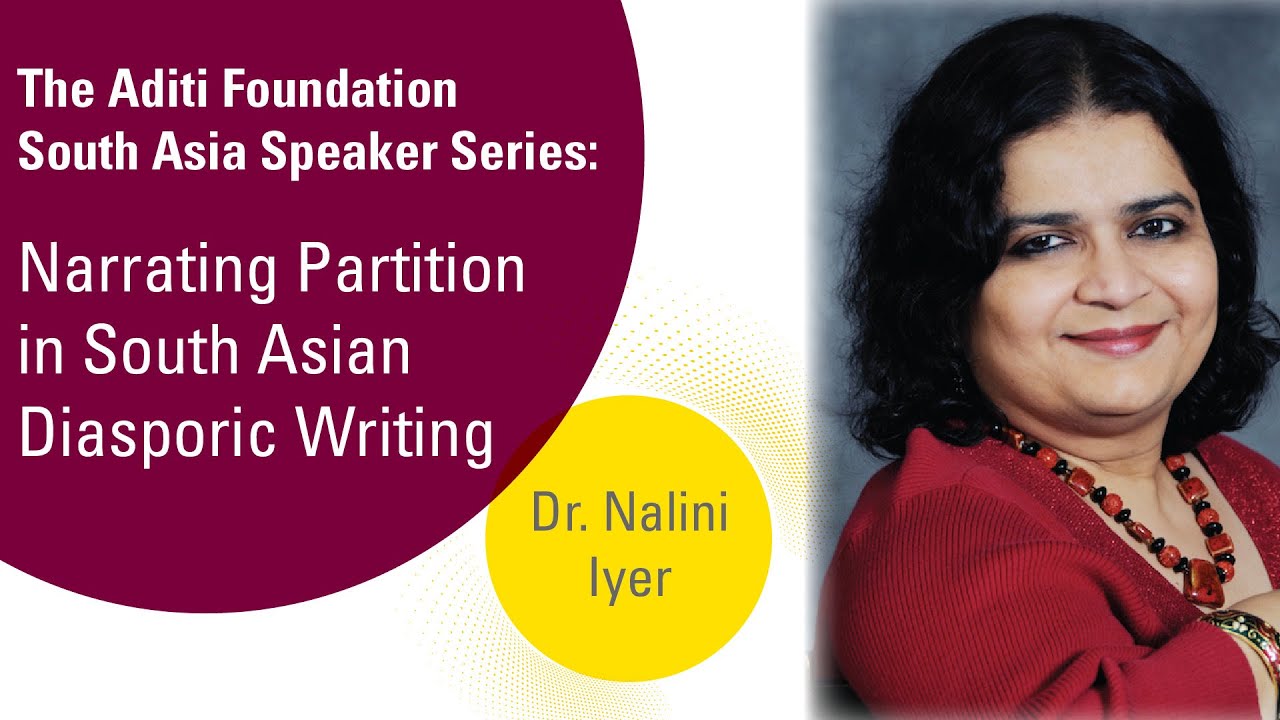
The video records the opening of the Aditi Foundation South Asia Speaker Series at McMaster University, moderated by Professor Chandrima Chakravarti, who provides logistical instructions and a concise historical overview of the 1947 Partition of British India, emphasizing its massive human displacement, violence, and lasting political and cultural repercussions. She then introduces Dr. Nalini Iyer, a Seattle University professor whose research focuses on Anglophone South Asian literature, diaspora, and partition studies. Dr. Iyer’s lecture is organized into three parts: (1) clarification of key terms such as South Asia, diaspora, and the concept of a "long" partition; (2) discussion of the 1947 Partition Archive – a digital oral‑history project that records survivor testimonies worldwide; (3) exploration of how partition is represented in South Asian diasporic writing. Iyer argues that diaspora studies has largely ignored the lingering effects of partition, which continue to shape identity, memory, and politics among South Asian communities abroad. She surveys four literary clusters – multigenerational trauma narratives, border‑and‑nation explorations, post‑9/11 Muslim identity works, and children/young‑adult texts – citing specific authors (e.g., Anita Rao Badami, Amitav Ghosh, Ayad Akhtar, Veera Nandani) and illustrating how these texts negotiate loss, belonging, and the politics of memory. Throughout, she reflects on methodological challenges of using oral histories, the ethics of trauma testimony, and the importance of “history from below.” The session concludes with closing remarks thanking organizers, technical staff, and participants, and announcing future talks in the series.
Chapters
So hello everyone and welcome to our first lecture in the Aditi Foundation South Asia Speaker Series organized by the Department of English and Cultural Studies at McMaster. I am Chandrima Chakravarti. I am a professor in the department and I will be moderating the session this afternoon. Dr. Iyer, we are delighted to have you with us today, and I will introduce Dr. Iyer properly in a little while, but I want to start with some housekeeping. And this is how we are envisioning this afternoon's event. I will offer brief remarks on the partition of British India, the focus of our talk this afternoon, before introducing our esteemed guest. And after Dr. Iyer's talk, which will be about 40 minutes long, we will invite questions from the audience. You are welcome to keep your videos on or off as you prefer, although Dr. Iyer would love to see your lovely smiling amazing faces when she speaks. However, please make sure that your microphones are muted. Thank you. For the Q&A, you are encouraged and warmly invited to have your videos on if you can. To ask a question, please type your question using the chat function on Zoom, which is at the bottom of your screen. Along with your question, it would be great if you could please note whether you would like to ask Dr. Iyer the question directly, or if you would like me to read it out on your behalf. And I will read out the questions in the order that they are posted on the chat. However, in order to prioritize students' voices and engagement with Dr. Iyer, I might have to skip some of your questions in order to make space for the students' questions if I see them, which I hope you won't mind too, too much. So my apologies in advance. Thank you. if I do break the order and skip over your question and go to the next one. And finally, if you need any technical help, you know, Anna, our wonderful Anna is right here, so please send her a note on chat or send her an email on that Eventbrite email page that you have. So now to move on to the topic for our lecture this afternoon, the partition of British India into India and Pakistan in 1947, a momentous event in South Asian history, and I'm sure that you know, many of you, and I see, you know, lots of people on the Zoom screen who teach South Asian partition literature and South Asian studies scholars in general, along with of course students, so I know there is a differential sort of level of knowledge that we are talking about in terms of the partition. Many of you are very and closely familiar with many of the details and nuances associated with the partition, but I just want to note a few basic things here for those who might be less familiar or unfamiliar with this history. So partition is the geographical division of land of what was British India, and it became 2 nation-states, one India and the other Pakistan. It primarily affected the northwest and the northeastern provinces of British India, and 3 religious communities— Muslim, Hindu, and Sikh— rooted essentially in the provinces of Punjab and Bengal, the 2 provinces that were partitioned. It resulted in the single largest mass migration in world history. About 15 million people moved, you know, on both sides of the border. It resulted in extreme sectarian violence. Death toll is suggested to be between 1 to 2 million, and these are just approximate conservative figures. Again, marked by extreme violence against women in particular, and it has left its mark on the politics of the region following nation-state formation, and it has also affected historical reconstructions of the past for each of these nation-states prior to partition. As we know from recent events in Kashmir, India, issues of border control continue to strain relations between India and Pakistan. Its effects continue to be felt within the national borders of India, Pakistan, and Bangladesh, And it has also— it also has effects on South Asian diasporas in the West because partition continues to linger in the memories of those who lived through it, and it has seeped into the consciousness of successor generations. 3 rival nationalisms of, you know, India, Bangladesh, Pakistan have fashioned and refined their own interpretations of partition. Few historians or social scientists have been able to stay aloof from the dominant interpretation in their own countries, and they have often contributed to state versions of partition history and powered the confrontational politics that continue to dominate interstate relations in South Asia. Yet while political histories of the independence struggle and anti-colonial struggles against British colonial rule have made their way into the educational curriculums The violence, the trauma, the loss that resulted from the— from this transition from colony to nation is rarely taught or talked about publicly. We hear a great deal about independence, about gaining sovereignty, but not of partition, which resulted in the displacement, mass migration, death, loss, sexual violence, physical violence, collectively what one can characterize as the founding trauma of nation formation. And partition also presents a story that cannot be told within the frame of the territorial nation-state's history. It is in this context that literary and cultural productions have gained significance, you know, dramatizing the loss, the trauma, and the suffering on both sides of the border. In their 2004 book Borders and Boundaries, Ritu Menon and Kamala Bhaskar write, the abundance of political histories on partition is almost equaled by the paucity of social histories of it. Literature has stepped in, at least partly, to record the full horror of partition. In one sense, it can be considered a kind of social history, not only because it so approximates reality, but because it is the only non-official contemporary record we have of the time apart from reportage, end quote. Given the lack of memorialization of the partition and the significant role played by films, poems, stories to offer testimony and witness to this seminal event in South Asian history, we are delighted to have been able to organize this talk on narrating the partition. And this is a free public lecture that is made possible by the generous support of the Aditi Foundation South Asia Lecture Fund, which makes it possible for our English and Cultural Studies Department to bring in a South Asian Studies creative artist or scholar to participate in courses taught in the department and include in this conversation the large McMaster and— the larger McMaster and Hamilton community. So my heartfelt thanks to the Aditi Foundation, the Department of English and Cultural Studies, and the Humanities Media and Publicity staff for taking care of all technical aspects of the event and making this event possible. And now to introduce our fabulous speaker in this series, Dr. Nalini Iyer. Dr. Iyer is Professor of English at Seattle University and current holder of the Thelen Pigott MacCone Endowed Chair for the Humanities. She teaches postcolonial studies, including South Asian and African writing, and courses on postcolonial and transnational feminisms. She has published 3 books and numerous articles and book chapters, and her research focuses on 3 interrelated areas: the hegemony of Anglophone writing in South Asia, South Asian diaspora studies, and finally partition studies. Her publications include the following: a co-edited book, Other Tongues: Rethinking the Language Debates in India, a co-authored book, Roots and Reflections: South Asians in the Pacific Northwest, and more recently a co-edited book on the partition titled Revisiting India's Partition: New Essays in Memory, Culture, and Politics. Dr. Iyer is the chief editor of the journal South Asian Review, and she is currently working on 2 research projects: a monograph that examines racialization in South Asian American literature and she's co-editing a book on teaching Anglophone South Asian diasporic literature. Her talk for us today is titled Narrating Partition in South Asian Diasporic Writing. Dr. Iyer will take it from here. A warm welcome from all of us. Thank you.
Greetings from Seattle. Thank you very much, Chandrima, for inviting me to do this talk. I thank Aditi Foundation, the English Department, and McMaster University for their support, and I want to also give a special shout out to the technical help from Anna and James, without whom I would be a lot more nervous about being here, so thank you very much for your help. So I'm, as Chandrima noted, my talk is geared really to students in her class called On Globalization, Film, and Literature, and the students have been reading an essay by Urvashi Butalia on Community, State, and Gender: Some Reflections on the Partition of India. And next class, I believe they're going to read a short story by Bapsi Sidwa called Defend Yourself Against Me. And my hope is that I'm giving them a larger context to navigate both these texts. And I know that Dr. Chakrabarty has given them some pre-recorded lectures and notes and so forth as well. My talk today is in 3 parts. I hope they are somewhat related. The first part is going to be sort of to clear some ground in terms of definitions, how am I I using certain terminology? In the second part, I'm going to be talking a bit about the oral history archive called the 1947 Partition Archive that is out of Berkeley, California, and the third section is going to attempt a sort of grouping of different ways in which partition shows up in South Asian diasporic texts, and these are really preliminary reflections, not any seriously deep, deeply well-written polished stuff, so bear with me on that. So Chandrima already talked about partition, so I won't go too deeply into that definition, definitions in that regard, but I want to use the term South Asia, and Chandrima talked about the British Empire, British India, and so this is one of those areas where terminology becomes interesting, and so what was Former British India gets referred to as South Asia these days, and the terminology emerged primarily in U.S. academia in the Cold War era as they tried to— the academic institutions tried to gain geopolitical influence through the educational missions. And so when we think about South Asia, the term is useful, but at the same time it overlooks the hostilities between countries, you know, India and Pakistan, for example. It overlooks the heterogeneity in those countries where people speak such a variety of languages. So a Sinhala-speaking person, a Bengali-speaking person, a Tamilian, an Urdu-speaking person are all South Asian. Similarly, we have questions of religion, Hinduism, Islam, Sikhism, Jainism, Buddhism, Christianity, and lots of other variations on those religions, as well as questions of caste politics, not only in India, but also in other parts of South Asia. South Asian identities are very heterogeneous, and the term South Asia can sometimes flatten out those differences. At the same time, they allow us to speak about historically and culturally related cultures and peoples. So for what it's worth, the terminology exists, and I'm going to use it, use it that way, and I'm happy to unpack some of it later. Let's go to the term diaspora, which is a term that comes from the Greek word for scattering, and early diaspora scholars use the Jewish diaspora as a model. In a now classical essay in the debut issue of the journal Diaspora: Journal of Transnational Studies, William Safran identifies the defining traits of a diaspora, including a long-lasting desire to return home. While Safran's list provides a valuable template for diasporic categorization, he only uses the Jewish diaspora as his model. Scholars such as Avtar Brauch, Robin Cohen, Stephen Wetteweg, among others, have conceptualized diaspora more broadly. In a specifically South Asian context, Avtar Vrar notes that diasporas are intersectional and involve both roots and routes. She states, quote, diasporas are simultaneously about space and place, about movement as well as settling down, unquote. Judith Brown offers us a useful definition, and she says, quote, diaspora— she uses the term diaspora to denote groups of people with a common ethnicity who have left their original homeland for prolonged periods of time and often permanently who retain a particular sense of cultural identity and often close kinship links with other scattered members of their group, thus acknowledging their shared physical and cultural origins, and who maintain links with that homeland and a sense of its role in their present identity, unquote. Additionally, Vijay Mishra suggests a categorization of old diasporas of indenture and new diasporas following the independence of India in 1947. The multiple trajectories of dispersion and settlements in East Africa, the Caribbean sometimes blur the boundaries between diasporas of indenture and the new diasporas. However, that chronological timeline is helpful, and because I'm looking at the intersections of partition and diaspora, I'm looking at post-World War II, post-1947 diasporas. And when I use the term South Asian diaspora, I am talking primarily about the scattering of South Asians post-World War II out of South Asia to countries primarily in the West— the UK, US, Canada, for example. There are internal diasporas in these, in the subcontinent, which is a different kind of discussion. So the term partition, another useful term, Chandrima gave us a lovely overview at the start of this moment, and I want to talk about the fact that I use the term partition as I did in the co-edited book on partition to borrow from Wazir Azamindar's terminology, the long partition, because often as Putrajit tells us in her essay as well that people think that, you know, partition happened in August 1947, but the reality is that the ongoing experience of partition for countries, communities, and individuals shows that the partition is not quite over. It's more of a continuum. For example, the South Subcontinent divided into India and Pakistan in 1947, and East and West Pakistan were geographically separated from each other by this landmass of the new nation India in between. It was a really bad idea to to do this in the first place. And not only was this geographic division awkward and problematic, we also had cultural and linguistic differences between East and West Pakistan that eventually led to East Pakistan breaking away in 1971, another partition if you will, to form the nation of Bangladesh. And prior to 1947, by the way, the British had attempted in 1905 a partition of Bengal for administrative purposes that had laid the foundation for this East Pakistan, West Pakistan problem. So the question of partition actually has been ongoing, and, and so today, for example, the question of Kashmir remains very, very problematic, fraught. It's been 74 years, and as of— and the violence and the search for nationhood and all of that that have haunted Kashmiris has been going on for decades, right? So partition split the communities along religious religious, linguistic, national, and caste lines, and the status of minorities in all 3 countries— India, Pakistan, and Bangladesh— as well as in Kashmir has been precarious. In India, for example, there are many communal or sectarian riots that have led to the deaths of thousands since partition. Partition itself, depending on whose numbers you look at, led to the displacement of something like 12 to 14 million people and the deaths of more than a million. As Bhutalia notes in her essay, partition was also a very gendered experience. Women's bodies became the battlefield, and rape and abduction common experiences for many. Sexual violence was not just directed at women but also men, as marauding bands of people seeking vengeance asked men to drop their pajamas to check if they were circumcised, as circumcision was considered a mark of the Muslim male body. Let's take a look at this really tiny short story by Sadaat Hasan Manto, who's one of the most well-known writers about the partition experience. Manto wrote the story in Urdu, and I'm using Alok Phalla's translation. The title of the story is Sorry. Story goes, the knife ripped through the stomach, reached down to the penis. The cord of the pajama was cut. The man with the knife exclaimed with surprise, as if he was reading the Kalma to ward off evil, chi chi chi, I made a mistake. The Stanley short story is chilling and says much about violence and mutilation of men's genitalia. While many fictional narratives, as well as stories told by survivors of partition violence, focus on the rape and abduction of women, which knew no boundaries of class, age, religion, or language, we should also remember that sexual violence was directed at men as well. Urvasi Bhutalia writes a pathbreaking feminist history on partition called The Other Side of Silence, in which she speaks to the ways in which partition narratives circulate amongst women and within families and are often silenced. The impact of partition trauma on women and on families continues across time and across many generations. So what then is the connection between partition and diaspora? In terms of South Asian studies, diaspora studies and partition studies remain 2 distinct fields with their own disciplinary histories, terminology, and methods. In literary studies, partition literature is— partition literature arrives in several languages: English, Urdu, Punjabi, Bengali, and a lot of this literature began getting published within a decade after the political upheavals. Similarly, the outward flow of people from South Asia to the West, especially the UK and the US and Canada after World War II also leads to many literary works being produced starting about the '50s and '60s, and this body of writing has grown significantly over time. As a scholar working in diaspora studies and later in partition studies, I started wondering about the linkages and more importantly about the limited number of crossover studies that linked these 2 fields. In 2007-2008, I began working on an oral history project in the Seattle area that is initiated by the University of Washington Libraries. Eventually, that work led to the publication of my second book, co-authored with Dr. Amy Bhatt, called Roots and Reflections: South Asians in the Pacific Northwest. In that project, we were gathering oral histories of South Asians who had moved to the Pacific Northwest after the U.S. passed the landmark legislation, the 1965 Immigration and Nationality Act. One of the topics in the interviews was about what motivated the individual to move and how they navigated cultural change. homesickness, et cetera? When we crafted that question, we thought of that as a warmup question, and boy, were we surprised. Many of the individuals who'd come to the US for graduate school in STEM fields, very typical of the skills-based shift in the migration in 1965, noted that they had experienced partition as children, or that their families had been dispersed by partition and had moved to India or Pakistan just before their birth. One person noted that his family, Punjabi Hindus, had moved from Pakistan to India and had had to rebuild their business from the ground up as they had left everything behind. everything behind. He said that once you have such an experience, leaving again for a different country, a different culture, is really not a big issue. Another person who had been born just before his Muslim family migrated from India to Pakistan talked about how his family faked his birth date so that he would not be considered a muhajir or refugee in Pakistan because there was a lot of stigma attached to the term muhajir. Still another woman responded to what seemed like a simple question to us, where were you born? And she told us about how her birth village had been in the border of West Bengal and Bangladesh and her family had moved during partition to India and then her village of birth became Bangladesh in 1971. There was no simple answer to where were you born. These narratives struck me, struck with me because they revealed an aspect of migration that Avtar Bra writes about, roots and routes. Some migrations build on previous ones that were often forced on the people. So when we talk about the South Asian diaspora, we must not assume that the migration to the West is the first foray into departure and resettlement in a family. Often diasporic experiences include multiple moments of arrival and departure. Partition was a huge displacement and formed an internal diaspora in the subcontinent as well. I want to note that not all the diasporas in the Indian subcontinent within the subcontinent are based on partition either. For example, people moving within a country from particular villages to large cities who then form ethnic enclaves in those cities. One of the examples of this is the post-independence but non-partition-related diaspora in the city of Bombay or Mumbai, where there's an area called Matunga where many Tamilian families from South India, especially Tamil Brahmins, moved to in the early 20th century when their young men went in search of jobs. These Tamil migrants formed a close-knit community sharing culture, language, and cuisine, established places of worship, business that catered to their needs, and formed schools and cultural organizations that ensured the transmission of their culture, and often their children intermarried with one This then is an internal diaspora and it's not a partition-related one. I often encounter— when you think about this double diaspora, sometimes people migrate within the subcontinent from one nation to another, sometimes from a village or a region to a city, and then they end up in the US or some— or Canada or someplace in the West, right? So often when I'm at a social event in Seattle in the South Asian community, I will hear snippets of stories about people's partition experience. Many of these folks are my age, children born in post-partition India or Pakistan whose parents migrated as children from Pakistan or into India or the other way around, and who preserve stories and cultural practices. Often these stories and cultural practices were the only things they brought with them from their erstwhile lived lives elsewhere. Now their descendants, children and grandchildren, share recipes and songs and stories of the lands they left behind because of partition. Often they also shared, if they were able to, stories of loss of people to violence. Telling these stories of partition forms a sense of community and allows for the generations to process the grief, the resilience, the bewilderment of a moment that shaped people's lives sometimes even before they were born. I'd recommend Ananya Jahanara Kabir's Partition's Post-Amnesias as a book that people might want to read in this context. So the first argument I make is that that the narrative of post-World War II South Asian diasporas is inevitably intertwined with the narrative of partition, although diaspora studies has tended to underplay that linkage. So now I want to move to the second section where I want to talk about partition archives and oral histories, right. The intertwining of the 1940— of the partition of '47 and the history of diasporas is very well demonstrated through the creation and the establishment of the 1947 Partition Archives, which were established, I believe, in about 2011 in California by a Dr. Gunita Bhalla, whose family had experienced partition and about which she, as an immigrant child in the United States, learned through family lore. A scientist by training, Bhalla chose to create an archive of these stories because she realizes that many stories went untold and unrecorded, and those who had been children during the partition were aging, and there was an urgency to capture their stories. So how did partition impact the diaspora? In her essay Partition Studies: Prospects and Pitfalls, Joya Chatterjee notes that partition has impacted people beyond the subcontinent. She writes, quote, forms of partial citizenship pioneered in the Indian subcontinent during the aftermath of the partition appear to have traveled to many parts of the world where peoples of Indian origin were found in significant numbers, complicating and compromising their status and producing new forms of quasi-citizenship in their wake. Throughout, and indeed beyond the erstwhile British Empire, their sudden rebranding as citizens of 2 different and hostile countries caused members of the Indian diaspora to grapple in new ways with questions of belonging. Partition in turn sparked fresh migrations to distant places around the world, and members of these new diasporas engaged in significant and novel forms of transnational politics. So it was not uncommon for people who had come as part of diasporas of indentures, say, to the Pacific Coast of the US and Canada, to suddenly find out that after 20 or so years of living here, that now they were citizens of either India or Pakistan, nations that had not existed in their current form in, you know, as they had known it. So that sort of disruption. In North America, for example, the South Asian diasporic communities often function internally with religious and national division, even though they may be viewed as a homogeneous community, and they actively support the political activities in South Asia, and that has increased now in the internet era as people are able to participate via social media and other ways with actual political both protests as well as support for fundamentalist and authoritarian regimes. So the support for Hindu nationalism or the celebration or critique of hostilities and wars between India and Pakistan, and they spill over into everyday lives of the South Asian diaspora. Especially you see that in places like where I live in Seattle, where there's a very large South Asian diasporic community, but they are a very fragmented community, and the tensions spill over when, for example, India passes a law on citizenship amendment rights, and then when people start protesting. So Seattle was the first city council to actually formally condemn that move, and it caused a lot of dissension and disruption in the South Asian diaspora. Community, whether or not the city council should have done that. And all of this sort of is a spillover to suggest that what it means to be South Asian is a very— it's a very complicated and very precarious situation sometimes. While the diaspora grew for post-1965, when the U.S. opened up immigration to South Asians and others after decades of barred zone policies, the community is often described as a labor diaspora that is predominantly middle-class and professional, and thus a mostly voluntary immigrant group. And as noted earlier, partition studies and diaspora studies are seen as 2 different bodies of knowledge. However, many post-1965 immigrants to North America already experienced uprooting and displacement due to partition, and the migration to North America was part of a long continuous journey in search of security, home, and belonging. So here I would suggest that the idea of the long partition extends also to diasporic communities who are still looking for home identity, security, and belonging. Rosemary Marangoli George argues that partition literature is often read within the context of developing nationalisms and should be read as diasporic literature because it is, quote, more concerned with the trauma of relocation and homesickness for the place left behind than with celebrations of independence, unquote. In recent years, writers and scholars living in North America have begun examining the legacy of partition and its memories in diaspora. This digital oral history project, 1947 Partition Archive, is a means of preserving those narratives of partition and diaspora. As of December 2020, there are 9,500 stories recorded from 12 countries and in over 36 languages. These stories have been gathered by 600 citizen historian volunteers and 150 story scholars and 200 community-based digital archivists. The sheer number, scope, and methodology of this project are remarkable. And I will urge you to visit that website to explore the narratives, the interactive maps, and to see videos about partition. This new archive of oral history spanning the globe offers a history from below and therefore counters that statist history that Dr. Chakrabarty referred to in her opening. Many of the narratives of those who now reside in the US but would experience partition in their childhoods show that characterizing South Asian immigrants as purely labor immigrants in pursuit of economic advancement misses an opportunity, opportunity to understand an important moment in subcontinental history. And one of the things that is striking is when you listen or read the summaries of some of the stories of partition, you see some themes that repeat in the partition literary works. For example, a lot of people talk about how Hindus and Muslims and Sikhs lived peaceably side by side, and that brings to mind, say, narratives like Khushwant Singh's Train to Pakistan, Pakistan, where, you know, the village of Manomajra before partition, everybody seemed to be living blissfully in each other's company, although if you read carefully, you see all the tensions that are already flaring up in that context. How can we literary scholars then engage these narratives to get new insights into partition, diaspora, and migration? What is our methodology? How do we work from an archive that is not fully accessible because it takes time and money to make some of these publicly available, and the archive keeps changing? In an article on partition and oral histories, Pippa Verdi writes about the importance of oral histories in opening up partition stories from below, which began in the 1980s following the 1984 riots. Bhutalia herself ended up writing The Other Side of Silence, as she tells us, because she witnessed the, the violence against Sikhs in 1984, and a lot of people who witnessed that in Delhi would say this is so much like Partition. And so she started investigating her own family's history and ends up writing that really important and brilliant book. So Verdi notes that oral histories are specifically significant in giving voices to women's experiences. Verdi also expresses caution about the oral— use of oral histories. She expresses concern over the ethics of having survivors relive a traumatic experience, of the power imbalance between interviewer/interviewee, and the issues of language region, class, and caste in the collection of such narratives. In the 1947 partition archive, when narratives are recalled, they are based on the memory of people who were mostly children or adolescents during the partition. Often these stories have evolved over the decades with tellings and retellings and with recollections of other narratives. The oral history archive is not necessarily about pinning down historical data or verifiable truth or evidence as much as it's about understanding how how people narrate their own truths, their own experiences with identity, subjectivity, and loss. The impact of partition and its role in the formation of diaspora in North America is not based on one or two stories in this archive, but on a collective. And of course, the archive, while it arises in the diasporic context, has stories that are global. So, you know, you have to pull out the segments that might actually focus on South Asians in North America. up like I did. The 1947 Partition Archives approach has been global in seeking narratives. Both narrators and interviewers come from different regions, generations, religious, linguistic, and class backgrounds. Because there are multiple citizen historians contributing to the archive, the undue power given to one single researcher or their perspective is also mitigated. In listening to a selection of these narratives as a literary scholar, I listened as I would to any story. What is the narrative arc? Who are the major players in the story? What is the time span? What were some of the themes in these stories, etc. I also listened to silences and awkward moments of telling where it seemed the narrator was wrestling with some aspect of the story. I recognized that these are not finely crafted works of fiction that are polished in craft. These are raw interviews where the person is speaking to an interlocutor, and to that end, I actually ended up choosing to focus for this paper on the narrative of Roshni Rustamji Kearns, who is not only a well-known scholar and a a writer, a creative writer, but she also experienced partition. And you can tell the difference between a raw interview and fictional works and scholarly works as you listen to her interview. She was born in 1938 in Karachi, which was a major port city in pre-partition India. She belonged to the Parsi community, and her narrative explains the Parsi history of migration to India and also the transnational spread of the community. The Parsi story is that of diaspora. says, we are everywhere— Australia, Spain, Hong Kong. She notes that her family, like that of many Parsis, benefited from imperial trade as middlemen, and one of her grandparents was part Chinese because her great-grandfather had married a Chinese woman in Shanghai. Her own mother was born and raised in Japan. So not only was Rustamji's family history transnational, but her Karachi was very cosmopolitan. When she travels down memory lane and she has what's of fond memories of childhood and family while also evaluating what contributed to who she was as a person. As the interviewer moves closer to the partition era, Rustamji's narrative tone and pace demonstrates how difficult that recollection is. When talking about partition memories, for example, she tells us she had a Hindu friend who might have been named Asha. Her memory falters here. Asha was in school one day and gone the next. Rustamji does not know if the family migrated or even if they survived partition. That remains, that story remains a gap, a very troubling gap for her. So when asked by Gunita Bala, the interviewer, what she remembers about partition, Rustamji tells us that they learned about political events in school as children, they anticipated independence, they sort of knew about the upcoming partition, and then she was very happy, for example, when the flag of Pakistan was raised in August 1947 to see a white white portion that depicted minority, the place of minorities in the nation. At the same time, she says that the Parsi children who had been studying Gujarati were now compelled to learn Urdu as well. So the place of minorities becomes ambivalent, and you have a sort of place in the new nation as long as you accede to modern, to majority culture. So the brief— so one of the things is that when you, when I, as I narrate this, you will see students especially who are going to read Sidhwa, you'll see similar themes in Sidhwa's short story that you're reading next week: the relationship between people of different religious groups in a cosmopolitan city, the place of a minority who was not Hindu, Muslim, or Sikh, the experience of women refugees, the trauma of partition, and what living in Houston in the diaspora may or may not do to shaping interethnic relationships. So now I'm going to stop talking about the Sidhwa short story. I don't want to do spoilers for you guys. So Rustamji's narrative also places migration in the— to the US in the context of home and belonging and the history of Parsi transnational migration. And she also talks about how as minorities they were constantly navigating survival and politics and the rest because they were risk-takers and business people who were middlemen in an imperial trade. Her narrative offers a counter perspective to the notion of home and belonging in South Asian diasporic literature, where often homeland and hostland tend to be monolithic entities in the narrative captured through a nostalgic lens, and a problem— constant theme in diasporic literatures of being caught between 2 cultures, or as Rushdie puts it in his essay Imaginary Homelands, falling between 2 stools. So let's talk about diasporic literature and partition. Now let's turn to a few literary works in the diaspora that also deal with partition. This discussion previously of oral histories shows how hard it is for people to talk about the trauma. Literary works in Hindi, Urdu, Punjabi, Bengali were among the first in the '50s forward to begin documenting experiences of the survivors. Fictionalizing allowed people some distance from their trauma and a means of processing their trauma. Partition gets narrated in several different ways in diasporic literary works, and I must note I'm talking about Anglophone diasporic literary works here, and I have sort of broadly divided these literary works into 4. 4 intersecting groups or interrelating groups. So the first group I placed narratives, those fictional narratives that recollect a trauma that is multi-generational. And a good example of this is Anita Rao Badami's novel, Can You Hear the Nightbird Call, which is set in Vancouver. Badami is an Indo-Canadian writer, who lived in Vancouver and now I believe lives somewhere in Montreal or Toronto or something like that. Other diasporic writers explore the questions— the second category is diasporic writers who explore questions of borders, boundaries, and nations, and consequently examine how partition rendered these fluid and thus contributed to a writer's sense of being caught between cultures as a diasporic subject. Examples of this kind of writing are Salman Rushdie's Midnight's Children, Amitav Ghosh's Shadow Lines, Temima Anam's A Golden Age. Third category, other writers struggle with their identities as Muslims in post-9/11, in the post-9/11 world where there is a global war on terror and Islamophobia is rampant. For example, Ayad Akhtar's play Disgraced and his autofictional work Homeland Elegies, which was published a few months ago, Kazım Ali's about-to-be-published memoir Northern Lights. These are all narratives where the writers struggle with the monolithic notion of Muslim that has emerged in recent times in the West and trace this moment of this essentializing of identities back to partition when people were homogenized as Hindu, Muslim, Sikh, etc. These writers also grapple with their relationship with other minority groups in the West. And fourth and finally, I think of writers who are, who are exploring how to pass on the history of partition to young readers and how to tell a traumatic story to young readers. An example of this is Veera Nandani's Newbery Award novel Night Diary, which was published in 2018. And this last category is a relatively new emerging category. So one of the compelling narratives of multigenerational trauma is by the Indo-Canadian writer Anita Rao Badami, Can You Hear the Night Bird Call? In that novel, Badami tells the story of 3 women, Sharan, Nimmo, and Leela, and weaves the complex narrative of imperialism, diaspora, minority rights, and nationalism. In Sharan's narrative, we learn of the Long Partition. She now lives in Vancouver with her husband and they run a business, but her connection to Canada begins even before her birth with the Komagata Maru incident. Her father had been a passenger in that ill-fated ship. Since a lot of my audience is Canadian, I don't have to explain the Komagata Maru. Sharan comes to Vancouver before partition and loses touch with her family. She reconnects with her niece Nimmo via a friend Leela and learns what partition has wrought in their lives. Nimmo lives in New Delhi and the family ghost's history gets intertwined with that of the Khalistan movement and the bombing of the Air India flight. What is significant about Badami's novel is that it shows how we cannot separate the racism of empire and immigration to Canada from the ongoing politics of the long partition. Partition is not a discrete historical event, and its impact is felt deeply by the diasporic community, even if some had already moved away from British India long before partition. For those living in the Pacific Coast Sikh communities that trace their histories back to the early 20th century, partition may not be their lived history, but it is their felt history in that they lost family and homeland. And a recently published novel by Rishi Reddy called Passage West has been really good for to look at the California experience. The Pacific Coast Sikh communities underwent a radical shift in their identities and felt displaced not only in Canada but also in South Asia. They always had transnational sensibilities and some sought to create a nation through the Khalistan movement. Such a nationalist movement had huge repercussions for the South Asian Canadian communities, and this is really Dr. Chakrabarty's area of experience that she's a lot about the Air India disaster, and so I will not go much into that. At the end of this novel, Jasbir, Sharan's nephew, returns to his mother Nimmo after bearing the weight of multiple tragedies, from the Komagata Maru through the partition to 1984 violence against Sikhs and the Air India crash. For Badami, diasporic experience is one of continuous journeys triggered by political trauma, including the long partition. For some diasporic writers, partition rendered nations and boundaries fluid and raised profound questions of belonging. A good example of this is Amitav Ghosh's novel Shadow Lines. In that novel, the narrator's grandmother grew up in Dhaka and moved to Calcutta after her marriage. Partition severed her connections to Dhaka, and many years later she plans her return there. As her family prepares her for her first plane trip abroad, the narrator recounts that grandmother asks her son, the narrator's father, if she would be able to see lines or trenches from the sky. He tells her she wouldn't, and then the grandmother asks, what was it all for then, partition and all the killing and everything, if there isn't something in between? The son explains that borders are really now experienced in airports and she would need to fill out forms. The narrator then states that he realized at that moment that she, the grandmother, quote, at that moment had not been able to quite understand how her place of birth had come to be so messily at odds with her nationality, unquote. This intertwining of partition and diaspora are central to Ghosh's narrative, and that passage with the grandmother was so striking to me, so haunted me, that I ended up actually using that in the introduction to the book on partition. And so in Ghosh's narrative, as the young protagonist tells the story, we see the story of different family members— grandmother, cousin Ila, and cousin Tridula— and their negotiations of borders, boundaries, and nations from very different subject positions as partition refugee, transnational diplomat's daughter, and Anglophile Indian respectively, and how that shaped the family's understanding of what it means to be Bengali, cosmopolitan, and Indian. Partition is represented through the story of a house divided literally in Dhaka between warring brothers and the tragic consequences of such a situation for family and country. For individuals, there's a sense of both loss and liberation, of being anchored to an imaginary identity and of being freed to be a citizen of the world. For Ghosh, the historical question of partition is imbricated with the issue of nation and belonging. Most diasporic subjects encounter borders at airports and in an earlier era at immigration checkpoints like Ellis Island or Angel Island. It is when we are called to account for ourselves via bureaucratic processes that we most acutely feel displaced discombobulated. What nation do I belong to, we ask. For those whose families moved from India or Pakistan during partition and then moved outside South Asia to the West, this is a persistent question. Diasporic life is neither easy nor straightforward, and all of it is infused with a confusing mix of precarity, fear, optimism, and opportunity. A third way that partition resonates in diasporic writing is in the post-9/11 works by Muslim writers, South Asian Muslim writers particularly, are struggling with issues of Islamophobia and the war on terror in their writing. Partition politics consolidated diverse religious identities into monolithic ones in South Asia. This is what David Gilmartin will argue. He talks about the high politics of nation-building consolidating what were very heterogeneous lived identities on religion in South Asia during partition. So for example, on-the-ground religious practices like Hindus and Muslims worshiping at Sufi shrines and celebrating holidays together disappear or get subsumed under this national monolithic national identity, and this becomes synchronous, even synonymous with nation. In the last 75 years since partition, these religious divides have grown sharper, deeper, and more violent, not only in South Asia but also in the diaspora. This is reflected in the writings of Monica Ali, Kamila Shamsie, Ayad Akhtar, Mohsin Hamid, among others. Take for example the Pulitzer Prize-winning play Disgraced by Akhtar. In that play, there's a Muslim lawyer in Manhattan, South Asian in heritage, who sees himself as very secular and whose life is increasingly complicated by post-9/11 politics. His character is named Amir Kapoor and has the plot unfolds, we learn that one of the difficulties with Amir Kapoor was that he had changed his name legally to Kapoor when— from a Muslim name to a Hindu name because he worked for a Jewish law firm and he was not sure that his Islamic identity would go over well and might— he was afraid it would hinder his progress to partner in that firm. And so when his— the partner has bought— I mean, this is really odd moment where, you know, there's this Nataraja statue on stage, which you find out that his boss has gifted him thinking he's Hindu, and there are all these dissonances about identity all through the play, including in the staging. And when the Paki— when he is interrogated by his, the law partner, about his heritage, he says, well, I am Indian because my parents were born in undivided India, and then, you know, when they were babies they went to Pakistan, but for the partner, while what Kapur— Amir is saying is not erroneous, the law partner sees this as fudging on details. The scene references partition as a passing historical event, but for Amir, his being Muslim is an already politically different, difficult identity prior to 9/11, and the events of 9/11 only make it worse. He sees the baggage of partition politics melding into contemporary Islamophobia. Akhtar, in his recent autofictional work Homeland Elegies, Ayad Akhtar writes about a playwright named Ayad Akhtar who's looking at his family history in that book and dwells a lot on partition and draws a through line between partition to the global war on terror in South Asia. Similarly, Kazim Ali, a queer South Asian Muslim poet who has a forthcoming memoir Northern Lights in which he writes about having no sense of belonging as a queer transnational Muslim man because his parents were from Vellore in southern India. They moved to Pakistan then during, during partition, and then they moved to UK and Canada and then the US. His memoir is about finding home and trying to reconcile the different facets of his identity: nation, religion, immigrant status, and queerness. Finally, a 4th thread in narrating partition in the diaspora is in children and young adult lit, where writers who are descendants of those who were impacted by partition tried to capture that history for young readers? How do you write about trauma, loss, and violence for children and young adults? How do you share that painful history with those for whom this is their family legacy? And, and, and what might they know about— just, they might know might just be gaps and silences. How do you explain the history of partition to non-South Asian children and youth so that the model minority perception of South Asians is challenged? These are some of the questions that Veera Nandani deals with in Night Diary, which won the Newbery Honor in 2018. In her novel, she tells the story of these twin siblings, Nisha and Amil. They're 12 years old. We learn that the mother is deceased. She was a Muslim artist. And the father is a Hindu doctor. And the whole novel is told as a diary, series of diary entries by Nisha. And we learn about the sort of childhood, playful childhood life, the children coming into awareness, of their— of the impending partition, and then the dramatic overnight escape of the family, the grandmother, the father, and the 2 children. And it's a harrowing tale of heat and lack of food and dehydration, almost dying, and encountering violence. They have a brief stopover at an uncle's house, the mother's brother's house. They've never met him before. And there, this little girl befriends a child next door. door, a Muslim girl, although she's been told to lay low and never show her face outside because they put themselves and the uncle at risk because they're perceived as Hindus, although they have a Muslim mother, right? As soon as the father finds out that she's been friending this girl, they leave their safe house. The father is very angry, he yells at the girl, and she promises, I will never speak again. And then they eventually find their way to a train station and they get on a train. And trains, as we know, in partition fiction, especially on the Punjab side, are tropes where— more than that, that's where a lot of the violence occurred, the deaths and the dismemberments on both sides of the border. And so when she— the child witnesses one such moment, and what's really interesting is that at the moment of that violence, the girl faints. And so she actually both witnesses and doesn't remember what she witnessed. And this becomes where the hinging moment in the narrative— like she uses writing as a sort of as a form of therapy, as a form of recording, and as also a form of connecting with her dead mother because she needs to tell the story, find that love for her mother. And we see how the young boy and the girl experience partition differently. So we see the gendered nature. But what's very interesting is this notion of silence and how do you narrate silence? How do you narrate trauma? And as is the case in the genre of writing for children, the end is a little uplifting, right? family is safe. They're in Jodhpur. They've gone from this big estate with fruits and flower trees and servants and things to a one-room tenement, but they're safe. And this girl is going to school. She's starting to make friends, but she just cannot speak. And at the end, we're like, she's going to make an attempt to speak. She promises that she will speak. And so when some of what happens here, the other thing is this narrative looks at Hindus and Muslims from a 12-year-old's perspective. That hybrid identity that these twins have is interesting because it signals that these differences are like artificial or socially constructed. But at the same time, you don't have any sense whatsoever about any regional variation until you get to the girl starting to learn to cook. And she makes a saibhaji, which is a Sindhi dish, a very popular dish. And she— that's when we realize the family is, you know, has some localized culture. practices when we see what the child cooks, but that requires cultural knowledge of South Asia to be able to parse that out. Hiranandani, in the, you know, like an essay that goes with the book, tells us that she amalgamated stories of her father's side of the family, different people who had escaped at various moments, pulled it together to write the story, and part of what she's doing as someone who lives in North America is figuring out how to transmit the stories of partition to young people to make them more aware of the history and to understand the trauma that they carry with them in their families. A lot of South Asian writers have started turning— there's an emergence, a dramatic emergence in numbers actually, of South Asian YA fiction. And a lot of these writers are actually writing about the Muslim experience in contemporary US, particularly in the Trump era, and they use a variety of genres. I'm thinking of Samira Ahmed's speculative novel called Internment. In all of this, there's the sense that the problem of the administration, Trump et al., of thinking of Muslims as a monolithic identity completely clashes with the way in which the young people identified their Muslim heritage. And what— and that if you're from India or Pakistan and you've arrived in North America, I'm thinking of a novel like A Place for Us by Fatima Farheen Mirza, then it's in the masjids that they come together with other Muslims from other parts of the globe to form a different kind of Muslim identity in diaspora. But the heritage of the partition, identi-formation, et cetera, still haunt that experience. And so in that regard, a lot of the YA narratives are, I think they echo what people like Ayaan Akhtar are trying to do, which is trying to understand what it means to be South Asian Muslim in North America and what are the roots of some of that troubled identity and challenges.
Okay, so our wonderful session has unfortunately come to an end. End. Thank you so much for joining in. Of course, for Nalini, for this amazing talk that opened up so much, you know, information and resources for us to go back to. Thank you to the Aditi Foundation for making it possible for us to host Nalini and to bring this conversation into— on the floor. Thanks to Department of English and Cultural Studies, to Humanities Media, but above all, thank you to each one of you for joining this conversation and making it into such engaging, animated boxes, right? So thank you, and thank you also for, you know, coming on video. Makes it easier for the speaker to see there are some nods and, you know, smiles in the process. So thank you very much for doing that. This was lovely, and we plan to, you know, continue this conversation through the Aditi Foundation South Asian Speaker Series. So we will have further speakers coming in. So thanks, Nalini, can't thank you enough for doing this for us.
No, the thanks are from me. First of all, to have a sense of community while we do so much of our work in isolation right now, for this opportunity to speak to students across borders and virtually too. And I know people have logged in from Turkey and India and a variety of other spaces. So I'm very grateful to all of you for being here, for being so invested in this topic. And Chandrima, I really, really appreciate this invitation. Thank you very much. Thank you.
More from Nalini

The Gallery of Audacious Women | Arundhathi Subramaniam in conversation with Nalini Iyer
Digital Technology and Women in Academic Publishing: Bracing Challenges and Opportunities


