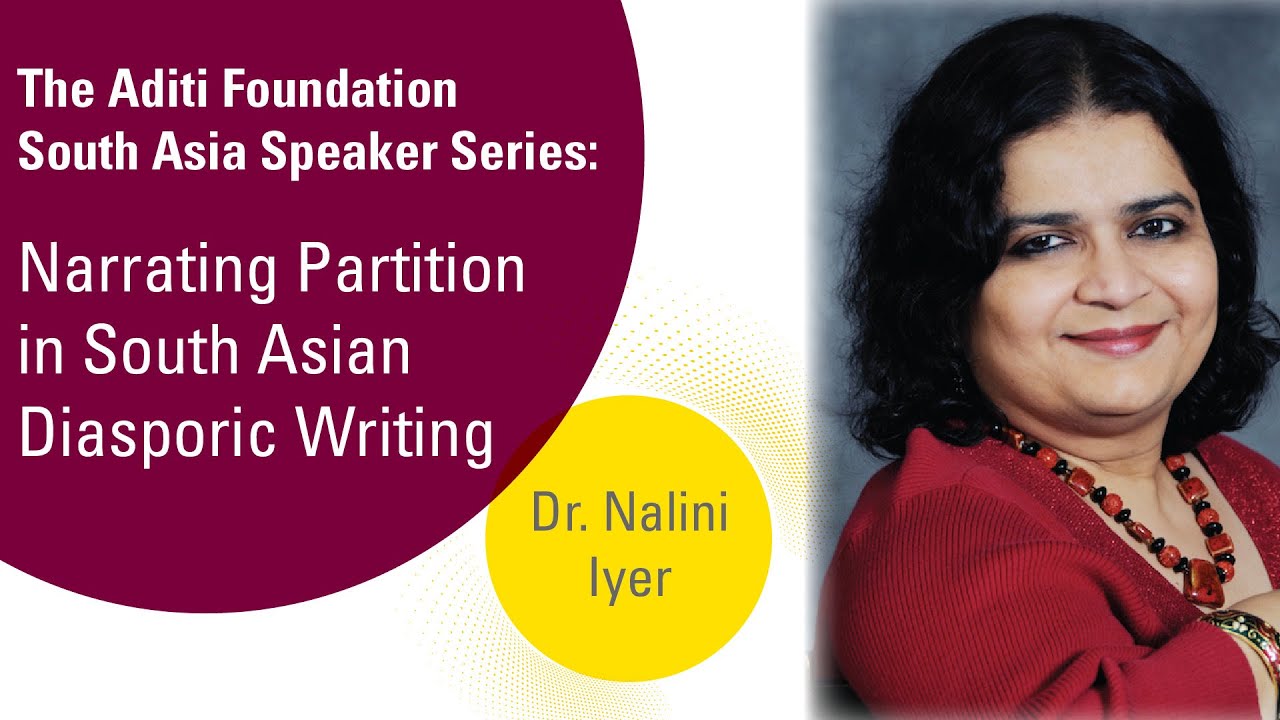
PROFESSOR NALINI IYER

In this virtual keynote, Professor Nalini Iyer expands the conventional view of diaspora by foregrounding internal Indian migrations alongside transnational movements. Drawing on her own family’s early 20th‑century relocation from Tamil Nadu to Jamshedpur for Tata Steel work, she illustrates how internal displacement creates diasporic communities within India. She then situates this perspective within a broader historical framework of South Asian immigration to North America, tracing pre‑1965 exclusion, post‑1965 liberalization, and post‑9/11 re‑racialization. Iyer surveys archival sources such as the Ghadar Party papers, the Komagata Maru incident, and early memoirs, linking them to contemporary literary responses—from Chitra Divakaruni’s Yuba City poems to Kartar Dhillon’s memoirs and Uma Krishnaswamy’s children’s novel. The talk moves to a theoretical discussion of power: she argues that as minority groups ascend socially they often consolidate power by excluding others, a pattern she observes among Sikhs and Dalits. Iyer’s personal stance as an agnostic‑atheist informs her critique of religious justifications for hierarchy. The session concludes with a lively Q&A where participants probe discrimination, internal diaspora, and the role of literature, followed by logistical remarks about upcoming paper‑presentation sessions. Throughout, Iyer emphasizes the need to break the binary between internal and transnational diaspora and to recognize the layered power relations that shape South Asian diasporic literature.
Chapters
Hello. Hi, yes.
Hello, hello, sir.
Ah, yes, ma'am, you are audible now.
So good morning.
Yeah, good morning, ma'am. Good morning. And our keynote speaker is present. She has joined well before everybody else.
Good morning. Yeah,
good morning, ma'am. Vanita, shall we start?
Oh, sure.
Yeah, okay,
shall we now?
Yes, yes.
Okay, good morning, ladies and gentlemen. On behalf of the PG and Research Department of English, I am extremely happy to welcome you all to session 1 of this 4-day Virtual International Conference on Diaspora Across Time and Space: Multifarious Understandings of Indian Diaspora Literature. It's with great pleasure I welcome Professor Nalini Iyer, Seattle University, USA, to preside over this session and share her insights with us on the theme, Remembering the Resistance of the Pioneer South Asian Americans. Dear delegates, meet Professor Nalini Iyer, who teaches postcolonial literatures at Seattle University. She received her PhD from Purdue University. Her teaching includes South Asian writing, postcolonial African literature, and courses on postcolonial and transnational feminism. She has published 3 books and numerous articles and book chapters, and her research focuses on 3 interrelated areas the hegemony of Anglophone writing in South Asia diaspora studies and partition studies. Her publications include the following: Other Tongues: Rethinking the Language Debates in India, Roots and Reflections: South Asians in the Pacific North, and Revisiting India's Partition: New Essays in Memory, Culture, and Politics. She guest edited a special issue of the journal Comparative Literary Studies on the topic Beyond the Postcolonial: Comparative South Asian Literatures. She has published numerous articles on South Asian diasporic literatures in journals such as Aerial, South Asian Review. She is currently working on a monograph that examines racialization in South Asian American literature and also co-editing a volume on teaching Anglophone South Asian diasporic literature for the MLA. She's also editor-in-chief for South Asian Review, the journal of the South Asian Literary Association, published. Honored to have you here with us, ma'am. May we request you to address the scholastic gathering here, please, ma'am?
Thank you very much, and I really want to appreciate Dr. Jai Singh for proffering this invitation. As I sit here thinking that this conference is about the South Asian diaspora and its iterations, I'm struck that we are meeting across time and space, literally via something like Zoom, and what that says about transporting oneself across. You are at about 8 AM-ish in India. It's Wednesday night, 7:43 where I am in Seattle. And because we are so close to the summer solstice and how far north Seattle is, there is still bright sunshine outside and the sunset is not till 9 PM. So you will actually likely see a change in the lighting in this room as the light changes outside. So, you know, and literally I get to welcome all of you into my home office because for the last 3 months we have been quarantined and working from home, like most of you are across the globe, as it were. So really quickly, I want to talk for a bit. I'm going to mostly read, and then I want to open it up for questions because I think conversations are really important as we think through some of the themes that I will be presenting. As, uh, as the person who introduced me, Dr. Vanita, said, my work has involved a lot of South Asian diasporic work, and I think I should really mention here my own history. I was born in Bombay, raised in Madras, finished my undergraduate education in Stella Maris College, and then in 1986 I moved to the United States for graduate study, and I'm one of those people who went to study abroad who never returned and just stayed where I, where I am, and this and this experience really, uh, has had me thinking through how do we see diasporic writing and diasporic, um, lives in, in literature. So my second book, which I co-authored with Amy Putt, was called Roots and Reflections: South Asians in the Pacific Northwest, and it was based on South Asian oral histories of immigrants who had come here post-1965, and it was the first cultural history of South Asian settlement here. And one of the important things is that South Asia— when we think about diasporal literature, we think about it in very broad umbrella terms, and you can read Naipaul and Jhumpa Lahiri and, and Shyam Selvadurai and everybody in under one rubric, and there are obviously themes that connect across, but I also think that it's important to delve deep into regions not only— particularly where people settled, the historic context in which they settled. You're cutting me. Okay, so the historic context in which they, they settled, because that often shapes the experience. So my interest is in South Asian diaspora in the Pacific, in the United States particularly, and also to some extent in North America. So I'm going to talk briefly and then we can have questions and answers. So one of the, the, so when I say South Asia, I'm talking India, Pakistan, Bangladesh, Sri Lanka, Nepal broadly. And South Asian immigration to North America, that is the US and Canada, began more than a century ago, but the numbers increased dramatically after the passage of the Immigration and Nationality Act, also known as the Hart-Celler Act of 1965. In that period, South Asian Ameri— immigrants— since that period, South Asian immigrants have been writing poetry, political tracts, fiction, autobiographies, and travel narratives that engage questions of immigrant subjectivity from a variety of perspectives. Both South Asian American writing is shaped by the history of immigration laws, and so my larger work is, which is a monograph in progress, is divided into 3 sections historically. So in the first section, I'm looking at people who wrote about their experiences and migrated between, uh, um, the early 20th century up to 1945, which I call the period of exclusion, and 1946 to 1965, which is referred to in American immigration history as the barred zone period, and then '65 to 2000 after the past— the passage of the Immigration and Nationality Act, where we saw this massive boom in South Asian migration, what in India we used to call the brain drain, period, and then post-9/11, including the Trump era, because I think in 2000 after the attack on the Twin Towers racialization changed for South Asians. In each of these phases South Asian Americans have been racialized differently, by which I mean the racialized narratives in popular culture, media, etc., have been different. Some scholars, Vivek Bald for example in his books The Sun Never Sets and Lisa Lowe in her narrative Intimacies of Four Corners, will argue that using U.S. immigration law to frame South Asian American experiences overlooks the globality of empire that spurred the movement of labor to the Americas, starting with indenture in the 1800s, and the transnational scope of resistance to empire. I concur with these scholars and argue that U.S. immigration laws are part of the operations of empire that police national borders selectively and on the basis of race. The racializations of South Asians definitely has a global scope, but their everyday lives in North America are impacted by immigration regimes. In her book, The Intimacies of Four Continents, Lisa Lowe argues that we silo histories into archives and disciplines and do not see the relationship between slavery, indenture, colonialism, and settler colonialism across continents. In addition to what Lowe notes, I will argue that questions of caste, class, education, language fluency, and religion impact who migrates from South Asia, when, and how they experience life in, in, in, in the United States. While Lowe's argument about siloed archives is a compelling and necessary one, we should also recognize that not all archives are equally established. The case of South Asian Americas is one such. While there are some studies in several scattered archives, and the only major study of South Asian American literature that I know of is Rajneesh Srikanth's a book from the early 2000s. And there are archives like the Ghadar Party papers at UC Berkeley, uh, the digital archives of the South Asian American Digital Archive, which by the way are free and open and available online for anybody and brilliant collection of material, or the South Asia Oral History Project at the University of Washington. These archives are still being built and our understanding continues to evolve. Currently South Asians are hyper-visibly invisible. We are recognized in politics and industry for achievement, so you will see frequently names of people like Nikki Haley in politics or Indra Nooyi or Sundar Pichai or Satya Nadella when we talk about achievements in, in industry, but we are represented as the model minority and the complex history of South Asians in North America is scattered and actually quite unknown even to South Asians themselves and in the mainstream culture as well. So part of my project as a scholar, a lifetime's commitment, has been to unearth this history and to, to communicate it, uh, to the community. And so my second book in many ways was triggered by the need, uh, because I have 2 daughters who I have raised in North America. I wanted to, I wanted them to know their own history of migration and the history of the community. So currently, um, so that's part of the talk today is about how and why we need to recover these narratives. So following the chronology of U.S. immigration law, I propose that we look at the different ways in which South Asians were racialized and how they used literary and cultural productions to rewrite these narratives. So in the period of exclusion, South Asians were called the tide of turbans or Hindus, even though many of the migrants were actually Sikhs and Muslims. During the barred zone period, they were selectively admitted desirable undesirables. In the post-'65 period, a model minority who were high achieving and educated but perpetually foreign and unassimilable. And post-9/11 pathologizes terrorists whose religion equals race and all of whom can be identified/misidentified as Muslims. In the context of such broad racial narratives, I discuss how South Asian American writers have used literature to question, resist, and sometimes internalize such racialization. In this paper, I want to focus on a few texts that emerged from the period of exclusion of the war zone period, There are 2 pivotal moments in early South Asian immigration history, particularly in the Pacific Coast. One is the formation of the Ghadar Party in 1913 in Astoria, Oregon, and I'm going to talk a little bit about the Ghadar Party further down, and the other is the Komagata Maru incident in Vancouver, British Columbia in 1914. Um, the Komagata Maru incident, if you're not familiar with it, the Komagata Maru was a ship that a group of, uh, Sikh, predominantly Sikh leaders commissioned. By the time India was of course part of the British Empire, and they transported some 376 people from the Punjab to Vancouver, British Columbia. And they were arriving here because they were subjects of the same British Empire, but Canada was getting very, very racial in the way it formed its immigration laws, and they had created a requirement that said that you have to have continuously traveled, they are experienced what they call continuous voyage in order to be able to, to become a landed immigrant in Canada. And so when the shipload of people came, only 24 of them were admitted into Canada, the rest were denied, and the ship was anchored off the coast of Vancouver, BC for many months, and the people were eventually turned back. So when the shipload of people arrived back in Calcutta, the Imperial Police went to arrest the leaders of this ship and there was a battle that ensued and 20 people died. So this is a very infamous moment and it's become a touchstone moment for many South Asians as they think through the experiences of race and racialization and immigration in, in North America. So not only is there writing by South Asians on these 2 events, the Ghadar Party formation and the Komagata Maru, in several languages— Hindi, Urdu, Punjabi English, but many contemporary works have also focused on recovering these moments. However, there are also writings from this period that are not affiliated with the radical Ghadarites, and these include autobiographies and children's books by Dhan Gopal Mukherjee, travel narratives by people like Satyadeva Prari Rajak, and R.K. Narayan's book My Dateless Diary. Both Satyadeva and Narayan were sojourners in the U.S. who lived and traveled across the country for a significant period, and then autobiographical narratives by Krishnala Sridharani and Shanta Rama Rao, among others. Much of the scholarship on pre-1965 period focuses on the experiences of the Ghadar Party and the radical resistance to both US immigration laws and to British imperialism in India. Without a doubt, the radical writings of the Ghadarites are an important component of South Asian American immigrant history. However, the focus on radical writers alone gives us a skewed perspective on what literary production was in this period. We need to recognize that not all those who wrote pre-1965 held similar views. Furthermore, class played a big part on— in how these writers, particularly those who came as students and travelers, experienced America. Besides the resistance from the Ghadarites, we see writers embracing a spiritual worldview, admiring American achievements, and attempting to be cultural ambassadors representing India to the West. However, the radicals have been romanticized by contemporary scholars and writers, and their lives on the Pacific Coast have been the focus of many a scholarly and creative project in our times. In fact, in the last couple of months, there's been a new novel that came out called Passage West by Rishi Reddy, which again is looking at California in the early 20th century. Whereas this section of my larger project is going to explore Ghadar writings, the travel narratives, autobiographies, and examine how pivotal moments like the formation of the Ghadar Party and the Komagata Magatha Maru incident have become touchstones in contemporary South Asian American writing. Today I'm going to talk briefly about Ghadar poets, and then I'm going to look at how writers like Chitra Divakaruni in her Yuba City poems, Uma Krishnaswamy in her children's book Step Up to the Plate, Maria Singh, and Kartar Dhillon in her fragmentary memoirs, and some writers in the Asian American Writers Workshop have repositioned gather right history into their creative works. So let's talk a little bit about a brief history of South Asian immigration to North America, because I think that is not very familiar to most people in the U.S. and not something I learned anyway when I was a student back many, many moons ago in India either. So perhaps the earliest South Asians who came to North America came to the 13 colonies as part of shipping crews, jumped ship, and disappeared into the population, leaving no trace of their lives after they left the ship. Vivek Paul, in his book Bengali Harlem and the Lost Histories of South Asia, writes that Bengali peddlers from what is today either West Bengal or Bangladesh began arriving in the U.S. in the 1880s, bringing embroidered silks and other exotic goods that fed the American Orientalist craze for things Indian. They sold goods along the East Coast cities and moved into African American working-class communities and established their lives there. During World War I, many Indian maritime workers who labored under near indentured conditions on British ships jumped ship and using clandestine networks escaped into the industrial belts where they worked in steel and munitions factories that were starved for workers. These folks were undocumented because the 1917 Immigration Act had criminalized or excluded Asian immigration from the United States. On the West Coast, the migration began in the 1890s when agricultural workers from the Punjab, mostly Sikh and Muslim people who were all labeled Hindus no matter what their religious identity arrived in British Columbia to work on farms and in the timber industry. Many moved south across the U.S.-Canadian border, and by 1907 there were several hundred Indian workers working in the timber mills of Bellingham, Washington. Bellingham, Washington is about 90 miles north of where I am, north of Seattle, and they were living in company-owned barrack-style housing. They worked for lower wages, so the Indian workers were willing to work for $2 an hour as opposed to what the white Americans were being— getting paid, which is $2.22 per hour. So they were willing to work for lower wages, company employed cheap labor obviously. So on Labor Day 1907, white workers rioted in Bellingham and demanded that the Hindu laborers be dismissed, and using a flimsy excuse of disrespect to white women watching the Labor Day parade, the white workers attacked the Indian workers in their homes, setting fire to the barracks and throwing people out and beating them. The Indians were rounded up in their own safe— for their own safety by the Bellingham police chief, put into the county jail for protection, subject to a kangaroo court inquiry the next morning, and then deported from the city on the first train passing through. The Indian— and by the way, Indians didn't settle in the Bellingham area for nearly 80 years after that. Indian laborers experienced such violence up and down the West Coast as they moved from timber town to timber town seeking work but encountering local rage. In 1913, they formed the Ghadar, or Revolutionary Party, in Astoria, Oregon, to fight British imperialism at home and racist immigration law in the U.S. and Canada. That relative to British Columbia, Washington and California, the state of Oregon did fight racism and prosecuted people in the perpetration of violence against South Asians, but they also enacted exclusionary laws that ensured Asian immigrants never received citizenship. So the message was what Vijay Prashad characterizes in his book The Karma of Brown Folk as give us your labor but not your lives approach. Experiencing exclusion laws, alien land ownership laws, and anti-miscegenation laws, The South Asian immigrants eventually settled in the Sacramento area of California and in the Imperial Valley. Although South Asians were able to get citizenship starting 1946, the number of people allowed into the country because of barred zone or country-based restrictions on immigration remained small, about 100 people from India each year. In this period of exclusion, South Asians were referred to as Hindus, even though many were Sikh and Muslim immigrants. And newspapers described them as a tide of turbans in referring to them as a problem, not unlike the Yellow Peril, which was the label they used for Chinese immigrants. They were characterized as undesirable migrants. Immigrants at this time on the West Coast were either agricultural laborers or students who came to institutions like the University of California, Berkeley, the University of Washington, and so forth. And despite the class differences between the groups, agricultural workers and students, they worked together to challenge imperialism globally. In fact, the agricultural workers would often support the poor students with food and money and scholarship, and they came together to fight imperialism. They were not very large in number, but they were hypervisibly invisible in that their distinct clothing and culture rendered them visible, yet the particulars of their lives were invisible, and they they were always lumped into the category of Hindus. So today, let's look at a few Ghadar poems, and because, you know, in 2013 was the 100th anniversary of the formation of the Ghadar Party, and on that occasion the Asian American Writers Workshop project asked South Asian American poets here to do poetic responses to Ghadar poems to mark that 100th anniversary. So the Ghadar Party used to have a newspaper and they also published volumes of poetry, which was titled Gadardi Goonge or Echoes of Mutiny. These poems were published primarily in Gurmukhi and Shamukhi. So here's one of the poems and I am going to read you a translation. So this poem is by Kartar Singh Sarabha and the translator is Ali Mir, a contemporary South Asian American poet, and the poem is, if they ask you who you are, Tell them that your name is rebel, that your occupation is to wipe out tyranny, that your work is to create gadar, that this is your namaz and your sandhya, and this is the way you worship, that this is your only true religion, that this is your Khuda, that this is your Ram. Another poem, this one is by a poet named Amar Singh, and he writes this poem on the occasion of the martyrdom of Pandit Sohan Lal Pathak. Who was one of the leaders of the Ghadar Party that was hanged in 1916 in Mandalay Jail for inciting rebellion against British rule. The Ghadar Party sent armed rebels back to India to fight the British. So the poem goes like this: We are called coolies in countries abroad, we do not have a flag of our own. Will we always live the life of slaves? Why do we not know the science of politics? A handful of people have taken control of our land, Hindustan. Why is not there a caretaker of Hindustan? It is better to die than live a life of servitude. We should never forget the saying, China has awakened from its sleep. Battle drums of Hindustan's awakening are raging. We do not need pundits or qazis as we do not want our ship to sink. The time for prayers and puja is past. This is the time to pick up the sword. The Ghadar paper is proclaiming that the time for revolt is here. They were pretty outspoken about violent uprisings. From the above examples, you can see that the Ghadar di Goonge poems exhorted a subject people in South Asia and in the United States to rise up against tyranny. As Maya Ramnath writes in her global history of the Ghadar movement, how the Ghadarites were positioned as immigrants living in the U.S. calling for liberation in India allowed them to, quote, articulate American class and race relations to the economics and geopolitics of empire by linking the grievances of discrimination against a low-wage immigrant labor force to the colonized status of their home country. These poets wrote in Punjabi and Urdu, and Ved Prakash Vatak has argued that their work follows folk poetry in terms of poetics. Contemporary poets Ali Mir, Bushra Rahman, Poorvi Shahid, Mohammad Shahid were asked to respond to the Ghadar poems and to craft their own verse in relation to the resistance movements of the present. Thus Ghadar is seen as inspiring a radical global resistance. Take for example Ali Mir's poem inspired by Kartar Singh Saraabaz, and it invites the reader to take up the cause of global protest in his poem, and the poem is called If Kartar Could Have Spoken. Come with us, dear friends, dear comrades. Accept our salutations. Join us. March in step with us. We are companions on the same path. Pay attention to our radical message. Bushra Rahman writes from the perspective of a new mother and talks about the need for women of color to fight for rights of new mothers. And Purvi Shah's poem draws on the notion of sandhya, or twilight, in Saraba's poem to speak of how in twilight we find a revolutionary and welcoming home. Her poem is inspired by the struggles of refugees, immigrants, and undocumented people, which she sees as being in a continuum with the struggles of the Ghadarites. For these poets, the Ghadarites' work is part of a global struggle and part of an American struggle against injustice. Thus we see the Ghadarites' struggle as one that resists racialization as a subject people or an unwanted race. On the other hand, Divakaruni's poem sequences in her collection Leaving Yuba City focus on fictionalized narratives and the emotional impact of racialization and exclusion felt by the Ghadarites. Diva Kuruni, who is an important South Asian American writer, is primarily known as a novelist, but her first work was a collection of poems titled Leaving Yuba City. This volume of poetry is organized around thematic clusters with prose poems and lyric poems as primary forms. The clusters focus on diverse themes, from a childhood in postcolonial India where a girl attends Catholic boarding school and experiences a rupture in her identity, to poems inspired by artworks. One such cluster is the Yuba City poems, which are 5 in number. Taken together, these poems tell the story of a city where many Sikhs settled as farmers and begin with the founding of the city and include poems about a Sikh man's wedding to a Mexican woman, the arrival of of brides left behind in India reuniting after many years with their husbands, to the second-generation children's struggles with racism in schools, to the title poem Leaving Yuba City, which focuses on a young Punjabi-American girl getting ready to flee her conventional home and community and find herself as an American. The first poem, The Founding of Yuba City, narrates the arrival of Sikh farmers who came to the area after having worked in the railroad. Calloused from pounding metal into the earth, she writes, their farmers' hands ached to plunge into moisture, unquote. The description of the land is sensuous and is connected to the newly arrived men's nostalgia for the fertile Punjab farms they left behind. The memory of land is intertwined with memories of their wives in their red skirts and hibiscus-scented hair. The poem speaks of their dreams. They did not fear work. Tomorrow they would find jobs, safe by the land zone, innocent of alien laws, they plant their crops. For the reader who knows U.S. immigration history, the poem marks the discrepancy between the farmers' dreams and the harsh reality of their lives. For those who don't, the poet offers a helpful, helpful historic endnote about the settling of Punjab farmers in the region in 1910 and the way the alien landlord, landlord The alien land laws basically said that if you are not an American citizen, you cannot own land. And so many of these immigrants were denied citizenship, they couldn't own land. If they had children born in America who had American citizenship, they could hold land in their name. So they were unable to hold land. And the final line of the footnote is a sobering one. It says, quote, a number of their families, a number of the original settlers were never reunited with their families, unquote. The poem underscores the racist immigration law regime that governs these men's lives and contrasts that with the dreams of growing wheat, spinach, and cauliflowers pushing up white fists toward the light. The poem speaks to the defiance of the settlers as well as their enriching of the land to which they had come. The second poem, Yuba City Wedding, narrates the story of an unknown Sikh man on the eve of his wedding to a Mexican woman. So one of the interesting historical facts, California had anti-miscegenation laws. In other words, they didn't allow people, uh, brown and Black people to marry white men and women. And so, uh, the Sikh men, or many of them came as single men or they had left their wives behind and couldn't go back, were not able to get married. And many of them then ended up marrying Mexican women, and there's a formation of a sort of a Punjabi-Mexican community that occurs in this region, and Karen Leonard has written a historic book about it called Making Ethnic Choices, and there is a documentary called Roots in the Sand as well that talks about this period. So these men, unable to go back to Punjab, marry and bring back wives, marry local Mexican women. So in this poem, the speaker is a man named Surdeep who wakes up on the morning of his wedding to Manuela, with a hangover and deep doubts about what he is about to do. Many Sikhs in his community have shunned him for marrying outside the community and express anxieties about his ability to raise children in their faith. The family of Manuela, who had originally resisted the interracial relationship, now welcome him, but this marriage also comes with a change of faith to Catholicism and a change of name to Isidro. The poem ends in ambivalence. The speaker is unsure about what his future holds, and yet looks forward to being the father of the baby that Manuela is carrying. This poem gets into the emotional state of one man and his experiences of assimilation and cultural change, and less on the ethnographic or historical elements that Leonard and Hart's works do. The 3rd poem, The Brides Come to Yuba City, speaks of the women who were left behind in Punjab, who eventually arrive in California in the 1940s after the changes to immigration law that allowed Indians to become citizens. This is also the moment when the Punjab was split in during the violent partition, as you all know. So the women were leaving behind a land that didn't exist anymore, and the California they come to is a foreign land. The women came carrying some Punjab in their luggage, laddoos from Jalandhar and seeds for Indian vegetables to grow. Some have not seen their husbands in 30 years and others are recent brides who married their husbands in absentia and had a ceremony solemnized by photograph. The poem's narrator says, the quote, the platform is endless wide, the men walk and walk without advancing, their lined wavering mouths, their eyes like drowning lights, we cannot recognize a single face, unquote. The final 2 poems in this collection look at the lives of children of the first settlers. Yuba City School speaks of a Sikh mother of a young boy as the speaker who tells of her son's experiences with discrimination, not just because of schoolyard bullies who mock his uncut hair and turban, but also at the hands of the system that seems indifferent to the needs of a non-English-speaking child. The poem juxtaposes the mother's thoughts with her ironing, a symbol of her being trapped in a web of domesticity, and ends with her determination to step out of the house to advocate for her son. In the final poem, the eponymous Leaving Yuba City, a young Sikh girl plans her escape from her ethnic community into the larger American world. She dreams of makeup, westernized clothes, a job, and assimilation. Thus, the cycle begins with the racism and hostile immigration laws that the pioneers faced, and then traces the generational impact of ethnic isolation and minoritization. The speaker in the final poem is unaware of the hardships that await her and imagines assimilation to be easy and critiques the ethnocentrism, the isolation, and generational differences in the community. The poem is juxtaposed with the seq— a poem juxtaposed with the sequence is called Indian Movie, New Jersey, and it's the final poem of the collection, and it takes the reader beyond the West Coast and the pioneers to the world of post-1965 immigrants who've experienced disillusionment with the American dream. As the community members lose themselves in a melodramatic plotline of a Bollywood blockbuster, the poem notes that, quote, we do not speak of motel raids, cancelled permits, stones thrown through glass windows, daughters and sons raped by Dotbusters, unquote. The Dotbusters is a reference to this white supremacist group that used to attack Indian women for wearing bindis. Thus, the poet links the pioneer narrative to the experience of the post-19th 1965 generation with racial discrimination that is also based on external symbols of religion. Divakaruni's poem collection comments on the racialization of South Asians in several ways. One, she focuses on the emotions of fictionalized poetic narrators to highlight the challenges of racialization, both through the immigration regime and through the isolation of the community. Two, she draws connections between the colonial and postcolonial experiences of race in India. And, for example, the poems that focus on the young girl in a boarding school run by English nuns and the subsequent migration and racialization of South Asians. She recognizes that racialization is transnational and has its roots in imperialism, just as resistance of the Ghadarites was also transnational. She emphasizes the impact of immigration and racialization on gender, sexuality, and family structure as an element that the revolutionary poetry of the Ghadarites did not. 4, Divakulani's work in this collection is also an attempt on her part to link South Asian American history to the histories of Asians in America, which at the time when she wrote these poems, Asian American studies did not include South Asian American experiences. It also distinguishes South Asian American writing from postcolonial Anglophone South Asian writing as having a different set of concerns, albeit with some links to postcolonial writing. Devakuruni's poems seek to bridge the historical gap between pre-'65 immigration of South Asians and the post-1965 immigration experiences. Unlike the Ghadar poets themselves who spoke of liberation of India from British rule and struggles against a racist immigrant regime, Devakuruni foregrounds the individual emotional and psychic impacts of a larger political struggle. The desire to unearth the lost histories of South Asians animates not just scholars and archivists, but also finds its way into books for children. Here I turn to Uma Krishnaswamy's novel for young readers, which is called Step Up to the Plate, Maria Singh, and was published in 2017. This is a historical novel by an Indo-Canadian children's author that is set in Yuba City, California in 1945, featuring a biracial girl, Maria Singh, the daughter of a Sikh immigrant and a Mexican-American woman, the novel captures the lives of early South Asian immigrants. The young readers learn of the mostly male Punjabi immigrants who were denied citizenship, were not allowed to bring their spouses, and so married Mexican women and raised their children as Catholic. Krishnaswamy melds historical material about Punjabi community, anti-Asian immigrant laws, and the resistance by immigrants, the xenophobia of the warriors, and the emergence of women's softball leagues in a well-paced narrative The story both educates the reader about a lesser-known chapter of Asian American history and interracial relationships, as well as engages the reader in the family life of a 5th grader. In an era of rationing and tightened resources, Maria's family and that of others in the community come together to support one another. Not only does the novel speak of the hardships people endured at the time, it also captures the spirit of community The emergence of a hybrid culture where rotis, tortillas, and murgh pulao curries mark the adha-adha, half-and-half cultures of the Punjabi Mexicans. Amidst the difficulties, in the pure joy that the girls on the local softball team organized by 5th grade teachers experience in the sport. The narrative also features how young girls step up to petition the city for a softball field and learn the meaning of democracy and standing up for one's rights. Krishnaswamy's narrative draws upon historical material to educate readers, but also presents a narrative of a brown mixed-race girl who finds joy, community, and political inspiration in her world. If Uma Krishnaswamy fictionalizes history, Kartar Dhillon writes from her personal experiences. Kartar Dhillon, who was born in 1915 to Bakshish Singh Dhillon and his wife Ratan Kaur, is among the first South Asian women born in the United States. She's left behind some fragmentary accounts of her life amongst the Punjabi pioneers of the West Coast, which have provided valuable insights into the historical period of South Asian immigration. However, much of the work done in mapping out the history has come from her— the stories of men upon whom books have been written, as Dhillon rightly observes. What makes Dhillon's work important is she's the first woman to document, although later in life, this world from a woman's perspective. While Dhillon's writings have been printed in the now-defunct Samar magazine, in a couple of anthologies on Asian American writers, and archived in the South Asian American Digital Archive, her work has been mostly used for historical purposes. My own book, Roots and Reflections, devoted a segment to her autobiographical pieces and a film made by her granddaughter, Erika Surat Anderson, to document the lived experiences of South Asians in the Pacific Northwest. Dhillon documents her life through the autobiographical narrative, often collaboratively, and critiques early South Asian American life from a gendered lens. Excuse me. Kartar Dhillon began documenting her life towards the end of the 20th century. Having been born in 1915 and having spent her early years in agricultural communities made up of mostly male Punjabi immigrants, Dhillon's memoir fragments speak to the early immigrant experiences from a female perspective. Whereas autobiographical pieces tend to be first-person narratives about the growth and evolution of the writer-narrator, Dhillon's memoir fragments are less about her as an individual and more about community and family. In her narratives about her home life, Parrot's Beak, her biographical sketch of her beloved brother Bud Dhillon, and her narrative about her travels with her granddaughter Erica to discover traces of Sikh life in Astoria, Oregon, she focuses on community and the role that individuals in her family— her brother, her parents— played in the struggles of the early pioneers. Thus we learned that her father, Bakshi Singh Dhillon, had been the only man fluent in English and Punjabi, and so had spent many evenings reading aloud from newspapers so his fellow agricultural workers could learn about India's independence struggle or sociopolitical issues in the United States. She writes that her father's fellow workers were untutored young men, having come from tilling the soils of Punjab to tilling the soil of California or working in the timber mills of Oregon. She notes that father fought— her father fought for workers' rights during the lumber mill strikes and was the liaison between Indian workers and the Hammond Lumber Mill Company. There is pride and adulation for her father's work, and she sees the importance of her documenting these matters. As she continues her description of life in Astoria, Oregon, and her quest to learn that history, she writes that they came across a newspaper article about her oldest brother winning academic recognition for perfect attendance at school. That newspaper piece recalls for Thinnan her mother's tireless work at home. She writes, I picture my mother rushing about our little house in Astoria in the mornings, simultaneously saying her prayers, cooking breakfast, dressing the children and sending off to school. It came as a revelation to me on reading that item in the newspaper that she had never let us miss a day of school. Perhaps that was how I scored so high even with all the changes to school. By juxtaposing her memories of her father's role in the community with her mother's role at home in ensuring that the children were clothed, fed, and sent to school, Vinod places both their contributions on the same plane. She also documents her mother's work supporting community needs when she stepped into the role cook for the lumber workers when there was no one who could do that work. Dhanal notes that her mother often donated all of her earnings to the work of the Gadhar Party. In Parrot's Beak, Dhanal speaks of her complex and difficult relationship with her mother, who had been harsh and demanding of her children, particularly daughters. Dhanal's essay candidly outlines her mother's abusive behavior with her, but also recognizes the challenges she had endured. endured. Ratan Kaur had been married at 17, moved from her village to the US, and often was the only woman in the predominantly male community except for her own daughters. Although her husband had taught her to read and write in Punjabi, Ratan Kaur had endured isolation. Karthar Dhillon notes that her mother had lived her own version of a feminist life— independent, hardworking, and refusing to compel her daughters into early marriage. On her deathbed, she tells Your father wanted to arrange marriages for you and your sisters before he died, but I absolutely refused. I told him we came to this country to give our children an education. What good will it do them if they have to marry men they do not know and perhaps might not like? You were only 11 years old when he died, you know, she says. However, the mother also saw it as her responsibility to prepare her daughter for the travails of a married life where a woman was always expected to fulfill the expectations expectations of the men. Dhillon writes that her own educational ambitions were derailed when she married a fiery Ghadar revolutionary, Surat Singh Gill, who expected that his wife would be subservient to him. In this essay, Dhillon foregrounds the stories of her mother and herself as they navigate a male-dominated world. Ratan Kaur's candid assessments of male domination and marriage paved the way for her daughter's independence. Eventually, Dhillon left her husband and raised her mother the children as a single parent. Although Janon is recognized for memorializing the lives of Sikh pioneers on the West Coast, her memoirs also document the lives of the pioneering women, and she's critical of the revolutionaries who wanted freedom and civil rights but denied those same rights to the womenfolk. Ratan Kaur's courage and steadfastness in the face of hardship, her determination to support her children toward better lives and combating patriarchal domination, are clearly recorded by the daughter. Although the mother-daughter relationship was hard and fractious, it was honest and prepared her for the life of an oldest daughter left with the care of her siblings when she was barely 17. Her father had tried to marry her off in India, and when she refused, he threw her out of the house, only to send the youngest children to her a few weeks later when one of the young ones burned their home down. Despite her own marital and financial difficulties, Dhillo raises these children as her own. Excuse me. One of the longest essays is one where she memorializes her brother Bud Dhillo, who had left California at the age of 12. These are amazing people to go to India to fight with the Ghadarites. He joined a party of men who followed a minor royal figure on this yatra to India, only to discover that their royal leader was incompetent and corrupt. Abandoned en route in China, Bud Dhillon, who was only 12 years old by the way, makes his way first to Japan and eventually to Moscow to attend university and study with Soviet intellectuals of the time. Dhillon's essays show how much she adores her older brother and has great admiration for his courage and selfless work for the Ghadar Party. She says very little about herself in this piece except to identify as Bud's sister and to note that she married Sura Singh Gill. Her narrative gives voice to Bud through excerpts from interviews and speaks to his role in building the community in California. Her goal is to give voice to the community. In her essay on returning to Astoria, Oregon, she recounts the archival work undertaken by herself and her granddaughter, as well as the conversation that they have with long-term residents of the area about Indian immigrants who worked for the Hammond Lumber Mill. These residents remembered little about the Indian community other than their exotic presence. In contrast, however, Dhillon herself discovers that her memories are filled with details. She writes, I remember more than I have written. I remember streets clogged with golden daffodils. I remember pussy willows— what an incredibly exotic plant. I'm sure I will never be able to adequately describe blackberry juice glistening in the sun. Dhillon reclaims a place for the community that Astoria, Oregon all but erased. Through her memories of the landscape, she claims a space for her people that had been legally denied to them by the Alien Land Laws of 1923. Dhillon's writing documents revolutions by Ghadarites who framed their struggle as that of international workers within an empire, and by women on the domestic front who supported the men in their struggles but also challenged their values on the role of women. Dhillon's writing also demonstrates a strong awareness of of the global context of the work of the Gadak Party. Theirs was a struggle against imperialism and for workers' rights. They collaborated with union workers, with Indian freedom fighters, and with socialist intellectuals across the globe. Her tribute to her brother carefully documents this. Unlike post-1965 South Asian diasporic writing, her narratives are free of auto-exoticism and orientalist nostalgia. In writing about the domestic sphere, her mother's work in raising children, the challenges of feeding and clothing orphaned siblings, the life of a single mother, she places women's work on par with working for the Ghadar Party. There is no sentimentalizing or romanticizing of the domestic sphere. Taken together, the contemporary reworkings of the Ghadar past in the Asian American Writers Workshop project, Chitra Divakaruni's Yuba City project, Uma Krishna Soni's children's book, and Dhillon's fragmentary memoirs point to several intriguing elements in how and why contemporary writers return to the Ghadar movement today. First, there is obvious need to document and reimagine this moment of radical South Asian resistance and politics for today's audience. For contemporary South Asians and South Asian Americans, this is an opportunity to recognize and learn about a longer history of immigration to North America that predates 1965 and the late 20th century tech boom. For non-South Asians in North America, this reimagining serves to challenge the model minority approach to South Asian Americans and to show solidarity amongst communities of color. Second, the Ghadar history is primarily rooted in the Punjab and in the Sikh community, and this rewriting broadens out the ethnic identification to all South Asians, thus imagining a radical past that inspires but also simultaneously blurs the complex political history of Sikhs in South Asia vis-à-vis partition, 1984, etc. Sikh experiences as a minority that felt the violence of partition and also pursued a separate state, and the subsequent violence in 1984 are all overlooked in this rewriting. Third, by focusing on the radicalism of Sikhs, contemporary scholars and writers overlook the other not-so-radical aspects of early South Asian American experiences, such as the Neo-Orientalist spirituality. So this rather lengthy talk was basically an opportunity to highlight the work that needs to be done in South Asian American literature, especially looking at pre-1965 writing and how the post-1965 world has reimagined that and how South Asians were responding to racialization at different historic moments. Thank you, and I'm open for questions. That was a long talk.
Thank you, Professor Nair. Professor, it was a nice talk.
Thank you.
Thank you, ma'am, for sharing your remarkable findings on South Asian settlement in the United States, particularly in North America, giving a comprehensive view on how the immigrants use literature to question and resist racialization and express the grievances of discrimination, and how they reposition history in their works. The poems you read shed light on the diaspora predicament of the South Asian community in the Pacific Coast. The session is now open for query and discussion.
I have a small query or observation. When we look at the location of minorities and their literatures within the nation-states, they, they were at the margins in the colonial period, and even after the end of the direct European colonization, again they are at the margins only. The position of Sikhs as a diaspora in USA and then position of Sikhs in India around 19— after 1984 and all that, you know, that period, everybody knows that. Do you think there are some similarities, the formation of nation-states on certain, certain lines has created diasporas even within the nation-state. People who were living in the places for centuries, they were converted into refugees or diaspora, whatever
we
say, in their own places.
Right, and I'm thinking, you know, as you say, as you talk about this, I'm thinking of like the Parsis in Pakistan, as we see in a novel like Cracking India. This is the minority within the nation-state and within empire equally minoritized. And the question of how democracies fail minority populations becomes an important question. And right now in the United States, as you all know, is the huge social movement, political protests. I live in Seattle where a lot of this is going on, the Black Lives Matter movement. And across the globe now people are, uh, you know, protesting the racialization. They're knocking down statues of Christopher Columbus and, and, and so forth. At the same time, the conversation in South Asian communities here, South Asian American communities here, is about how there is anti-Blackness within South Asian communities. And that is something that we have to contend with and come, you know, understand how— because the majority of the South Asian population in the United States right now, especially after 1965, is upper middle class, upper caste, Savarna migrants. And the Sikh community in some ways, because of their proximity to Hinduism, have become sort of seen as part of the Hindu upper caste communities. And within the, the South Asian community here, and we saw this recently when the demonstrations were happening against the CANRC in December and so forth, that there's a lot of anti-Muslim sentiment as well within the South Asian community. So right now there are lots of conversations happening about what exactly is the politics of our community and how Hindu domination is occurring even in this minority within the larger nation-state. And I think it's a very important and complex question that we have to definitely deal with.
Yeah, and I think nobody knows the definite answer.
No.
And it very surprisingly, I think last year or year than that, the Canadian Prime Minister came and he gave a statement that I have more Sikhs as ministers in my government than entire— than Indian government,
right?
So if we look at this statement from other angle, so now means the Sikhs are diaspora in India or Canada, where they are a diaspora. Sikhs are, you know, Sikhism belongs to India, Sikhs belong to India, but within India, you know, They are pushed to margins.
Oh yes, and also during partition, those who lived in what is today Pakistan experienced the forced migration, so their diasporic experience begins there. Um, and, uh, you know, I don't know if you're familiar with the 1947 Partition Archive, which is a digital archive out of California where they have been recording over 7,000 stories of people who have you know, been displaced during partition, and a very large number of those sharing the stories are Sikhs because they have, you know, theirs has been a story of multiple, multiple displacements.
Yeah,
you know, the last 70-some years.
Yeah. So any other questions?
Oh, I see some questions in the chat Ah, yes. Okay, let me, let me go up here. Okay, this is the question from Anjali. Has the literature of the Punjabi Sikh helped in bringing social awareness to issues raised? Its goal is definitely to bring social awareness, and the social awareness has, as I've mentioned, uh, the community here, um, South Asians here do not know this history. And so the literary works are one way of sort of broadening that understanding, and in 2014 when there was the celebration or commemoration of the 100th anniversary of the Komagata Maru incident, there was a lot of writing that was done about that, poems and plays and so forth, films, and that has raised some awareness and consciousness about at least this history, but not enough. Would be what I would say. Then the other question, also from Anjali: in what ways, the practical ways, that is the domestic sphere and the belief system, the mindset, has the literature contributed to— is there a progress? Please share your thoughts. Hmm, so that's a big broad question, and I think I'm going to read that as how has, how has The— I guess I'm thinking about the patriarchy within the domestic sphere and what has literature done. I think this is a complex question because there are a lot of women writers right now in the South Asian American canon. I'm thinking of Jhumpa Lahiri, Chitra Divakaruni Bharati, Mokherjee, a lot of queer writers who are drawing attention to heteronormative patriarchal structures. But sometimes the writing tends to suggest everything Indian is bad, everything American is liberatory for the women. And this is a problem I have with Chitra Dhirwa Koruni's writing sometimes, because all her female characters are oppressed in India and then they find themselves in the United States. I think the same problem arises with Jhumpa Lahiri's writing as well. India is the oppressive space, the US is a liberational space. It doesn't take into account the fact that within the United States, we South Asian women are women of color. We are always minoritized by race, and those people that these writers are writing about are upper-middle-class women like myself, women with education and so forth. We're not writing about the work— they're not writing about the working class women. They're not writing about those who are working in, you know, hair salons and beauty parlors and grocery stores who may or may not be speaking English, who might be stuck. And also there is in the US now so many people on those H-1B visas, a lot of their wives can't work and they're stuck in the home, although they are educated upper middle class women. And I think the I would argue that the immigration regime and the racial politics further impact how the domestic sphere is shaped in this country. For example, incidence of domestic violence in the South Asian community is really, really high. People, men with advanced degrees working in tech companies with really high median incomes, have no problem going home and beating up their spouses. And that's a problem. In fact, we have in pretty much every big city where there is a large South Asian community, there are organizations that are working with victims of domestic violence. And that, that is a concern in our community. So I don't know that patriarchy and domestic sphere has improved. I think we're seeing changes, some, some, some, but not enough. Okay, another question. How has the pandemic affected the structure and sensibility of the South Asian diaspora? Um, I'm having a really hard time answering that question because I'm living in the middle of the pandemic and we're all isolated in our homes. And I think I will say this, that the— when India went into lockdown and one fine day they were like, no flights. And OCI cardholders like myself, you know, or people who are on visitor visas— that means if you have an American citizenship, you can't travel back to India. And you can't travel back if there's a family emergency. Forget visiting for fun, but if there's a family emergency or someone's getting married and all of that, you can't go back. And for many of us who live here, we have aging parents in India, and it's a source of concern that what happens if something happens to our relatives? How do we go back? How do we engage? I also know of people from India who came to do scholarly work in the US who got stuck here, and the US closed down all its offices and so forth. So people who came to visit, whether they came to visit family or whatnot, are actually stuck here because there are no flights. Their visas are expiring. That renders their position precarious. illegal, that's a problem. And neither the US government nor the Indian government is addressing this. So definitely in terms of the pandemic, that is something I would see immediately. The other thing I'm hearing of, because I live in Seattle, you know, Microsoft, Amazon, we have a lot of Indian workers here who are on the H-1B temporary visas. And as this economy is tanking and there is unemployment, a lot of people find themselves unemployed and therefore immediately out of visa status, but unable to travel back because of the airline shutdowns. So there are a lot of people who are in quite a bit of distress and are caught, you know, it's like Trishanku, you're neither, you don't belong in the US because you're on a visitor visa or whatever, you're not living in India and the Indian government is not doing something for you. So these are people who are relying then on community support structures. International students are in really bad shape if they came to this country and the universities closed suddenly, they closed down the dorms, these students don't have a place to go, their visa status, their ability to finish their programs, their money is running out. It's, it's a very stressful situation for a lot of students in the, in the US as well. All right, how South Asian writers create narratives about diasporic experience in and across the globe? A very broad question, and I don't know how to answer that except to say that there are a lot of non-narratives about the diasporic experience, and one of the questions might be actually for South Asians in the diaspora, can we write about something besides our own caught-between-two-worlds experience? And that's an important question to ask. The contribution of Shauna Singh Baldwin to diasporic literature. Shauna Singh Baldwin is an important writer. Her What the Body Remembers, Tiger's Claw, several— I mean, she's an important voice and one of the few Sikh women who has gained stature as a writer and a thinker, and I think she's a very important voice definitely for South Asian diaspora. How do you feel the diaspora literature has brought social and cultural bonding between two ends. No, no, I don't think— I think South Asian diasporic writing is— there is a not very positive response to South Asian diasporic writing within South Asia. There's a sense that people are writing inauthentic— inauthentically, they don't have a sense of what's actually happening on the ground in India. There's a lot of nostalgia, and South Asian diasporic writing in the US US is only so valued as a sort of an exotic thing. It's a very Orientalist approach to the writing. So I think that it is— there is not a social or cultural bonding on either end. Okay, Punjabi Sikh diaspora of Singapore. I, you know, I don't know much about Balikot, Jaswal, other than reading the erotic stories for Punjabi widows. So I actually don't have a comment for, uh, anything on that. Um, I don't know about the Punjabi Sikh diaspora of Singapore. Do you think the diaspora will always be interested in their homeland politics even after generations? I would say not beyond the first, maybe second generation, and I speak here, um, really both as a professor who has seen a lot of second-generation children in her classrooms, as well as the mother of 2 young women, 20 and 24, they are much more engaged with the politics of the U.S. and the world that they occupy. So for them, it's about racial politics here, about electoral politics, and also fighting, and especially if for queer South Asians in the second generation, the struggle is getting their families to recognize them, understand them, and, and, you know, embrace who they are. And so I think their focus is on family issues and local US issues. The pandemic world would give birth to a new genre, reverse migration, maybe post-pandemic literature. I absolutely do think we're going to see post-pandemic literature as a sort of a global genre that evolves, and we will have a South Asian inflection to it. Already I see, you know, when you think about the plight of the migrant workers, for example, who have been traversing on by walking to their homes or towns and so forth, it's, it reminds a lot of people of the kafilas of partition where people were walking home across thousands of miles or being displaced. I think we're going to see some, some, we will see an emergence of a global genre. I think we're going to see a lot of mass market writing, you know, in the science fiction vein and dystopic, dystopic films and things like that. On the South Asian side, I'd be interested in seeing how and what emerges. And as As the editor of a journal, quite honestly, I am already in conversation with my associate editor for 2 years down the line, we need to have a special issue on post-pandemic South Asian writing. So yeah, we are anticipating that at least in about 2 years we will have a distance, a sufficient distance from this experience to write about it. But I also think I think that, you know, I'm thinking of like Samuel Pepys and the Diaries, Journals of Plague Year and so forth. I think we're going to see a lot of personal narratives, and we're going to see a lot of digital narratives. I'm thinking of blogs, Facebook posts, Instagram stories, etc., that are going to emerge as post-pandemic forms in a more serious way. So, other questions? I'm happy to take Other questions? Well, I don't see any other questions.
Ma'am, I have a question.
Please.
Uh, there are marginalized and discriminated communities in India which still is following the system of varna caste system. So do these communities, marginalized communities, enjoy a sense of freedom as immigrants?
You know, um, that's an interesting question and When you think of the Dalit Bahujan issues, I'm thinking of Sujata Gidla, about 2 years ago wrote a narrative, a memoir called Ants Among Elephants, and she lives, as you might already know, and I know it's a controversial narrative. I've seen, I think it's Shubhra Selam's critique of it as well, but in the introduction of Ants Among Elephants, Sujatha Gidla writes about sitting in a bar in the US and somebody sort of flirting with her and touching her, and she talks about how significant being touched was as a Dalit woman. And I'm also a big fan of the intellectual activist Thenmozhi Soundararajan, who was born— and she's Dalit— she was born and raised in this country She runs a nonprofit called Equality Labs. She's part of a nonprofit called Equality Labs. She's, I think, one of the founders. And they did a survey of caste in the United States, which I think was a remarkably important project because it highlighted that in the diaspora, we carry with us our baggage of caste and its attendant discriminations. And so consequently, for Dalit Americans in the workplace, especially when they are working with Savarna Americans, there's been a lot of discrimination. In academia, there are very few Dalit academics, for example. The other issue too is, and this is part of what the reckoning I think for those of us who are from the upper caste, the Savarna people, people is that the anti-Black racism that our community holds has its roots in our Savarna politics back home. And even though many of us— I mean, with my last name you can tell I grew up in Madras from a Tamil Brahmin community. I had to leave India to understand all the privileges that were granted to me socioeconomic mobility, education, the networks that allowed me to migrate. I mean, the caste network and the kinship network is one of the most important ones when it, you know, you hear about Patel motels, you know, people from the same area, the same community, they help their families migrate, they set up petrol bunks, they set up motels. So there are caste lines and kinship lines and a lot of Tamil Brahmin. I came in the '80s. When I came here, most of the IIT Madras class that came to the US with me was Tamil Brahmin men. And they all came here. They— my brother is an IIT Madras graduate. My husband's an IIT Bombay graduate. All Tamil Brahmin privilege definitely contributes to how we end up where we do. So I'm very, very mindful of that and very aware of that. And one of the things that Tainmori Sondel Rajan has written about is that when people came here, like her parents' generation— so Tainmori is in her 30s or probably— um, then her parents came here in the '70s and so forth. They could not— they hid their Dalit identity because they were afraid that they will be distanced within the South Asian community. And she talks about in this very moving piece about how the com— the Dalit members of the South Asian community would secretly identify with each other and form a sort of a, an underground network of support, at the same time live in fear. So they are living with multiple levels of discrimination, right? White America discriminating, immigration status is precarious, and then there is this fear of being outed as Dalit, which would then lead to, you can't come to my house for this celebration, you can't come to the temple for that, all of that. So yeah, caste and caste discrimination unfortunately are alive and well in the U.S. in the South Asian community. I can't tell you how many events there are in this, just in this region, that are caste identified. Savarna identified. You walk into temples, it's still Brahmin priests with, you know, all the Brahmin rituals. Yeah, in fact, I think we hold on to a— there's a lot more progress in middle-class India in some ways than there is in the middle-class US because this community actually coalesces around discrimination very easily.
So true, ma'am. Sorry to hear this. Thank you. Thank you, ma'am.
So, so, Vanita, ma'am, you can move the session forward.
Okay.
Hello.
I think someone is posing a question, sir.
Yes, ma'am.
Yeah, do I agree with Radha's View that India's internally diasporized, absolutely. I think Radhakrishnan is very right about that. And I think it's a question of, I think diaspora in that regard is not necess— it can be displacement of people, you know, from rural to urban areas, or when we have, say, people from the Northeast working in Bangalore, they form a diasporic community, and this has been going on for a while. So my own personal personal history. My family is from— my mother's side of the family is from Palkad, and my grandfather and his brother-in-law, they all moved to Jamshedpur in Bihar, or now Jharkhand, in the early 20th century to work for the Tata Steel Company. And my mother grew up in Jamshedpur, as did her nieces and nephews. And so that was a Tamil diasporic community. I was the first person born in my— and my father's family is from Kerala, Trivandrum. We were Tamilians. I am the only child on both sides of the family that actually grew up in Tamil Nadu. Everybody else is a part of internal diaspora within India. So yes, absolutely, I think Radhakrishnan's new— I think we have to consider internal diasporas and we don't do much with that. quite yet because we think of diasporas as transnational, and I think that, that binary needs to be broken.
Hello.
Yes.
Good morning, ma'am.
Good morning.
I want to ask something that you were talking about, Sikhs, they face discrimination on the basis of minority, but when they become a part of the majority, they practice the same discrimination with the Dalits. What makes them to do these kind of things?
I would say that is true about just about— I can think of a variety of groups, as I've been talking about, where this happens. And my off-the-cuff theorization about this is that as you climb the power ladder socially, you consolidate your power by excluding other people.
Yes.
So that's, you know, I'm not powerful if I can't exclude somebody. So it is, I think we have to rethink our
question And that kind of power, perhaps it has its origin in a religion somewhere.
I, as a, as an agnostic slash atheist, would agree with you, but not everybody will. Okay,
okay, thank you.
You're welcome.
Any more questions, participants?
I think now no questions. Some compliments are there.
Okay.
Yeah.
Okay. Shall we wind up, sir, this session?
Yeah. Yes. So, Professor Nalini Iyer ji, thank you. Thanks for, you know, accepting and giving us such a, you know, interactive session. I think everybody likes asking questions and everybody is excited. With answers you gave. So ma'am, Vanita.
No, thank you very much to this audience. I have 145 participants according to the Zoom box at the bottom, and I am very grateful that you are all here at this early hour, ready to listen to a long winding conversation about diasporas and, and, and so forth. So I really thank you, and thank you very much, Jeff,
Thank you, ma'am. Dear delegates, there are multiple perspectives taken on the diasporic condition across the world. A writer said, so here you are, too foreign for home, too foreign for here, never enough for both. Another said, eliminate the diaspora or the diaspora will eliminate you. Thank you, ma'am. Hiren Desai claimed, the Indian diaspora is a wonderful place to write from, and I am lucky to be a part of it. Waiting to listen to the multifarious understandings of Indian diaspora literature in the ensuing paper presentation session, I wish all the delegates a productive and enlightening time. Thank you all.
Sir, thank you. Sir, they think sir.
Yes, ma'am.
Thank you.
Yeah, yeah.
For this wonderful session you have arranged for us.
Yeah. And there is one more session, you know, going to happen along with Nalini's today.
No, sir, paper presentation.
Are you sure? I think— let me check. I think there is one, one assistant professor who is going to speak today, or he's going to speak tomorrow. Okay, that is tomorrow. पीसीतारमना रमन। आह, today it's not there. It is tomorrow. पीसीतारमन सेशन इस टुमोर। हाँ, so ma'am, okay, hello. Hello. हाँ, yes ma'am.
Hello sir.
हाँ, yes yes ma'am.
Shall we move on to the next session, paper presentation session?
Ah, yes, ma'am, we can start. And,
uh, okay,
okay, because today it is the only session, the only one keynote speech was there. So I think the parallel session will happen through, you know, Google Meet ID.
Ah, yes, yes, sir,
it will start by 10 o'clock.
Okay, so
it's only tomorrow we are having. So ma'am,
can we end this meeting now?
Yeah, we can end the meeting.
Okay, uh, recording I will send you.
Okay, this session is ended now and we'll meet in Google Meet participants. Okay, have a good time. Thank you. Thank you, Dr. Jason.
Thank you. Most welcome. So, ma'am, the session was wonderful and she presented a very— she presented very nicely and she took all the questions and answered. So I think everybody liked this session.
Yes, sir.
So now I am ending the It's making.
More from Nalini

The Gallery of Audacious Women | Arundhathi Subramaniam in conversation with Nalini Iyer
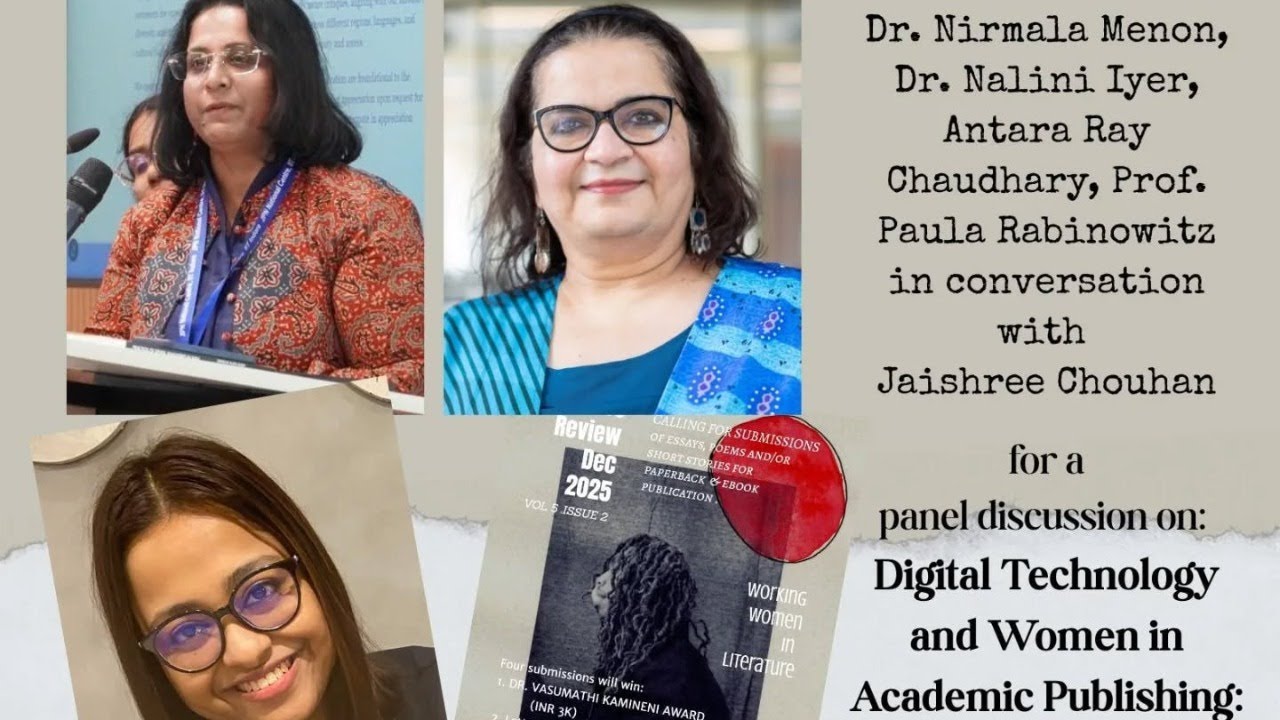
Digital Technology and Women in Academic Publishing: Bracing Challenges and Opportunities