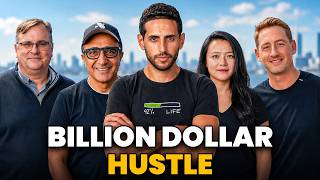
The video presents five distinct billionaire founder stories, each illustrating how a seemingly "crazy" idea, relentless execution, and a willingness to defy conventional wisdom can create massive businesses. 1. Reid Hoffman – Describes how he turned the private, paper‑based resume into the public, online professional network LinkedIn, growing it from 2,000 users to over 1 billion members and a $26 billion Microsoft acquisition. He also highlights his early investments in Facebook, OpenAI and Airbnb, and his belief that AI will be the next transformative, "crazy" idea. 2. Hamdi Ulukaya – The Kurdish‑born founder of Chobani recounts immigrating to the U.S., hating commercial yogurt, buying a small factory, and building the largest yogurt brand in America. He emphasizes hiring refugees and immigrants (30 % of staff), paying double‑market wages, giving equity to all employees, and pledging to give away most of his wealth while alive. 3. Shuo (Sho) Wang – Co‑founder of the global hiring platform Deal, she moved from China to the U.S. at 16, learned English, attended MIT, and identified the problem of talented graduates unable to find jobs abroad. Starting with zero sales experience, she sent 100 cold emails daily, persisted through a 98 % rejection rate, and grew Deal to $1 billion annual revenue, a 1,000‑person sales force, and 1.2 million hires worldwide. 4. Prayudh Mahagitsiri – After studying in the U.S., he introduced instant coffee to Thailand, building the country’s sole instant‑coffee factory and partnering with Nestlé. Over 50 years the brand captured >90 % of Thai coffee consumption, producing 25,000 tons annually and supporting 100,000 farmers. The segment also notes a current legal dispute with Nestlé, underscoring the fragility of even long‑standing partnerships. 5. Jared (Zendrop founder) – Raised in a low‑income single‑parent household, he discovered cheap hoverboards from China, bought them for $300 and sold for $1,300, then scaled the model to a full‑service dropshipping platform. By automating sourcing, shipping, and fulfillment for millions of users, Zendrop moved $200 million of goods in a single year and now serves 4 million entrepreneurs. The narrator weaves these stories together to convey a central lesson: bold, unconventional ideas—whether digital resumes, refugee‑centric food production, global hiring, instant coffee, or borderless e‑commerce—can be turned into billion‑dollar enterprises when founders persist, iterate, and focus on impact.
Chapters
He invented LinkedIn. That's the guy.
My name is Reid Hoffman, and this is my story.
Listen to his story because his new idea may be 100 times bigger than LinkedIn. But first, this is how LinkedIn started. In 2002, Reid Hoffman noticed something strange. Everybody had a resume, but everybody kept it private in the drawer.
People only took their resume out of the drawer when they were desperate for a job.
That's it.
Uh, more or less.
To get a job, you would print your resume 100 times, mail it to 100 places, and hope for the best. But Reid had a crazy idea.
What if you took your resume and put it online so everyone could see it?
Putting your private documents online? Why? His roommate literally said, "Why would I want my resume online? That's weird." Investors told him it will never work. And they were right. In the first week, only 2,000 people joined LinkedIn. Nobody cared.
Great entrepreneurship is when you have an idea that other people think are crazy and you know that you're right. And in this case, I knew I was right.
Slowly the world changed. People got on the internet and wanted a job, so they joined LinkedIn and uploaded their resume. 10,000 people, 100,000 people, people than a million people. More resumes, more recruiters, more jobs. And now more than 1 billion people use LinkedIn. And in 2016, Microsoft bought LinkedIn for $26 billion, one of the biggest acquisitions in history. LinkedIn was not his only crazy idea. Reid was also the first investor in Facebook, OpenAI, and Airbnb, three crazy 'crazy idea companies.' According to Reid, the next big crazy idea is AI.
So LinkedIn gives you a job. AI gives you your own company. It gives you your entire team for whatever you want to do.
Everyone anywhere in the world will be able to take a single idea and turn it into a full business.
We are at the greatest moment in my lifetime in human history. AI is transforming what we can do. I couldn't sit on the sidelines for this.
Reid Hoffman helped 1 billion people get a job, and now we may not even need a job. You can create your own job. You just have to believe in your crazy idea. Thank you, Reid.
Thank you, Nuseir Yassin.
This is great. So excited.
Before we continue, guys, I've got to show you something really cool from the sponsors of this video. The Inmo Air 3. These look like regular glasses, but they're actually AR that doesn't need any wires or bulky headset. They're designed like everyday eyewear, so you can literally wear them anywhere—on the street, on a flight, even just chilling at home. And just like that, you get a massive 150-inch screen, movies, videos, right in front of your eyes with amazing clarity. You can even play full games on that same giant screen anytime, anywhere. It's lightweight, Portable, effortless. You can do everything just by putting them on. This is what AR should feel like. So if you're into new tech or just want to see the future early, check out the Inmo Air 3. Link is in the description below. And grab your 15% off before it's gone. Now back to the video.
I found him! This is the guy who immigrated from Turkey, came to America, became a billionaire, and he doesn't even like business. Hi, I'm Hamdi, and I am the anti-CEO. Hamdi built the largest yogurt company in America, Chobani, and his story is really crazy.
Whatever came through yogurt needs to go back to the world. Don't need it. No one needs money in the grave.
That's a great line. Hamdi is not a traditional CEO. He is a Kurdish nomad in northeastern Turkey, near the mountains, far away from cities. In fact, he doesn't even know his actual birthday.
My mother says I was born when we were coming back from the mountains. So the nomads come from the mountains somewhere around October. So I'm born in somewhere around October.
At age 22, he was forced to move to America. And in America, he tried the local yogurt.
And he hated it. I need some water. Is it really that bad? It's pretty awful. 45 grams sugar, this stick of ingredients. Really, really, really bad stuff.
He didn't want to be a businessman. He just wanted to make a better yogurt. So he bought a small yogurt factory, hired a few workers, and made yogurt just like the one he grew up eating in the mountains.
And he called it Çobani. Yogurt is I said, "There's this old factory. Only problem is I have no money." I have 4 people, and I said, "How am I going to make this yogurt?" And that's how the journey started.
And America loved it. In 17 years, Chobani became one of the biggest yogurt companies in America, with billions of dollars in sales and thousands of employees.
I never studied business. I never went to business school. The only thing I know is I'm gonna make this yogurt, hopefully it will grow, but one thing I don't want it to happen is I don't want to be the businessman I grew up hating. So that means be with the community, be with the employees, be with humanity, be with the environment.
30% of his company is made of refugees and immigrants from Africa, Afghanistan, Nepal, and South America. Some of them can't even speak English. A lot of the people you hire can't speak English. Me neither.
I didn't. When I started, I still struggle with it. I didn't speak English.
Didn't matter. According to him, refugees are great workers and they stop being refugees when you give them a job.
Once you have a job, the minute you have a job, that's the minute you stop being a refugee.
And he paid every single hourly employee Double the market wage.
Double. If somebody works in your company, can they make the end of the week feeding their own family and paying all their expenses?
Then he gave each and every single employee a share of the company. Every single person. And millions of dollars every year he donates to the community.
This is all the milk we made in our plant is going to North Carolina. For our brothers and sisters in need.
All of this is happening from here, Twin Falls, Idaho, where he built the largest yogurt factory in the world. Just look at this. And of course, from all of this, he became a billionaire. But here is the crazy part. He committed to give away the majority of his money to charity while he's alive.
I always knew that whatever came through yogurt needs to go back to the world. Don't need it. No one needs money in the grave.
Hamdi shows that it's possible. It's possible to build a big company and lift everybody up with you.
I'm so proud that because of the movement that we have started and the companies that join the movement worldwide, Hundreds of thousands of refugees have an access to job and their life is changing. It's impressive.
This Kurdish nomad from Turkey came to America and changed the way millions of Americans eat and do business, all from a cup of yogurt. This woman makes a billion dollars a year and she couldn't speak English until she was 16.
My name is Shu. I'm co-founder of Deal.
This is the story of the best saleswoman in the world. Shu grew up in China. When she was 16, she moved to the US and didn't speak a word of English.
When I first moved here, I watched a lot of Disney movies and then TV series like Friends. Friends is is my favorite. I also took English as a second language classes in high school.
Sho was smart. She got into MIT, and there she met her friend Alex. Together, they saw a big problem.
Our friends at MIT, they're very, very smart, but they couldn't find job at the time of graduation because they live outside of the US. That is a big problem.
So they built a platform to help companies hire people anywhere in the world.
And we called it Deal.
But selling this company was hard, so Sho rolled her sleeves and got to work. She opened her laptop and learned something she never did before— sales.
I have Zero experience at sales. Yeah. Zero. Zero.
She sent 100 cold emails every day, 3,000 emails a month, 36,000 emails a year to sell deals to companies.
I sent 100 emails. 98 of them got ignored. Only 2 responded.
If someone said no, she found someone else. If they didn't reply, she tried again and again and again until they responded.
It is quite repetitive, but like, you know, when I received the first response from prospects saying that, hey, I'd love to learn more, that is quite exciting. I did not give up because I have a goal and I need to finish that goal.
She became a selling machine, worked day and night until she got a yes, and It worked. Deal exploded from zero to a billion dollars a year in revenue in 6 years. Now, Sho leads 1,000 salespeople around the world and helped hire 1.2 million people globally. Do you still do sales today?
I still do sales today, yes. A lot of us are scared of selling.
We don't like rejection. But look at her! This woman couldn't speak English at age 16 and now makes $1 billion a year. All because she never stopped trying. Thank you, Sho. Thank you. This is the coffee billionaire of Thailand. He made $1 billion selling coffee. How?
Hi, my name is Prayuth Mahakisili. Let me tell you my coffee story.
50 years ago, Prayuth went to study in the United States. There, he saw something that was everywhere in the country: instant coffee.
I saw so many friends drinking instant coffee, but in Thailand, They were ready to find instant coffee.
So when he came back to Thailand, he said, "I'm going to bring instant coffee into our country." So he built the first and only coffee factory in Thailand that does instant coffee. And then he invited Nestlé from Switzerland to Thailand. That was 50 years ago.
Yes, 54 years ago.
54 years ago? Yes. And turns out his idea was genius. Thailand loved instant coffee. It became one of the most coffee-loving nations in all of Asia. We love instant coffee!
It's cheaper, easier, and faster to drink instant coffee.
How much coffee do you drink?
3 cups per day. Is that how you look so young? Possible.
Every year for 50 years, his coffee business grew, and now more than 90% of Thailand drinks instant coffee from his factory.
We make over 25,000 tons of coffee per year, and 100,000 Thai farmers grow coffee for his factory. This coffee factory is my pride and keep farmer going and keep Thailand growing.
This is how he became a coffee billionaire. He saw something in the world and brought it to his country.
If you see something good, don't just buy it, take it home and try to create something better.
That's what you did. Yes. But this story is not all good news. Today, Pryod and his partner Nestlé have a legal battle, and their 50-year marriage is coming to an end.
Husband and wife can have different idea, can quarrel, can divorce, but you cannot kill your child.
And that child is the factory, the 100,000 farmers, all is in danger, and Thailand may lose the instant coffee. This coffee business, just like my children, I cannot see it being taken away. The legal battle is going, but there is a lesson for every entrepreneur. If you notice something people love, bring it to your country and sell it. You can make billions and hell, millions. Thank you, Mr. Chairman. Kap kun kaap. This is the king of dropshipping. He made hundreds of millions of dollars, and it all started with this.
Hey, my name is Jared, and this is my story.
Jared grew up to a single mom with very little money and divorced parents.
We were clipping coupons on Saturdays to save money at the grocery store. And, you know, I was never ordering the steak at dinner. It was always the chicken to save the money.
But 10 years ago, his life changed when he discovered the hoverboard from China.
He thought to himself, what if I sell this in America? So he did.
He bought each one for $300 and sold it for $1,300. He made $1,000 profit on every hoverboard. Every item sold.
I got an order on my phone for 22 hoverboards and made $22,000 that night. So I thought I should probably go all in on this.
So he had a crazy idea. What if he did the same thing with millions of other products from China and teach others how to do it?
I think this can be a big business.
He flew to China and found 10,000 Chinese factories that make millions millions of products. He rented 2 giant warehouses and hired 500 people.
I don't know how to speak Chinese, but I do know how to say hello, thank you, and fish soup.
How do you say fish soup?
Yutang. That's your Chinese? Pretty much, yeah. And then he built a website called Zendrop. The idea is to help anyone in the world products in China and sell them in their home country without touching anything. No need to fly to China. No need to speak Chinese. This was the beginning of dropshipping. So you went from hoverboard to dog leash to shoes, jewelry, clothes, games, and Nerf guns. All the above.
My team and I We do all the dirty work, all the shipping, all the dropping, so that you could sell anything from the comfort of your home.
And their simple idea exploded. 4 million everyday people joined their platform. And last year alone, he moved $200 million worth of products.
A lot of people just don't think it's possible for them to change their circumstances, to build a business. They see other people people doing it, and they think that they must know something special. But the truth is, anyone can do it. If you keep trying something, eventually something will work.
10 years ago, we all bought a hoverboard, tried it a few times, and moved on. But Jared didn't. He turned this simple toy into an empire.