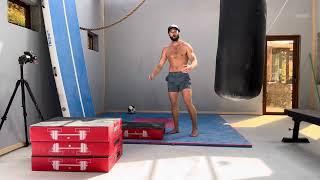
A coach demonstrates five warm-up movements before squatting: deep squat bounces, split squats, step-ups, instability drills, and rear-foot-elevated split squats. Each targets specific areas like ankles, knees, and hip flexors to improve squat quality and mobility.
Chapters
This video, I'm going to go through some of the movements I love to do before squatting, explain a bit about why I like to do them and how to do them, what the benefits are. So I'm going to start with the one that I'm in right now, which is getting in a deep squat position and bouncing in that bottom position. This was something that was part of the ATG system in the early days. I picked it up from Ben Patrick, really working on that bottom part strength. And if it's too heavy, you can use something to support you to make it lighter. You can hold onto anything above the head or you can hold onto extra weight. But this movement for reps. I also like to incorporate a little bit more of the lower leg using the calves. Because my calves and Achilles have been more of an issue for me than knees. You can incorporate both. And another one that I really like to do is the split squat. You got two main areas of benefit or three main areas of benefit. You've got the work that you're doing for the ankle here. You've got the work that's going on at the knee, but then you've also got that back hip flexor. So being able to open up the hips before squatting means it's going to be easier getting into the bottom position. Less pressure on the lumbar spine. When you're on the softbox, it's going to make the footwork a bit harder. I'm just using the softbox because that's what's here. But I'm a big fan. Pulsing in the bottom position similar to the one we've just done. But we're getting more of that hip flexor. Find that stretching the hip flexors before squatting improves the quality of the squat sessions. Makes it easier to warm up also. So rather than just warming up the squat, my squats are generally better if I do this work first. Okay. Then step up variations up onto the toe. This would be something between a Patrick and a Peterson step up, almost simulating like a takeoff. Again, the squishy surface is going to make the footwork a bit harder. Switch on more proprioception. It's not something you need to do, but it's not something you need to be concerned about or shy away from as well. Sometimes instability training is used overly used, sometimes it's overly demonized. Neither is probably very close to the truth. Like, nothing wrong with doing some stuff on unstable surfaces, but probably don't need to train everything that way. Another one that I was playing with Today is essentially like a speed ladder. Different drills, Timing. Might think, okay, it's silly, why would you do that? But just one minute of this sort of work will get the heart rate up. It'll also keep you feeling younger. Imagine I like what Pavel Tatiline said of, you know, power lifters should be able to run like runners can lift. So a marathon runner is going to be terrible in the gym with a power lifter and a power lift is going to be terrible on a run with the runner. But the power lifter should be able to run and the runner should be able to lift. When you can do it to a basic level, everything rises. Having massive weaknesses that we really can't do, can't use it always not a good thing. So even if you're not someone who's playing sports, probably even more and better to use this. If you're playing a lot of sports, basketball, soccer, whatever it is, you probably don't necessarily need this work. You might, you might like it, you might want to include it, you might want to get really good at it, go really fast. But yeah, it's something that I wish I'd have included more of over the years. Basic low level foot skill coordination stuff. So I do my foot juggling pretty much every day. I'm doing some work on being able to control a ball and that does give me some general base of balance and stability, ability to get to different positions. But I've definitely deteriorated a lot in terms of my ability to run and, you know, speed of footwork and things like that. If I'm not doing it, if I don't do it for years, then those abilities are going to be lost. So these are some of the movements I like to do before getting into my squats, split squat position on the flat ground. I like really leaning back into it, potentially even having some weight overhead. It's also good to have that foot more out in front. Can use a bit more posterior chain. It's a bit more like the splits. It's a bit more like just a standard lunge or a rear foot elevated lunge. It's going to give us rear foot elevated split squat. It's going to give us more stimulus like this in the front leg. They're not bad positions. You don't have to be always in this knee over toe position. You're going to get good at that if you use that. But then you can actually become not as good in these positions that maybe people who don't train ATG or knees over toes might be strong in. You might lose those positions a little bit if you don't use them, so. Hope that helped. Tell me which ones you're doing, how you like to warm up, how you like to prepare. Now we're going to get into the squats and see how front squat into back squat goes today. Have a great day. Until next time.