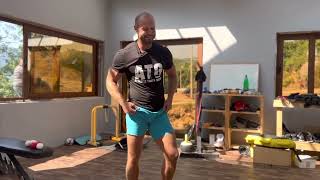
A trainer shows five tests to run before lifting: grip strength to check your nervous system, body weight to track hydration, light rack pulls to activate muscles, juggling to test coordination, and handstand holds to build wrist readiness. The goal is neural prep alongside strength.
Questions this video answers
Left: 67 kg; Right: 63.1 kg.
85.3 kg.
110 kg (isometric; practicing sets of five).
200 kg.
13 (first effort); later count reached ~29–30 during session.
Chapters
So some of the things that I like to do before training is test my grip. I use this with professional athletes. We tested before every strength session. Not because grip is so important. That's my first one for the day. 67 kilos on the left, 63.1 on the right. It's not really a magical thing. It's a measure of neural output. So what I'm interested in is how strong is the signal that's coming from my brain and my spinal cord to my hand to start the day today. So 67 kilos and 63 kilos, these things are about 20 bucks. I also generally will take my body weight as well. So I like to see when you test your body weight often. So 85.3 kilos there this morning. If you test your body weight often, then it also works as a measure of hydration and how much food you've eaten, as well as whether you're gaining mass or losing mass. But you don't gain or lose a lot of mass from day to day, but it is useful in that way. So I like to do these two things before I start training, and then I will generally get into some sort of skill development. So just strength training alone kind of can leave you stiff and with less capacity. If you only train strength, you get worse and worse at everything that you're not training. If you play a sport, if you play soccer, for example, probably be a lot better than me at this. But if you don't play soccer, like I don't, then you probably won't have this capacity. A lot of people who start this, the first challenge is just to kick the ball back to the hand. And so what we're getting here is not just this foot hitting this ball, but it's also the stabilization of this leg. So if I'm going off. That body. Awareness of where you are in space is a universally important concept. Switches on the nervous system, gets everything alive. So if I then go into some squatting or into some rack pulls, this will be my first lift of the day. The magnet wants to transfer. Take this one off. Start with an isometric. Just pull on the bar, but without actually moving it. And you might think, how can you pull on 110 kilos without moving it? That's crazy light. But it switches everything on a bit. It's like a bit of a hack to not have to warm up. A bit of a hack to not have to warm up is to do an isometric with the weight. So just pull on the weight without actually lifting it, and then when you go to pull it, your system will be switched on. It's lightweight. My best with this grip without hooking is 200kg from the floor. This is 110kg. I'm practicing sets of five at 110kg. Yesterday I did maybe eight sets throughout the day. Good thing about living here in the village is the gym's always nearby, so I'll just gradually edge that weight up, get my body used to pulling heavy loads again. This will help with the base for the snatch and other movements as well. Come forward and then you won't be in the sun. And the other one that I'd really like to do, so you can see I did sort of do some weight training there, but generally what I'll do will be some foot juggling, some hand juggling, and then I'm going to be awake. 1, 2, 3, 4, 5, 6, 7, 8, 9, 10, 11, 12, 13, 13. First effort. Five ball for the day. 29, 30. This also gives me a bit of a measure of how I'm going neurologically, how accurate the system is. I can feel if it's sort of draining. Sometimes when you go for maximal juggling, you can feel it's like draining the neural power because you're visually tracking five objects at the same time. There's a lot going on and so it's sort of maxing out your brain capacity, which is a good thing. But sometimes you can feel it's really quite draining and it gives you a clue that maybe the nervous system has been overly taxed. Another one that I like to do is some version of a handstand. So frog sit, Mano. You want to show the frog situation. There we go. This is about the. If you. If you look closely, you can see that the hands are working very close. You want to come up and do a really close one on the hands. Come close. You know, I just want you to be able to see the hands. Yeah. See, the hands are actually balancing and balancing. Wow. Yeah, you're always pressing to the handstand there. Is that what you're trying to do? So he's getting close to his handstands. Do you want to show them where you're up to with your handstand? If you. If you can frog sit, then you can actually have an attempt on the handstand and your hands will be active. So not the best start today with my handstands. Three kick ups. Do you want to practice yours manufacture? Nice. That's it. You're getting used to. If it goes too far Then you don't really crash anymore, do you? You know how to get over there? We go. Nice. Any longer and longer and you can practice wall drills and you can make things really focused with the handstands. But that frog sit is a great entry point. And then it means you're gaining spatial awareness and the wrists things to be able to get into your skill. So I really like doing that before I lift. I feel like I'm more ready. I've just handled body weight on my hands, so it's not actually that crazy. If I go and press 60 kilos now, let's see how this feels. Three, four. So five reps. Second lift of the day. My best on that. Maybe 75 for five, maybe 72, 73. It's been a while, so it's not maximal, but it's not that far off. If you warm up in this way, you get neurological gains, you get skill gains at the same time as preparing yourself for big lifting. So ask any questions. If it seems too crazy, that's probably a good thing. My business is uncommon success and I train in an uncommon way. My the philosophy is that if you have a massive base of hand, eye coordination, of balance, of mobility, skill development, then you'll be able to apply that to other things that you want to do outside of the gym. So if you go and play basketball, if you go and play some tennis, you'll have more of a foundation from training this way. It's a shame to be able to train every day or train five days a week, four days a week, but to be losing coordination, to be losing brain matter, because you're not actually stressing and challenging your brain for skills. So this is the philosophy. It works very well. Love to hear any questions, thoughts, feedback, if you've implemented some of this already, if you're thinking about implementing it, any questions, hit me in the comments and look forward to hearing from you.