6-figure online coaches in year one @MucciStrength @Bulletproof_baller @DiMFiT @daza_elite
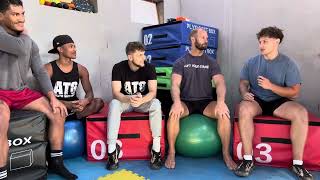
A recorded group conversation with coaches (Liam, Kadeem, Speaker C, Nick) and a host about personal rehabilitation using ATG/Ben Patrick methods, failures of conventional physio, mindset/avoidance in recovery, and translating physical wins into online coaching businesses and communities (Discord/Dab Elite, Uncommon Success). They describe rapid audience growth, coaching philosophy (integrating diverse methods), building gyms/villages, and ambitions to scale brands and athletic culture.
Chapters
So when I was your age, I was thinking about upgrading mankind's athletic future. I was going to university for it. And I was thinking, like, there's a lot of answers here. It's probably not that complicated for society to be more athletic, for our health to improve. But then at that place, the university where I was studying exercise, it didn't seem as though what we were studying and like the energy of what we're doing was actually going to change anything for better. You guys have gone a different path from that traditional study exercise, sports science, to make an impact, but you are making impact. So the point of this conversation is to share the journey of how you've gotten to the point that you're at now and understand a bit more about where you're going with what you're doing at the sort of young, relatively young in your, your professional lives. Capture a bit of sort of how you got to where you are so soon and where you want to go with it. And maybe you can check as you, you did go to university, you went for something else.
Psychology. Yeah. I mean, obviously university, everything's just a tool, but university, you get funneled into something. I chose to do psychology because I was interested in it, but probably wasn't the right choice. It's just something I was good at in A level. So I went there, done the three years. It's literally designed in a way so that you literally just do the coursework, you don't show up to the lectures and then. And then you're good. So, yeah, it's interesting looking at. And the thing is, as well, like I've learned more about psychology in the last year than I have at three years of uni because I, I've chose to do the self learning and that's probably the most important thing. Like if people go to uni and they do the self learning as well as the stuff that's there is necessarily not bad. Obviously there's loads more stuff out there and you can learn a lot more through different sources than just the one that's fed for university, because it's one side of a view of things.
Now you'd be more like self taught over the. With your athletic journey versus what you learn in psychology.
Yeah.
People say, you know, you're not qualified to do what you're doing. Like, what is it that gives you the authority? Like, you speak with a lot of conviction, you're getting results with people.
Yeah, yeah. I mean, if you go through that system and it's not the right system system, if it doesn't get the right results, then I've skipped all the years of programming so I don't have to rewire my brain to think in a certain way. Like I got the results with ATG and the Ben Patrick method of stuff. So I dove right into that. But like I still read research, I still do all the study outside of it. So it's like results and anecdotal evidence to me sometimes can be more convicting than research study because it's actually happening in real life. You're seeing it in front of your eyes like, oh my God, I'm having like no one re injure and like I've gone from unbelievable injuries to being able to do the stuff I'm doing. So it's like I've literally seen it change my life. So using it to change others is like a no brainer. Yeah.
So yeah, you had catastrophic injury injury yourself and then you went through the traditional system.
Yeah.
What was your experience with working with those who had been qualified through the conventional methods?
Yeah, yeah. So I mean if no one, if anyone doesn't know, I snapped my kneecap in half when I was 16 and then had surgery on it after that surgery. I then had like four different physios which some one of them was good to be fair, like compassionate wise. But the exercises weren't great. It was all muscle, it was leg press, it was leg extensions, it was Bulgarian split squats which aren't necessarily bad exercises but like the internals of my knee just got worse and worse because yeah, it was tough and then yeah, I mean if they haven't experienced what I was going through, like it just seemed like they didn't really care too much. Like I was getting the same exercises as we had like a group training class as well where like 40 year olds were getting the same exercise as me, where I wanted to return to like elite sport. And then yeah, it's just not the same. Like the internals just got worse and worse. Like I ended up developing like ACL meniscus damage after that and then like tendon pain. And because I was getting more pain than my quads shrunk more and then because my quad shrunk more I was getting more pain and more injuries. So it's just like a cycle and there wasn't really a clear way to get out of it until I found the ATG stuff. But half of the ATG stuff as well I think is in the mind because you see someone like Ben Patrick or me do it and it's like wow. He's been able to do it. So it's like, I believe I can do it now. Whereas the physios are like, they don't instill any hope in you really.
And why would they have hope? Like, they're a bit jaded because they know that they're getting moderate results. Like sometimes people get a bit better. Probably a lot of clients also don't really do the things that they say. They're used to people not doing what they say to do and then even if they do it, it's not really working. It's a whole system of like unconvicted process that, you know, it's a generalization what's what you, what you experience and what a lot of people are experiencing. So then there's this idea, you know, maybe we can touch on this merch like that. Because you're probably getting had the most criticism potentially of like, what's so special about atg. Like, everyone trains quads, everyone trains hamstrings, everyone trains calves. And you know, we don't. No one needs to train tibs. So what is it that you experience? Because you, you were in a Div 1 system, you're, you're potentially at the height of what college strength and conditioning should be. Like, not the biggest college, but, you know, a major college. Divine opportunity. What is it that's different about it that allows you to be so convicted that then kind of triggers some people because you've got so much conviction, you're putting so much energy out there about, well, hey, this is different. What's, what's different?
Yeah, I was brought up in like the football ego lifting strength rooms and I didn't change when I went to Bryant University, which is small division one school, fcs. The biggest difference that I know that brings me so much conviction is. The rate of non contact issues going on in a contact sport. Like, you'd think that majority of the injuries in like a high contact sport like football would come from hitting or tackling or landing on the ground hard or whatever. But majority of them come just by the lack of training principles in the gym. And something that I finally realized when I was at college dealing with a lot of issues, specifically hips. Like, yeah, I had a huge opportunity. I was playing next week, I'm in the er. I had like numbness from the left side of my head down to my foot. I had like a bunch of nerve damage. All this stuff.
What happened.
Nobody could tell me what it was exactly. They said it was Covid. They, they told me I went to maybe 15 different chiropractors within, like the tri state area. Driving like two, three hours to find different guys. Doctors told me that I had neurological problems. I went to a neurologist, he's like, your EKG is fine. The whole thing. I got MRIs.
So nothing. No catastrophic injury. Like, there's nothing clearly that.
No.
Wow.
No.
But severe numbness where like I couldn't, like the eyelid opening and closing, I couldn't feel. That was like a theme for like at least two to three months. And over the span of me going to see these doctors and everything, I mean, emotions are just haywire. Like, you're just miserable. Like, you're just like, I don't know what I'm doing. And then. But it's not just me. Like, players, even if it's not as chronic as I was, like, players just continuously go to the PT route separate from the strength training, and you have the ego lifting with grandma pt and then it just never, it never correlates to solving the non contact issue.
So so far between what you're doing for performance versus what the rehab stuff is this massive area in the middle that's massive.
Massive. And once I, you know, I went the same route as Liam in terms of just ATG and studying those principles and then finally, like doing the research myself. And then, you know, I had issues with my strength coach at college and the PT and just stopped doing what they were telling me. And I was just doing it on my own and trying to figure it out. And I finally was seeing progress. Like within two to three months, like started feeling blood flow going down my leg and I'm like, yo, I'm alive again. Like, literally. And then my teammates had like, similar nagging issues, whatever, regarding like, low back. Because we constantly had like low back flare ups every time we sprinted. Like, everybody on the team had like these hip flexor, like low back flare ups all the time. The first thing was like I was doing couch stretch after practice and like, everybody's like, yo, what are you doing? What is this? So I'm helping like four, six, maybe four to six of my teammates, and they're all like top players on the team. My strength coach comes over, he's like, what do you. What are you guys doing? And like, it's. It's almost like, what did he think about it? He's like, yeah, yeah. He told Guy's great. Yeah, he said that in the beginning. And then he said, yeah, keep doing what you're doing. And then it got to a point. Where I had like 10 people coming after, coming up to me after the lift because I was studying this stuff. So after our lift, we would hit another lift with ATG stuff and everybody's sitting there and they're like, oh my gosh, my hips never felt better like that. And I were hitting city good mornings. Like we're hitting rdls because we haven't hit them in like weeks. And he called my train coach called me into his office multiple times and he's like, yeah, like, you know, you're not going to take over the weight room. Like, whatever, whatever. And I'm like, yeah, I get it. But like, we're making progress fast. So I was like, there's a bit of a disconnect. And then I made the fat. Like I was a, let's say like a third on the depth chart. Like for my position. I got to a point, yeah, I got to a point where I was like chasing the starting spot in the middle of like spring ball, which is like off season practice and stuff like that. And everybody was like, yeah, like, how have you made the strides? My coaches are looking at me like, yo, your hips are like phenomenal. Like, what happened? I'm like, I just trained myself and they still knocked me for training myself.
Interesting.
And it was just, it was just a crazy route. And then I got like a supposed COVID test. I was out for another eight weeks because I couldn't. There was a ridiculous protocol, whatever ended up leaving the transfer portal. That's story from the time. But the purpose is like the. I tell all my clients this and everybody, every football player that I work with, the majority of the teammates that I work with now is like, you'd be, you'd be astonished to see how fast you can change how you feel within your play in the matter of just like the, the clear and concise coaching. And that's kind of how I model my, my football teams now is, is like when I was in College, we had one strength coach with 65 players. It was very, very difficult for us to get one good form, be able to get touched up depending on someone's technique. Everybody's kind of going, Strinko's just sitting in the back freaking drinking chocolate milk. Like literally that's how the vibe was. And now I structure it where every single kid on the team knows that I know where he's at in terms of his split squat form or his squat height or his city. Good morning. What where he's at with weight or whatever it is the level of progression I know every single person in the room and it gives the athletes comfort because I dealt with like that like my entire life with high school and college. So, yeah, to sum that long answer, it's like, that's the difference is the intention with coaching and then the disconnect between performance and the healing from injury.
Yeah. And it's like untrained areas. Like, you make progress so fast because it's like roots of avoidance for me. Like, I was told, like, don't, don't go knees over toes. Like, do the split squat, lunge to this height. So I mean, so then it's like once you start training that area, like, it's unbelievable. I went from like my knee, I mean, I said this before, but like, I was wake up in the morning and my knee would be so stiff that would snap into place and that would wake me up. And that went away within like three months of doing atg. And they couldn't tell me what it was. They couldn't tell me how to fix it. They were just like, carry on building more quad muscle. My screws were coming out my knee. They're like, build more quad muscle. I try and it hurts like, yeah, it's Covid.
Yeah, it's like, yeah, you get, you get newbie gains because it's movements that you haven't been doing. It's positions that you haven't been strengthening. I was squatting 160, you know, round double body weight, feeling like, okay, well, this is like, this is reasonably strong. It's not huge, it's not world class, but it's like strong. But I had no strength in that full deep knee bend position. My knees still hurt. I wasn't athletic. And the more weight I added to the bar, the older I felt, the less athletic I felt. And then you get these newbie gains. When you start doing kneeling squats, you start working on the reverse Nordic. Like, I had zero strength on the reverse Nordic, even though I had like decent sized quads and like objectively reasonably strong to have a full depth, you know, 160 squat. So people, you know, throw stones of like, well, it's just training the quads. But then when you go to do it, it's like, well, this is not just training the quads. Like, he's got huge quads, but there's no. He's going nowhere near a reverse Nordic. He's got absolutely no strength out of the bottom or like the hack squat as all hacksquart was crazy humbling. It's like you load up the bar, doing reps at 140 and then try a hack squat with 5 kilos sitting behind the hips. It doesn't freaking move because you put the load right onto the long range of the quad and really have to load the quad rather than being able to lift with the back. These details of the movement, the details of the positions, the muscle groups that you have trained, they do make a big difference. And I think that's. If we were able to express that more clearly and people understood that there is so much difference between the type of adaptation you get from these seemingly superficial changes in the movements that you're using, I think there would be more understanding and more exploration into what's really going on. Like, ATG has been the catalyst in this for a lot of people and that the principles carry over to shoulders, carry over to triceps, carry over to biceps. And I think, like, that message, the core idea of what's changed is getting lost. And people are getting lost in trying to battle about who should have the most followers on Instagram rather than having a conversation of what is different about this. Why is it that those physios didn't know? Why is it that that strength coach doesn't know this stuff? There is something different. Like, it is different knowledge. It's not just, we're all training quads, we're all training hamstrings. It's all the same. It's. It really isn't like we're all trained squats. Kadeem, like, you've been on this journey as well. Like wanting to be able to play soccer, right? Like, that's the big driver for you is just like, I want to, I want to be able to play. What is it that's got you back to being able to play? We're playing here. You're experiencing again, like, yeah, to.
To give a little bit of background. My.
Yeah.
14 years old. Had my knee started to hurt and. And I was playing football my whole life, soccer and obviously I went to doctors as well, tried all the different stuff. Basically just pain reducing creams, icing, nothing special. And it never held me back from actually playing football. But I couldn't go more. So I continued to play and play and play until a little over a year ago. I was really at a bad point, just got out of military. Then a bunch of different stuff came together. And then I wanted to return finally to play football again. And I injured my quad on both sides. First time coming back, tried to do rehab on my own, came back again, same thing again. The quads. And when I was finally coming back again, then the more I upped the intensity, the worse my knee got because over the years my patellar tendon just degenerated like, completely because I avoided it. Avoidance was really my biggest enemy. And yeah, I realized if I want to continue to enjoy the sport I love, I needed to change something. So that's when I started to look for solutions. And yeah, also I discovered Ben right atg. And, and since then, I've been on a, on a journey of learning a lot. Really. It's taught me more than I've ever learned before and I'm grateful for, for the journey I've been. Been on because. Yeah, when, when you're, when you're dealing with, with an injury for so long and you try to return and it just doesn't get better, then it's, it's. I've realized it's a lot in the mind. Liam has helped me with that a lot. And yeah, the, the turning point, I would say even though I knew about, like, I had the, the exercises, I knew what people were getting results with, I still couldn't get the results I wanted because in the mind, I wasn't fully convicted that I personally could actually do it. So for people watching, listening, like, I really can't emphasize it enough that avoidance, fear and, and thinking, okay, you, you, you can't, like, you have to be really 100% convicted because I was teaching that I got amazing results with people. People were getting rid of patellar tendonitis, tendinopathy, what I was dealing with.
Yeah.
And I was still not quite able to fully get rid of it myself.
Yeah.
And I was like, yeah, what's happening? And it really wasn't until that that change happened.
Yeah.
And I think this, this, this is a big thing. You can have all the methods you can. Yeah. But that's the biggest thing.
So we've, we've had these personal journeys and we'll share as well with Nick, but we've had these personal journeys where it was like, for me, it was 20 years. I was obsessed with strength training, training all the time. And I just accepted that my knees were going to hurt if I squatted. If I wanted to squat more weight, my knees were going to hurt more. Like, you can't. For me, I can't be convinced that the thing that we're talking about doesn't do anything. Like, and you can't be convinced that nothing changed for you because, like, you just know. And then when you express that, then it triggers some People of like, well, what is it that's, you know, they don't understand what's different. You've now gone in this journey of teaching it to other people, which makes you more convicted. Cause you've got pro athletes reaching out to you, saying, hey, like, I'm doing all the stuff the system's telling me to do. I'm just not getting the result that I want. I'm curious, is there something that I'm not doing that I could be doing that will make a difference? You're showing them the stuff. They're like, wow, thank you. This is a miracle, you know, or, you know, whatever language they use, but, like, they're getting that same result. So you're getting this reinforcement loop of, okay, we're doing something different here. This is good. The world needs to know about this. Now you've also, I think, Liam, you know, you're the, you're the big one in this. You've all done it with each other. Like, you've been helping each other out to be able to share more to others, and now you've built these businesses. The dream of most men your age is to be able to make ten grand a month online and be able to travel the world, be able to think about having a family, thinking about, you know, most men your age don't even want to think about having a family. But I know you, you, you all are like, you're able to progress through life because you, you are able to transfer this knowledge to others. And ATG for coaches has been a vehicle for you to sort of progress into coaching and then within uncommon success, the encouragement of, okay, let's turn this into serious brand, serious income and see how far it can go. I want, I want to share a bit about, like, how much the connection with, between you guys and giving yourself permission to share what you've, you've learned. And that journey of business is a second journey. So we've got this journey of the physical change, which you can't deny. Then there's like, the intellectual transformation to business. I'm hearing you every day, like, spitting gold, talking about sales processes, talking about funnels, talking about emails. Like you're as passionate about that business side of things, of being able to get this message out. Did you see this as something like, was this something that you knew was in you when you were going through psychology and such like, that you would become this, like, business owner, business mentor?
Nah, no way. No. I mean, when I was going through uni psychology and stuff like that, there was no Thoughts of even that I had no idea what I was going to do, to be honest. Like, I was going to do a master's in physio. Even in the third year. Like, I started doing Tesco delivery driving and then listen to podcasts, listen to you doing that kind of stuff. And that's what started to change my mind, to open up some ideas. But then it was even then I was like, I'll do a master's in physio. But then I went and saw what they were doing in the masters in physio. I was like, let me, Let me, like, give them help. Because there's these people coming in, struggling with their knees, and I'm literally sitting there like, and I'm not allowed to say anything. Like, it's crazy. But yeah. And then a lot of things happened at one time. So, like, finished uni, broke up with a girlfriend, and then literally, like a week later I joined Uncommon Success. So it was like just like an absolute whirlwind. And your mind just keeps expanding, expanding, expanding. Like. But the thing is, like, it, business people have bad interpretation of money. I had a bad interpretation of money. Now I view money as like, you're helping so many people. It's like, the more money I can make, that means I've had to help more people. So that's why I'm so passionate. It's like, if. If you don't know the funnels, if you don't know the email marketing, if you don't know whatever it is, then you're doing a disservice to the people that would be reached. Like, Ben, we are all sitting here because Ben Patrick, he was able to market himself for YouTube. You found him. I found him. You found him. So it's like, if we can't do that for other people and put people in this situation, like, what are we doing? There's no point just doing yourself. That's selfish. Wow. You fix your knees, good for you. This fix thousands of people's needs. Do you know what I mean? But yeah, it's. It develops, develops over time and like, you keep expanding and like, like, yeah, to be honest, like, joining Uncommon Success is probably the biggest propeller because you're around people constantly and they're telling you, oh, you're doing this, you're doing that. And then like, yeah, it's good to have a self image. You can build up. You can tell yourself one thing. But like, Neville Goddard had this visualization where he would have other people tell him, oh, you, you've got so Much money. You got this, you got that. And because you can accept it better. So when I hear you saying it, or Justin saying, or Kadeem saying, oh, you got gold. I'm like, yeah, I do got gold. I started going. So, yeah, like, I can't thank you enough for even putting this together.
You two connected pretty early on in the journey. Like, what was it like when you first spoke to each other? What was your first impression of each other?
Yeah, I mean, we first spoke in like, like July, maybe August, when we weren't doing too much. Like we were just getting started, whatever it is. And then we had like a 30 minute conversation. It was cool. Everything like that four, five, six months go by. And then it was like the universe gives you stuff when. When you are ready for it and it comes at the perfect time. And like, it was like Christmas. I was having like this whole revelation about, like, religion, whatever. Like, I didn't know what was going on. And then you were doing the same thing. Like, you just broke up with your girlfriend. And then, like, just randomly, I saw your Instagram profile. I was like, you wanna hop on the call? And then we hop on the call, like, all the coincidences. And we end up talking for like eight hours. I go to bed, like, I'm usually in bed by like 9. I'm going to bed like 3 or 7, 3am and we just had like this massive conversation. And since then it's just been go, go, go.
Yeah, yeah.
I mean.
Yeah, I joined Oncom. I was.
Yeah.
Yeah. Having those conversations repeatedly. Rap, like, was the. A big reason for the rapid growth. Like, there's no question about that. We. We talked like nearly every day for.
I don't know.
Yeah, like three, Three. Three months, roughly.
Was that. That was around the Daboli time as well?
Yeah, yeah, yeah.
Maybe share a bit about that.
This.
That was a wild time.
Yeah.
Good time. Yeah, everyone blew up. Yeah, we were on the. We were on the dab elite. Like every day. It's pretty much just like a discord where we'd all hop on for an hour. Well, it was supposed to be an hour every day. It ended up being 15 minutes.
Ended up being three hour calls and hours.
And we were just discussing, okay, what are you doing with your reels? What are you doing with your business? What are you doing with this? What are you doing with that? Moochie then got a video that blew up. I pretty much took the video. So did Evan, and so did Evan, and we all blew up at the same time. And it was just like the force was just boom, boom, boom. And everything was just growing so quickly. And you can see that in the content. If I was to go into my archive and find the videos from like that period of time in that month, I'm a different person. Like, it's.
It's night. It's night. And, you know, it's funny that you say that, like, because of that time where we just had rapid growth and like every day felt like, like a month because of how much we were like changing throughout the day. Like, new ideas were popping into our heads, we were writing down stuff. Like there was no time in that time. Like, we were just right, this is what can I do today? And then things change. Like every, like every week. We had, I don't know, 5K plus followers. 5K plus followers or whatever. And it was like, okay, he's got 6,000 comments in this one and then he's got a thousand. Okay, how do we monetize? Okay, what's your ebook? And then we were just like always backing each other. And I think, yeah, we couldn't have done it without, you know, one you creating the dab. Because that just skyrocketed. Especially with, like the brotherhood just bringing guys together that never even talked to each other before. But, like, we're doing it now, like, because of that rapid growth that me and Liam had. The reason why we're here together. And then it's also the reason why when we go back home, like, you guys are gonna be together. Like me, Nick, Aiden Andreas, we're gonna be together because we know how powerful it is. It's absolutely no question, like, it has to be this way just because, yeah, you grow so much as a person. It's like the infinite, infinite fulfillment. Yeah.
Yeah. Let's see if we can break this down a little bit of like, because it doesn't seem intuitively that important of like, why you would want to be on a discord call for two, three hours with, with other guys. I, I built business in 2014. I started this real movement project and I started running four day events. We'd come together like this train really hard, think about what we want to do with life. And then everyone would go back and on those events, everyone would be buzzing. But then it was only the guys who opened gyms who then had that vortex of community around them. Like they were the ones who continued to grow. But it was, there was always something missing when we, the gradual trend has been towards, like, more contact. And now with the villagers, it's like there's an opportunity to live together for a period of time. Some of the guys have lived together for a month or two months or three months. Then we did the Dab Elite. It was like there was two times a day, disciplined action, Brotherhood is what it was. There were two times a day where you could jump on with others and say what you did in the last 24 hours, what you're doing next 24 hours. Which is what all executives have. They have their personal assistant, they have a team, they have the daily meetings. Like, in business, it's normal to have regular contact. And then people think, especially, you know, young guys, they start their online training business. They think, like, I'm just going to do it on my own. It's going to be fine. No one in business does that. No athlete does that. No athlete goes, oh, I'm going to go to the Olympics. I'm just going to train myself in my garage and then I'm going to go to the Olympics. Like, I'm going to be. I'm going to be the greatest basketball player of all time. Just going to set myself up here in the park and everything's going to be good. Like, it's. Yeah, it's literally ridiculous that you laugh, but that's what we do in business. And like, yeah, how's that working out for you? And spiritually as well. And like, like the bigger questions that we're having about how do you have a beautiful family and, you know, what is the framework for life? And these bigger questions that we get to play with as well, the foundation is the physicality, which is. Doesn't lie. If you go, either do a reverse Nordic and a Nordic and a backflip or a snatch or you can't. And so, you know, this is part of the proof. Like, people can hate on it, but it's like, well, how many people can really do this? How many young men who've had multiple surgeries end up being able to do these movements? And statistically, objectively, like, it's very, very low. And we just get started. Like, there's. There's so much further that we go that we can go. And that's what we're. Every time we get together, the vision expands further. So finding these few people who can believe in you, who are going to challenge you, who are going to ask, how are you going? How did you go this month? What's going on with your relationship with this girl? What's going on with your bank account? Have you been pushing it with your training? What's the progression that you're after. It makes all the difference. When I was in business to begin with, I try to do a lot of it on my own. When I look back, the times where I grew fast, I had one, two, three guys that were either with me in the business or we were really close together. Together. Every time I get that, things accelerate. When it's more of me on my own, things slow down. And this is, this is my experience. And I've been able to do more in business than I ever thought I could do. But same deal with the training. Like the last two months of training here, here in the village. There's other guys here all the time, train probably like two, three, four times as much volume as I would if I was here on my own. And you get better faster. So it's not a mystery when you think about it with training. Like, if you get to train full time with the best in the world, whoever the best wrestling squad is in the world, if you, you go there, you live with them, you train like, you're gonna get so much better. It's obvious. But then we don't take that to other aspects of life. We don't take it as seriously because it's not in the, in the, in the paradigm. Also, when you teach, like, how much impact has it made for your understanding of the body to be coaching others? How much impact has it made for your understanding of business to be firing everybody up about business systems? Like, you think you're giving, but you're getting so much. You are giving, but, like, you receive even more in return. So it's a radical concept because young men think they're going to do it on their own. These stories of the lone wolf and all that stuff. So where, where does it go now that you've, you've, you know, you've got to this point, like, it's. I see it with you as well, like, okay, 10k months, like, that's the dream. How do you, how does it get any better than that if your business is able to do 10k months? Like, that's in your early 20s. Like, you know, you travel in the world. How many countries have you been to now since, like, things have started to kick off from Tesco driver psychology students and now 15 times this year. If you travel 15 times this year from, you know, how many times did you travel in the years before that? Like, yeah, so you got this completely different opportunity of life. Now. All the great people in history, they did have the opportunity to travel. They did have the opportunity to have These meetings of the minds. And I'm not saying that we're the greatest people in history yet, but, you know, that's what we're working towards of, like, the. Maybe not the greatest people in history, but, you know, that you get the idea of, like, we're developing as. As men by going through this process, by pushing the physicality to another level, taking the business to another level, thinking about what kind of families we want to. We want to build. And it is pretty foreign. Like, you have a conversation with someone who hasn't been exposed to any of this, and it's like you're from another planet. Like, because people get stuck in these downward cycles of not. Not being able to, you know, see. They're in the dark, they're buried, and they can't see that type of life.
But even people that have been exposed to a certain extent, like, I still have conversation with people that I meet, and they're just like, they. They just. I told about my vision and they're just like, how do you think that big? Like, where is it coming from? And, like, my original goal was like, 3k a month when I. Or just making more than I would make in my Tesco delivery driver job, and I made that within, like, a month. And then it was like, I was like, what is going on? Like, what? And now it's like, that. That goal just seems ridiculous. Like, why do I have such a small goal? But, yeah, what was the question about the future? Like, where's it going?
Yeah, where do you see it going now?
Yes, it's going to be absolutely crazy. Like, like you say, like, we are taught to grind hard, do it by yourself, do that kind of stuff, and it's just no fun. Like, I listened to Tate a lot. I listened to some people in the UK first. Man, all these people, and they're like, they're now changing their ways of, like, okay, it's probably. Tay was a bit there with Tristan and stuff, but, like, me and Kadeem look like we're gonna combine to build one of the best football brands of all time, help people return to sport and then even maybe get connections with pro teams, stuff like that, bring different training methods together, go from there, but then, like, business as well. Like, help people with that, Build massive things to help people improve in business, improving themselves, just open their vision. And then you have, like, the smart side of stuff, like the families, the villages, everything. Like, I can't even tell you. Every three months, my vision gets bigger and bigger and bigger. Like, if you would ask me three months ago, what's your vision? It would have been 10 times more than it is now. In three months, you asked, my vision is going to be 10 times bigger than it is now. Like, yeah, okay. Yeah.
The thing about wanting to do this alone is so true. Like, there's really, like, if you look at all the. And I just realized this last month, right, I was in the grind, and the achieving great softened. Obviously, it wasn't even there. When you think, okay, you're doing everything alone, you're wearing all the hats, it's working great. But if. The more I thought about the future where I want to go, the more I realized, like, I don't want to be doing this alone forever. Like, I want to be able to share my knowledge, to learn more. And as you said, like, combine visions together and. And build together is so much more powerful. So I think that's like, yeah. If, like, a lot of people, I think the. For me as well, the ego comes. Comes in, like, yeah, I want to build this big thing, and I'm gonna be, like, the. The best at this, and it's gonna be mine. Like, I'm gonna be known for it. But, like, this is really selfish, right? Like, if we combine, for example, what we're doing, we're going to be able to help so many more people, and I'm going to be able to help Liam. He's going to be able to help me. And it's. It's just, yeah. Like, I think realizing that the. The ego often, not. Not even just about in business, like, in general, in life. I'm about to read a book that I don't know what it's called, but it's. It's going to be about ego. Like how ego comes in your way. Yeah. Really eager to learn more about that, because I think this is a big thing that's holding people back, like, trying, ah, push through this alone. There's no point. Like, if you have this opportunity, use it. Yeah.
Yeah.
It's funny. I always kind of saw myself as that lone wolf growing up, because I was the only person in my family here in the US I literally have it tattooed on me. The wolf is my first tattoo, but when I had that mindset of, I'm gonna do it all by myself and this is gonna be mine, and you know, what you just described, I never achieved what I wanted to achieve. And it wasn't until, you know, I joined this network and I got around other people who had similar visions that not only did my vision expand and get bigger, But I actually saw the progress I wanted to make. Like I had. I've had my page for about four years and I never made any money online until I joined Uncommon Success didn't make a single penny. And then within six months of being an uncomfortable, I made more than my 9 to 5 job. And the support, too, from you guys, from everybody in the network. I mean, Mooch literally sat me down at a steakhouse and told me, you need to quit your job. If you're serious about doing this and you really want to live this life, you need to quit your job. And I had been pushing it off for so long, I'd already made more than my job. But that fear was still there, that fear of uncertainty, that fear of hardship. So without the support of you guys as my brothers, like, I wouldn't be here. I wouldn't have the vision I have now. I would probably still be, you know, coaching wrestling, which is awesome, but I'd be. I wouldn't have the freedom that I'm striving for to come to Europe on a whim and say, oh, you know what, I want to come train with these guys. Like, we're going to have a great time. I would be locked down in one location. And as my vision expanded, I realized it's not what I wanted. I wanted to travel, I wanted to network and meet with some of the best minds in this industry and see what we can do because we really can grow a lot faster when we go together.
Yeah, it's epic, Nick. Like, that's. I sort of wanted to throw to you later in it because you came in after these guys have done a little bit more, and it's easier for me to say to you, like, well, look, young men younger than you come in, worked hard, talk to them, talk to them about what they're doing, have a look at what we're doing here with assistance. And yeah, you dive in with both feet. I think once you get that face to face contact as well, it's so much more powerful. Putting the effort into, to change your physical location, it can lead to that much faster transformation. It can happen a lot faster than you think. If you're willing to go all in on it. The idea that it's like bringing some of the greatest minds together, like, that's, that's what excites me the most with real movement. That was Ben Patrick was part of that mastermind. He was doing exactly what you guys are doing within real movement. He was getting on there and sharing, you know, this is what I believe and this is what I'm doing with my social media. When he had less than 100,000 followers, you know, he was making two grand a month online. And he's. I said, like, you know, I need you to speak to these other coaches and share what you're doing. And it doesn't mean that every coach who does that's going to get to too many followers and, you know, everything that. That Ben's doing. But the principle holds true. I've now had this with dozens of coaches where once they start coaching other coaches and they feel that energy flow of mentorship, master, apprentice, things explode. And that's what I'm excited about. Like, that an uncommon athletic now is like, yeah, it leverages atg, and we love atg. We've all had powerful experiences, like in the knees, specifically, and in the hips through doing exactly those methods. And that's. That's a beautiful thing. It's always going to be part of our history and part of the story. Where else can training go? You know, what else is there to learn? How? What are the new frontiers? What are the possibilities? I see this great connection coming between parkour and wrestling and weightlifting and CrossFit and gymnastics and work method and functional patterns and, you know, with Pilates and Feldenkrais, you know, we're playing with these balls. From the outside, it might look crazy, but there is this great possibility in this Internet age, in this time that we have, where if we can lower the ego and step away from the tribalism of I'm a rope guy, or I'm a this guy or that guy, and just focus on athletic ability and see what is the body really capable of. Like, this is a beautiful opportunity that we have right now. We're arriving to it because the physical methods are emerging, but also because there's this like, emotional intellectual thing of. Yeah, there's nothing to be scared of with trying to be on a Swiss ball for half an hour and see what comes of it, other than a few tumbles, like, which we. A lot of tumbles here. But, yeah, the expansion.
Yeah, yeah. Well, that's. That's what's fired me up recently in the whole process of you building on common athletic is. Yeah, like, I'm gonna purchase a gym and expand with all these capacities of training and principles. Because again, like you said earlier, like we started with this. It's like you don't understand until you try the thing. Like I was. When you decide to do things on your own, you create bias on your own. And then when you expand with people like we're doing with business or training or whatever, like with WEC and atg, bias goes away. You decide to be accepting and inclusive of different methods of training. And having you come to the gym and start to show me, like, some of this stuff and me be open to it, it's been like the most fun time in the gym ever for me personally.
Yeah.
Because I was just, you know, ATG is the way that was my. My mindset on everything. And now it's like the most ultimate athlete is going to come out of my gym. And I know it's gonna happen and we're all gonna build them and like, it's. I just, like, there's no. And this is gonna create what Uncommon Athletic is. Is doing. And what, What I'm. What we're building in in the States is the beginning of what you were trying to do with. What succeeded with real movement with atg, is that all of these coaches from different backgrounds are going to realize that you're not being humbled. You're expanding your areas of training to help more people. It's that simple. Because every single athlete doesn't necessarily care about the training principle specifically, maybe what's more applicable to them, but you're able to then connect everything so that they get it in their heads. So, like you were showing me yesterday with the sports science lab stuff, like, or the WEC stuff and the rope and atg, or just traditional powerlifting or snatch. Like, all athletes know that there's an aspect of something that they have to have in their game, but almost every single coach that they go to has one type of thing and they stick to that and they don't really expand. And to have that adaptability as coaches in the same gym together is going to create massive energy. Like, it's already happening. We already have had clients come to the gym and they're like, right, he's doing Landmine. I'm coaching on the split squat. And then it's just like, the energy is. We're wired. We're just absolutely wired. Because it's just like the. And once we get this on video and it's captured and people get to see what we're talking about, it's going to open a lot of people's mouths a little bit and also their minds to what the potential could be for. Yeah, just training. Training athletes in. In every realm in the same environment, instead of like, having them have to go to the PT to separate from the. The training systems. Right. Like, it's like, what if we had it all right here for you. We can work on your rotational stuff. Oh. If you have an issue with the ligament. Okay, great. Liam's here. Or, you know, whatever. It's like. It's. It's the bulletproof athletic ability. That's. That's what. At least the future that I have for. For the vision that I have for myself right now is like, we're gonna take over. Like, we're gonna blow whatever out of the water.
Yeah.
You know what I'm saying?
Like, this is a little controversial.
Yeah. All of.
All of.
All of the coaches that I've studied and coaches that I've been around, like, I think this is all what they wanted deeply. But a lot of people are too afraid to talk about it in terms of. Yeah, yeah, yeah.
I think it's like leading. Attempting to lead the whole industry forward. Like, it sounds arrogant, but it's. It's like that's what we. That's what we want to do. And as someone who's been a strength coach who gets wrapped up in Barbour numbers and the metrics, but then feels older, feels less athletic, the exciting thing is to do something better than that and to create a new future for coaches where. Yeah, they don't have to be so tribal about this is my method. But they. We create a new normal where you're expected to be able to use all the stuff. Like, that's what this physical environment. It's all here in the gym. So everything in here you should be able to use. There's boxing gloves over here. There's kettlebells over here. There's jumps, you know, boxes to jump up onto over here. But why don't we get to a point where we're able to use all of that and everyone's still going to specialize. You specialize in the knees, Specialize in what you want. Like, that's the power of it as well. You have your specialty, but then you're not closed to what those other things can do, and you put a month into developing your ability with it, so it's not a foreign thing to you anymore. And you don't have to be scared of the people from over the hill. Like, it's. It's tribe. That tribalism is built into us for a good reason, because the people from over the hill might have wanted to come and kick the shit out of us. But in this, there's nothing to be scared of. There's literally nothing to be scared of with. With learning these other other techniques and methods and, you know, that same thing can come into business. That same thing can come into villages. Like, you know, I'm opening up my, my life here, my family, exposing my, myself to, to you guys and other people who come here. It's the same openness that can move us forward. I think, you know, it's a deeper, deeper conversation about the future of mankind and spirituality and emotion, emotional development, intellectual development. The environment encourages you to do that. That's the, you know, the Claire Graves model of spiral development. To get into the psychology stuff, the environment has to change and the training environment has to change for coaches to continue to expand, to be more open. And if it's like, okay, my tissues can't tolerate this type of training, well, good. Like, let's figure out how they can. Or my nervous system doesn't know how to do this stuff yet. Good, let's. What do we need to do to wire it in? My mobility doesn't allow me to do this.
Well, good.
And also, not just for the coaches, but also like the athletes. Like, I told my story, you guys heard. Like, you're just completely neglected if you, if you decide to go do something new. And once the coaches adopt this mindset of like, there is no dogma. I don't have to stick to the old principles that I was taught in college or whatever. Like, things change rapidly for the young athletes all the way up the chain to the pro guys because they're like, right, awesome. You're doing work method phenomenal. Like, I love it. Instead of, oh, you're doing. Because that negative emotion, then it goes into the athlete's head and he's like, oh, what do you mean? Because they look at the coach like, I kind of seek some advice or approval from him and then they knock it down and then it just closes off this thing in their head where they just, they don't, they don't live in an expanding mindset with training that correlates to their play. They live like, no, I have to do the freaking deadlift so that my jump goes up. Like, they only think that way and it's very, very close minded and they're in their box. And then they're like, oh man, this is the, this is the peak of my athleticism. I'll never, I'll never break through this barrier.
Yeah, it's the same in soccer. It's like, if America has the best training systems in the world, why aren't USA getting better? Because they don't allow play. Like, Brazilians are better, better, better, better because they just have fun they play like in England it's, it's more just like you play from you're four years old and you play until whatever and you go down the park and you kick a ball against the wall and you do this and you do that. Whereas in, in usa like it's very strict, very strict and then they don't come out as good. It's like not peak athleticism, especially for sports like soccer.
Yeah, the skill development side of things is something that is massively neglected in pro sport, especially general skill development. Like there's general strength training, there's general speed training, but there's no general skill development even though we know that multi sport athletes more chance of going further. So that's a big part of this. What I want to put forward with uncommon athletic that the coaches are able to do it and then the coaches are setting the tone for the athletes to continue to be able to, to have a bigger repertoire of which movements they're capable of, a bigger vocabulary. And yeah, there's a lot of questions within this. What does the training week look like and how much total training volume can they do? But what you're going to find is that you can tolerate so much more training volume when you have more variation within it and you actually recover and you can do more deadlifts and more of those basic movements because you're doing more of this other stuff, which is. Louis Simmons was even saying it. It's like the most rigid powerlifting, like we're going to be the best in the world at these three lifts. And he had his athletes, his power lifters become the most well rounded power lifters because they were doing a lot of sled work and they were doing, you know, effectively like things that became ATG via Charles Poliquin. You know, like they were, they were onto that. So yeah, there's a lot of questions. How does it all fit together? How do you teach it all? How do you become that, you know, that coach? How long is it going to take for a coach to be able to box and play some basic soccer and be able to snatch and be able to do split? And I get it like it's, it's intimidating, but what's, what's the alternative? And if it's, it's not as hard as you think, like when you get onto good methods, when you get consistency, when you're excited about life, then you can progress so far in a, in a short period of time. And creating the villages is the environment where someone can come live in, train eight hours a day for three months and see what comes out the other side, you know, work on your business in between, listen, study. I'm excited for that future and I think that's, that's the biggest thing. It's like building the future that you believe in most, that you're, that you're most excited about and creating those opportunities for others to do. I'm never going to be a professional athlete or Olympian. I'm in my 40s. Like, it's, it's not going to be me now. That's okay. Like, the journey still continues. Whatever stage in life you're in, whether you're an athlete, whether you're this coach or there's so many other guys out there who just know that there's something more to experience physically. Like the drawn to continue the physical journey that's within you because it's a beautiful part of life. Physical development, emotional development, intellectual development, they should all continue all through life, regardless of if someone's going to pay you for it or if it's, you know, you're going to get some trophy. It's within us as, as you see with the child, like, we keep going back to the truth. The baby has the truth. The baby never takes a day off. The baby doesn't have a day where it's just like, no, I don't think I'm going to crawl. Like, it's just, it's just big beyond me, you know, like I'm genetically, you know, I got this thing. My mother didn't crawl. My, my grandfather didn't crawl. Like, it's, it's, yeah, it's ridiculous. But then we do that as, as 25 year olds. Like, oh, yeah, no, I can't snatch. Like, it's, you know, my, my brother had a bad shoulder once and you know, it's a Wednesday and you know, like we come up with all these reasons why we can't continue to expand. And I get it, it's challenging to expand. But yeah, once you start, you feel it here. You feel this vibe of like whatever's going. You see one person starts something or you start watching a tutorial and then all of a sudden like all six of us are there, we're vibing off it. We're, you know, we're sharing this idea, that idea. What did he say about this openness?
And.
It'S a better way and that, yeah, the future, that we're still in the infancy of all this. It hasn't come together yet. If you look at parkour, like, look at parkour really have a look, Go and watch some YouTube about parkour and go, like, have they done something that the rest of the world of sport and athletics is missing? Like, is there something there that professional soccer players and professional football players and rugby players are missing? They might not be able to jump off two stories or three stories, but if they can't jump off half a story, something might be missing from the training paradigm. We don't need to close the door. If circus performers can get to juggling nine balls, is there maybe a benefit to all athletes being able to juggle four or five balls visually, being able to track these things, like, I know through experience, it has a huge impact. The wrestler warm up. It's a beautiful thing. Every athlete should be doing some wrestling. Every child instinctively wants to do it. You watch the puppies every day wrestle. There's not a day that the puppies don't wrestle. How does it all fit together? How much volume of each thing, how much, you know, rotational work versus linear work? None of it's bad. We want to be able to have that conversation. I think that's the great thing as well, for the coach to be able to explain to the athlete, yeah, we want to do the work method. But what I'm really looking for you at the moment is some development in these tissues and in this quality in your nervous system. And I need you to get this amount of this stuff done, and then this other stuff fits in here, and then we're going to do more of it here. Once you get to X1, like, have that logical conversation rather than being like, no, that guy's a lunatic. You know, if you do that again, like, I'm getting you kicked out of the program. Yeah.
Evaluation as a coach expands tremendously with this. Usually, like, if you look at a guy run, you're like, oh, yeah, your squats got to go up. You can't. But now it's like, right, you got to add some rotation like you expect. When you expand your capacity as a coach, you have, like, all these different things in your arsenal. The evaluation of the athlete is so much more clear to you because all these different realms of training focus on specific areas probably that you didn't focus on before. Like, the functional pattern stuff is so technical that I know that I got a lot to work on with it. And then once I know I. I can work on it and I'm working on it, whatever. Like, I then see it in the player that I train, because it's the only way that I'll learn how to do it. And like you were saying, like what does the training look like? How do you, how do you. Yeah, we're doing it right now. We're just, we're just playing around with it right now. This is the, the, the, the seed that will be sown like very, very, very soon. And it only, it only occurs if we continue to ask these questions like you, the parkour. Like, ask yourself the question, ask yourself the question about the juggles. People still look at me like I'm crazy, but like I have a 300 pound lineman, three ball. Like it's amazing.
So then when he sees those hands coming, he's visually going to be able to track those hands better. I know with boxing, like you can see the gloves like it's, it's not rocket science, but some people just want to close off to it. Like, no, no, that can't work. Well, what if it does? You know, what's the cost, the cost of learning to juggle? There's no neural, like, it takes some time, but there's no, you're not going to get injured, you're not going to be drained. It's not going to take away from your chin ups that day.
Yeah. What's the worst thing that can happen?
What's the worst thing that happens? You know the worst thing that happens is you get more confidence to do new things. So yeah, this is, this is the bright future that we each then have responsibility of. Like, what are you bringing forward? What are you specializing in now? What are you picking up this month that you couldn't do last month? Getting from, never been doing it before. Like the road flow for example. I've never done it before to. Okay, I got all the basics down. That's a good responsibility. But then what can you bring to us with the new technology and the knee stuff? Like what nuance did you develop that you can, that you can share? I'm encouraging you to bring more of the football stuff to us. You already taught me some stuff. And just seeing you be amazing with the football is expanding for me. It's expansive to see. Oh like he's small but he's strong with body leverages and positions and the agility that goes with it. Doing that wrestling session with you, I've been wanting to do that for months, years, probably decades. But like not having the environment, like just jumping in with rugby players is not necessarily the smartest idea. I did a few sessions with them and I broke my nose. I got slammed. Like, you know, like it's, it's, it's a tough game. Like on ramping is key. If we can on ramp people into a more expanded vision, like that's the power of ATG as well. It's like it's such a powerful on ramp into athleticism. We all need these, these on ramps into, into what we do. Yeah. Final, final thoughts. Anything anyone wants to share before we wrap it?
Yeah, I think just adding more skills to your arsenal is never going to be a weak. Like, I was never coordinated when it came to hand eye sports. No throwing, no catching, that was never my thing. And I always identified myself as, oh, I'm a wrestler, I'm a fighter. Like, this is what I do. So I never tried to expand that capacity. I never tried to expand that skill set because it's not me. But when I started juggling and I finally got the three ball juggle, it was like, oh, wow. Like I'm more than this one identity that I placed myself into. And I think the same applies to training and all the different training styles that are out there. It's like, yeah, you can be an ATG guy and like that's great. You've mastered all these skills. What if you also added some more to that? What else could you gain if you were to expand your horizons? And how could that take your training, your body and the athletes that you train to the next level?
Yeah.
And, and we as humans, we get like, once we get kind of adapted or thing gets normal, then it's like we don't value it that much anymore. So for me, especially if a lot of people come that I work with, then say, oh, I feel like a child again. And that's when you're like capacities or like you expand kind of what you want to do. Because so many athletes are just worried about, okay, getting out of pain or fixing that specific issue. So they try and focus on that one thing that is supposedly the solution. But when they would focus on different stuff, they would already be having fun. And like, this is what I experienced here. Like, I'm climbing up the ropes. I'm, I'm trying to, it's, it's so fun and I'm feeling like a child. Like this childlike feeling is so powerful. We talked about children, like, they're just doing. They, they do whatever they want. And this is like, if you're doing whatever you want, you can then decide, okay, now I want to, I want to focus on that. And I know this is going to help me to then perform better with football because football is always, soccer is always going to be my number one thing. But it's that feeling that you get that like, energy as well. It's only gonna help you. It's not gonna hurt. So I really like this, love it.
It's.
It's true physical freedom. You know, I think as you level up as an athlete, you go to college and, you know, you have elite level aspirations, it tends to become a little bit, like strict mentally. Like, oh, you have to get your lift in, you have to get your conditioning, and you have to get this many sessions of, you know, skill work in a week. And it's like, yeah, you can do all of your skill work and you can still develop as an athlete and a high level athlete, but you can have fun doing it. And I think there's something very powerful to that.
Yeah, yeah. And I liked what you said about like, oh, you get stuck in the pain. Like, I had five years worth of, like not being able to do anything, and now I'm flipping around, I'm jumping 30 inches when I haven't jumped before. It's like, how far can we take it? And we've got to be the leaders in, like, how far. It's like, if someone's seen me go from all the damage I had in my knee, like the snap and whatever, to being able to do all this crazy stuff, do the parkour, do the soccer, do everything, then like the getting out of pain. It's not that big, is it? Because that's just the first step. But it might take a while. But it's not that unbelievable anymore that anyone can kind of do it.
Yeah, becoming and for everyone. This is every man. Every man is leading mankind's athletic future forward. Mankind's athletic future changes when each person decides, yeah, okay, I'm getting better, I'm going to expand. It's an individual decision. People talk about the trajectory of mankind and the this is happening, that's happening. None of it's set in stone. If you can change, then everyone can change. You have changed, so everyone can change. Every man that you see walking down the street, they're looking at you and they're thinking, we instinctively do this as humans. Like, do I want what they've got? And it's not about the people talk about you don't judge yourself on other people and blah, blah, blah. We're always going to be looking in the environment saying, yeah, do I want what he's got? Yes or no? Do I want to eat how he's eating? Do I want to move how he's moving? So the Best thing we can do, the biggest responsibility we have is to improve ourselves and become more complete in the way that we want to. My vision for myself is that at 45, I can jump in on any sport better than better than is normal. You know, like to be as the best I can be or to potentially be the best of, like I can jump in on a gymnastics sessions, on a parkour session, on a tricking session, on a boxing session, on a tennis game, on, on whatever's going and feel like I'm physically going to hold myself together. I also have a foundation of skills to do that. Like, that's the vision that I have for myself because I know that in doing that I'm going to encourage a lot of other men to expand themselves. I know I'm going to show a vision to my children that, okay, this is what, this is how it is and it's fun as anything. It's so fun. Like me, I fall in love with that vision of myself of being able to jump in straight away on tabletop tennis and then if it's rock climbing and then if it's parkour, I don't need to be the best at any of this stuff individually. But the idea of being able to jump in and know I'm going to be fine, that excites me. So that's what I've set my training template up around and I want to encourage more men to do that. If it's football, if it's wrestling, if it's American football, and if there's like a touch of what I'm doing, that brings a bit of magic to what you're doing. The squeeze of lime, as Ido Portal put it, I think is a great way, like water changes dramatically with a squeeze of lime, but a squeeze of lime is just a few drops. And I do think that this philosophy is a powerful thing. If you're going to support the next Conor McGregor or George St. Pierre, like these amazing all round athletes, The Kobe Bryant, LeBron James, like it's not going to be squat, bench, deadlift, that's going to do that, it's not even going to be atg. Like, Ben's range of skills in basketball is absolutely phenomenal. What he can do with two basketballs, the things that he can do with the barbell, he can do a lot more. He's got a great snatch. He's developed a lot more beyond atg. It's really important that ATG stays that, that thing that does that specific job because that's, that's A tool. And that was Ben's journey. All the surgeries, like, it's. It's so valuable as what it is. But as you guys are seeing and as. As everyone sees, like, there's. There's a bigger thing here of mankind's athletic future. That, yeah, if you look at the statistics, it's bleak. Like, it's. We're not on a good path. Like, obesity didn't really used to be a thing, and now it's. It's. It's everyone. It's everything. But the future will be what we write it, and it has to be aspirational, inspirational. There were 10,000 CrossFit gyms that popped up out of nowhere because people were excited. And there was a thing of, like, can you do the ring Muscle ups rx, you know, can you. Can you snatch? Can you do the thing? And they had this aspirational thing to be shooting for. That's our responsibility, everyone. Set up your game and allow people to play your game. Encourage them to create their own games. Like, this is what Uncommon Athletic is about. And I know that there's more leaders coming. You know, that we talk about Ben Patrick a lot. He's been a huge influence on all of us. But if you look, you know, back at all the other guys who were in real movement and other guys who came through ATG for coaches, you look at Zach Woodward and Matthew Scarlet and, you know, there's Tom Hunt, who break the World Pack March record, and this, you could go on forever, you know, like, of guys who've done something really good in their sport. There's the ballet strength guys got 100,000 followers. There's the volleyball guy's got 100,000 followers. Like, you keep doing this. Things change. And if we can change in the physical and we can have these physical locations and have the business awareness that goes. Goes with it. Like, it changes families as well, and it sets up new spirals of development. So it's. It's about the handstand and the juggling, but it's not about the handstand and the juggling. Yeah. Having a think about what it is. What's your vision like?
If you.
If you watch this far through, you know, share a comment it's about. This is not a monologue. This is not just about us being like, yeah, life's better and we're having fun. It's an invitation. What is it that you want to express physically? What support do you need? What can you bring to this gym? If you're coming here to Montenegro, if you visit in one of the other locations. Moochie's about to set up there in the States. Liam and Kadeem, Everything's expanding fast. What are you going to bring to the party? You can. 100%. You can. Yeah. You have the excuse. I've got a family. I got no money. I got. Blah, blah, blah. It doesn't matter. Everyone can contribute. Everyone is contributing. We are. We are the collective sum, mankind. Our standards for athleticism are so low because we look at each other. If you can do 20 push ups today. Oh, I'm fit. Okay. But if you grew up in an athletic world, 20 push ups would be the equivalent of being morbidly obese. Like, it's horrendously low standard, right? We just did. Yesterday, we did 200 push ups in 10 minutes. Every. Every 15 seconds. Set of five push ups. What if this was the baseline, like, minimum standard for mankind? It's what we make it.
Stay locked in.
Thank you, brothers.
Good stuff.
Thank you.










