A SIMPLE System To Build ATHLETIC Muscle
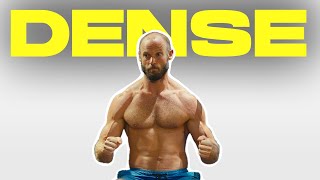
Keegan explains how to build muscle while staying athletic: get stronger to increase training volume, train to success instead of failure, and use dense training like sets on the minute to do more work in less time. Include faster reps and light loads to build tendon elasticity.
Chapters
Today we're going to talk about gaining muscle while not losing your athleticism, actually building your athleticism. I want to gain muscle. So Keegan, what do I do?
Gaining muscle is essential for many athletes. If you're a rugby player, if you're a wrestler, at times there's no choice but to be heavier, to be able to join the team. So if you need to add more muscle, the biggest thing and the thing that people don't understand is that you need to get stronger for total volume. So when I say stronger, I mean more weight that you're able to move. And total volume meaning how far you moved that, how many reps you did it for within the session, within the week, within the month. And it's really the accumulation over time of a lot of volume and gradually being able to do that with more weight. The other variables that are in this is like the density of the work that you do. So if you're getting more work done in less time, from a practical standpoint, that's really important because if you're taking longer and longer to get your work done, or if your work takes a lot of time, like a lot of people program three minute rests and five minute rests. And so you can only really do like two main movements for, for a workout. If you're training like this. But if you're improving the amount of work that you're getting done in the session, you're able to work with more weight, you're increasing the density of the training, then you're going to get to a good point. Naturally this style of training is also going to encourage you to go faster, which is also what we want as athletes to increase that elastic component.
Why is going faster increase the elastic component?
When you go faster, you naturally going to be more elastic. And yeah, if you're pushing for density, if you're having like shorter rest periods, if you're going to do, for example, like we did today, five repetitions on one movement and then five repetitions on another movement all inside of the same minute. Well, if you're grinding it and it's, and it's really slow, you're barely going to have, have time to move between. So as you practice that, the natural thing to do is going to be like you're going to get faster with, with the movements. Okay, you can do slow eccentrics and there's a place for, for slow movement in, in the gym. But overall the most important thing is to not grind and not go too slow on the way up so that you can keep the Nervous system fresh. And that's what it's going to help you to get that big total volume. So the biggest mistake. Yeah, the biggest mistake is what we're talking about is with that, okay, let's train to failure. Everything on the Internet says you need to train to failure. The research says if you train to failure, that set will stimulate more hypertrophy than if you don't train to failure in that set. And that's true, but we don't care about that set. What we care about is the overall effect of the training session and then the training week and then the training month. So the problem and the thing they're not talking about in the research is when you train to failure on that set, your next set is destroyed. You can't do even the same thing again. So if you consistently train to failure in that way, you have to have longer times between your sessions. So you might only train Monday and Thursday on a certain movement because you train to failure and you're getting, you're getting more fatigue accumulation. You train multiple movements to failure. Like you. What are you doing? Even just the word of training to failure is it, Is it? You're practicing failure, failure, failure.
Maybe we just train to success.
Train to success. 100% is, yeah, don't get worn down, be able to do more volume, stay fresh, keep the thing moving fast. You keep pushing up the volume, keep pushing up the weight. You can do. Don't worry that you didn't go to failure. That's not what you need, especially for athletes. Technically, if you're taking a bunch of steroids and you're young, healthy, other than the steroids kind of guy, I mean.
Even with all the steroids.
Yeah, yeah, you can.
If you just do like, you just care about the muscle, maybe, yeah, you.
Can look at that approach and it can work, but it's not, it's not the best approach. The times where I've had the best gains and even just putting tons of mass on, on young athletes. I had a rugby player in France, Damien Cardas, and the coach is like, he's too small. He can't play. Like he's 80 kilos. The average weight in rugby, Rugby league is in that league was probably about 97 kilos. It's around 100 kilos. So 80 kilos. Like, yeah, he's fast and he's okay, but he's just too light. He tore his hamstring at training. It was probably a mistake that I made. We maxed out deadlifts and then he went and sprinted and he tore his hamstring. It was one of the. When I was just new as a coach, so I got to work with him because he had a hamstring tear. We did clusters on chin ups and bench press and he came back 87 kilos. It turned out the other winger got injured just when he was ready to return. He played his debut. He scored five tries on debut. It was the record for the league. He was already super fast, but he was 87 kilos. And the coach was just like, oh well, let's see, like he needs to play.
Yeah.
And it was. But we didn't train anything to failure. We, we did a lot of like dense work and we did like lots of singles, like lower, lower repetition stuff which is also like counterintuitive. Most people say that doesn't work. And yeah, it's, that's how to get results.
You talk a lot about dense. Maybe for the ones who don't know what dense strength is. Like the system, you can explain it.
It's a, it's a general concept like talking about dense training. Like it is a training variable. Like you have the variables of intensity, which is the weight on the bar. Intensity means the actual load, like the percentage of the 1 RM. That's really what intensity means. We can use it in normal language in many ways, but in strictly in the strength world, intensity means the weight on the bar. Volume is the combination of the sets and the reps. So if you do 10 sets of 10 with 100 kilos, then you're going to get 10,000 kilos and that's your volume for the session. The third big variable is the density of how long did you have in between the things that you're doing. So it's not often spoken about, but there are lots of methods over the time that have used it. There's escalating density training with Charles Staley 20 something years old system CrossFit is a very dense style of training. Not much restrictions. Keep going, stay away from failure to accumulate all of your reps. Dense method is my system that I created in 2013 to simplify gains in the gym. Because I was watching a lot of people going to the gym and I'm watching them taking rest periods and like bro, you don't need that rest period. You're not strong enough to deserve a long rest period. And I really just thought it was going to be to help people who didn't have much training experience and were maybe like time pressured, go to the gym, work on the minute and get a win. Be gamified. So people will make the mistake either of. If you go to failure on your, on your set in dense, say we're doing 10 sets of five repetitions. If you use your five repetition maximum for your first set on your second set, you're going to get two repetitions at most. So you're not going to get your 10 sets of five. So it's self limiting, which means it's auto regulating, which means people can't mess it up on their own. So it's built into the system that you can't mess it up. If you tell me you did 10 sets of five on the minute, I don't need to worry that you chose too much weight. If you were able to complete the thing, then it had to be within a decent range. You can still kind of push it a little bit too far, which we don't want to do, and you just make it. But it's so hard to judge it to just make it. Usually you miss if you choose too much weight. So dense method is this training on the minute. We use five 10 or 20 minute blocks and so we can track the scores on everything and what it gives you or it gives this imaginary guy that was wasting his time in the gym back in the day that I was designing it for, it gives you the feedback of, okay, I did 10 sets of one today at 100 kilos. Next time I'm going to go 10 sets of two at 100 kilos, because that was easy. Or next time I'm going to go 10 sets of one at 102.5 kilos. And what I found the big surprise was that when I did it for myself, I'm like, oh man, I'm hitting new bests. Like, it actually works for me. And then I started using it with the players and I use it with Sonny Bill Williams, you know, the most. And all of a sudden he's bench pressing 142.5, which the other players used to laugh at him, that he didn't have a big bench. He's got long arms and he never really worked on it too much, but he hit his lifetime best within four sessions of using this dance. And we did it in a special way using three different intensities within the same block. But yeah, maybe we can talk about that in another video. But it actually worked for athletes just as well. And now we see with CrossFit and lot of other coaches have started to use, I mean, Ben Patrick used it inside of atg. Nico, who's here with us in this location used it with motion concept. But now tens of thousands of coaches I think have trained with this style of training. And I just think it's, it's the best default way to train. If you're not sure what you should do in terms of sets and reps, use dense. You're not going to mess it up as easy as if you do three sets of eight, you're going to mess it up. You can use too much weight, you use not enough weight, you rest too long, and then you don't know to be able to do the same session again. If you just take a little bit longer rest, did you really get better or did you just rest longer?
Rest longer.
So this is why I love the dense training.
So basically the concept of getting more work done in the same amount of time means you get stronger. There's no way to mess it up.
Yeah.
How we do it is we set a timer and every minute we do a repetition that it be one repetition or three or five or even ten. You can go even above that. But it's like a 10 minute timer and every minute at the start of the minute you just do your reps and then you rest or you do another movement, right?
Yeah. And we even started like if someone's listening to this and they want to do it, right now we're doing the three. So three minutes of work. Everyone's got three minutes. Maybe people don't have five or 10, but everyone has three. One of the ones we've been doing is 10 repetitions of dumbbell bench on the minute for, for three minutes. I'm up to 30 kilos on that. Kevin Elwood did 35 kilos. He's a little bit lighter than me and so he's like the, the benchmark that I'm moving towards. I haven't done much of this work for a while and it's, it's a nice, simple game. I think the 3D10s are a really good way to kind of get yourself back into training. Because it's not much volume and it's not much intensity. Like because it's tens and they're coming around fast, you have to use a pretty low weight. So if you're thinking what weight should I use for that? Start with 40% of what you could do. So if I can bench press 100 kilos, I'm going to do 40 kilos, I'm going to have 10 repetitions, I'm going to rest 20, 30 seconds, whatever, depending on how slow you go at the start. You probably go pretty slow. Gradually you start going faster because you get used to it. Another 10 repetitions, rest, another 10 repetitions, rest. So the more repetitions you're doing, the shorter your rest becomes as well. That also increases the density. You're going to do that session so easily and you're going to say to me, Keegan, like, oh, how am I going to get any better with using 40 kilos? But the thing is, you get carryover from every rep range. This is a big misconception as well. People think the hypertrophy rep range is 8 to 12 reps is bullshit. Singles work, fives work, tens work, twenties work, fifties work, everything works. If you can do more work with 30% of your 1 RM, like the push ups that we've been talking about, once you can do 100 straight push ups, of course your bench press went up. You can practice a little bit to transfer it over. A couple of sessions of heavy work will help to transfer the work that you did over, but it's already going to be better. And then you're building on success. When you do that session with the 40 kilos, you do the next session with the 42 kilos, you do the next session with. All of a sudden you're back in the momentum of training again. You're in the joy of training. And then we can progress to other methods of dance with higher intens intensity or different repetition types. But this is if someone needs an invitation to get back into their training. Like, here's an invitation for you. Three sets of ten on the minute gives you plenty of time to do a full body workout in like 20, 30 minutes if you want to. And, and even if you're like, no, but yeah, I'm too injured for that, keegan. Like even 40 kilos on the bench, I've got this thing, you don't know my shoulders, blah, blah, blah. Do it with 20 kilos. Do. Do 20 reps with 20 kilos. Like it doesn't matter how light you go. People say, I can't squat, I can't deadlift. Can you deadlift a broomstick? Okay, start with that. Just do. Do 20 reps on the minute with the broomstick. Seriously. And then do two, two and a half kilos. It's crazy how fast you surprise yourself if you just do the thing again and just, just do it with whatever crazy lightweight that, that you think you might need to. Because when people say I can't bench press, they mean I can't bench press the weight that I want without it hurting. Me like.
Yeah, like increasing step by step your ability again. And that makes sense. Maybe we can touch a little bit on the elasticity component. You said you're more elastic. Maybe you can. I mean for the ones that don't know elasticity is mainly produced by the tendons. Maybe you can expand a little bit on that. Even though we probably going to make a different episode on elasticity itself.
We can talk more in detail, but yeah, the white tissue, particularly the tendons contribute a lot. If you think about the kangaroo and its ability to do massive jumps, you slice in the B roll, kangaroos in motion. But a lot of, a lot of amazing athleticism. You look at someone doing a single foot dunk, there's athletes who could do a single foot dunk. They take off on one foot without the heel touching the ground. That means that tendon is such high quality. So much strength. When we train using more bounce in the gym, then we work the tendons more. Some people will call it bad technique, but it really isn't. And of course older lifters who always train slow, they will be scared of doing faster repetitions. Again, it's the problem of I can't train, I can't train with faster repetitions.
You have to scale it down.
What it means is I can't train with faster with the weight I want to train with.
Yeah.
Can you do it with the broomstick? Okay. Can you, can you do it with the five kilos? Okay. So you can always find a weight that you can do it with, especially if you do it after your heavy stuff. But yeah, the Archuleta example, which we speak about quite a lot quite often, it really can be a revolution. The Marinovic system, they built a revolution in strength training, but it's just a bit too messy and a bit too hard for people to understand to apply to bring it across. I think the main permission you need to make your training more elastic is like forget about the weight on the bar. Just do whatever weight you need to do to be able to be elastic. Again, if that's less than a barbell ways, that's fine. Hook up a band. If you can't get lighter than or use, use dumbbells. Even with the cables, you can, you can do elastic type reps where you drop it and catch it onto your, onto your tendons. And yeah, this, this. If you're doing this style of work. Getting back to your original question, if you're adding mass and you're continuing to do the stuff where you're absorbing force quickly, everyone thinks about jumps but we need to be jumping with every part of the body. We need to be jumping with, with our push ups, jumping with our chin ups, jumping with our, with our hamstrings or our Nordics and, and we can, we just need to go light enough that there's, there's not too much stress with it.
Yeah, okay. Yeah. I would say considering the attendance, we would do another episode of how to prepare yourself for these kinds of repetitions for the fast stuff because you don't want to start too heavy, too fast with the fast stuff.
If you want to be trained within the new athlete system, if you want to be on the leaderboards, if you want to be gamified with dense, then you can come into the system the app go to newathleteproject.com you can find out more information. If you're interested in coming to a camp, there's links in the description to get involved. The most fun part of this is the feeling of building something important together. And your training mattering more to you is a big part of you building the body that you want. When you're on a rugby team and that team is working towards the goal of a championship premiership and you see the other players working hard, you're going to work harder. That's the environment that we're building with New athlete project. When you come to a physical event but also meeting up with local people in your area. We've also opened up the membership for that which is super cheap so you can meet other people around the world who are interested in not just this force and mass conversation, but also the skills conversation. We're dancing, we're doing combat, we're juggling.
We'Re doing flips, handstands.
You can't find this anywhere else. I couldn't find this anywhere else. So I'm building it. It's the system that I want to embody for the rest of my life. Becoming the best athlete I can be. Going into my 40s, 50s, this is what I want to be doing. But it's also the example that I love setting for my children who are just out here and they see me training this way. And my 2 year old can directly apply what he's seeing me do. He's working on his juggling, he's working on his kicking. He's not even two yet. I just saw the thing, there was a pop up for my. My wife gets emails of like the landmarks and the child. It says maybe your child can throw by now. He's been throwing for a year already. And he's not too the other one the other week said like, yeah, maybe he can start to kick. Like he's been kicking for a year and it's just because she's in this environmental time where he's seeing it happen. And the same thing that's true for him is true for me. It's true for Lukas, it's true for you. If you change the environment where it's normal to be much more athletic and be athletic across a breadth of things, then the chances of your, you know, we all respond to that environment. So if you want to be juggling dancing, weightlifting, bigger, leaner, traveling the world feeling complet different about yourself and your ability to take on new things, maybe playing chess and Rubik's Cube and the mind games as well that we do, then you have the opportunity to get started. Let's have a conversation and see how it fits for you. But yeah, I hope you got some value out of this. Also, feel free to ask any questions comments about this idea. If there's something that wasn't as clear as you would like it to be, ask away and we'll reply to every comment.
Yeah, perfect. Also, if you want to contribute to this podcast, we are open to discuss topics that interest you. So write in the comments down below the topics that burn on your mind and see you in the next one. Leave a subscribe Like Comment let's get jacked.










