Anterior Chain Athletic Range
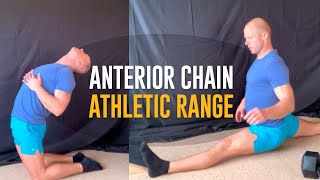
Keegan Smith walks through anterior-chain exercises from neck to feet, treating mobility as progressive strength training. He demonstrates neck stretches, cross-bench pullovers, ab controls, split-squats, and quad work, with regressions for injury and ways to vary load and speed.
Chapters
ATG coaches. In this series we're going to go through anterior chain athletic range. The fastest way to improve someone's athleticism is to untie the shoelaces and increase the athletic range. Alright, so the first step we're going to start from the top. We're going to look at the neck. So it's very easy to get tightness in the neck and the cervical upper thoracic spine. Lots of time looking at screens, bending forward, etc. Similar to our pullover, just using the weight of the head. This one also works well. Just laying flat on the ground doesn't have to be elevated and you can really feel it stretch back if it's feeling muscular and you can feel muscular tension there in the front and that's going to be a really great place to start. Thoracic, we're going to go with our cross bench pull over. Okay. So with all of these movements, if there's any kind of injury or serious dysfunction, then we want to start with inner range work for the area and progress towards the outer range. So if someone's had a neck injury, you wouldn't necessarily start with that outer range work. Loading the neck flexors. Okay, so our cross bench. Open up the thoracic spine. So we've done the neck, we've done the thoracic spine. Next we're going to go through the abs to get to get to lumbar, reaching back and then really focus on using your abs the whole time. Keep the glutes flexed, don't move the hips. You're going to feel this. Really, you should feel a lot of tension in the abs on this one. If you're feeling it really jamming up in the back. Again, not ready for this. Regress the range to the point where there's no sensation in the spine. You want to just feel sensation in the abs. Okay, so we're working our way down the body. Next is the hips. This one is really going to make all the difference as far as getting that front split. For most people it is the hip flexor that is the, the biggest weakness. I do have the front split, but it's not as flat as Ben's. So getting into our split squat position, back leg, elevated weight on the back. Now this position itself, you'll feel a lot of tension. Fights are straighten that back leg. And you'll be able to see whether, when you look at these from the side, you'll be able to see how close you are to getting the hip in the right position for that front split. So Fighting with that glute, fighting for the upright torso, you don't want to bend forward on the other side. Okay. So working a lift off, you're also going to get a lot of work through that front ankle, which is all good. Fighting, fighting always. We can regress the weight. Fighting through that glute, fighting through the quad. Okay. If it's again too much elevation, we can regress it back to flat ground. If you feel it better this variation, that, that might be a better place to go. Flying through the trunk, through the torso, straighten that back leg. We're going to use this bottom position. So more load, more speed, more bouncing, more time of the tools that we can use. How much time should we use? How much load should we use? How much speed should we use? Anyone who tells you they know the answer to that doesn't know what they're talking about. It needs to be progressive. It's strength training. Right, so we can start from front foot elevated, progress to rear foot elevated. We can also progress in terms of load. If someone is stronger, then progressing load will help them to get into the movement. If you're working with, like rugby players, someone's weaker, then you want to just more so progress through the positions. All right, so that really opens up the hips in a way that few things can. So next one after that, we want to get into the quads. First step for this is just to be able to sit on the heels. Now, if the ankles are the issue, which they will be for quite a few people, then we want to warm them up. Had really good feedback from people. Warming up the tib ant. Okay. Usually just lean against the wall, warming up the tib ant and then finding a bit more comfort, a bit more range. Okay. So the quad, if we're able to get to this position, then we can progress back to here. Now, rather than just going into the bottom of the bilateral natural knee extension, you're probably going to feel more in the quads and get more out of it by going to single leg. Okay. So same thing with the variations. Can go to elbows and then we can go flat back. When you're in this position, you feel you can play with whether your hip is sitting inside the knee or whether it's actually right on top stacked. Okay. So both of those positions are going to be useful. It's going to be deeper for the quad. Again, how do we progress this? We can add more load by attempting to do our natural knee extension in this position. Contracting. In this position, we can add speed by bouncing. Should you do that? Well, it depends how strong the tendons are. If you've had issues with the top of the quadricep tendons, then probably not. If it's all healthy and all good, everything's strong. It's just progression in the same way that you would progress strength training. That's why I think it's better if we forget about the idea of stretching and just think of everything as strength training. Now what does that mean for this? It means that this is a very, very low intensity form of strength training. Okay. Doesn't make it bad, it just makes it low intensity, which means you can do it when you want to relax. It means you can do it while you're watching tv, but still consider it a low intensity form of strength training. So if you do a lot of it, it will still have some strengthening effects and toning effect. A lot of people have had strength gains on their big lifts by doing this sort of work. Because it's just strength training, the muscles are working. It can also help the positions to be more efficient. Okay, so last one for our anterior chain is being able to get some weight onto the toes, onto the ankles. That's progressing in terms of with some speed. If we use more ballistic movements, we'll use more force, then we're going to get faster progression. So we want to be able to put some weight onto the front of the foot. You can. Assist with the upper body rocking onto the. Now that might be extremely uncomfortable to start with or it might be fine. But what you'll find is same as with anything, it'll become more comfortable as you practice it more. So that's taking you through the whole posterior chain. The more we can loosen up that posterior, the closer we're going to get to that level five flat split. Next I'm going to take you through the posterior chain. So we're going to complement with these.










