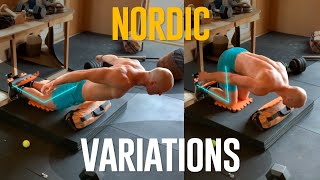
Keegan Smith explains how to apply knees-over-toes principles to hamstring training using a Nordic Bar. He separates tendon-dominant from muscle-dominant variations and argues for training in an athletic range rather than full range, drawing on Poliquin-style methods.
Chapters
So I got my Nordic Bar here, made by Michael Sears, one of the original Real Movement and Pruvit crew, now doing lots and lots of business with his own factory. That's very exciting itself. I'm going to show you a variation of how you can use. So the first ones, they're very tendon dominant and the second ones are very muscle dominant. It's very important to make that distinction. That's what we're talking about with athletic range, not talking about full range. Full range training is massively overrated. What's important is using athletic range. So knowing whether we're putting a lot of tension on the tendon or knowing whether we're putting a lot of tension on the muscle and whether it's muscle dominant. So put all that out on YouTube. I've been thinking about it for a couple of years. The ideas have become clearer and clearer. I think it's just time for the strength training world to either evolve and take that on board as like a fundamental paradigm of strength training, or, you know, just prove it, throw it out. Prove that it's not important that it doesn't work like that, but it definitely does. It was the foundation of the Poliquin success. Everyone talks about structural balance, but actually it was athletic range. He never named it. That was really, I think, his biggest secret ingredient. There are a lot of things within the Polkman system that were amazing. I think that's the number one that was never shared. And, yeah, it's time for the athletic world to understand it or disprove it. So there's the challenge.