Athletic Expansion & Fuller Expression
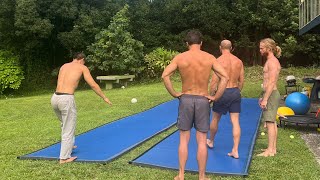
A coach breaks down athletic development into three pillars: health (diet, recovery, mental state), force (slow, fast, and elastic strength), and skills (balance, timing, multi-directional movement). The framework treats swinging, sprinting, and dancing as the ultimate outcomes.
Chapters
So athletic excellence, athletic development, It can be done much better and it needs to be done much better. How are we going to do it much better? Better than what worked with the world champion team that I worked with and you know, better than what we've done so far with, with ATG and with other systems. How can we get to the next level? What would that look like? It starts with the frameworks and with the thinking and eventually it gets to practical matters. But what I've arrived to of this simple, like the simplicity of the framework is going to be very important for the power of the framework. So the simplest, the simplest framework that is easy to remember is health, force and skills, all as the three kind of foundations. If you don't have health, then there's no chance that you're going to have elite athletic performance. Long term people look for shortcuts and. But this holistic approach to performance is becoming more popular, getting more sun, the great food, all of the things that go with health practices. So within this we have like cleaning the body, we have diet, we have digestion. And the mind is very, very important in terms of know how we're experiencing health. So we're continually cultivating health as the foundation to be able to do more, to recover better. Then we have the force paradigm of how do we produce more force faster. That was my primary goal with the rugby team that I work with. I want it to be the team that would produce the most forced, fastest. If as the strength coach, strength, speed, power, nutrition, I was helping them to have better health and I wanted them to be able to produce more force faster. How do we produce more force faster? We train slow strength, we train fast strength, we train elastic strength. These are really the, the key things most people are ignoring at least one of these areas, the slow strength, the fast strength or the elastic work. The reason I separate fast and elastic is because in the poliquin system it was about accelerating load. So it was about being able to go from a dead start and to be able to move that way quickly or lower it down slowly and then move it quickly. And this is great for the nervous system and it does develop some tissue quality. But elasticity is. King Charles would always say take the elastic athlete because he didn't know how to or his system didn't develop elastic athletes. But there are systems that develop elastic athletes and we need to understand and know those systems. So within each of these areas there are leading voices who have winning philosophies that we need to go into. We need to understand and Apply and then skills. I didn't have this general paradigm of skill development when I was working with professional athletes. If I had of, we would have gone to a whole other level of development. So we have like the balance balls and beats. Balance. Most people underestimate or write off balance. I think that's my biggest learning from being 10 meters off the ground yesterday in the, in the, on the ladder, in the bamboos, and even the day before being up in the trees over here. Balance is such a, such a blessing, such a key thing, playing so much soccer at the moment. One of the reasons that soccer players are so adaptable is because they're spending so much time on one foot and on the ball of one foot. So when we continually improve our balance, we have a bigger and bigger foundation for, for our performance. The ball side of things, the general paradigm is that we just practice the sport that we, that we're trying to be good at. So, you know, if you want to be a great soccer player, then you practice a lot with the soccer ball. And there's a lot, obviously that's important and there's a lot of value in that. But working with the other balls as well, working on, on general ball and bat skills, the amount of men who, who can't swing an ax or can't swing a sledgehammer. You know, in a group of 10, there's always going to be a few who's like, yeah, no, I've never chopped down a tree. And they can't really swing an axe. If you've played a lot of golf, if you've played a lot of hockey, then you'll probably be fine. If you play a lot of baseball, then you'll be fine with the axe. But a lot of people don't have those abilities. So we need to build these three skill foundations. The beats, finding the rhythm and timing. You see it a lot with boxing, you see a lot with wrestling, but the ultimate expression is through dance and wrestle. So all of this builds the foundation for Dance and WrestleMania. We also have sprinting, but everyone's people are talking more and more about sprinting and straight line sprinting and this paradigm of like cardio and body composition and visceral fat. It's such a limited paradigm. We won the freak, we won the lottery. We won the lottery of what a human is capable of doing, what an, what an animal is capable of doing, what, you know, we have so much possibility for how we can express ourselves and thinking of it in terms of this, this limited view of like burning calories and yeah, you know, getting rid of the visceral fat and all these, you know, the VO2, all of these paradigms are so limited compared to what we're capable of in expansive expression as humans. And you can see this with children, you can see this with babies. I have a young baby and he's not thinking in terms of how to optimize his longevity and his cardiovascular health. He's expressing himself, he's expressing himself fully and that's what we should be expanding into. So we have the sprinting and with the sprinting we want it to be multi directional. So multi directional sprinting? Yeah, it seems like, okay, well that's going to be riskier, that's going to be harder. But if we don't have healthy frameworks to begin with, we no chance of arriving to the best. So the way we change the athletic future of mankind is to have better paradigms about what it is that we're trying to achieve, that we're achieving. So these are like, these are the, the end games like swinging and throwing, the ability to swing and throw, swing and implement, swing and release or rotate around a fixed point. This is the end game. We need to be able to sprint multi directionally. We need to be able to swing and throw and we need to be able to dance, wrestle. Everything is moving us towards that. We have these basic paradigms, force, health, skill, and then the general underpinning of these is posture, on top of which we build positional strength, on top of which we build power or performance. So there's a lot of emphasis on performance and focus on performance. But often we're lacking the postural positions that we need for that. ATG is great for the positions. You see this growth in systems like GODA and wec. Method and functional patterns, positions, focus. It really is valuable to slow things down and get into exactly the right positions that you want to be in or any position and to be able to fully control and own that position. IDO Portal is also moving things in that direction with being able to articulate all the joints and have control over many positions. So this general paradigm allows us to expand beyond what 99% of coaches and athletes and of course everyday people and gym goers are thinking about. I can tell you from experience that it's a much better paradigm to live from to train from. I've been living it more fully the last year, but Even the last 10 years, you know, being able to balance balls beats, you know, balance. You have this spatial awareness, body awareness thing, being able to do flips on a trampoline, being able to do forward rolls, cartwheels. You'll never regret expanding this. The skill base. Then we come down to things like, like the methods. Like we have dense. We're doing things like giant sets. We have things like the natural method. And it doesn't really matter which methods we use on top of this, but we need to have for example, the positional stuff. We get the range in there and then we have kind of the more biomechanics approach. So these, these are the methods of how we get there. Dense is the on the minute training. And within that we can also do clusters. Clusters are a great form of training as well. Giant sets is putting multiple movements back to back for the same muscle group. Natural method is kind of an expansion within the, within the giants. The, the giant method. Natural method is working the same area of the body, but yeah, putting it all back to back and then simply ramping with, with your sets as well. If you're working with athletes, then ramping to a top set is, is one of the most basic ways to train, but it's one of the most powerful. It's what they use with west side barbell. It's what the Bulgarians were using. It's what we used a lot with the professional athletes, just ramping to a top set for the day. But Dense allows you to practice with a sub maximal weight for a lot of quality repetitions and speed. And then the Giant sets are a way to bring more complexity and muscle growth and build lots of different motor patterns and lots of resilience into tissues from different angles. So the goal as we roll out the uncommon athletic system, the next evolution, the next, the next pass of it, is to have these really simple frameworks that coaches can remember, can understand. We want to get to the point where we can swing, where we can sprint and we can dance. This is our goalpost. This is our North Star. If we're getting closer to those things, then our training system is smart and it works. If we're getting further away from those things, then our training system sucks. And it should change because it's taking us away from our, our human nature. Every, every week we're working on, maybe every day we're working on force, health and skill. I work on these things every day to be able to produce more force quicker from the nervous system. Slow strength, elastic strength, the skills consistently expanding the skill base, simple methods to get there. And this idea of building posture and positions, underpinning all of this, always going back to posture and positions so this is the general framework. Love to hear thoughts, feedback, questions around this. It's very simple, but it's 20 years in the making and I've never seen anyone articulate the the expanded version, but in a simplified way as well. How to get there the goal is to have more coaches and athletes who are thinking in this way and who are progressing towards each of these areas. Each of these areas doesn't really matter which methods you use. It's more about simplification of that to not make it overly complex. And yeah, I appreciate the opportunity to to share what I'm up to here. Would love to to hear more questions and feedback.










