Dense Strength Bench Press Workout And Explanation
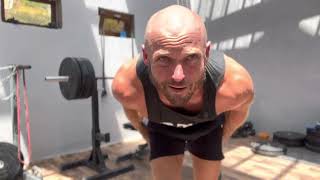
The bench press reveals your nervous system's strength and force-production capacity. This workout uses a 10D1 protocol (ten reps, one rep, repeat) and other on-the-minute schemes, emphasizing concentric speed and rack safety. James Tedesco's rugby performance illustrates how dense-strength training builds measurable power you can track and pass on.
Chapters
Does bench press matter? Should you work hard to have a strong bench press? A lot of people would say no, and they would be wrong. Because if your bench press is weak, then you are weak. The muscles that push are driven by the same things that push with your legs or that pull with your arms. They're driven by the brain. And so if there is no force capacity production and in the pressing muscles, there is no force production capacity, It's all one piece, it's all one unit. If you have a really strong bench press, I struggled getting that out of the rack. I'm not exactly sure why. If you have a really big bench press, then it means that you have a really strong nervous system. I worked with a player in rugby named James Tedesco, and James Tedesco had a lot of talent. People were looking at him thinking, this guy's going to be a good player. But he had three years of injuries in a row. He had skinny legs, he was able to. He followed a dead strength protocol and he bench pressed 170 kilos, weighing around about 90 kilos at the time. I was like, wow, this guy has a supreme nervous system. Now. He needed to build the legs so that he could handle the force production capacity that he had in his upper body, in his lower body. But the fact that he could bench press a lot of weight was a decent predictor what James Tesco went on to do. Those of you who are from Australia or who like rugby league is, become one of the best players of the modern era, he's won premierships and he barely missed a game. Between the time when I worked with him and, you know, a long way into the future, he's been become a very, very reliable player. And we worked on full squats and we worked on simple things that he hadn't been focusing on. And I'm not claiming that the credit for that or for his career, but I know that the camp that we did and the work that we were doing, I encouraged the team to take him out of team practice and focus on his specific issue. But that superpowered nervous system is the point. He had it and it was good proof of what was to come. With his career. Still struggling out of the rack, but not too bad. Let's look at the time here. So we're on about the 2:30. So that concept is a really important one. Is your nervous system really powerful? Does the charge that comes from your brain innovate the muscles very well? Is the wiring in your body firing very well? And small changes in nutrition and minerals in the body quality of fats, these things, it makes sense that they would improve the wiring, the messaging, the sending of signals within the body. If they didn't, what is the body actually made of? So this would be my best. My best on the records is 114, 214 would be nice. Get this out a bit better. All right, it's moving. Okay. So the goal here is to press this 10 times in a row on the minute. And yeah, that was about the right timing. If I can hit a new best on this, then it means that I'm stronger, but it also means that my nervous system is developing the ability to produce a lot of force. If you do weightlifting or powerlifting, a big part of what you're doing is powering up the nervous system. You're training the brain to be able to send these forces. You send the charge that's required. Yeah, part of it is adding muscle, but it's also partly the wiring. And so both need to improve. Should improve. Want to improve your athletic ability. What's really important is the concentric speed on these movements. So sometimes the first one I didn't really warm up very much for this. I just went from 100 to 120. I made a big jump and I wasn't exactly sure how this was going to go. First one was like, oh, that's fairly heavy. Second one was like, oh, that was alright. But I struggled out now the rack both times and that one was really smooth. So I'm pretty confident that I'm going to get these. Usually I have my dinger going off. I need to bring another phone into the gym or another timing device of some sort of to make it easier to tell the time, not have to go back and forward. But I'm a big fan of having a big bench press and seeing people with big bench presses. It isn't a bad thing. Yes, we want to develop the lower body. A lot of athletes should focus on being lower body dominant. And so what that means is being able to full squat more than you can bench press press. This again before I keep talking. Easy, easy. So we want to be able to squat about 10%, maybe 20% more of what we bench press. That means we've got lower body dominance. And you might think, well, 120 kilos on the bar there, 120 kilos on the bar there. Shouldn't it be a lot more to be lower body dominant? But what we're forgetting in that equation is that on the squat, you're lifting 85% of your body weight on the bench press, you're only lifting your arms, which is a much less significant part of body weights, you know, 15, 10, 15% of body weight that you're actually lifting. So physics, in physics, you would say that you're lifting a lot more when you're squatting 120 versus benching 120. But, But we still, yeah, we still want to squat a bit more than what we bench press. But if I see someone who has a phenomenal bench press, I'm still happy. I want to make sure their legs are safe and I want to improve things. But it's still a good sign to see a big bench press. If it comes with a big belly, then maybe not as good, not ideal. Sometimes it can be that the guy with, often the guy with the biggest bench press in the team doesn't play, but the biggest relative bench press generally does. So relative to body weight, if the bench press is big, that's a good thing. So 10D1, if you can do that with one and a half times your body weight, that's pretty good. That's, you know, uncommon to see someone who can do that. Especially if you're not, you know, 60 kilos, not a featherweight. This is less than 150%, less than 150% of my body weight. I'm always aspiring to that next level. So, yeah, we want to get, we want to have these standards. Go after these standards. Generally, I would see one or two guys close to double body weight in their bench press. In elite rugby, rugby league, one of the lighter players would generally be around that. Someone who weighs 80 kilos pressed in 160. You do see it. Shorter guy, shorter levers. Doesn't necessarily mean, because of the physics of that equation, the lot, the shorter levers disadvantage in force production. They're not going to throw the discus as far they don't have the long levers to produce that force. Yeah, be consistent. If you are going to do this on your own, it's better not to put the collars on. If you don't put the collars on, if you, If I happen to not be able to make this weight, I can just tip the weight off. I could also shift it down to my hips and just stand up. But there have been people who have put the bar down and got it stuck on their chest. It's ended up on their throat and they've died. I don't know how you could actually do that without, you know, being able to wrestle it off to the side. But I Wouldn't want anyone to do that. So just let the weights fall off. Do you think I'd get this for two? It's funny when you do a lot of singles, it's like, I don't know if I'd get more than one of these. I will go for twos and threes. I like doing ones, threes, fives and tens on the minute. And then I just track my scores. Whichever one seems like the lowest hanging fruit I go after. And the one that I care about most for me is the 10D one. Even though physique is most important. The 10D 3 or 10D 5, probably more valuable. Maybe even the 10D 10. All right. Getting a few. I don't actually know how many I've done. I think that might be 10, but it also might not. So I'm gonna do one more because we have these leaderboards in the uncommon success app, just like with the rugby teams. If you don't score it, if you don't chart it, if you don't measure it against others, it doesn't really matter. It doesn't really count. So we've got maximal strength scoreboards and we've also got relative. But it's not just like powerlifting because there's lots of different areas. So we have skills, strength, speed, stretch, stamina. So everyone has the opportunity to excel in something, lead the way. That's what I want. The idea is that the strength, the athletic development, is a springboard for a better life. More so than being just about, you know, ego or weight on the bar. You do want to have confidence in yourself and do want to do things that seem impossible. I wasn't really sure if I was going to be able to bench press this today, even for one, or what, because I've only done 114, just maybe a week ago for this 10D one. So I'm pretty happy that that went smoothly. Keep getting those wins, life gets better. It's a good feeling to know. All right. I've never done that before. That was good. I think that there's a very good chance of hitting all time bests on lots of lifts here over the next couple of months. And I want that to be a springboard for thousands of other men to hit new standards that they've never hit before. This training method of dense strength, man, we're playing around with some ultra dance as well. It works and it's very simple and it's very addictive. And it also means that every session is kind of gamified. You get to compare yourself to your old self and also to others. And I actually would like to make the argument that comparing yourself to others is a good thing and that we should be looking to others for inspiration. I think that all achievement and all success is built on that. The passing down of generational knowledge from one generation to the next. It's about doing something beautiful and building on what's been done before and doing something more beautiful. If you're not trying to do something better and more beautiful, then what are you doing? It's a race to the bottom. So you're just not going to do that in a vacuum. You're not going to become incredibly strong in a vacuum of not being able to see the other men in the world who are attempting to become incredibly strong as well. Same goes for business, same goes for art. It's all about passing down knowledge. Picasso said, good artists copy, great artists steal. What he was saying is that make it your own. If you value it, make it your own. Make dense strength your own. Make any of the stuff that you can learn in uncommon success or from atg. Make it your own. Do it in your own way. Build your own spin on it. Solve something that hasn't been solved before. It's the ultimate complement when hundreds of coaches are using dense strength. Ben Patrick uses dense strength within atg, which is the most utilized training system of the modern time. Nico de Paoli has used dense strength almost exclusively to build one of the most phenomenal physiques and physical abilities that you're going to see. It's also been used breaking world records in weightlifting. It's been used in lots of different sports, elite sports around the world. I've been talking about it since 2014. But it's finally becoming something that a lot of coaches, if not most coaches, are aware of and are playing with. And that's a good thing because you go to the gym and you're going to see most people aren't really staying focused. They're not on task, they're not having fun, they're not in a game, and therefore they're not going to get to levels that they want to go to. So we've got the dense strength course within the free UNCOM app. So we made a second app. As if one app wasn't enough work and enough to deal with. We've got a second one and it's at 5 uncomm.IO. i'll put the address below, but it's free at the moment. It's going to be like $500 working probably towards eventually being like 3,000 or $5,000. It's free at the moment to download and you have the dense strength course within that so you can learn fairly deeply why I've put dense strength together, how it works, why it works and generally when coaches go through it, athletes go through it, guys who love the gym go through it. They feel as though they have a better understanding. And if it ends your concern over, okay, what program should I follow, how do I set this up, what should I train today? If we end that confusion, just the confusion of what program should I do, that's a great thing because we can just get on with the work. And when you're coaching, if your athletes know what to do, what's coming up next, they're not confused, then you can focus on form, you can focus on repetition, execution. It becomes a very simple game and self regulating to a large extent without the distraction. And that is the goal. If we can get past distraction, that's a very good thing. So love to hear feedback questions, don't have to go and download the free app. You're welcome to ask any questions here. I'd love to hear if you have a go at this 10d1 bench press. What do you get? What's your body weight? I love hearing other people's numbers, hearing their journey. How did you get there? And yeah, what does it mean to you? What has it done for you? Strength training is a beautiful, beautiful thing. No man has the right to be an amateur. The game continues.










