Dense Strength To Double Bodyweight Back Squat... then 200kg.
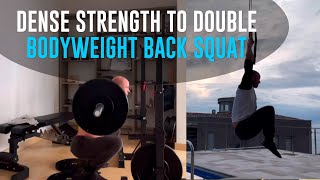
A training session working up to speed back squats on-the-minute sets, rack pulls at 160kg, and finishers. The goal is returning to a 200kg double-overhand deadlift and snatching 101kg on consecutive days, using on-the-minute work to build speed-strength without strict percentages.
Chapters
Often people will say they don't have enough time to train. I would always argue against that. I would say decrease your rest periods. And if you go hard enough, a minute is a long time. If you run as fast as you can, then a minute is a long time. If you squat at a reasonable weight as fast as you can, then a minute is a long time. So I did some rack pulls today. I got jammed a little bit there, did some rack pulls to kind of switch the nervous system on. And I would like to get back to double overhand, deadlifting off the floor, no hook grip, 200kg. That is my best ever. I only got there once. I've been over 190 a bunch of times. I would like to get back to that. And so this is a little bit of preparation for that and something to switch on the nervous system. So I went to 160kg, which is, yeah, about 80 of the best that I've lifted. And I was able to get three repetitions. I could feel it sort of coming a bit loose after that, but it was a good way to get the system going. And I just pretty much loaded and lifted all the way through. It's a very short range of motion, so you don't need much rest in between repetitions on this, especially if it's not that heavy, which this wasn't that heavy for me. So nice to get back to those. And then I went into squats and the plan was 10 sets of two on at longest on the minute. And so I didn't feel as though I was going to squat very well today. My legs feel as though they've done a lot of work and they have done a lot of work relative to what they've been doing over the last 18 months. So I didn't really expect, expect much from myself today. I was thinking that, yeah, I'll probably just go really light and just get it done and, and forget about it kind of thing. That was the, the plan for today and. But then once I started to actually lift as, especially after doing those rack pulls, I found that actually felt fine. And 60 kilograms felt way too light to use. For these 10 doubles. The plan was to use, yeah, 60, 70 kilograms for doubles for speed. Just feel, feel nice, feel smooth. What you'll find is that if you train on the minute there, I set my timer there for 10 minutes and I didn't have a minute beeper because I was using my camera for this and I didn't have any other timer with me. But on the minute actually works very very well for strength development for 99% of people. And there may be a few people who need longer rests because they're training with such massive weights and they're very specifically wanting to be able to lift the heaviest weights for one repetition and they don't want to have work capacity. And, you know, there's a case for that. But for 99% of people, I've seen that lifting on the minute works really well. And in fact, some of the strongest people in history have done a lot of on the minute training as well. You'll see if you look into methods that they've used, then some of the training that they've done has been this style on the minute. And then maybe they've done some other longer rest period work as well. It's a very common theme among super strong people. And so I would encourage, yeah, if you don't go close to failure, then you don't need anywhere near as much rest. And so it's kind of a clustering effect where you can get a lot of really high quality work done and you don't have to spend a bunch of time sitting around. I miss a squat rack there. Getting used to squatting again? No, I don't know. It's not common, but it happens. So as I was going through these sets, I was thinking, yeah, this is actually. This is pretty light, it's pretty good. This is fine to add more weight. So I think I started around 80 kg on these. And I was planning just to do the 80 kg the whole time, but since they were feeling quite light and the way I'm judging that is the speed on the way up, really trying to have decent control on the way down. As if I could stop in any position and then go faster on the way up than on the way down. If I'm doing that, then I'm winning. I would call these like perfect reps. There's no pause, there's no pulse, there's no anything fancy, but they're nice smooth reps. So I did put some more weight on, as you can see there. And yeah, at this stage especially dictating percentages doesn't really make that much sense. I'm just checking the time here to figure out because I was going quite a bit faster than on the minute. It doesn't make sense to try and follow percentages when you're at the level that I'm at at the moment, which is kind of deconditioned and getting back to some decent weights. If I follow percentages, it's Just going to be ridiculous. It's like when you start, if you start with a new personal training client, you start with a new athlete, you can't set out the percentages. You can, you know, have a weight that they're going to max out reps on for quality, something like that. But if you set percentages, you're going to be wrong because things are going to change so much from session to session, from week to week. If you've watched all these videos, you saw that in the first week, the first couple of sessions, I could sort of squatting 40 kilos and 60 kilos. And to be honest, yeah, it felt probably harder than 100 kilos felt today, even with the rack pulls, because I haven't been deadlifting the 60kg felt heavy at the start today. And then I was, you know, concerned, bracing really hard, like on 80, 90, 100 bracing really hard. And by the time I got to 160, it was like, okay, this is, this is fine. I could go a bunch more if I could grip this harder. So the mind plays tricks of, oh, this is really heavy. But when you persist, it's like, no, it's actually not that heavy. It's nothing to worry about at all. This is not that heavy. Let's, let's continue on with the game. So here's 100 kilos and I really, for 100 kilos, I would like to be able to do well. I need to be able to do probably 20, 25, 30 reps, really at 100 kilos. For my goal, I have done 110 for 20 with the breathing squats style. So probably took two or three minutes. But again, that was 2016. I did a lot of those breathing squats. Really tough style of training. Here we go. So I'm looking for that same form, keeping the knees forward, using the legs, So you see a bit of bounce out of the bottom. I do want to be able to bounce like that. I do want to have the knee integrity and the strength and all that to, to be able to get out of the bottom fast. And so it's good to train sometimes without it. It's good to do, you know, 10 second eccentric every inch of the way. You could stop if someone said stop and you could hold there for, you know, as long as you need to. You want to be able to pause in any position when you're using like a moderate weight, maybe 60%, 70%, and gradually increase the amount of weight. You can handle that one for a little bit less bounce. Yeah, it's up to you, ultimately, to decide what you. What you want from your reps. But with the goal being speed here, and the idea being to make the weight feel light, that's the style of rep that makes the weight feel light and that gives me confidence that, you know, 130, 140 kilograms is not a million miles away. It's not too far away. The most I've done so far is 120, 110 with the pause. So you can see probably making some gains here. And that's the most important thing. If you can feel progression, you don't have to be going anywhere near your max. If you train on the minute and use a weight that's really, really light for you, and then you add two and a half kilos and you keep doing that, then eventually you get strong. There's no rule that, oh, no, you don't get strong because you didn't take a long rest period. You can see that I am using a fast twitch on these. I am able to really accelerate the bar. So, yes, I could have done five sets of five at 100 kilos, I would have got 25 reps. Instead, I did four sets of two. Something like that, eight reps. There's a lot in the tank. And that means that if I want to come back and do 10 by 2 at 100 kilos, if I want to do 10 by 2 at 110, I'm going to feel confident to do that. So it's just a different type of stimulus for if I was really trying to grind. Now, since the goal is to snatch 101 kilos on consecutive days, I want this speed on the bar. So this is really what it's about. And maximum strength, always be a percentage of the speed. Strength. So here we go, last set. There's not too much deterioration, maybe not the fastest set, but it was a really good confidence builder on a day that I didn't feel amazing about training. So your body will lie to you. I finished the session with some hang work, activating the glutes and trying to touch the heel to the butt and then activating the hip flexors, trying to touch. Well, I wasn't really trying to touch the knees to their shoulders or anything, but just getting some movement through the lumbar spine. Some tractioning felt good today. Yeah, back, back felt good. But it's a good way to finish a session with some activation of the abs and some tractioning, light tractioning. So this was a nice surprise. Some. Some days you feel like you're going to do something good and and it doesn't happen. And some days you feel like it's gonna be terrible and it works out okay. I also did quite a few hills this morning and this afternoon and yeah, looking forward to speed work on the upper body tomorrow. Train more on the minute is the moral to the story. Don't let time be a limiting factor. You you can get much stronger without using long rest periods at some stage. If you want to break some world record, then maybe you will need that longer rest, but maybe you won't.










