Elite Skills, Range & Beyond
Building broad movement skills through dance, gymnastics, and juggling improves balance, timing, and athletic performance better than early specialization. The Uncommon Athletic network connects people with 99 mentors who offer monthly challenges and coaching across disciplines, with users reporting rapid gains in weeks and fixes for chronic issues like ankle problems.
Chapters
Often while we're developing skills in one specific sport, like we're becoming a soccer player or something else, our overall skill ability decreases and we keep specializing in that one thing with that one type of ball. And we're seeing that, okay, we're becoming less and less athletic, or we're putting more and more time into the gym and our physique, but we feel like we're less and less capable of going and playing a game of tennis. This foundation will mean that you retain and continue to develop the base for any sport. And the big idea, the thesis is that the bigger that base is, the further you can actually go in terms of specialization, as well as being able to pick up the odd game where you want.
Exactly. So life will always bring you different kind of games and different kind of challenges. And the wider your range of skills is, the wider your base of skills, the wider your capacities, your balance, your accuracy, your timing, all those things. It will help you pick up new games. It will help you play different sports into your old days. Play with your children. Your children are unpredictable. They're going to give you everything. You know that better than me. And you will be more ready for all these challenges. The more, the wider your capacities. Yes.
Some people would say no, it's bullshit. Like you just need to, if you want to be an amazing tennis player, just play tennis. But then you look, Djokovic can juggle with his feet. Most of the best athletes. My experience working with world champion athletes is that they tend to be great across a wide range of areas. And probably dance is the big one. That those athletes that can dance, break dancing, gymnastics, any other kind of dance, they tend to have a faster ability to pick up movements and they tend to be able to take those, those movements further. What are your thoughts on that concept of like that there is a general foundation that means anything that you try and pick up, you will pick it up faster and further.
Yeah, 100%. And you know, there's even overlap in juggling and handstand work or gymnastics and sometimes feels very far fetched, but it is there. There are certain qualities of where you're looking, your peripheral vision, all those things that really help you with other sports. Learning to juggle, using your vision in different ways, using your eyes very quickly in different modes. It will help you, even in traffic, even in fighting. Seeing a punch coming from the side that you weren't expecting, but you can see it in the side of your eyes. Juggling can help you improve those things.
I've heard that from many athletes Especially rugby players, they're just like, oh, I just. Every now and then I'll just catch a ball that I, like, have no idea how and why I would have caught it. Or I've had guys go from being like, having terrible hands to having good hands. I've had people go from saying, I can't drive at night, I've been visually impaired, visually damaged, to saying that I've got much more confidence with my driving. Like, there is a big component to this. And as you improve coordination with the hands and feet, balance with the hands and feet, you have the options to go in other directions. It's also super fun. It's a great way to warm up. It's an alternative to taking your 10,000 steps for the day, really. If you just walk forward, like, what is your return on that investment? You get your heart rate up a tiny bit and you do, you know you're doing something, it's good. I like walking. It's not to hate on walking, but if you were to invest that same amount of time, or even half of it into skill development, where are you going to be 12 months after that investment? You're going to have an amazing array of things you're to going. You can teach that to professional athletes, you can teach that to children. You can build a business purely based around it. In the way that Niels is. You won't know until you experience it for yourself. You really can't fully understand this until you do it.
And it's also this connection to the floor that we've really lost. Like many of the sports, they're on our feet. They kind of lose this connection with the floor. You see this a lot with fighters. Fighters, of course, especially the mma. It's very close to the floor and learning the ability to move swiftly around on the floor like children can. They have this natural ability because the first three years of your life, you spent living close to the floor. But as we grow older, we move away from this ground, from this ground movement. And we're being put in chairs in school, we're being put in chairs in the office, and we lose more and more that ability to move on the floor, while our whole system is built upon that skill. And this is something that I reintroduce to people as well, this connection to the floor, how you move well around on the floor.
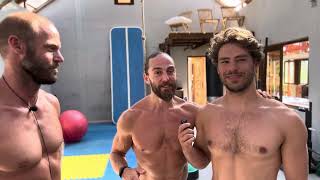
So there are 99 mentors. This is the model of uncommon athletic. 99 different coaches and myself who are leading others to further athletic ability. You're exposed then to Giorgo and Sebastian, who's over there, and Tamir. And what is it that interests you about being connected to guys who maybe haven't done as much work with the tennis ball or the soft acrobatics in these areas.
Yeah. I think what you already mentioned before in this video is about opening up your frame of reference. So instead of thinking inside the box of your specific discipline, of your specific sports, every discipline has something to offer. Like if you look at ballet, there's so much in ballet. But would I normally think, oh, I'm going to practice some ballet? I wouldn't normally think so. But being in contact with a high level ballet coach, all of a sudden you're being exposed to what it means to have strong feet. Like your whole idea of what it means to have strong feet going completely changes.
Yeah. Or, and you can't forget it even after like we just did a tiny bit of ballet in the, in the last 12 months. Because there is a professional ballerina in the, in the network. Even just dipping your toes in the water with that, you, you change your frame of reference. And then even if you never work hard on it, you always know that that's a possibility and you know that arcad can go so much further.
And it's also beautiful how much progress you can make in, in the first week of practice already. If you do a week of practice in one discipline every time, then you're going to get a lot of growth from that and a lot of benefits and you will build a more generalistic capacity base.
Yeah. So every month there's a challenge, there's a few different ones that you can choose from to add something new to what you're doing 10, 15 minutes a day, supplementary to your training. But imagine who you become over the course of the years if you continue to expose yourself to something new as well as go deep on something else. In the amount of time that you would usually take to train anyway, you can continue to build new skills, new abilities. This is what's exciting for me. It's not necessarily for everybody, but there are some people out there who would love to have access to world leading coaches across lots of different areas and then be able to go to physical locations to express those abilities, be around others who have a similar openness to learning physically.
Yeah. I can say from personal experience that I never used any skills. I was a powerlifter. I was all clumsy all over the place. Niels here has helped me with that and it has great carryover to strength. He has great carryover to body awareness. Even when pressing, if you want to press or if you want to be good in the gym, the skills are going to get you that extra thing. They're going to connect you to your bad side, they're going to reconnect you to your whole body and you will be able to perform better. It seems silly. I didn't believe it either, but, yeah, these guys helped me see it. So it's real.
Yeah. Thank you. And I think you touch upon a really important point here, is exposing your weakness. And we often live inside our comfort zone, inside our strengths, and we really like to pursue the things we are really good at. But what Yorgos is saying here, if you never throw in a ball, you only know that you are bad at catching. If you throw it and then try to catch it and then find out, oh, I suck at catching. Okay, there's something to gain there. And so it's a really good point. Thank you for mentioning that.
Yeah.
And you took on the snatch, which is the ultimate barbell lift, but the barbell hasn't been like a huge part. You come from calisthenics background and you know, going into the work that you've done, you open up to experience. Okay, this is what it's like to snatch. And then within 20 minutes, half an hour. Now, you don't have that thing in your mind of, well, I can't, I can't do this. You could go into a CrossFit gym and join a ward and you would be fine if there was a snatch in it.
Exactly. And it's also, yeah. What you mentioned before, like, what type of person are you becoming to go through those things you were not good at? Again, it's the comfort zone that keeps us inside and getting out of that stretching, that going through the discomfort of learning new things, of feeling uncomfortable with, I cannot do this. Instead of walking away. See, what is that? Because more often than not, you can pick it up very quickly and the growth you get from that, the expansion in your mind, like, oh, I can learn this. And then the next thing, you have that frame of I can learn new things instead of I cannot do it and walking away.
This continues. We just had it with Tim Frey, who's one, one of the leaders in rope flow and he was teaching us stuff from WEC method. We have Sebastian here, who has done a lot of work with functional patterns. All this stuff is really new to me. I'm taking on as new stuff at 41. I've done some stuff as a coach and I've had some results. But I go back to being a beginner again. And honestly, because I've done so much of this taking on your stuff, I'm not feeling self conscious about. Okay. Don't know whether I'm learning this faster than average or less fast than average. It doesn't really matter. What matters is I'm in that moment. I'm doing that thing and I love it now. You know, I love road flow and even a few years ago, I probably wasn't this open to taking on those things. We did some parkour here with Jonathan while he was here jumping over boxes and yeah, in the past I would have felt very embarrassed about that because I'm used to maybe being one of the better ones, especially if it's the stuff that I'm leading, you know, if I'm, if I'm leading and it's the stuff that I've been practicing. But it's a beautiful thing to be okay with. Okay, well, I'm not best at everything. And in this model, no one's going to be the best at everything because there's 100 plus disciplines and coaches from every background. So you can't get with the black belt in jiu jitsu and the weightlifting world champion and the boxing champion and the ballerina and kick their ass. Nobody's going to do that.
You rediscover how great it is to be a beginner again and learn something new and start over and. Yeah. And if you ever run into issues like you need those tissues. Right. So we're gonna fix those also. So we're helping each other.
Yeah. And this is the. I come to Yorgos, I have a crack in my ankle. I've had it for most of my life, actually. Like walking the stairs when I'm lifting up from the, from the toes. I come to Yorgos says, okay, I have a couple of exercises for you that I can do. Work at this and this and this way. I knew the exercises, but I didn't know the exact way of doing it. Like, he's telling me to do very minor ranges of it. Within two days of doing those exercises, the crack, it's of course not right away gone, but I feel it's different. Something is different in that.
Yeah. One thing to always be aware of that chronic issues would take longer to heal from. But if you start seeing the results after two days, you know, you're on the right path and you're gonna get there in some weeks, you know, and. Yeah, and if you don't take care of those issues, they're only gonna get worse. So we want to live and become strong and old and be able to do the stuff we love and learn new things.
Yeah.
These are the types of men that are within this network. They're open to you coming at whatever level you're at. As long as you've got a mentality of improving and. And if you can show some discipline and show that you can be consistent with stuff, you're going to be very welcome. You're going to enjoy this network. Follow the Uncommon Athletic page if you'd like to hear more from these guys and get involved with some of their content, some of their materials. We want you to have this experience as well. Improve yourself athletically and see where it takes you for the other aspects of your life.










