Expansion Method 2.0
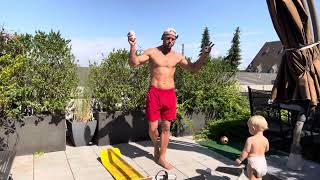
A daily 25-minute routine split into five 5-minute blocks: balance, object manipulation, rhythm, throwing, and sprinting. Use slacklines, juggling progressions, speed ladders, and handstands to build coordination and athletic foundations that work alongside strength training.
Chapters
We start the day 25 minutes of skills. If you're really pushed, just do five minutes. One set balance, one set of balls, one set of beats. One practice of your throwing, one practice of your sprint technique and jumping. Even five minutes a day will make you much more athletic than the average man, the average athlete. These are your primary skills. Balance, balls and beats. Primary skills, Sprinting and throwing. Primary force elements. If we work on the primary elements, we continue to improve them. Everything else can improve as well. These are our foundation. These are our talented kids that just pick anything up. They have that balance balls and beats underpinning. So we can work on the balance on the slant. It's a good way to work on it. Just simply standing on a slant livens up our balance. Standing on the slant, on one foot, two feet. These are like $15 off Amazon usually. I've got slant boards in other places. Actually got a one of the adjustable slant boards upstairs. Balance. That's our first round of balance balls. Now continue to work on your foundation. If you can't three ball juggle yet. Two ball juggling. This one's actually just as hard as three ball. Just 1, 2, 1, 2. When you tilt your head to the side. If I go left every. Every time. First right every time. Then we're bringing in some of the special skills. Close the left eye. We can work on our foundational skills combined with this. The special skills. The primary skills combined with the special skills. The special skills are balance actually comes in on both sets. So we've got one eye closed, standing on one foot onto the ball of the foot. So we're stacking things together. Stacking things together is part of the special skills. So adding that complexity. Also talking on the video at the same time adds a bit more complexity. Other ways that we can bring in the special skills. So rotation. Still doing the one eye. So we can go back to levels of juggling that are easy but make it more difficult. With the special skills elements, build up a bigger base. It's not just about pushing the top level of the skills ahead. Get a little bit of the balls on the feet as well. Still on the buckle. Balance balls, beats. So skipping is a good way to get into the beats. Rope flow is a good way to get into the beats. See, I'm just working with the squares here. Thinking about staying on the same rhythm. Boxing type footwork. How do we get our beats going? Rope is the easiest way to get started with it. Any of your footwork drills from karate or boxing, you can dive into the beats. Section. If you need more ideas and support with this, it's going to bring our lowest level of elasticity in. It's obviously an elastic component to the beats as well. Find your rhythm. Any of your speed ladder type stuff would fit in here as well. Speed ladders aren't amazing for developing maximal speed and power, but they are good for building coordination, timing and a foundation for our. Foundation for our speed power elastic stuff as well. Going into more intensity. So we'll go back to balance again. I'm a big fan of the Gibbon. It's kind of a mobile slack line. Another version of this could be just having a pole or a post. A short pole or post will do the job. You can go deeper inside the balance section. Some of the other tools that we recommend. Little bounces, tipping up the board. Watching out for your son's banana. Banana. You notice this stuff gets better every day that you do it. It's a little bit better. The world's best shot putter, who's competing on a stable surface, concrete, has a slack line in his gym. You can see if you go through his YouTube videos. Current World champion in shot put. You see this little guy instinctively wants to work on his balance. Works on it every day. As his balance improves, everything else improves. He can go further with everything else. He sees me doing it, he wants to do it. He's building his primary skills. Slippery banana hands. Balance balls, beats, throws and jumps. The other one with the balance is the. The handstands and the foundation into acrobatics. Do some handstands. Handstand. There you go. Handstand. Likes going head only. Definitely working on his balance. And he's working on his vestibular system to be able to keep control with his body inverted. Give me a spot or what? Back to the balls. You can have the timer going so it goes off every minute. He's up on the slant there upon the balls of his feet. Look at that. Then stepping off, stepping up and down off things. It's really important. He's gonna juggle. We juggle together. That's the one. Number one. Number one. He loves to juggle with me too. Okay. Bump, bump, bump. They work it a bit on spinning the balls more, Spin them on the throws. Thinking about handball, pitching, getting spin on the ball. It's not specific to that, but it does change your juggling quite a bit. You think about spinning the balls out of the hands. Yeah. You can give yourself an opportunity there somewhere within the mix to hit some new personal bests. You might sometimes want to use the 10 second timer so that you can record your session and see if you hit a new personal best. Going for the lower throws on the five ball. Yeah up regulating and increasing the amount of actions you can take within a second. If I was able to do that same thing while standing on the slack line then I would be a better athlete than not being able to do it on the slack line because it would mean I can handle more complex balance at the same time as complex visual task. So the primary skills are getting better. But then the the secret skill of the total processing power. We call it stacking. Putting the stacking as many of these things together at the same time. I'm gonna do my next beats on the bossy ball. It won't take you long of doing this. You think like oh look, he's not even working that hard. How's this gonna even do anything? Wait until you do it. Do it for a month. See if you know yourself as an athlete. We're stuck in paradigms of thinking it's all about cardio or just need to practice our sport or the team player, the coach is going to come up with a solution. Work on your primary skills. These are the foundations that all athletes have. One of the top NRL players just scored a try the other day and then he did a backflip. It wasn't just a backflip though. It was a single foot gainer off about three step run up. Probably learned that on the beach as a child. I hope he learned it at the club that he's at. I hope he learned it later in his career but that's probably not the case. You see he wants to be there on his own on the ball. He's working on his jumping. Pretty risky for him at the moment. You want to jump off? Yeah, He's able to make that chaotic fall from like hip high the babies have. He already has better primary skills than some adults. He's probably already surpassed a lot of the elderly population. So the, the beats can be working on like sprint technique or foundations for running. Probably doesn't look like I'm doing much here, but my ankles are doing quite a lot to deal with chaos of the ball. This has been a weakness of mine. Strength in the lower leg, the feet. Another one that I'm working on for the sprint technique is more hip extension, heel to bum and hip extension. So balance balls, beats. They're three of our five. So do five minutes balance, five minutes of balls, five minutes of beats. And then we want to do five minutes of Throwing as well. Kick it to me. Kick. Five minutes of throwing. So any of the drills that you're working on for your throwing, you can learn more about throwing in that specific area. Throwing without releasing the ball is a good way to get into it. That's less aggressive. Throwing straight down is also much less aggressive. For the shoulder. Throwing a tennis ball is less aggressive. It's better to find less aggressive ways to get started. We can always increase the intensity as we know that the body is tolerating it well. Work on it from both sides of the body and both shoulders. To be working. One of the primary functions of the shoulder is to be able to throw. It's what sets us apart. We also want to be able to support on it like the handstand. And we want to be able to hang on it. One arm, two arm, brake, heading, monkey bars, rock climbing. We need these ancestral functions to be there. If we want the joints to feel amazing, we should use them as they're intended to be used. Same with anything. If you use your sports car as a bulldozer, then the car is not going to be in great shape. That's what it's like. If you're just doing bench press with your shoulders, you're using your sports car as a bulldozer. Throwing technique. Running Big part of getting back into running is the hip flexor. Athletes sprinters have great hip flexors and they have great plantar flexion tend to be the biggest weaknesses. So if we can improve our push into the ground with this foot ability to keep the heel off the ground, even maximally keeping the heel off the ground and driving the hip flexor, then we're going to become faster over that 100 meters for that pure speed work. So you could actually be going for a sprint if you've got the space for it. You could be sprinting on the spot or you can be working on pieces that fit within your sprinting. So we're thinking about it more from a skills perspective. We're definitely going to see structural changes as well. So take your time. Think about throwing. We want to be throwing with the hips and the spine more than we're throwing with the shoulder or as well as throwing with the shoulder and the arm. This is a 2 1.5 kilo bar. I have a 2 kilo and a 1 kilo like a fishing rod, like a javelin. Throwing doesn't just mean throwing. It means anything that contributes towards that throwing outcome. Bounce balls, beats and then throws and sprinting. Jumping and sprinting. Is also going to condition Our body, it's going to prepare us for baseball, for golf, for lacrosse, for casting a fishing rod, for chopping down a tree. All these foundations, they're all throwing. Throwing elements left handed, right handed. Get better at both. Great for the wrists as well. Spine balance balls, beats throwing and jumping, throwing and sprinting come back to the balance. So if you're on these wedges, you can have your low wedge. Standing on two feet. On the balls of the feet might be enough stimulus for now. It's fine. Start the level you're at. If you want to stack on top of your balance, it's fine. You just generally keep the balance as the primary focus. So I probably wouldn't work on my five ball if balance is the main focus. But if I want to work on my five ball, I might bring balance in as the stacking tool, if that makes sense. So you can do all them together at the same time. Even just adding in, tapping my foot just on the toe, staying on the ball, the other foot on the beat adds another level of complexity. Yeah, it's definitely easier if I'm not tapping the toe. You can see the slants still need more work. It's given us gentle foot conditioning as well. Foot conditioning is key. This is us every day, better balance balls, beats every day building that foundation for the throws and the sprinting. All the different methods are there. You can change over the course of the year. Only been training this way really the last three or four months. Been slowly incorporating more of these things over the last year. And it's, it's definitely a much better way to train than anything I've done in the past. So on top of this, we'll still go and do our strength work. If you push for time, just do five minutes of this, then go into your strength or do 25 minutes of this and then 25 minutes of strength, force work. You're going to be well lit up, well ready to function, But you lower the intensity back. Also a big reason the skill stuff will actually heal your body, because you're using your body in the way that it wants to be used. It's meant to be used, but you're taking the pressure off of not trying to be your maximal with your jumping or with whatever else you're doing. The emphasis isn't on the force, but there is force there. You can work through different positions with your three ball juggling. Being able to do it head down, round, behind you, over the head. If I can get away from the sun, It all comes together. We become a more well rounded athlete and then we're capable of much more in any complex sporting environment. We can do this at home every day. This is how we take it to another level. Primary skills. And we'll dive more into the secret skills as well. Hope this makes sense. Let's be hitting it every day. Take it to another level. And the skills are really primary.










