Fixing Your Back. Fix Your Future.
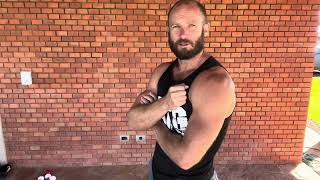
A trainer walks through fixing a nagging low-back issue using bodyweight moves, mobility work like ATG split squats and back bridges, and strength exercises like suitcase carries. He covers his training philosophy of skill, speed, stamina, strength, and stretch, then pitches his men-focused apps and workshops.
Chapters
So most of the time you should feel really good in your body and you want to strive towards that. But when there is an issue, it's good to face it head on. Same thing when you have a financial issue or an issue with relationship. How can you change that position? How can you change that reality? I've been having a problem with my back this year. A lot of the year. I've hardly been to the gym this year. I jammed it up a couple of times doing squats. I think I got really, really tight in the anterior chain. But I've been getting this issue when I carry the suitcases. I've changed countries 20 times this year. We're bringing all kinds of bags with us along the way, bringing a wife and children. And I've hardly been to the gym. Now I know how to look after my back when I'm in the gym. There's certain exercises that I love to do that help my back. And I've just kind of been ignoring this thing because I'm used to having like little niggles somewhere and it's like, yeah, it'll go away, it's fine. But it's really started to bother me that it's not going away. And some days it pinches a little bit, you know, with forward flexion, but it's coming from the side in here. So I'm interested to hear from you guys, like what you've done with body weight, only to improve it. I'm going to share some ideas of what I think I should do and maybe it'll help me to actually solve this thing and work on it consistently with bodyweight movements. There is a little gym where I am here in Paraguay. It's got some dumbbells and stuff, but I haven't been going. Maybe this will get me in there as well. So I might shoot another video in that gym and see what I can do with the stuff there. But the issue is it. It feels like it sort of needs to stretch like the area into the Ql there. So probably issues with getting a bit too tight in this glute. I can feel that sort of connect into that area when I'm swimming. I've been swimming across the lake here. There's a beautiful big clay lake. It's about maybe 200 meters across. I mean, swimming across that. And when I get that nice stretch out to the front, that feels good with like in it. So I'm playing around with little side flexion movements, but it's like it's ripping the scab off as well. If you're familiar with the short and long range concept, I can feel that the long range thing is getting right into where the issue is. But then each day it's still tight again. So what it seems like I need to do is so strengthen that area so that it doesn't keep niggling. So I do need to strengthen it into long range, but I also could do with strengthening it in short range in these side flexes. The other thing that I think is causing me the issue is that getting too tight in the, in the anterior chain. So I feel like I need to work more on the diagonal stretch to work into more extension. Also working more on the, the back bridge. So this is my cold back bridge here in the morning. I think I'm still getting there on camera. So that's giving me a beautiful big global anterior chain stretch. And I can feel immediately that that extension is a positive thing for the area. But I also need to work this strength side flexion. So normally with weights I would do side bends or overhead side bends. And this will strengthen the obliques, but also work a little bit on the, the quadratus lumborum. So I go slightly forward with that. With putting the arms overhead, it probably is enough weight at high reps to give an effect like as if I was using a dumbbell at the side. Or the version that you might have seen in the ATG training would be using the back extension machine. This is another body weight progression on it as well. If I was holding a dumbbell here. But again, it's a little bit trickier to balance overhead, but the overhead version is probably good as well. So the forward fold mobility that I have has gone further than the extension mobility. So I'm much better at going forward because I worked on all these handstand variations. And it feels amazing to do that. If you're going to the gym, you're training yourself, you're training yourself years and over years. I would highly recommend building the ability to handstand. To handstand, push up, like, continue to layer skill development on top of what you're doing with your body composition, on top of what you're doing with your barbell work. It's a beautiful thing to have skills you are not going to regret building skills. You can also build skills in terms of being able to catch and throw, catch and throw, kick, kick at a distance, kick to yourself, juggle to yourself, throw. We should be maintaining these basic abilities. The idea of strength training gyms, it's kind of a distraction from the idea of athletic development. So the five capacities should be there. We should have skill, speed, stamina, strength, and stretch. Now it feels like the stretch is the issue for me. It's like a compression issue that I'm getting here. And for sure it can relate to doing a lot of squats. I've been doing lots and lots of squats, so I need to open this area up. This, the diagonal stretch, the other one. That's obvious. The elephant in the room is continuing to open up on the ATG split squat. It's particularly this side, but it should be both sides. I want to be able to get some extension with that. I like the variation where you put a dumbbell on the back of the hips so you can put both hands on the back of the hips. Kind of almost gives the same. Now, even though I think about all of these solutions, am I doing them? Not all the time. Right. It's. It's easy to let your own stuff slip up. Like, I'm not playing any professional sport. I'm here in Paraguay. I don't really know anyone here. I'm just trucking away, doing my thing. But I do need to face this if I'm helping others with their training, if I'm being a good role model for my children. We've all got these things to face in our lives, and oftentimes I won't share it because I feel like you share your best. You share the things that are going to lift others up. If you're the person who's always moaning about being sick or being poor or whatever it is, people don't want to be around you, Particularly for men, the goal is to be someone who lifts others up, who inspires others, who seems to do things with ease. But occasionally it can help to be vulnerable, to be open about. Okay, well, this is the challenge at the moment. Generally, everyone has a challenge physically. Have they have challenges in relationships, they have challenges financially. There's always something that's going on that's a challenge. Even if someone's very wealthy, even if they have great relationship, even if they have a great body at the root of it, there's always a challenge there. Now, the point is not always to share that challenge. Like, why would you share that challenge with people who aren't going to be able to fix it? Why would you share that challenge with people who it's only going to make things more difficult for them or bring them down. There's no point in that. But the goal with sharing this today is for myself to face it head on. But but also to bring forth the question of well, how would you fix this? So I'm open to suggestions. Comments I honestly I haven't put a coherent plan together. I'm not very good at following programs in general and a lot of great strength coaches say they never follow a program for more than a week or two. Dan Joel and Christian Thibodeau are guys that I really respect and enjoy the work of. So they generally follow things for about two weeks at the most. It's okay if you don't love following 12 week blocks of the same stuff or you know, whole year cycles. It's cool if you do as well. We have different personality types. That's why the neuro dense concept that Fabian's bringing out like different ways of doing dense based on different personality profiles. It makes a lot of sense. There's like the Paveled Satzelin. Some of that stuff is the really long cycles and that's fine. But for myself I do need to have some discipline, consistency around putting some time into fixing this each day. Now I can put the timer on and just say look, I'm going to work on things that I think are going to fix my back for the next 10 minutes and if I do that every day for a period of time it's probably going to feel really good again. Also getting into the gym and doing things that I know fix it in the gym will be good, but I need to. It's also valuable to think about fixing this with body weight. So some other stuff that could help and could work for me would be the supported side flexion stuff. So other variations of side flexion I can feel that stretches into the area as well and it's like on and off. It's nothing serious, but it's just a niggle and it's annoying. I played soccer with the children here first sort of full speed soccer game at the school a couple of weeks ago, maybe 10 days ago. And. And I didn't think about it once. It didn't cause me any issues buzzing around the field like, like I might have 10 years ago, 20 years ago, 30 years ago. But it is, it is there, it is making me feel funny sometimes picking stuff up off the floor. So it's like coming and going. So maybe this sort of movement as well. This would be a long range side flexion. Still a lot of people haven't really fully understood the idea of short and long range. If the movement is heaviest when the stretch is there, then it's long range. So that movement there's Quite a lot of load under the stretch where short range would be if I had to actively push myself towards the floor. So if I was pushing a weight down, if the cable was from above and I was pushing it down, then that would be a short range side flexor exercise for this right side. So you imagine the cables coming from above, pushing it down. If it was from the other side and I've got a dumbbell here, then this becomes long range for these muscles. So it feels like I probably just need more long range. It feels like I probably just need more long range. Work into this side flexion, more extension, keep opening up the anterior chain, work on those back bridge, handstand push ups and back bridge holds, diagonal stretch and ATG split squats. And fairly confident that this will erase itself. The other thing that would make sense would be like suitcase carries, suitcase walks. This is facing directly into the fire because it seems like every time I'm moving these heavy bags around then it jams up again and then it's like takes a few more days to settle down. I don't want to continue in this cycle. I'm 40, I got another 60 years of training myself. I don't want to hold onto an area of weakness that I have to protect myself from. So need to face this thing. I'd love to hear what is the thing that you need to face. I'll make you a tutorial like this if I think I can help. A lot of stuff is super easy to fix. The grip, tendonitis stuff, really, really easy to fix. With the short and long range concept, I've helped people fix shoulder issues. They're like, oh, I've been to the surgeon, I've been to the physio, I've been to everyone. We talk about it for 10 minutes, they do what I say and then it's fine. I had that from a guy that I had dinner with in London. We spoke about everything at dinner. We spent about five minutes on his shoulder and then he messaged me a week later going like, oh yeah, my shoulder's pretty good now. Messaged me a week after that, yeah, I'm back to top weights again on presses. And it's this simple concept of short and long range. Didn't do any rotator cuff work, didn't do anything fancy. Just understood the principle of short and long range and the idea of working with blood flow to get to the next level. So yeah, this is the game. Face the challenge, face the challenge head on. If there's something that I can help you out with please let me know. I'm building out an uncommon man app as a free experience. I've got a workshop coming up this weekend. Next weekend, Sunday, here together with my mentor, Paul Counsel. Change the way I look at money. Look, change changed the way I look at human psychology, business, wealth in general. There's two sides of money is kind of business and keeping money growing money. We've got a free workshop coming up with him as well as dozen other speakers, men that I really respect who've had a positive impact on me. These events are great for me to be able to learn and reconnect and I'm making that available to anyone who wants to get amongst it. Yeah, the pro app is progressing well, so it's a way for you to have some accountability and support from men around the world who are getting their training done each day. The app is free and when you get to 10,000 reps, you unlock certain bonuses, you unlock courses as you get your reps done. So it's pretty cool. I've wanted something like this for a long time. The technology keeps getting better and better and I want to continue to be able to pay men to get better. So I want to pay men to get better in the pro game that they're getting rewards that should end up being strong financial rewards simply for getting the work done. Now, the real reward will come from the market. The market will tell you if your product is good and if you're, you know, if your service is good and such. But if I can reward people through the process, then they'll actually get through the process to the point where they get to feel those, those big rewards. And then with the free app, you can do repetitions to unlock the education and learning. The free stuff doesn't really work that well. And this app won't be free for very long. It'll be like a $30 a month type of a deal. The pro game is more like hiring a personal trainer. So you have me and dozens of other elite men as well as hundreds of teammates who've decided to live to a high standard. And it's pretty much cost the same as hiring a personal trainer trainer in the, in the western world to be a part of that, that program. I spend every day thinking about how to make those better. I had some good ideas about it today. Every day is an idea day. Every day is a chance to think about, well, how can I solve this better? Unfortunately, the massive money of big tech and the massive money going into government is not focused on how do we Build strong land. How do we build great families? How do we create the ultimate environments for children to grow up in? That is what I'm thinking about every day. And I know there's a lot of other men who are thinking about as well, but most are not able to or willing to, or at the point where they believe in themselves enough to build real solutions for it. But we're building villages, we're building technology. It's working. There's a lot of success stories, a lot of men making more money. There's more villages. The villages are progressing. And it comes through exactly the philosophy that I've spoken about here with the back. Fix the back, fix your body, fix your life. Ultimately, for me, if I had to deal with this back thing for the rest of my life, but I get to do what I want to do with the villages, with this technology, with building success stories of men who get solutions out to the world, like the ATG solution, which needed to get out to the world, which has gotten out to the world. There's so many more challenges for us to solve. We're building a language system and program to be able to learn languages very fast. We've got a productivity system. We've got a freedom business builder. All of these things are like infinite puzzles where you can't finish it, but you can consistently make it better. So the way that we've built systems in training with things like dance and range, basic skills, we know that these systems work better than the old technology. We're getting reports from thousands of men around the world that once they start training dance style, they get new gains that they couldn't get before and they feel better and fresher and it's more consistent and it has a bigger mental return than other styles of training. We're doing that same thing with business side of things. We're doing that same thing with the way we're building our app. It's like, how do we do something revolutionary, something new, something better that changes the way we do things? We're doing that with the training. The challenge is to do that with entrepreneurship as well. So we'll continue to push the training side ahead and we'll continue to develop the best coaches, but we also want to turn that into things that have a deeper impact. Farms, schools, leveraging technology and education, online stuff. These are things that we need to need to solve challenges that must be overcome. We should have healthy, clean water, clean food. Shouldn't be as hard as it is right now. We need to move ourselves away from the influences of those who want to destroy us objectively. There's clearly a destructive force that is dominating the Western world at the moment. But it's our choice whether we give our attention to that all day or we build solutions. So I vote for solutions. I'm committing here to sorting out this little niggle in my back. I hope this was valuable. Look forward to speaking to you.










