Get STRONG Without Fatigue Using DENSE STRENGTH
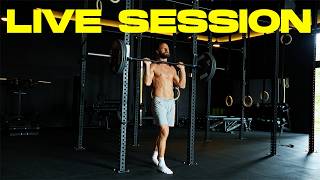
Coach guides Lucas through dense strength training, a sub-maximal method that builds strength while avoiding nervous-system fatigue. Using wave-loading patterns and fixed time per set, you can press near body weight without training to failure. The overhead press builds shoulder health and prepares you for handstand push-ups.
Chapters
Just because the brain's tired doesn't mean you did a better job with the body. When you go closer to failure on each set, take more away from the nervous system, you take more away from the next day's training. It means you feel more tired and less motivated to train again. When you go closer to failure by having set density, your training is organized, which means that you can organize and you know when you progress. We're going to press. Pressing is good to build shoulders. It's also good to have healthy shoulders. If we do handstands, it makes sense that we should be able to support more than body weight overhead. We did a hundred kilo lockouts to illustrate this point in our last upper body session, which wasn't on YouTube. But just feeling a lot of weight overhead is a good thing. And then you can kind of think about this bottom position. It's one variation of something like the VMO squats. So if we go to the bottom of the squat and bounce in the bottom of the squat, that's something that's useful for our squats and for our health of our knees, health of our hips. So maybe we get the same thing. If we do the same thing with our shoulders, it's not exactly the same, but it's useful. And it's also good to get comfortable in the bottom part and warming up the press. If you're really strong from the bottom in the press, then it's going to be easier to press bigger weights. Bottom position can be really nice. See what Lucas thinks about his warm up sets. Yep.
So it's really nice to feel the position, feel the feel the shoulders getting loaded and the stretch. We can also do the same in the mid position and work only the top position. Also,
in the old times it was really normal to be able to press body weight. It was kind of considered what you would do within the first year of training, you would get to pressing body weight. But these days it's less common. A lot of it's because of the switch towards bench press and just the change in the style of lifting. In the old days, almost everything was an overhead press of some sort, whether behind the neck pressing or they were jerking or dumbbells. Everything that was upper body was kind of in this range and with some sort of variation. Doing jerks and push presses allow us to feel more weight. It's more likely that we're going to be able to do more weight if we're feeling a lot more than what we can actually press in whichever part of the range of Motion whether it's in this bottom range motion that Lucas is doing right now or whether it's in the top range of motion. If you're feeling a lot more weight than you can handle in the full range. Because when we talk about full range of motion like it's. We're basically just focusing on wherever the sticking point is. So for most people the sticking point on this press is going to be somewhere between like the mouth and the top of the head. And it depends a little bit on the individual. Working on Lucas's reflexes. Today we played table tennis today. Lucas said he wanted to have a game but I've been practicing and he didn't realize so. No, but it's, it's a really. Yeah, it's a really good game. Table tennis. To work on the reflexes foundation of athleticism. Tracking with the eyes. Usually press around the other way but we're just facing towards the camera. The dead strength. There's many ways to use it. Dense method. It's a sub maximal lifting system where you lift less than what you could lift in every set. But you use density, which is why it's called dense to make this training very organized and it encourages self regulation. So when you go closer to failure on each set, you take more away from the nervous system, you take more away from the next day's training. That means you feel more tired and less motivated to train again when you go closer to failure. Just because the brain's tired doesn't mean you did a better job with the body. So if I was to train three sets of 10 on standing press, it's going to be less weight than this for 10 reps at the moment. But if I train 10 sets of three, then I can use this weight. If I do it dense style, then it doesn't actually take that long either. It takes around 10 minutes. By having set density, your training is organized, which means that you can organize and you know when you progress. If you take a little bit longer rest, you didn't actually progress. If you use a slightly bigger weight but you have a slightly longer rest in effect, your overall training effect is the same because you made one variable easier while you made another one harder. So we have fixed density. So you might notice I'm not doing the same number of repetitions on each set. I'm using wave loaded Dance, which is a variation I don't usually start people on because just simpler to think about something like what Lucas is doing. Single rep, each set nice and controlled, nice and smooth. But when you wave Load. Then the intensity is going up, up each set two, then three, then five. But now I go back to the two and it's a relative rest. It has longer pause, longer rest between the sets, the set doesn't take as long and the set takes less energy out of me. So in the end, what matters to the body, in the end, what matters to the body is the work that's getting done. And we get to be, get to do really good quality work with the, the dance. So the overall, the overall weight lifted, the tonnage lifted, the volume lifted for the session is going to be at a higher intensity because we're able to go for more sub maximal sets. So for Lucas this is like a maximal set. I wouldn't progress from here. I would restart the cycle, go back down to 40 kilos, go 42, 45, 47. By the time he gets to 50 again, he'll be ready for 52 and a half. But another way that we could progress it would be to go 11 sets of on the minute or 12, 13, 14 sets on the minute with the singles. That's, that's another way that he could progress. But really for Lucas and his goals, it's going to be better to go back and work on More so the 10D5 range and even building up, maybe sometimes putting in the 20 D3, 25 sessions. But even if his goal is mostly to put on some muscle, it's still useful to do the 10D1 session and keep in touch with your strength. Now when he goes back to the 40 kilos, it's going to feel light. So the little surprise that we have for Lucas is that we're still going to do the fives with 40 kilos and we'll see how it feels coming off those sets of singles with the 50. Let's just have a look, see what it feels like.
I mean, the dense stuff. I've done it with the overhead press a lot and when we last were in Montenegro together, I couldn't even do one rep with the 50 kilos. So it's a good, good progress.
Yeah. In terms of the handstand push up, you probably, you want definitely 3/4 of body weight, but more so like 85, 90% of body weight. He's probably going to give you the handstand push up. How did that feel, Lucas?
Like I could do like maybe two or three more, but let's see, how
many did you do then? I did five reps. Okay, that was good. That was the plan.
Yeah, for me to get the handstand Push up. I probably need 80 kilos. 85 kilos over at press.
Yeah, not on this. Not on the minute.
No, not on the minute. But I mean, eventually I get it on the minute.
You want to do the. Yeah, those 10 singles at 70 and yeah, you probably. You might get it. Probably not. Yeah, 10 singles at 77. 75. 77. Something like this. This is. Yeah, this is about the best that I've been. Probably would have been to do singles at 70, but I'm a little bit lighter as well.
But I've noticed with the dense, it's like sometimes in a session, you start the session like the first set and the second, maybe even the third, they feel a little bit slow. They don't feel as strong. But as you warm into the, into the session, you will notice that you. That you feel stronger. The second set with the, with the five reps felt better than the first one now.
Yeah. So, yeah, if you choose the right weight, it can definitely feel better as you go along. Most of the sessions should feel like that. They shouldn't feel like you're struggling to get to the end. They should feel like you're getting more excited as you go. Yeah, you really don't need to do the maximal, maximal sessions.
What I'm doing right here is probably also more like a test. I shouldn't be grinding this much in the dense.
You know that those, those ones are okay. Like your fives are okay. The singles were a little bit grindy, but I don't mind it because I think it's teaching you to activate your muscles and to switch on. If you were already strong and you were lifting like that, if I felt like you were good at activating your nervous system and your muscles, then it would be bad and you don't want to be doing that. But at the moment, we're still teaching you to really switch everything on hard, fast. So the singles are really good for that. They do help with that. You might be thinking like, oh, why, why am I doing fives if he's doing fives? And I just did 2, 3, 5. 2, 3, 5, 2, 3, 5. I've already done quite a lot of volume there. If you add up the volume of the 2, 3, 5 at 50. So for me now doing some speed reps, it's actually a nice way to finish it, feeling nice and smooth. And it's also a good stimulus for me. Like the 40s are still. This is still useful for me to practice being smooth, to get fast out of the bottom and not, not everything Needs to be really hard, really heavy. And if you look at the way a lot of the Soviet lifting was done for the throwing sports, they would use submaximal loads with speed.
Five.
So like 60% loads can be really valuable still for power athletes, Bonded Choco is famous for using like 60 to 80% loads and not doing 80 to 100%. Yeah. Some people say hold the breath, but if you're looking for more repeatable sessions, then I'm aiming for more like something like what you would see a fighter doing. Like, so this slight. There's a slight exhale under pressure at the moment where I'm going hard. So I'm not holding the breath here. But that's is at the bottom, not at the top. That's is at the bottom, not at the top. That's is when you go just sort of the opposite rhythm. Of course, we're doing quite a lot of reps. You don't really be holding your breath the whole time because the next set is going to come around quite quickly. And it's also like pushing more of a stress response if you hold your breath. So, like holding your breath less often, it's okay to do it occasionally with a really maximal lift for really short lifts if you want to, but less. It's down here. So, yeah, you can get better activation by squeezing the bar harder, squeezing your glutes and creating pressure in the body through the breath at the bottom. Still a bit late. Yeah, it's when you. When you go. This weight's a bit heavy for him to be playing with something new learning. But it's okay. But if we can accelerate it really hard out the bottom, then it should be smooth for the rest of lift from there. Obviously it's easier for me to say because it's a lower percentage for me, but I'm going hard from you.
This was six or five.
Might have been six. I was just thinking about the breath. You're also a bit narrow. The gripping, like here, like inside. I'm gripping here. I'm shorter than you. You can see some of this. For me, you're like full finger inside. Probably means you're using your triceps a lot more and your shoulders less. You're going to be able to use less weight. Like.
Is this last set or second?
Last. Second last. Me too. Rest. He wants it. He wants to finish it.
All right, don't quit here.
It's good to stay away from failure, but it's also good to train towards tomorrow's session being a good one. It's not going to take too much out of him if he fails on, on this, this weight, like failing on a higher rep thing. And when you're deeper into fatigue, you use less energy than when you fail on a 1 RM pushing its maximum weight. But you don't, you don't really want to fail. Take too much out of the system.
Yeah, but the wider grip felt stronger.
Oh, yeah, that's, that's why you wanted to get it. Fast, faster, down, up, fast,
Last second.
It's a bit more like a test set than we would like, but it's okay to test sometimes. He already did the singles, which means that if we hadn't have already done the singles, in theory that would have been easier, but in practice maybe it was better because we switched on the nervous system fully, is nice and warm and it made the 40 feel light going into next time when you, if you wanted to do the 40 for 10 sets of six, you wouldn't probably do that next session. But if that was a goal that you wanted to hit, or if you're going to do the 42.5 next session, 42.5, 103 would be a good place to go then, you know, you've got to get that easily. 10d4, I think you're going to get easily. You can probably go 10d5. Like when you're earlier in your career and you're not as close to the maximum potential that you're going to have, you can make those bigger jumps. If you were more experienced, you might go 5d3 and then 5d5, then 5d4 and then 5d10d4. Like you go up, you find another way to make like slower progression or you go forward and then go backwards. So you go 10d3 then 10d4, then 10d3 again, then 10d4 again, then 10d3 again, Then 10d5. So you like play more games with the intensity as you get more experienced, so that you're not always playing on the edge of what you're capable of is how you're going to get continued progression with the dents, which is what we want. But yeah, this is, this is a nice, nice set. Nice series. 20 minutes of pressing, which, you know, a lot of people will take that amount of time anyway. If they're doing a bench press session or something, they would maybe do a
three to four sets.
Yeah. In this time period, talking and messing around or going close to failure, getting spotted. Yeah. And this is quite a lot of volume. Usually we don't do like 20 sets on the same, but it's not actually 20 sets in the traditional way of thinking about it because all of the sets are submaximal so it's, it's really some kind of cluster. In effect you'd probably divide it by two and a half, something like that divided by three. So you would think of it as being more so something like an 8 set or 12 set. Yeah, 6, 6 to 10 set kind of session if you're thinking about it more in traditional way. But yeah, if you would like to get set up for yourself with the dance or just learn more about dense if you comment dense or go to newathlete.com using the link in the description, you can find out more information about how to use this dense method for yourself. Whether you want to do it for muscle size, for power that can be adapted in many different ways, you can learn about that and apply it in your own training.










