Holistic Athletic Body
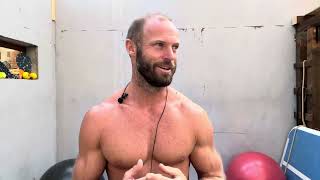
A coach-led YouTube monologue introducing the "Holistic Athletic Body" concept: choosing an ideal athletic physique aligned with life goals, prioritizing health foundations (immune, gut, sun, nature, breath, lifestyle) to support training adaptation, and using measurements like the fat-free mass index and a derived "muscle number" to assess realistic muscle potential. The speaker discusses sport-specific tradeoffs in muscle/fat distribution, offers rough height-to-mass examples for natural limits, and frames this as an invitation to decide and pursue a personalized physique plan rather than quick cosmetic shortcuts.
Questions this video answers
About 18 to 28.
Muscle number = FFMI × 4; ~100 is presented as a 'natural' reference.
About 85 kg as a maximal mass for a very muscular, shredded natural 185 cm male.
A 170 cm person aiming to be 90 kg and shredded is described as unlikely physiologically (would require heavy steroid use).
Chapters
Holistic athletic physique. This is an introduction talking about what is the ideal body for the life that you want to have? If you can make the decision of, I want to be this type of athlete, therefore I need this type of body and execute on that, the chances of you achieving a lot more athletically increase. It's also a powerful thing for self image, self esteem. If you feel good about the way that you look, you're more likely to treat yourself better, likely to eat better, you're likely to have better relationships, you're likely to be more confident in business. Some people are triggered by this conversation, think that, oh, no, we shouldn't judge a book by its cover and. But we're all making those snap judgments. Okay, clearly that person is able to discipline themselves. If you see a strong physique, you might have questions of like, is that through steroids, Is it genetic? Do they even train? But on some level, there's some respect there. When you see someone who's got a very athletic physique, and the inverse has to then be true. If you see someone who's very sloppy, looks like they haven't trained in a long time, couldn't run to the corner if they needed to, you're naturally going to be a little bit wary of, does that person know how to do the things that they want to do? Where else in their life does that show up? There's the idea that how you do anything is how you do everything. It's not an absolute, it's not 100% true, but there's going to be some carryover if you're able to get yourself in the shape that you want to get into. So what does it take to have this holistic athletic physique? What does that even mean? The holistic is that we want to be building health. At the same time, there's a lot of people taking shortcuts, macro diets, steroids, you know, hormone replacement, etc. To be able to have the physique that they want, that's kind of short term. You get the silicon AB implants, all that sort of stuff. That's not what I'm talking about. That's not the goal. The goal is that you have a physique that you're proud of, but that you're becoming healthier in the process. You're building adaptive capacity to training through what you're doing with your nutrition, your lifestyle. Holistic also means that we're incorporating the sun. We care about digestive health, we care about time in nature. There's other factors for health, breath, work. These are things that can have a dramatic impact on the physique, but also on the health, on the foundation. So this is the foundation to then be able to go and train hard with the methods to be able to hit dense sessions and do speed work and push after your goals with confidence that your body's going to continue to adapt with you to that load. So your adaptability is going to be determined by this health underlying holistic health capacity. If your immune system is struggling because you have allergies, that you're always getting sick, you will have trouble adapting to strength training. After you do strength training, there's damaged cells and the immune system is going and clearing that out and helping to support the adaptive process. If the immune system is already overburdened, the lymphatic system is already overburdened and is going to be much more difficult. I learned this at the biosignature level one with, with Charles Pollock when he was talking about like, the immune system is the foundation for hypertrophy. And I was like, oh, okay. Well, I'd had autoimmune stuff and problems with allergies and problems with my immune system for most of my life. And so that made sense why it was always difficult for me to get the physique that I wanted. So this is our underpinning. Generally there's areas that we can improve if there's things that we know cause issues for the gut. It's. It's going to be better, it's going to be easier to get the results that we want. If we take that out when we get down then to what is your ideal body composition? Like, do you need more muscle for what you're wanting to do, or do you actually just want to look better? Sometimes a lot of men say, like, I need to be heavier. But what they really mean is that they need to be leaner. Sometimes you need to be heavier. And it does have a place. If you're a rugby player and you're 78 kilos and then it's probably going to be better if you put on some, some mass, some of that will be muscle, some of that will be fat, and you just make that decision. But identifying for yourself what your ideal body composition is and then moving towards that is important. There's a thing called the fat Free Mass index or height adjusted Fat Free Mass index. This is like the bmi, the body mass index, where the BMI tells you, oh, you're overweight or you're obese. People are Very muscular. Especially if they have a little bit of fat. They'll come in as overweight or obese on the bmi, even though it's actually muscle that puts them there. The fat free mass index version of that takes the fat mass out and it tells us how close we are to our natural muscle building potential. So if you're, it's especially valid for lean people. But when you take that measurement, it's a number around between sort of 18 and 28. You take that number, you'll know roughly where you are compared to your natural muscle mass potential. And the leaner you are, the more accurate that will be. If you're holding more fat, then the number will be higher. If you look at the studies on it, the biggest numbers of fat free mass are going to be in offensive lineman. There's research in American football, they're going to have more fat within the muscle and it becomes gray with the, the testing mechanisms to be able to kind of measure. Exactly. But these things give us some idea. So if you're 170cm and you're like, yeah, I want to be 90 kilos and shredded, so you're going to have to take a shitload of steroids to do that. Like that's just not something that's going to happen physiologically. A good simple way of doing this, it's good to look at the fat free mass index and I create an index called the muscle number, which is really just using that number and making it more sensitive by timesing it by four, which means that 100 is kind of like the natty number or your natural potential. I have worked with athletes who have 100, 510 muscle number and I believe that they're natural. There are, there are freaks. But the other way that you can sort of know roughly what would be an elite physique for you is to take your height in centimeters. So say you're 185cm. If you were very muscular, shredded, without exceptional genetics, 85 kilos would be your maximal mass. And you will see 185 centimeter guys that are 95 kilos and they're pretty lean. But if they were to really shred down to sort of bodybuilding close to stage physique, that would be 85 kilos. Or they have great genetics or they've used steroids. You know, maybe with all the supplements and modern stuff, as well as doing traditional stuff, like maybe those numbers can be a bit higher. That's not really the point of this conversation. To explore that maximum natural muscle Mass, we will talk about that as well. But what we need to start with is just you to have a picture of. Yeah, I need significantly more muscle mass, or actually I've got probably about the amount of muscle mass that I need for the kind of things I want to do. If you look at the Olympics in the sprinting, they're not super heavy athletes. If you're a soccer player, they're not super heavy athletes. It's not always essential to add a lot more muscle mass. And what's also important is where this mass is distributed. So if you want to be great at handstand push ups and chin ups, then you want a significant amount of muscle mass above the belly button. If you are a lower body dominant athlete. If you want to be a lower body dominant athlete, which is generally more functional, healthier to be lower body dominant, then we want to bias the training volume so that the muscle mass will move more towards the lower body. But that's for each. Again, it's for each person to decide. If you're a kayak athlete, then you want to be upper body dominant. You can train legs, but you don't really want to hypertrophy the legs too much. If you're a track cyclist, you need some strength in the upper body, but you want to maximally hypertropy the legs. So this is you deciding what your ideal physique muscle mass would, would look like. And then same for fat mass. This one's even more triggering and challenging of, okay, you tell me I'm too fat. With professional athletes in the athletic world, especially if it's a relative power sport, if we're talking about dunking, high jumping, soccer, sprinting, weightlifting is a really important one. Gymnastics is a really important one. Like you need to be shredded, and that's okay. And so those athletes are shredded. And it's not that difficult to do for boxing, for ufc. And there will be those exceptions. Obviously in weightlifting, in the open class, they're not shredded. And as you get closer to the open, open weight class, you'll see that there'll be a little bit more muscle, a little bit more fat on some of the athletes, particularly females. But it doesn't make you a bad person if you don't want to do that as well, it's up to you to decide what is your ideal physique. For most, it's going to be valuable to be lean, and it's good to get the experience of being lean and realizing it's not as difficult as people will make out. There are a Lot of people who are natural and they stay lean year round. What I've seen to be most effective with that is to be able to manipulate and customize carbohydrate intake timing. That's the easiest way to stay leaner with high performance. But there's, there's many ways to do the diets. What's important is you decide the outcome that you want. That's what this first conversation is about. So we customize, we upgrade the health, we upgrade, we customize the muscle mass, we customize the fat mass and we're in a really good position then to be able to live life, to go train, perform, recover. What we're going to go through over the course of this custom athletic physique module is how to do that, when to eat, what to eat, how to add more muscle mass, how to be that heavy, very muscular, rugby physique type athlete. If you wanted to be a sumo wrestler, what would you do? If you just need to be heavier at all costs, any cost, then what would you do? But then also shredding down quickly, sustain, shredded, if that's the goal, and practices that will improve the health along the journey. So this is the introduction to custom athletic physique. I want you to think deeply about what you really want, not what you think is possible, not what you think your mother thinks you should do, or your coach or someone else that you decide, what is it, how is it that you would like to look? It might take you a few years to be able to change your mentality and discipline around things, to be able to make the habits that need to go with that automatic. It might not. It might be that today you flick a switch. If you've already got exactly the physique that will serve you, if it's the optimal physique for serving your mission in life, your purpose, all the movements that you want to achieve, then that's fine. We can focus on the training to get you there and the performance side of athletics. Generally, if I'm coaching someone, there's changes that need to be made in the physical vehicle. Charlie Francis said, looks right, flies right. If you look at the person and you're like, yeah, that's exactly the kind of physique that they need for this sport, for this goal, for this role, then happy days. If you look at the person like, oh, yeah, he's on the edge, there's going to be those outliers, right? There's like the athlete who's really underweight that still plays rugby, it's like, yeah, he did, but look at how he was able to do that. He was super skillful, he was super tough, he had a bunch of injuries and he still managed to have a decent career. But those outliers will generally have other exceptional things that will help them to make up for their physique. You don't want to choose to be that person at a disadvantage. You want to choose to be in as close to the optimal as you can based on your own genetics and your ability to execute on plans and find exactly the plan that is going to work for you. Yeah, fundamentally, philosophically, it's the invitation into taking your own journey in life more seriously, being more exceptional, giving yourself permission to be elite. Oftentimes people will be like, yeah, my physique's fine, I don't need to change anything about it. But if it looks average, it performs average. Like, what's the fun in that? The goal with uncommon athletic is to move away from the median. If you're right near the median for mankind at the moment, or men at the moment, median, it means you line everybody up in the world and those who are standing in the middle, they're the median. But. But the median in the Western world at the moment is not a great place to be in terms of finances, in terms of relationships, in terms of physique, in terms of athletic ability. So we want to move away from the median towards the excellent end. This is the start of that conversation. So get really clear about exactly what it is that you want. If you could choose. Don't be worried about how much. Don't be scared. I'm going to be really hungry if I do this, or there's no way I could ever eat enough to be able to do this, or blah, blah, blah, we're going to look at the details. Don't worry about the details for now. Don't worry about the how. The how is not relevant. What I'm asking you is, what do you want? If you can tell me what you want, I'm sure we can move towards that. I'm sure we can get you there. This is the start of the conversation. If you've got questions that are coming up for this, if you're all in, I want to hear from you. Let's make moves, enjoy the journey.










