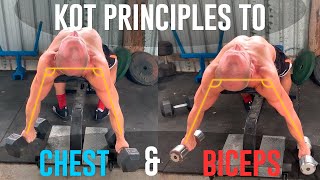
This content was created by Keegan Smith. This content was uploaded by Keegan Smith. This is a YouTube video titled "How To Apply Knees Over Toes Principles To Chest & Biceps" (created 2021-05-17). It contains an instructional dialogue between two speakers (labeled Speaker A and Speaker B) discussing applying mobility and strength principles to the chest and biceps. Key points include training to hold end-range positions to build connective tissue resilience, a benchmark of holding the bottom of a curl with ~25% bodyweight in each hand for 30 seconds, attention to arm and shoulder angles (thoracic spine and external rotation), and addressing common issues like pec minor, pec and biceps niggles/tears.
Questions this video answers
25% of body weight in each hand held for 30 seconds.
Chapters
Alright, so the ability to hold positions. I think one of the massive, biggest problems that we see is that you can't get into a position and you can't be strong in a position. So we want to be able to hold the end range positions and as those positions get stronger, then we have more options for the rest of our training and a lot more resilience. So we're going to lay down your connective tissues and just get rid of a lot of niggles through these kinds of movements. Okay, so one of our benchmarks, upper body, get to the bottom of the curl. We want 25% of body weight in each hand and the ability to hold that position for 30 seconds. So look at the arm angle, the angle of the shoulders, basically where it's as if I'm on a flat bench because I'm on the incline by the top is kind of squashed over. So if you're on an elevated bench, that'll work. Or if you've got a bench with a broken top, you could work off the incline. But when we're able to hold this position for 30 seconds, you see open up just a little bit more round to the front. We want to be sort of. Yes. Slightly more towards the externally rotated side flight. To externally rotate a little bit more, you find that thoracic spine, but also chest will start to remodel. So you don't have to curl to get out of that. It's going to make dramatic changes in the shoulders.
Pec, pec minor.
A lot of the little niggles that we have around the shoulder. Pec tears, bicep tears because of lack of ability to get into these positions. So getting into and out of these positions is also a good thing. But that's our test. You'll notice with this weight, it's not quite as vertical. The hang, okay. The hang, I can really squeeze into the bottom with a little bit more weight. Able to get further to the bottom.
These have been massive for my shoulders. Feeling better through the biceps, through the pecs, chest. You'll feel it in different positions depending on where you're tightest. But the same principle runs all through the body. This is what we need for the biceps principally and also for the chest.