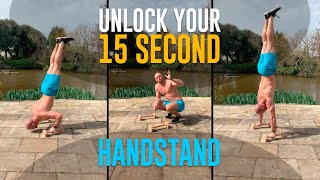
Keegan Smith breaks down handstand progressions from crow pose through freestanding handstand push-ups. He covers balance drills like closing your eyes and moving your head, wall-assisted practice, and strength work with pike variations and dips to build toward the full movement.
Chapters
Following on from yesterday, asking about the pike and the handstand, here's the handstand tutorial to show you that you can get in the handstand game in some way. I want you to work on this, okay? If you can balance like this, if you look at my shoulders now I'm doing a handstand. Just the center of gravity is very, very low. So the challenge in this movement is more so going to be with the abs and the hips. If it's too difficult, then you can raise parallels. Another way to get started from the very beginning is to put the weight onto the elbows. So like a crow position or a crane position in the kind of yoga terminology. All these positions are versions of a handstand. Okay. So if you can put the elbows, the knees all the way, the knees all the way up into the armpits, then you can see it's becoming a higher position. As we get higher, then we progressing into the handstand. So just working on these positions in themselves will start to develop balance that we want from there. Being able to get any time on the hands. With small jumps is developing your skills towards the handstand. Now, if you're a real beginner, you might want to use the wall, put a wall there as a safety. So if you do happen to go too far, I go too far on this. It's easy enough just to twist out. But if you're not in the habit of that, then having a wall there and practicing just getting your feet to the wall is going to be a good place to start. Now once you've got that confidence, or if you're already confident, then working on being able to balance with the bent arm on the handstand. Again, we're just regressing the positions back. So this would be like a bent arm, bent leg version of the handstand. So develop from the bent arm, bent leg handstand to straight arm, bent leg and then straight arm straight leg or straight leg, bent arm. Practicing for yourself, like those kind of bail twist out positions. As soon as you have that confidence that you're going to be fine, that you know how to get off, then you'll be able to progress faster and faster. Some little tips and tricks that might help you along the way is when you're in these lower positions. So like the crow position, you can close your eyes and it's going to put a bigger emphasis on your balance. So if you're in this position, close your eyes, you're going to get more feedback from your body. You're going to listen to your body rather than using your eyes to sense where the ground is. Another variation of this would be to move the head. So we're building, like a bigger foundation of our base, challenging the balance in other ways with the lower center of gravity. And then you'll see people, as they become more advanced in hand balancing, practicing, moving the head, pushing the head through. So those kind of variations are things that you can play with as you develop your handstand. We're doing it with the body closer to the ground. It's going to be easier. And then you basically got the two pieces to put together. So we want that bottom position, shoulder stand. We want to be able to hold the handstand. And as those two things come together, then we're going to get our handstand push up. We've looked at the skill component. We're also going to need the strength component. So one of the ways that you can get some reps to be able to do the freestanding handstand push up is the piped variation. You get that vertical feeling, But still the legs are taking some of the weight. So if you want to regress that down further, you can make it more horizontal in the bottom where you're stronger, press it up to more vertical. If you need to regress it back even further, or if you want to use a more vertical push up option, these are actually surprisingly effective. In the bottom position. It is quite a vertical. Before you laugh, they're quite deceptive. You might start to feel a bit more upper pec activation, which is an area that a lot of guys like to work on. So work on your foundation with these. Developing all your pressing strength. Dips behind the neck press, dumbbell presses will all build a foundation to be able to do the freestanding handstand push up. Some of these specific regressions, getting a bit more position specific will help to accelerate the journey. Come with me.