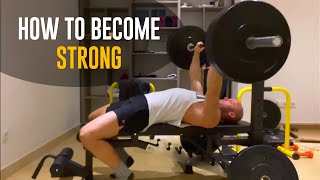
This content was created by sociable-sophisticated. This content was uploaded by sociable-sophisticated. This is a YouTube video titled "How To Become Strong - Bench Press Workout" (created 2022-01-09). The excerpt is a single-speaker, first-person training narration and instructional commentary describing a bench-press-focused workout and broader strength-training philosophy. The speaker details session structure and loads (snatch practice, 10x10 at 40 kg, working sets at ~60–90 kg, singles, triples, pause reps and mid-position pauses), mentions training twice a day, a goal of a 95 kg standing press, ancillary skills (freestanding handstand push-ups, one-arm chin-ups), and references the Bulgarian training approach and the importance of consistent practice over time. The content reads like a personal training log and coaching advice rather than a dialogue.
Questions this video answers
95 kilo standing press.
40 minutes of snatch practice, progressed up to 110 (kg).
10x10 at 40 kilos.
Day 14.
Training twice a day most days.
Chapters
Do what you want to be good at. I'd like to bench press a heavier weight, and bench press or dips are the two movements that you can lift most weight on for the upper body in the pressing. So I have a goal of 95 kilo standing press, which means I'm going to need to be able to press a lot more weight. Pressing more weight on the dips and bench press are going to give me more foundation to be able to stand and press the weight that I want to press. So I did 40 minutes of snatch practice in the morning and then scored it up to 110. And then I went for a long walk in the afternoon with my children. We kind of got stuck, and we ended up out for, like, four hours. And then I got home and I thought, oh, I might do something else, you know, get a second session in. But I really felt pretty average for that. So I just started by pressing the bar a bunch of times, and then I did 10 by 10 at 40 kilos as a way to kind of see if I was going to do something else. It wasn't challenging, but it was like, okay, well, let's see how this feels. And if it feels good, then I might do something else. So I think I then went on to 60 kilos and then 70 kilos. This might be the first at 70. And everything was feeling not that great. It's day 14. I've been training twice a day most days. And, yeah, I didn't really feel amazing for a session after the day that I'd had. But I thought, let's start. Let's touch the bar and see how it goes. I've been listening quite a bit to John Bros. And he talks about, like, you know, if you can touch the bar, then. Then you win. If you can. If you could squat the bar, then you're winning. You're in the game. So that was the plan, and that's what I did. And as often happens, I did start to feel okay. I didn't feel amazing, like I was gonna break any more records or do anything spectacular, but I felt okay. And I ended up getting to 80 kilos and then 90 kilos and just did a bunch of practice. And if you think about it, the only way you can be terrible at something is if you don't practice. If you practice enough, you're going to be okay at it. You're not going to be the best in the world. To be the best in the world, you have to be smart and you have to have the genetic potential and you have to get your sleep right. You have to, you know, everything. In any endeavor to, to be the best in the world is unlikely and it takes a specific special effort. But to be very good really only takes the decision. The decision to be really good is quite rare and therefore anyone who makes that decision is going to achieve quite a bit. So I'm not living proof of that in the bench press at the moment, but I'm endeavoring to become so. And in this session is an illustration of that. I practiced. I practiced and I practiced and the weight felt heavy and then it felt okay. So I started with just doing singles at 90 and then I did some triples and then I did some pause reps and then I did some mid position pauses. I didn't really do anything fast, but yeah, make it feel as light as you can. And I did think about, okay, well, maybe I should go up now. But the way I started the session convinced me, no, like, don't really need to go up. This is not meant to be a tough day. So I put that mid position pause in there, just really dominating the weight. And I'd be surprised if that session doesn't result in lifting a bigger weight in the near future. So I went back to 60 kilos and then I don't know what I was doing here. I was trying to get comfortable. I've got like a scratch on my back and it was bothering me all through this session, but I thought I could get around it on the lightweight and that's why I was wriggling and wandering around the bench. But bottom line is, if you get that practice in, you're going to be very good. It doesn't take science to be very good. It takes effort to be very good. It takes science and intelligence and a combination of everything to be the best of the best genetic potential. But very good is about showing up, doing the work. The sooner you do the work, the sooner you get to the result. That's another. It's a perspective that, that a lot of people won't agree with, but it's the perspective, yeah, that John Bros was talking about Bulgarian kind of perspective of like, by the time you've done X, you'll be able to do Y. So the sooner you do X, the sooner you'll be able to do Y. And that was the Bulgarian system, where they had kids at the age of 17 who were able to break world records because they'd done the work since they were 13. They started earlier in the Bulgarian system. And I haven't forgotten about my freestanding handstand push ups or my one arm chin ups. And so I still got some work in on these. Working to a bit more depth, keeping it smooth. Day 14.