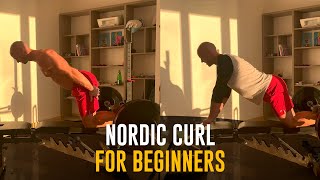
An instructor breaks down Nordic hamstring curls from basics to advanced, using a bench and squat rack setup. Start with single-leg pulls and bottom-position holds, progress to isometric pulses and explosive starts, and keep sets to 20-30 seconds. The exercise builds hamstring strength for sprinters and injury recovery.
Chapters
Long before I got my first strict Nordic, I was using this variation. Now, if you look at it, it looks just like a Nordic. I am building some momentum, but I'm getting single leg pull. So I get to test out the bottom position of the Nordic on both legs, individually and in isolation. If you do this exercise, you will realize that there is a significant amount of force being generated. Even though it looks relatively simple, this a great one for sprinters. Anyone coming back from a hamstring injury, to make sure that you're able to handle the tension, we could add weight to this. We could go even more explosively. We could work from a dead start in the kind of straight body position. All those small tweaks will make the difference depending on your goals and the positions that you want to dominate for your sport or your ambitions. So it's also really important for stabilizing the knee to be really strong behind the knee. We want to think about the hamstring. Hamstrings at the knee as well as at the hip. Now, looking at how we can get this done on a flat bench. So I'm in the squat rack here, barbell under the calves. You can work the bottom position for reps. If you look at this, there's not much angle there, angle change at the knee, but because the upper body is getting further and further forward, there's more and more tension going on to the hamstrings. Okay. So using a self spot to get through the full range of motion is another way to build yourself into the Nordic. So if as the further the head goes forward, the more tension there is on the hamstring. So even though the hips aren't moving, then the bottom position, we can work on pulsing that bottom position. These are nice, safe ways to build our foundation on the Nordic. On this one, I'm just pulling, pulling, pulling, trying to lift that bar up. Isometric, very, very small range of motion pulses to build the foundation so the body can handle the tendon tension that is needed for the full Nordic. Okay, so this is how we can start to build the foundations for the Nordic before we can achieve the full movement and we can train for higher reps. You can see that most of these variations I've been able to work for, you know, 20 or 30 second sets rather than sometimes. The way we train the Nordic is kind of all or nothing. And, yeah, I also did a handstand to finish my training session yesterday. So enjoy. Get your Nordic and everyone can start.