How To Improve Foot, Ankle and Achilles Strength Using ATG Principles
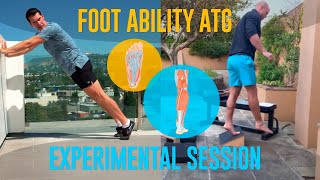
A guide to strengthening feet, ankles, and Achilles using ATG principles. Start with foam pad pumps, progress through short to long-range calf and big-toe work, then add slant boards and sled training. The key is building inner-range strength before moving to longer, higher-stress positions.
Chapters
Strong feet. ATG is all about building health from the ground up. So the first thing that we need to do, or something that I've been thinking about, is how we can put some more work into the feet. Now, the ATG program is already very foot dominant with the sleds and with the flexor halicolongus, calf raises and all the work that we do inside the ATG programs. But if there is an issue with the feet, if there is persistent ankle injuries or an Achilles issue, then we may need to put more focus into that area. So this video is putting some ideas forward of what that might look like. So the first principle would be to get a pump, get some work going below the area that is our main focus. So I'm on two foam pads here. What they do is basically keep the feet under tension the whole time. By having a short period of time on the pads, digging your toes into the pads, pushing onto the ball of feet, you'll get an intense burn into the plantar fascia, into the toes, also lifting the toes up off the mat, driving them into the mat. So we're getting as much pump strength work into the foot as we can. When we feel like the feet are about to cramp, then we're probably in a pretty good position. That's some short range work for the feet. Now, if we want to go more long range, full flexors of the big toe, you put that big toe under a big stretch. Now taking these off the ground, we can increase that stretch. We can also do raises onto the big toe. So now we're getting long range work for the plantar fascia. If you've had plantar fascia issues, and it's likely that this is going to make them worse or really challenge that area initially. So the long range work is the aggressive work that forces a lot of change. Now that we've got some work into the feet, the next step would be to go for short range. So this would be like the equivalent of the step up in the ATG system. We're using the slant board in the opposite direction. Now, this is not a lot of weight, but in this example, we're not putting the Achilles under stretch. And what that means is it's very muscular. We can get some work into the soleus without putting a lot of stretch and strain on the connective tissue. So when we do these sorts of movements, we generally go for higher repetitions and. We don't need to really max out in terms of the weight. But this inner range work allows us to get Work into the muscle, build the neural connection, Let the body know that it's safe to do work in this area and it can help us get to the mid range and long range work. So to go to mid range, all these exercises can be done in seated or in standing. Seated will be less aggressive. Okay. So progressing to just on the flat ground, that will make it more of a mid range exercise. You can get all the way up onto the big toe if the weight is light. As you progress through the weight, you may not be able to get up that high. But if you keep that intention and we'll keep making that big toe stronger and stronger, which we know improves performance as well. Big toe is important for acceleration, important for vertical jump. All right, so then we can progress to a longer range version. So you're actually getting into more of a stretch. You'll see with this one, I'm able to get the heel. Still able to get the heel down to the board. You can take that even further, increasing the angle to really get into long range. Still working to get up onto the big toe. The same progressions then can be done in standing, choosing which way to do it first so we can do short range. If there are issues in the area, then working on the short range before going into long range can make a smoother, healthier transition. Now, not everybody will need to go through these. Sometimes just going straight into long range work can get the job done. Simply strengthening the area, strengthening the calves can alleviate some of these issues. Doing the sled work alone, when we do reverse sled, if you look at it, you're actually getting that kind of inner range work for the foot and the plantar fascia. So a lot of issues in the feet do go away with the ATG system as it is. But what I'm putting forward here are some things that we might want to look at if we're not getting the result that we want. So if the issue is persisting, this is an expansion of how you could specialize for the feet or coming back from an Achilles injury, from an ankle injury you might want to check off. Okay, so then this would become more extreme range. If we're getting the knee forward over the toe, then that's really that aggressive position where Achilles tendons do snap. The Ziani calf raise, if we're getting into those more explosively, that's really the aggressive kind of work that causes issues. Achilles generally snap when someone's running backwards, so they're, they're running backwards and then boom, push off. They're Running backwards, but momentum is going the other way and that knees forward. So it really is like speed in that long range position. So that's why the FHL calf raise makes so much sense. But it's not necessarily the place that we would want to start if someone's coming back from issues in that area of the body. Some other food for thought here, because the ankle is potentially more complex. Now, some people will say, and I believe this is kind of a Poloquin philosophy of like, the legs are dumb and the upper body is smart. So you need to give complexity to the upper body. Because of all the possibilities that we have in the shoulder joint and at the wrist, we use more exercises and we have to give more complexity to the upper body, which makes sense. And I understand and it makes sense that the hips and the knees don't need complexity. But potentially the highest of tolerance to volume and level of complexity is actually in the foot. Now we don't need to be able to play the piano with the foot, we don't need extreme dexterity of the toes, but we probably may need more exercises. Now Ben's put forward a lot of exercises with the dumbbell strapped to the foot, which make a lot of sense. Kaduziani has come back from Achilles injury to be able to dunk again. He's a big fan of work on the slant board. So I'm putting forward that idea of using the wedge. There is work. I think it's maybe Gary Ward, someone. Ward, sorry if I mess up the name. You can let me know who that is if you, if you know. But there is work, you know, that's been done around sort of wedges and around the foot. But Katoziani for sure has had great results with using the wedge. So if you're doing step ups, if you're doing calf raises on these angles, then you're going to give that different stimulus to the foot and obviously to the tibialis posterior behind the shin bone, the peroneals down the side here. So I do think there's something to spending time on the slant board laterally. Probably want to have shoes on. The sandpaper is pretty rough on the feet. And the other one that I had for you is the use of the pipes of the rails in the. The Marinovic system. It's no longer available, but the Marinovic work is really interesting work to check out. They use a lot of pipes. You'll see in the Ido Portale system, they're doing a lot of rail balancing in their shoes up on high rails. It's not exactly the same concept, but the idea of using a thin pipe to open up the feet to stretch between the bones, probably something that we should be looking at. Also really good to put pressure into the plantar fascia. We're meant to be walking on rough surfaces, we're not meant to be walking on flat surfaces and cushions and pillows all day. So, you know, having feet that are able to do what our ancestors feet were able to do is probably a good thing to have. Like, it's pretty hard to argue with the logic of, well, we used to walk without shoes or with, you know, thin pieces of leather on our feet across all sorts of terrain. So our feet are actually used to complexity and they probably crave complexity. And when they've lost some of the ability they should have, there's probably a decrease in performance and in increase in injury susceptibility. If your toes are a bit stuck together, you can also use the toes to kind of use the pipes to leverage the big toe and the second toe apart. So, yeah, this is what I had for you around feet. I think that they're, for the most part, the feet are covered really well in the ATG system, but we may want to experiment with some more specialization for the feet if there has been a specific issue or injury in that area. Let me know what you think, Let me know what I'm missing and yeah, let's get stronger feet.










