If It’s Important Do It Everyday - Squat
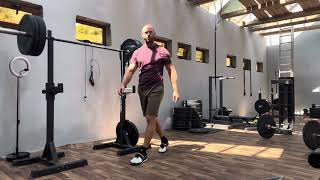
Two people discuss rebuilding squat strength after a fibula fracture and the practice of squatting daily when it matters. They cover specific programming like 10 sets of 10 on the minute, climbing from 70-80 kg, and why hard physical challenges matter for longevity and mental toughness.
Chapters
Last year, my big goal was to have a big squat. I put a lot of effort into rebuilding my squat back from not having a barbell for a number of months. At the end of the year, I broke my leg. Small fracture in the fibula. Nothing major, but enough to stop me from squatting. Even though I got back to my best, close to my best squats, I got to 145, 140 for 3, 140 with the long pause, kilograms. And now the goal is to get back to again. So what is your squat goal and how you're going to get there?
Personally, my approach when I get serious.
About something is generally to do it every day.
If it's important, do it every day.
If it's not important, don't do it. This is more of a life lesson than a strength training philosophy. You don't have to strength train this.
Way, but I'm thinking about getting back on that squat every day. Train like I started last year. End up doing some hectic squat sessions, like 10 by 10 on the minute. So 10D10, start a new set of 10 repetitions every minute. And I got up to 70 kilos for 10 sets on the minute, which was very brutal.
And then.
I had to go at 80 kilos.
I got seven rounds at 80 kilos.
I really wanted, like, near body weight.
For 10 sets of 10 on the minute.
That will turn a boy into a man.
That will transform you.
If you can take on those kinds of challenges, whether you complete it or not, it's a big experience. You go and fight the dragon. The 70 was actually a shock to me when I first started that challenge.
And I was getting, like.
I was.
Getting 40 kilos, and I thought, I don't know if I can get 50.
And then I got 50, and I thought, maybe I can get 60. Got 60 and then you got 70. A good thing was that I had.
Luke Carter with me.
Luke Carter is there in the Bali Time Chamber at the moment. He's recording a documentary about that Bali Time Chamber experience. The idea that Nico and I kind of cooked up worked on for a month while I was there in Bali with him. It's now come to life. That was only a few months ago. And, you know, now that they're having that experience, I think that documentary is.
Going to be really powerful. I think the lights may be better from this side.
But consider that idea. What if you did it every day? If it's important to you, should you do it every day? Maybe you should. Maybe you shouldn't. Give me your Thoughts Educate me in the comments about your approach. I would get extremely fired up and motivated by stuff like John Bros work and squat every day. Matthew Perryman. Maybe you've dived into some of that work. I looked at that stuff. 2016, maybe. I remember squatting every day for a while.
That's 80 kilos. So that's about halfway of where I need to be as a baseline if.
I'm hitting 160, probably don't need to have that much of a pause. If I'm able to squat 160, then that's a really strong base for the.
Snatch of 100 kilos.
I'm a big fan of the snatch. I think everyone should work on heavy snatch at some stage. And it's the most athletic movement. It's poetic, it's beautiful. It's challenging to begin with, like anything worthwhile, but you can definitely get it. If you get the technique of the snatch down, then it becomes about strength. Dmitry Klokov, the most famous, one of the most famous weightlifters.
He recommended that.
Most of us don't bother doing weightlifting because you're just too weak. And in the end, people talk a lot about technique in weightlifting, but in the end you do have to be crazy strong. And if you're not crazy strong, you're wasting your time to an extent. Now, I would still argue that probably a really good thing for a person as they age to maintain the ability to snatch. There's a Tim Ferriss podcast with a Polish man who moved to America. Jersey is his first name, I believe. He wrote a book around longevity and weightlifting. And he's got a really nice sequence and he talks about a 60 year old who came to him who's really immobile. And the 60 year old got to work on snatch. And the 60 year old went from feeling like a 60 year old and moving like a 60 year old to by the time it was 70, 10 years of dedication, he was actually able to effectively snatch. Now I love that idea. You get younger, you get younger and younger. As you get older physically, you get younger. At 60, you can't do it. At 70, you can do it. Takes away all the excuses for someone who's 20, 30, 40, 50. If you didn't start gymnastics and parkour when you're a child, well, start now. I learned to do a back somersault at 30. I took on juggling in my 30s. I first learned to do a handstand around 30. So if you're older than me, happy days. Get after it. If you're Younger than me. Happy days. Get after it. You're probably not 70. If you listen to this, if you're 70 and you listen to this, let me know. Beautiful. There's all kinds of things going on in my body. Telling me a story about this, telling me a story about that. The body lies. Get on with it. Dichotomy is important in one sense. Keep yourself safe, do your prehab, warm up, be smart for long term. On the other hand, just get after it. Bulgarians who John Bros.
Modeled off, they maxed out all the time.
They set up a competitive environment and they were able to beat the Russian giants, the Soviet giants. They set a new standard for the world in weightlifting. From a tiny little obscure country which is not far from where I am now. They had a small program, yeah, you can talk about steroids, but more than likely it was an even playing field. They set up a competitive environment where great things were expected. That's why we built villages, set up a competitive environment where great things are expected and see what happen. Starting to feel a bit heavy on the back.
Easy weight.
All right, 120 and it starts to feel heavy. All right. It is what it is.
It is what it is.
Wherever you're at right now, that's where you're at right now. Doesn't mean it's where you're going to be three months from now. If you squatted every day, doesn't mean.
It'S your destiny to be where you are.
So the goal is squat heavy so that I can snatch, heavy so that I can jump. And there's other ways to go about.
Jumping, but I want to go about it this way, come at it from the perspective of weightlifting. Being able to produce a lot of force with the legs very quickly. I love the gracefulness of the snatch.
If you want to build yourself a great life, start with building yourself a great body. Be able to do all sorts of things that others can't do. I've personally chosen to do all of the hardest things. Snatching, handstands, five ball juggling, juggling with my feet. These are the hardest things that you can learn in terms of training. Swimming for max distance, underwater, something I've played around with.
You decide for yourself what challenges you're.
Going to take on. But the more things you can do that are difficult for others to match, the more respect you will have. And even if it's not so you can be a coach like me and work with professional athletes, top coaches, it's still something that's going to help you with Respecting yourself and believing in yourself and it's going to help you to win the respect of others. Historically, you had to win the respect of others to survive. If you weren't a valued member of your tribe, then maybe they just let the opposing tribes take you or your.
Wife or your children.
If you're a valued member of the tribe, then you know if something happens to you, the tribe will look after your family. If something happens to you, other tribes know well there's a consequence to attacking that man. If you kill that man, then it's going to create a war between these families and those tribes. It's not meant to be every man for himself, that every man for himself doesn't work. No one does it in elite sport, no one does it in elite business. But the common man is more isolated than ever, thinking he's going to do things alone. This will be last one for today.
So make it pretty. Hey.
Yeah, that was all right. It wasn't disgusting.
I was a bit worried it was.
Going to be disgusting. 1:30.
Some would say that's disgusting for a.
Guy that's been in the gym for the last 24 years. But we continue.
We're not done yet.
The game has no end. It's an infinite game. Little broken leg last year, crack in the fibula. Okay. Knee gets sore when you get back into squatting. Back gets sore when you get back into squatting. Okay, good. Play on. More learning, more training, more patience.
Beautiful. Some back off reps.
What's the most consecutive days that you've squatted every day for?
What happened? It's as much about the mental journey as the physical one. That's 12 minutes. Most people have got 12 minutes, whether it's calling in at a local gym to get it done or buying yourself a rack and some plates like this. A few hundred bucks. Maybe get a second hand from someone who gave up, get it even cheaper.
Who would you become? We need more strong men. Strong men make good times. Become one of those strong men.
What's the alternative?
I got some work to do. You got some work to do.
That's the fun.
Let's go.










