Keegan Smith Experience #104 | Sebastian Coello
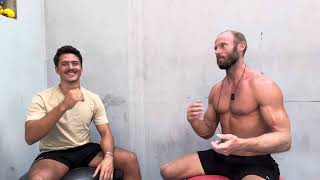
Sebastian Coello went from football to biomechanics after breaking both bones in his lower leg. His rehab showed him traditional physio wasn't enough, so he built a system around full-range strength, loading from every angle, and teaching the body to feel and move better.
Chapters
Sebastian was going to introduce you to his pussy, but we're gonna talk about biomechanics and abundance, why that's become a big part of how you train people, and then what some of the big ideas are. So it's been a big few days for me having you here. As I was saying last night, it feels like I'm a complete rookie in strength training after 20 years of being obsessed about this stuff. The things that we're doing are different and they feel different, and you talk about them differently, and it's fun. Like, it's great to have that new experience again. What is it that drew you to the biomechanics? Like, a bit of your background story is going to be really valuable to give context into when we jump into it.
Yeah. So I think it kind of, for a lot of people in general in the biomechanics field, it starts with, like, a huge injury. Right. Or for me, at least, it started with a curiosity in movement initially, where I wanted to become a better footballer, better athlete, better just. Yeah, well, athlete in general across different things that I was doing at the time. And then while trying to pursue football, I had a huge double tibia and fibular fracture that basically set me off the game for two years, roughly three surgeries. I was just in a state of needing to start again with everything. And then this was like, the first time that I'd kind of got introduced into the physio world, because before that it was all just, you know, football training, why am I going to use my upper body, why am I going to use my course? Just running, fitness, playing skills, all that. So got introduced into the kind of the physio realm of kind of rehab. Rehab and understanding that. And I got some really good results initially where I was just kind of focusing on, you know, one thing at a time with, you know, strengthening the glute, strengthening the hamstring, getting all that kind of down. And then what started to happen was I just got better initially, but then as I started to play football again and ramp up, I had a whole bunch of compensations that actually occurred flat from the surgery itself. Right. And that's where I started to a lot of the kind of techniques and perspectives that the traditional kind of physio realm kind of gave me no longer started to serve me, you know, in that. In that realm. But that's more from like the. The injury kind of start. Yeah.
So, yeah, you had big fracture, tip fib. You can see, like there's.
You still got a difference twice in size. Yeah. Yeah.
But then you had. What issues did. Were you getting?
Yeah, yeah. So when the, when the surgeon basically healed or put a titanium plate down the shin, the. Because of the displacement of the tibia, it was basically my. If you imagine here down, it was in half, Right. So the bone came straight out of the skin here. Femur, like, leg was literally out here. Right. And so when they had to put the tibia and the fibula kind of back in line, they had rotated it out kind of a few centimeters and few centimeters doesn't sound like a lot. But when you're running and when. Once it heals and your foot is literally changed into a different direction, right. The way your body kind of, I guess, works with that area completely changes.
Right.
So had the. Had the tibia fibula, and basically once it, Once it healed, I. And because of the rotation, my knee now had to change the way it was loading. My hip had to change the way it was loading. And you know, think about it like a domino effect. Once the, Once the foot would hit the ground, for example, now my knee was changing how it loaded, hip change how it loaded. And that started to cause a lot of kind of twists, turns, and pain in my. In my hip. So I had basically sciatica for about a year and a half afterwards. And. And obviously my perspective was like, why don't I just, like, work on the hip? I, like, keep strengthening the glute, opening up the glute, and. And then my knee would start hurting. Okay, let me get into, like, some knee flexions. Let me get, like, get the hamstring going. Let me get the internal and external rotation going. Let me get into some different things. I'll roll my ankle four or five times. Okay, let me, let me work on my ankle. Right. And. And what I wasn't doing was actually working on those kind of structures altogether and actually mending the relationship between how they're meant to work in space, in movement and. Yeah, that was kind of where I started to go down the rabbit hole of.
So when. When was the. When was this that you sort of realized that what you're doing wasn't really going to get you to where you wanted to go when you started to experience.
Yeah. So 16 years old and. Well, I was about to turn 17 when I broke the leg, and 18 was when I started to kind of do a bit of research. And it was around 19 years old when I started to really go down the path of wanting to become a better athlete and actually trying to break down more like what's Going on in movement.
Yeah.
Yep, yep. 19 years old. So I'm 27 now. So it's been a few years.
Yeah. And so cut into where you are now. I know you've dived into a lot of different rabbit holes and this is one that you've been really passionate about. Like spend a few days with you. I could see that you're someone who researches and goes deep on stuff and you remember stuff.
Yep.
What, what is it now? Like what are the biggest things that have changed, would you say, through that whole journey the last eight years, gone deep on this stuff?
I think, I think regardless of what field you're in, there's always that initial three to four years where you go so deep into it and you just constantly researching. This is if you have that natural curiosity, you're not there to kind of share information. You just like absorbing, absorbing, absorbing. Then the following four to five years after that is when those initial three to four years you actually start to remember and start to pick, put the pieces together. So I may have heard of a technique when I was in the like first two years of researching didn't make sense to me at the time. Right. And then that all that research could be even just the nutrition aspects, you know, to fascia and kind of hydration and how your body is in general, health wise. But then it goes into the movement and then you start to, you know, watch film of people moving, you start to watch athletics and you start to understand different movements are like gymnastics, watching gymnastics for the first time, like taking it seriously and going, how are these athletes doing this? But it doesn't make sense at the time because you don't have the tools and you don't have the, the, the nuance or working with people and seeing those patterns in movement until. Yeah. And then later down the line, that's when everything started to kind of make a little bit more sense. So. Yeah. So you were saying the, the process afterwards.
Yeah. What are the, what's, yeah. What are the biggest things that have kind of stuck with you?
Yeah.
So from going through all this.
Yeah, yeah. So the initial, the biggest things that basically I came to realize more from one thing was what I was reading and then what I was doing in the gym with clients. Right. And then the biggest things that stuck with me was number one, that the industry was obsessed with bilateral movement, bilateral lifts, you know, staying in that 50 meter, 50 centimeter, sort of square box, lifting up and down, moving, you know, bench pressing on a bench, doing a whole bunch of movements like that. And Then my movement reality was sprinting, moving, cutting laterally, doing a whole bunch of rotational movements that I just wasn't kind of strength training at the time. But obviously in my head I was like, okay, well if I just get super strong in these, it'll transfer over to that as an example. Right. I'll just get super strong. And a lot of it did like initially, like I got working on my legs and stuff. But the, I guess the main principles that, that started to stick with me when I started to train clients. I realized that number one, you need to be accustomed to experiencing what it is to load the body in different force vectors, different ranges of motion. So force vector being a directional force. You know, as an example, how my body works when I have to move forward, how it has to move back, how it has to rotate, moving lateral up and down. And the nuances and the kind of different, the ways that the body starts to self organize and movement in those different directions of force. Right. That's like key. I mean you can break that down 100 billion times but into different parts. But the self organization of the body in movement was one of the biggest things that fascinated me. Yeah, initially.
Yeah, it's a, and it's a big, that's what we've been going through here. It's a bit, it's a big statement. It's a big question of should we mimic the sport and is if run, you know, heavy basketball, heavy football, heavy baseball, is that how we get athletes to the next level? And I think there's, there's a component of that, like with javelin throwers and wonder chalk stuff is like, yeah, we should throw implements around the weight of the one that we need to compete. Compete with.
Yep.
But then what we're doing, what we've been doing here is a lot of this stuff, like really, really slow. And I feel like what we're doing is like a really slow weighted form of dancing.
Yeah.
And like I've been talking about this stuff for a few years of when you work with a break dancer or ballerina or you have an athlete that's done more dancing, they pick things up faster. And then what we're doing is getting in these positions and then you're making, you're asking for the micro adjustments that are the things that make dancing beautiful. It's like we're building that foundation to be able to make dancing beautiful. But it's for running, throwing, and, and it's like specific to that. But it's clearly strength training because it's slow. The Muscle burns. You can, you know, you can pump in those positions, you can go fast, you can go different speeds, but it's clearly strength training. It's just not just an expression of power.
Yep.
So, yeah, this. This foundational underpinning, that sort of ido portale and. And you know what I'm talking about with the dance, it seems like this is a different way of doing that same thing. Like, does that, like, does that make sense to you or have you thought about it in that way? Or what were you. What were you changing actually?
You know, when you see the dance, it's like. It makes sense. I didn't actually think about it like that way initially, but I mean, all movement is a dance. At the end of the day, it's just, you know, when you dancers do.
It well, that's the thing, like, where they. They have a lot of options and a lot of dexterity.
Yep. And it.
It feels like it's the kind of strength training that you were showing me that you're working with. You've worked with a few dancers and.
Yep, yep. And the kinesthetic awareness makes so much.
Sense that they would want this style of training that you talking about, because it's all about the execution of the micro movements in dance, whereas with the squat or a bench press or something, it's not about that. You're not making these little changes as you're doing the thing.
Yeah.
So it's.
Yeah, yeah, yeah. So actually similar to what we were talking about yesterday with, as you just said there with the dances and the movements, it's like a lot of. And you know how you, you know, when you look at a dancer and you look at a series of movements and how they're able to put it together. There's a lot in dancing that obviously if you. If you watch sports in general, you watch movement in general, you go, this basketball is in that exact same position. You know, whether it's like reaching up, you know, for a dunk, or whether it's like stepping to the side. And a lot of break dancers are in those kind of unilateral, loaded positions where they've got to rotate quickly and. And what dancers, I guess, do better than any other movers or any other sports. Sports is they have to stick to being able to transfer, like, for example, weight from the palm of the hand all the way to the other foot, you know, and then experiencing the body and its different ways of, like, working and fatiguing across the entire spectrum of movement. Right. So if you're going to do a cartwheel, you're going from your hands all the way to your feet. Right. But if you've got, you know, blockages in your body and fascia in your core and your stomach and your hips, you're not going to be able to do that, that. That cartwheel. Right. So obviously, the earlier they start when their fascia is malleable when they're kids, obviously the better they're going to learn those patterns and become completely automatic in general. And I think that's what. That's what a lot of this training can actually do. It's basically trying to reorganize movement and get you feeling the fatigue that you're actually meant to feel if you were a kid experimenting with these movements. Right. But you're not actually necessarily, you know, it's not like you're just dancing, you're actually applying this to more fundamental movements, which is actually another thing we were talking about yesterday. Right. Like, what are the. What are those certain, you know, four, five, six movements that you see in basketball, soccer, break dancing, you know, whatever it is, whether it's the bum, back, hip hinge, one leg in front of the other, as an example, or the rotation of the trunk, then, you know, the translation and the transition of your feet, for example, in those movements, as an example. I mean, we can break it down in a video going crazy with it.
But, yeah, it's not squat bench deadlift that are the fundamental three movements of, like, on a basketball court.
Yep.
But we're also having that discussion of, clearly, squat bench deadlift does have some benefits for some athletes some of the time. Neural development, tissue development, how much of the type of muscle being developed could be better if it was in other patterns and stuff, I think is very debatable.
Yep.
But the question of, do you need to be able to transfer this stuff? Like, is it something quite different to what you're doing on the field? There's no question of that.
Yep.
Will it be relatively automatic for some athletes, maybe.
Yep.
Will most athletes get some benefit from helping them to transfer that into this? Like, that seems like it's a pretty likely hypothesis. Once you start feeling this stuff of like, okay, I'm feeling this position, I'm feeling this position. Even the guys here were saying, like, yeah, I could feel it walking, like, straight after. I can feel. I can feel that something different is going on there. So some are saying, like, okay, let's scrap all the old stuff. Let's only do this. Which I see is like, maybe transferability stuff and maybe you can develop a foundation that. But it's still pretty new to sort of say we need to scrap.
Just stop everything in. Yeah, yeah.
The question is, like, the ratios of this stuff, how much atg, how much powerlifting, how much weightlifting, and then how much sort of go to functional patterns work. Yep, whatever. You know, this kind of biomechanical influence, and there's lots of guys doing it in lots of different ways. Just some of the brands that have got traction to then eventually have this outcome of like, feel amazing actually being able to throw. Sprint.
Yeah, yeah. I think. Well, we were discussing so many times in the last couple days, just about when and where some of these positions would come up. And then you realize there's actually way more options than you think there are. So in the example of a unilateral, you know, you're bringing your left leg in front, right leg back, and you're loading that front leg. Okay. If you. Let's just take. Let's just strip away, like, all movement. For all gym stuff we've ever done before, just strip it away completely. And the only thing we've got is our body weight. As an example, when we're in nature, walking, hike, we got to pick things up. We've got to do different things. There's all of a sudden, if you. If you strip away all the gym work, you actually look at the way humans move, and obviously lifting is a part of it. No doubt. Running is a part of it. No doubt. Walking, standing, sitting down, whether it's a deep squad or just sitting down on the ground, whatever it is. So these are kind of like more the positions, and obviously you can just go, well, yeah, like, that's. That's just the way we position. But we. Let's just train. We want to train in this fashion, for example, to take ourselves to the next level. It's like, okay, cool. But what you, like, think about for a second what we all do kind of in nature, and wouldn't it make sense to become really good at these positions so that when you do do all the other gym work, it's adding to those already. Like those patterns that are already automatic for you. You know, you were describing it a little bit better way, but. Yeah.
Well, the funny one was like.
Yeah.
When we're talking about the powerlifting.
Yeah.
Mark Bell talking about there's a point of no return once you've done a certain amount of squatting, certain amount of deadlifting, like that is built into your. Your hardware.
Yeah.
And then we'll toss out the idea of like, what about the opposite of that? What about if we did so much volume of athletic positions that that became part of the hardware? Someone who's not familiar with the biomechanics approach that you're talking about. I think the big difference, everyone's thinking, well, yeah, I do unilateral training, I do hip hinge, I do put my weight on the front leg, etc. One of the big things that struck me about the way you're thinking about things is that like 360 degree force production and like how, how it links together. So, yeah, you're talking about, okay, the weight's going to be on the front foot, but then in your mind all the different force vectors fit into that. And then what you're doing with the opposing limb, what you're doing with the rib cage, all can be variations of how we do stuff with weight on the front leg. And the force could be coming from here, or it could be coming from here, or it could be coming from here.
Yep.
And so it becomes something very different to like, I do Bulgarians, I'm sweet. Or I do split squats.
True.
It's a very different one way of looking at it. That's why my mind is like continually over this. These few days. I'm like trying to keep up, like, like learning a different language, trying to think about what is he even thinking about, what is he talking about.
Yep, yep.
So then, yeah, that idea of like, if you did enough of that stuff of like these sort of athletic positions at different speeds with different force coming from different angles, you maybe start to build this huge athletic positions vocabulary in your mind and your fascia that maybe whatever else you do, like you always got that like a dancer's probably always going to be able to dance.
Yep.
But they might not necessarily be able to produce a lot of force, will be strong in all of those different positions. So yeah, this is like the. That was a big, big thought of. Yeah. Maybe, maybe you can permanently wire that in. In the same way you can permanently wire in the.
Yeah.
Squat.
Yeah. We haven't been in the industry necessarily focusing on that, on actually going, what are the main movements that we've got to be good at? Not in the gym, but just movements in general. Some people have done a lot of hypothesis and, you know, a lot of testing and a lot of theories around that, but it's almost like we need to start seeing more results in that. We need to start seeing, okay, can we get someone who, let's just say a dancer, for example, right there There are some. You could. You could make the argument that, for example, some ways of dancing are better than others. Right. Why? Like, why would. What certain. Okay, so certain types of dancing may put your joints at like, more of a risk of injury in that moment. Right. So, for example, you're going to be on your, you know, you're going to be doing a whole bunch of flips and stuff. Okay. There may be some stage, you slip and it is what it is. Right. But still, if the fundamental is being on your feet, rotating, moving again, that the translation over to. Into other athletic movements is there, you know, in terms of that movement. But yeah, I think when you start to think in what you just said in terms of that 360, where's the force production? As you said, your mind starts to go, well, what are the movements am I doing that I can actually load different directions of force? Like, I've been doing the same movement in the same direction of force. But how is this going to feel when I start to load it, you know, with. In front of me, as opposed to a barbell, my back, you know, how's it going to feel if I have to reach the side? All of a sudden different muscles are working in the exact same movement pattern. You know what I mean? And that's. That's where. That's where a lot of people are going to find the therapeutic benefit of it. Because maybe that. That exact movement that they're doing is exactly what they need just in the other fourth direction, as an example. Right. Maybe that. Maybe they don't actually. Maybe you. You were as a coach, for example, telling them, hey, you need to be doing this. This unilateral ATG squat, for example, Right. And it's like the movement is exactly what he needed. He just needed it loaded from the other end of the. From. From a lateral position, for example, a lateral force. Because all of a sudden his adductor is actually going to be working there a lot more. He's going to be loading into that. But it's the exact same movement pattern.
Yeah.
You know, and that's maybe what he needed all this time, a bit more adductive strength, as an example. Right. He couldn't. His knee was bowing out and his ankle was collapsing and he was doing the front squats. He was getting a load of benefit in his quads, getting the hip range of motion, getting the ankle range of motion. But what he was missing was, you know, the different feelings of having it work in different directions. Yeah, yeah, A lot. There's a lot to It.
Yeah.
But it's fun.
Yeah.
Yeah.
And it's, it's, I think for, for any coach, like being able to unleash. Okay. This is a new way of looking at this. Let's, let's see where it goes. And the question becomes, what ratio between this. Different types of work am I going to do? Should I go all in on this? Should it be something that I do for, you know, percentage of my training? Is it a certain day of the week? Is it the way what I do before and after.
Yep.
The main lifts, like, I don't think anyone has the complete answer on that.
Because it's always evolving, right? It's always evolving.
Yeah. And you know, like, if I have to coach the world champion in shot put.
Yep.
They're going to lift some super heavyweight because everyone who's broken a world record in shot put over the last 50 years has had a super strong bench press. They've had a super strong squat. And maybe you're going to be the first one to coach someone who. You take that stuff out of their program and then they, they throw further. If that happens, then everyone's going to look and it's not happening and athletes are looking and maybe it's just time.
Yep.
But probably they need the integration as well. And if you, I don't know if you've seen the. Werner Gunther, the Swiss shot putter. He's pictures. His videos go up a lot.
He had a training video recent with the.
No, it's like 40, 50 years ago.
Right.
Dude, he's got a bit of a mullet. He's training in Switzerland. He does a lot of like Aussie. Yeah. He does a lot of integrated movement stuff as well as like super heavy lifting. It's a really beautiful training paradigm and stuff that. Yeah. That they show sort of this whole big picture of what, what builds a champion shot putter. And there is, you know, this element of like the skill developments, not just squat, bench, deadlift plus plaque, practicing in sport, like there is. There's a ton of integration stuff. Stuff that they're putting in there. So, yeah, I think the fun is in working this out and I love that you're bringing this opportunity to the network and to more people in the world to, hey, let's explore this. You're not married to any one Dogma. You've done a heap of atg. You've done a heap of traditional strength training as well and you've got different movements. Like, we've done this, the pressure breathing. We've done these core Exercises with the barbell that are heavy and clearly, like there's a lot of phys. There's a lot of force in the movements.
Yep.
There's. It's not like dinky little pink dumbbell stuff. Like, it's brutal.
Yeah.
You know, you've thrown around the 24 kilo kettlebell like it's a paperweight. You know, you make it look like it's eight kilos. You've lifted the heavy sandbags. So like there's, there's all, there's all these different traditional tools as well as doing things with the, the cable machine and these really slow movements that I've never tried before myself. And they absolutely lit up my particularly right glute and that, that chain where I have had the issues. So, like, I've got some personal experience of it. I've seen you working hard with this. I see that you're able to do things that a lot of guys in the gym especially, like no warming up. You're just jumping into things and showing things that shows that there's, there's health in your system. So I'm excited to explore it more with you. And it's good that we, you know, we're going to go on this journey together, showing some other people the foundations of biomechanics and open the discussion and let's, let's stay open to. We haven't solved it all yet.
Let's be.
Yeah.
I mean, having people like you as well and the other guys here just like actually open to just trying it out, that's like the most important thing is, you know, there's more to, there's always more to learn. And as we said, as you said before, it's not, it's not set in nothing set in stone yet, know, constantly evolving and the systems will get, you know, more refined and people will start to see what is actually like giving them results when they start to try things and start to discard what isn't giving them results. Because, you know, at some point everyone has their own individual, like biomechanics. Right. With that. And if you can go deeper on that, like the world is your oyster, really, you can, you can do so many more. So like the athletic potential if you are stuck in like one direction, for example, and once you discover that there's so much more to movement than just what you're doing in that moment. I mean, I mean, think about, think about the potential for that.
Yeah, yeah. And the ability, the thing we didn't touch on is like the ability to deal with the tough cases and the tough issues, like, that's what you. You love that you thrive on that and that's what you're priding yourself on with this system of like, yeah, the people are really messed up that think they're never going to. To sprint again or they think their spine's permanently not going to be in a good position. Like, you've got strategies that are helping that stuff, which is pretty cool as well. And like something that I haven't personally. I was like speed, power, force, production athletes. Yeah. But not like the tough cases was like, that's someone else's stuff to deal with. And they probably weren't even in the system to start with any of the kind of some of the people that you're talking about.
Yep.
But. But if they were and they had those issues, it wasn't my thing to deal with and I didn't know how to deal with it. And so getting into ATG has given me the confidence of like, oh, now if a player tells me they've got patella tendonitis, I'm not just going to tell them, go the physio or toughen up or, you know, let's just go slower today.
Yeah, yeah, yeah. The pain is in your head.
Some stuff. Yeah, I've actually got some strategies of like. Yeah, yeah. I used to deal with that as well. Here's how we're going to get over it.
Yep.
And this feels like another door's opening of like I could pack. Potentially help other people with other stuff.
Yeah.
So, yeah, looking forward to the journey ahead. Appreciate you coming here to Montenegro.
It's been awesome sharing with.
With myself and with the guys and.
Yeah, I feel recharged as well.
Yeah, yeah. Having you go here with the children, everything's been.
Yeah.
Fun as well that they've had. Had a ton of fun meeting her as well. So.
Yeah.
Thanks for coming. Looking forward to doing more events next time we'll have to formalize it, but.
Bit more for sure. Yeah, we'll go deeper on it, but yeah, absolutely. Good stuff. Good stuff.










