Klokov Inspired Squats To Max
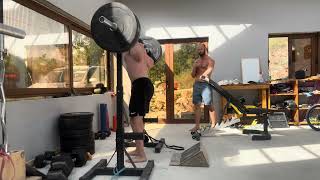
A front squat into back squat pairing using 5 kg jumps to build strength and rack up reps. The coach walks through tempo cues, warm-up structure, and program variants while coaching someone named Kev through the session.
Questions this video answers
60 kilos
5 kilogram jumps (total weight)
About 85%
8–10 warm-up sets (Poliquin recommendation)
If you go over 12 warm-up sets you are likely to get an artificially low reading of a max.
Chapters
All right, so it has to be a game. That's the trick. If it's not a game, you're probably not going to come back to it. It's probably not going to be fun. Strength training should be a game. That's how we started. Dense Strength is in gamifying strength training. So you always have that feeling of achieving something within a session. There's a few different versions of dense. Today we're going to be using the ramping version. So we're going to go front squat, into back squat, 5 kilogram jumps until it's not time to jump weight anymore. So we're going to stop when the quality is still higher. This is a good way to practice movement. Get a bunch of easy practice in, which is very valuable. And then you also get a test, you also get a score. So starting at 60 kilos, and then we're going to ramp it up. Okay, it's in the heat or something. Yeah. Cool. Yeah, we can just look at a timer on the, on the, on the phone. All right. Technical difficulties with the phone. So earlier sets, earlier reps are a good opportunity to practice whatever technique you want. If you want to do pauses in the mid position, if you want to slow eccentrics while the weight's nice and light, you can develop more skill to develop your weakness. Eccentric pauses are easier than concentric pauses. If you pause on the way up and then you have to go again, really teaches the body to be able to re accelerate the bar or to be able to grind. So, yeah, five kilo total weight. So because it's standardized, that's why it's a game. But it's not simply a game of, okay, how heavy can I lift? Today you're accumulating repetitions within the process. So you're practicing as well as getting a number. That's the style of training that makes the most sense to me. Using it with pro athletes, they like buying into the game. They're used to playing for numbers. They're used to playing to win. If there's no scoreboard, then you don't really play with full intensity. If there is a scoreboard, you're likely to play harder. So this one's going to give us a score. What do you think you would get if you had to guess? Depends how familiar with repeat effort training you are. If you're used to long rests, then you might be a long way from your 1 RM or front squat. But if you're familiar with this type of training, if you're used to this type of training, Then it shouldn't be too far away from your one rep max in the front squat. Some people might actually squat more than they've squatted before. It was because of the fact of nice long warm up on the Poliquin system. They recommended eight to ten warm up sets. So we'll see how many we end up with. But 8 to 12, somewhere around that range. If you go over the 12 you're likely to get a low, an artificially low reading of a max. If you go under 8 then you might get a low reading as well. Our objective isn't only to get a good strength number. Our objective is also to get that training effect. That's where it's best of both worlds. I mean playing around with the dense X as well. Just built around going for maximum repetitions on your final set of dense. This is something we've used a lot. Even with the 10 sets where you go for maximum smooth repetitions on the last set. It's a good way to judge how much more you've got left in the cycle. But it's also, you can also do it with more, more emphasis on that one test set and staying, staying fresher, using less time. So that's what the dense X is. And writing that up again. It's Kevin. So the intensity should just gradually start to sneak up. But there's, there's not much real challenge this way. Challenge is more so getting the two reps done plus the bar speed change. The weights. It. £85. Just under £190. 187. It. This method or concept of going straight from front squat into back squat. First saw from Dmitry Klokov. Not sure where he saw it from, but you're getting a bit more of a skill stimulus. The back squat should always be pretty easy compared to the front squat. Generally the front squat will be about 85% of the back squat. So we should find the. The back squat is always quite easy even though we've just done the front squat. So there's an element of pre fatig. We're just behind the clock. It's tough to get to on the same. Still, still plenty dense. All right, 100. It. Kind of doesn't gives the ego a little bit of a rest because it's not going to be a true one rm. And you're looking to really maintain quality build to something that works for the day. But yeah, tons of practice. If you're doing on your own you could do it with more tempo as well. Sticking to the tempo. You could Also start higher. If you wanted more average intensity, you could start higher. So you start at 80 kilos, 90 kilos and go two and a half kilo jumps every set. This is a pretty good way to really warm up gradually into it. Certainly some fatigue accumulated now. Strong. What are you thinking, Kev? Yeah, it shouldn't be. Shouldn't be feeling cold at this point. So legs were good, but position started to be lost there. That'll do for me. One of the ways I like to. Here we go. Nice. One of the cycles I've done to get my front squat up was to do five singles. Started at 100 kilos, five D1, five singles on the minute, and then went up two and a half kilos every session until I got to 120, 125. And that pushed my front squat to a new level. So 130front squat@ that stage. And that was just around also when I snatched 100 kilos. So pushing up the quad strength and the ability to have that knee, knees forward squat is a good way to get at it. And a simple application how simple strength gains can be. Again with that 5D one at 100, it was really easy. And then it slowly creeps up on you session after session. You don't really need to do the hard ones. I probably should have stopped that cycle at about 115, but yeah, I ended up going a little bit further and didn't hurt myself or anything. But you really don't need to do the more testing reps or ugly reps. You're on your own now, Kev. I can go back squat off to you. Oh, yeah, yeah. So going for a new best after all that. Pretty solid. But yeah, he might have grounded out. The thing is like, I. I don't. There's no real benefit in grinding it out unless you have to hit that number for some reason or if you know, you know, you know you're safe, you know you recover well from grinding, but generally it's just not worth. Done for the block, done for me. So simple, simple workout. Good way to get a bit of an idea on where you're at with intensity. I know that my squats aren't as good on the heavyweights as they will be would be could be have been. And that's, you know, a way to see where you're up to, but also to develop it. So I know that from today's session, the next weight will be. Next time I do this, it's going to be better and getting some practice with decent intensity. But yeah, capped by the style of the session. So better to tap out in the way that I did. Definitely feel the position change. Need to work on more positional strength in the front squats, so slower work, more pauses and some higher rep stuff as well. Please ask with any questions. Let me know how you go if you give it a shot yourself. And yeah, till next time.










