Living with and beyond back pain - Ashleigh Gass
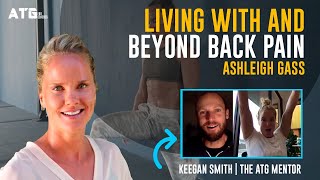
Multi-speaker YouTube interview (transcript) focusing on lived experience of lumbar disc pathology and recovery. Keegan recounts early athletic background, progressive degenerative changes at L4–L5 and L5–S1 discovered at age 21, an acute event in his early 30s from a fragmented 7 mm disc that wrapped around the S1 nerve root causing S1 dermatome loss and drop-foot–like symptoms, an outpatient neurosurgical decompression, and a multi-month to multi-year rehabilitation involving progressive training, manual fascial work, and gymnastics-style mobility/strength. A second speaker describes her own herniated discs (L4–L5, S1–S2) from 2014 and recovery using ATG and mobility. The discussion mixes clinical detail (MRIs, nerve conduction tests, reflex losses) with practical rehab advice and reflections on training culture.
Chapters
Yeah, I'm just curious what your injury was and what your kind of story is in regards to that injury recovery, how it went.
Yeah, just give you the cliff Notes. So it wasn't like a one time injury. So I was an athlete growing up. I was gymnast for like the first nine, ten years of my life, and then kind of just took on everything, including weightlifting, and was very kind of aggressive with all of it on my own. And I was, by the time I reached 21, I mean, I was just in chronic, my back hurt all the time. And I went and got the MRIs done because that's really all anyone knew how to do. Let's get this kid an MRI. And at 21, I had severe degenerative changes at L4, L5, L5, S1, multiple fairly significant disc bulges. And then on the right side, L5 and S1 never separated. So that's called a fusion. Fusion on the one side, which may or may not have had much to do with why those segments were degenerating that significantly at such a young age. I'll never know that. No one will ever know that. So I was like, okay, fine, you know, big deal. I just, if I, I was a collegiate athlete, so when I had to put my shoes on, I, you know, I go through phases where the pain was tolerable and then it would be not tolerable. So I would just like lie on the ground and put my shoes on and go train rather than have to bend over to put my shoes on. Like, I just, I didn't care. I was like, I was that, like, that stubborn about it and just went through like over from age, like 21, when it was first, like known what was going on in there through to my early 30s, I just did it all anyway. And I'd spend a bit more time stretching, rolling out on lacrosse ball. No one really knew what to do from a manual standpoint. Sometimes I'd get an elbow in the piriformis, if I was lucky, hands through to psoas. And you know, early 30s, I started to experience phases of like, numbness down the, down the S1, dermatome, a little bit of drop foot here and there, and I was like, oh. You know, I would text a colleague and be like, oh, my foot. And they're like, I'd be like, I'd be, you know, it would always be fine in a week or so if I just did things a bit differently in training or spent more time rolling around on the lacrosse ball. I was always able to like, Maneuver my way out of the next level of I don't know. Shit. Sorry. We're putting up a Christmas tree. It's not my specialty. Derek's like, do I put the star up? I'm like, I don't know. Do we have to? Fine.
Christmas in Florida.
Yeah. And so the degenerative changes had just gotten to the point where there was just. It was just a bit of a shit storm. And I think I was 33 or so, maybe 34. And I was just working with clients one day. And this is, you know, I had been competing in all the stuff. And I went home one afternoon, I was getting out of my car and I was like. And like, that was it. I just felt like I was going to puke. I had to crawl up to my condo and I was done. And like, I had had a bunch of those episodes over the years where the disc would just, you know, it would just shift a little bit more and compress upon a nerve. And I'd go down but two or three days and I would cross ball and, you know, lots of body weight, lunges, just to keep my glutes active. I would always come out of it. Always come out of it. Not this time. I called the do friend of mine. It was like an afternoon. I finally made it up to my condo. I'm like, I'm in trouble. He came running over with an injection of lidocaine and a bunch of other stuff and just got the injection right into like L5S1. And, you know, I was. He was with me, sitting on the floor. I was crying. I was hurting. And a couple of hours that injection kicks in and I'm like, okay, I think I can. I was walking around, I'm like, I think I'm going to be okay. And that night, it was just the whole. The night was just my entire. The dermatoma vest one feeds like, the lateral glute, hamstring, lateral calf, Achilles reflex, and the foot. So that night, as that injection wore off, it was like a neurological, like, shutdown. It was the weirdest thing I've ever experienced. It was a mix of cramping and, like, the nervous system on that side down my left leg just going. And midway through that morning, my foot was numb and I was like, fuck, this isn't good. Like, it was really numb. And I went, what did I do? I trained. I did pull ups and chest press. And I'm like, so I really wasn't in pain anymore. But my. As the day went on, foot numb, calf numb by the End of the day, my. The whole S1 dermatome was like. I'm like, I think I have dropped leg. So a couple of days went by and I just. I kept training. I would have to, like, watch my foot doing lunges so that I didn't fall because I couldn't. I couldn't feel it. It was numb. Bye, man. See you. And I was talking to my colleagues and they're like, yeah, this doesn't sound good. Get on some prednisone. So I got on prednisone and a prednisone pack that wrecked my GI system. So I was only on that thing for, like, a day because the first step was trying to calm down the inflammatory process that was obviously going on. And I just lost the ability to walk properly. It was like I had a broken ankle. People were asking what was wrong with my foot and ankle, because I. That when that dermatome goes and it's numb, you can look at your hand and your arm and you know that it's there, but you can't use it. Like, you. Calf raises. Like, no calf raises. No. Like, I would support myself and force myself to do calf raises, but no. Worky, worky. It's like a fake paralysis almost. So that was. That went on for a couple of weeks before, honestly, before I started to really take it seriously, because I had always bounced out of it. Finally went to get an mri and my colleague was like, you know, it was a 7 millimeter disc protrusion that had fragmented. And so the pieces of the disc had actually broken and wrapped down around the S1 nerve root, which is why I lost the S1 Dermatome, because there were pieces of a disc wrapped around it. So the neurosurgery wasn't to get me out of pain. It was to be like, if we don't get those disc pieces off the S1 nerve root, you're going to. Not only are you going to lose that nerve root, but you're going to lose the neurological function of your left leg probably forever. We're not even sure that you're going to get it back, but you need a neurosurger, like, a consult, like, tomorrow. So that's the short story. And then. So I had neurosurgery got the disc fragments pulled off, and I had surgery on a Friday afternoon. It was an outpatient thing. Surgery was very easy. That wasn't complicated in any way. And the neurosurgeon's like, yep, went in, cleaned it up. No one knew what was going to happen from there. And I was training by Monday morning, I couldn't feel my legs. Still, that took. It took me a good six months to get that feeling back. And because with the nervous system, it takes the nerves about a millimeter a day of growth from L5s1 down to the Achilles reflex. That's a long journey. So, you know, I'd lost the sciatic nerve. No, wasn't involved at all. It was the S1. It was the S1 dermatome. So the S1 nerve root comes out of the S1 out of the sacrum.
Yeah.
So it's the whole lateral line. The sciatic nerve really wasn't involved much at all. So what happened is the tissues in my leg, I lost a good 3 inches off of most of my calf. I still don't have an Achilles reflex on the left side, but it doesn't actually inhibit my ability to run. So it was just from there, it was just a step by step rebuild. I never stopped walking. I would strap my foot into a bike and make myself go bike riding. I made myself use my leg and. And forced calf raises, even when I couldn't do them, because I knew that one day I was going to get my leg back. And sure enough, it was probably about four months after neurosurgery where I woke up in the middle of night, my left calf was cramping. And I was like, yes, because a cramp means it's coming back.
Feel it again.
It's like there was a reboot of the whole left side. And then I discovered gymnastic strength training via Rob Wolf's podcast. And I just went after rebuilding my spine from a mobility standpoint because I knew never trained flexion, that was always contraindicated. And I bought into that because it hurt. So, you know, pain, I bought into it. That's the short story. So that was neurosurgery, I think was in probably. That's probably seven years ago. And so my back's amazing. Like, my back is probably better than anyone's back that we work with here. The stuff that I still struggle with, but I'm really getting to the bottom of now, are the fascial lines that just when I lost the reflex and then I lost the tibial reflex and I lost some of the. I had all these nerve tests done, nerve conduction tests done, so they could actually conclude what reflexes I had lost. And it was the majority of the ones on the left side. I had to rebuild that. But then the tissues are weird because the fascia line just Kind of go like everything just sticks together like glue. That's been the journey that's been the most eye opening for me is actually finding the right combination of training and manual work and just getting into those tissues with anything like edges of benches, edges of barbells, just open the lines up so that when I do things like running, the response isn't just my leg turns to cement the next day, which was exactly how that went for a bunch of months. Drove me nuts. And now I'm actually at the point where that's resolving itself and I'm really, really getting back to full sprint capacity without paying for it in fasc. And the whole line's freezing up. So that's the story of that best journey of my life. I wish it hadn't happened, but if it hadn't happened, I just would have been pigheadedly doing my own thing.
Yeah, every injury is an opportunity to learn, right?
Holy shit.
Yeah, yeah.
So, yeah, I was one of those people growing up that made fun of people with back pain. I was like, why is that person crawling into the clinic? They must be wimping.
Like, I, I Similarly, I had two herniated discs, L4 L5 S1 S2, pretty common, but. So it's similar kind of story, just way less severe than yours. But I was a regular in Cairos and acupunctures, physios, spent thousands of dollars on stuff and, you know, it would be temporary band aid, heel and then I'd go train and it would be two weeks back where, you know, sleeping was hard, everything was difficult and, you know, I was pretty young. That happened to me in 2014, so 23 years old, similar to you at that time. You know, training was difficult. I didn't really know much about anatomy or, you know, how a spine operated. I was very much afraid to bend my spine. I was told not to round my spine. And it's funny how that's so like. Yeah, it's funny how it's becoming mainstream now. You know, a Jefferson curl, you see it on like every mobility page. And it worked for me. And you know, in terms of training all my physios in kairos, they were kind of telling me, you know, you can't fix it, it's going to be with you for life. You're never going to be able to restore your athletic potential. And I was like, I never really believed it. I never really liked anyone telling me anything. Like I kind of thought it was bullshit. And I was like, I got to figure something out. So, yeah, then I just started doing my own studies and through atg, like that's what kind of helped me. I won't say, like, I won't give it all the credit, although it is wonderful. But like it helped me maintain or, sorry, regain like lumbo pelvic control. Like my back, my back injury was like. I'm sure you could agree that it's just like a breeding ground for inflammation in like your glutes, your thighs, your hip flexors. Blood was not going to that area and I didn't really know how or, or where to start and definitely helped me a lot and yeah, love it.
Guys, I would love to. I've got a call I need to jump on. To be continued.
Yeah, Keegan, yeah, great, great, great connect. And yeah, next time we'll dive a little bit deeper again. And yeah, I'll put up the recording for the other time as well with the back one as well, so people can dive into that. But yeah, looking forward to it. Hopefully see you in April, but we'll chat for sure before then.
Yeah, thanks for your time, guys. And I'll confirm when. As soon as I book my flights to. To get to la. I'll let you know.
Perfect. Yeah, good to see on.










