New Leverage Athlete
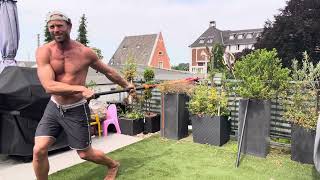
A coach teaches rotational training for athletes using rope flow, light weighted bars, and bands to build spinal mobility and trunk-driven power. Start light with 1-2 kg bars and doubled bands, focusing on anti-rotation and counter-coil patterns. The work applies to golf, baseball, boxing, and combat sports.
Chapters
Rotational training became a bigger part of my training when I started to do rope flow. Initially, I probably wasn't driving it that much from the spine, but as I practiced it more, I could feel my spine moving more and I started to explore more of what was going on with functional patterns. David Weck these other alternative approaches. People have been talking to me about spinal engine theory and these ideas for a couple of years, but I hadn't really bought into it. The road flow is a good way to, to start and to feel the spine loosening up. And then you realize like, you can, you can do those same sorts of movements without the rope. And then rope becomes its own thing, which is a cool thing and I'm quite into it myself. But not everybody needs to be doing rope in the way that people who love rope flow are doing. If we start to use that figure 8 pattern, just make figure eights with the bar on the back, we can do them forwards and backwards, do them with straight legs. We can do it with split stance. It really does use the spine in the way that it's meant to be used. And you will feel some creaks and cracks, especially if you get into more thoracic extension and play with these movements. Play with it in a little bit of side flexion. And these bars that I got, this one's one kilo. I've got up to two kilos. Not heavy at all, but it gives you the opportunity to play where if you had a barbell on your back, you wouldn't be able to get like this kind of speed and smaller movements. I think that the barbell, the, the rope is a great place to start. But then working into some more of these movements and thinking about leverage, we want to be able to execute these big rotational movements at high speed. So here's a one kilo bar. And thinking about it like throwing a fishing rod, it's also a bit like a baseball pitch or lacrosse. But then you can also play that opposite side of shoveling the dog over the fence to the neighbor. And you see that you can get to high velocities with this type of bar. Then you can pulse in those individual little spots, driving it from the, not the arms at all, from the trunk. Find those positions, end position. These bars are very versatile. I was looking at it with golf. I saw there was one golfer who pointed the club down at the ball. I don't know if I could hit the ball well from that position. I don't know if you can either. Let me left handed, right handed. But Thinking about that mobility, You can feel your spine open up. But you're also going to get some strength development through those positions. But baseball positions, playing with the reverse rotation as well, the recoil, the counter coil. So if we, if we counter coil coming into the, into the swing, we're going to tense all of that connective tissue fascia. Little tendons between the discs in the spine generate that rotational speed. You get some grip work. You get a feeling of being more athletic as well than a lot of stuff that you do in the gym. You never get to these kinds of velocities. Holding onto the bar becomes its own thing. Working into the forearms. I like using the bars like that as well. Leverage. Thinking about it as like a sledgehammer. Big circles, fast circles. You can use it in those leverage game ways as well. Similar to a baseball bat. I don't know what a baseball bat weighs. Guessing it's less than a kilo. And then these go up to the 2 kilos. So you're getting a bit of that overweight stimulus. One of the other big things that I want to show was then turn that into even more leverage. This is the 2 kilo. As soon as I attach it here with the bands, then I'm getting a bigger resistance component. And I can still go fast or I can go slow. And it starts to look like some of that functional patterns stuff. You're getting an anti rotation stimulus. You can take the pressure off, letting my arms come back, put the pressure on and then those little micro movements again, driving it from the trunk. Thinking about pulling this shoulder back as the other one goes forward. So we've got these lower positions. This is a bit like a hockey, hockey player, hockey swing. Too much tension. But you can get creative with it. Lots of different positions. Then you've got that over the shoulder. Type 1 like lacrosse or casting a fishing rod. The good thing about that is because you're getting the leverage away from the body. You create so much rotational torque. You can make it a lot heavier by taking it further away from the body. Then you go the other side of the body. So I love this tool of leverage. If we could quantify it a little bit more, it would be even better. But regardless, it's helping us to work. So these rotational muscles, you'll see some of the wrestlers, judo players playing around with these kind of bands. I'm a big fan of them. You can get thicker ones than these. I usually use them all doubled up. But you can do lots of stuff in rotation with these lighter bands as well. Over the head is going to make it more intense, bring in more of the obliques. If you think about a lot of the great stuff that happens in sport, it's happening through these movements. Some people will tell you you don't need to train them in the gym because when you swing the baseball bat, when you swing the golf club, just a basic strength program will make difference for a baseball player or a golfer. This is true. But if you're not playing golf or baseball, then you're not getting any of that kind of stimulus. And then when you do it, it's not going to feel good for your back, for your body, because you haven't been doing it. So we need to be rotating our spines. And if you just go and play golf, you're probably only going to be hitting that bottom rotational pattern and you're only going to hit it from one side. So this is my opposite side. Try and get the round to that point. The club at the floor thing, this is a lighter one. This one's just plastic. Weighs nothing. I don't know what it weighs. It's 100 grams. So you got left to right, right to left. But then you want these other swings. So I would recommend bringing some swinging and just start with just nice and smooth, like as if you're just playing in the park and you're just hitting your boy some catches. Don't go crazy. If you do go crazy, you might get really sore with it, but that will also show you that, okay, these tissues are not prepared for this. If you've been training and you get really sore like that, it's like, okay, well, my training is obviously not helping for that kind of thing. Think about just being able to hit the ball to your son. I think I'm actually better with the reverse grip on this side. Practice that a lot more so they can be easy swings with no weight like this, you don't have to go all the way to the edges. You can stay more in the middle. This rotational training, leverage training, it's got a place it's needed. Functional patterns have used a lot of it to correct scoliosis and fix rib position, shoulder position. Super interesting work and they've got lots of really great results. They're getting results with giving people back athletic gait and throwing pattern. Don't think it's the best high force production system, and I think there's a reason it hasn't been well adopted by athletes, is because it's not very effective for producing athletes to produce a lot of force. It's been around long enough now that if it was going to make athletes champions, it would have helped a lot of athletes to become champions. And you know, they're there, they're continuing to evolve and it's a great system in lots of different ways. They have had success with different fighters and lots of different people. But I think they would have got more mass adoption if there was a bigger. If it was having a big enough impact on existing athletes. The best results and the case studies they're most proud of are with people who are disabled or have really bad spine problems. And those stories are amazing. Also with the WEC method, you know, the coils in these positions, it's being more accepted that it has its place. The question is just how do we train it? How do we quantify it? Where's it actually going to go to? And I think there's still a lot of evolution to come with how we train leverage. You see functional patterns doing a lot of this type of work with their cable machine. They've created a cool cable machine to be able to do more of this horizontal type loading because I think they're quite opposed to actual loading, which makes sense with delicate spines and the background of the system. But there's going to be more tools coming to this realm. We're going to continue to evolve it. If you haven't really got into it yet, I would highly recommend getting into it. Getting. Getting into the infinity pattern. I was just watching, been doing a lot of research on Japanese athletes. Just written a little book about Japanese athletes. A little guide, a lot of the videos I've been watching. There's a young or not so young, but a light boxer there who's knocking out a lot of fighters in the lightweights. Undefeated 25 fights. And it's really, you see when you watch, it's really this really fast trunk rotation. It's not that much to do with the arms. The mass in the arms just can't produce what's needed there. If I punch with my arms, I'm not going to be a good boxer. It's going to be a bad day. But if I can load up the positions. I was watching also a little bit of Mike Tyson, Mike Tyson clips. There's some shorts. And you see he's able to land in these loaded positions. It's all this trunk shoulder rotation coming out of the hips. Bam. And so if you haven't been doing that, it's not going to be there. If you have been doing that, then, yeah, your power cleans and your bench Press might do the job. They help the nervous system, they build bigger muscles and there's a place and there's a logic to why traditional training has worked. It was applied a lot to athletics, where it's really simple. The 100 meter runners, the short putters, etc. They can use weightlifting techniques and bodybuilding techniques and get results. But more complex sports, you see there's more and more certainty that these off center type of movements, whether using sandbags, throwing medicine balls, throwing kettlebells, it's been done for quite a while. But we're getting more quantification of it, more science with it. I would encourage you go deeper, apply it, play with it. Doesn't have to be high force to begin with, Work with it where you're at. But this, this infinity pattern from all different stances. That's where sport happens. For me, a lot of game is about opening the thoracic. If I'm going to be pitching, pitching from, I want to be getting down. Here is open, getting down and open into the. I'm throwing with my spine. Hope this helped. We're going to go a lot deeper. How to systemize it, which patterns to look at, but you can see some there. Bottom, middle, top, backwards in all three. Backwards, backwards, backwards, top, different stance, right foot forward, left foot forward. If you're going to play hockey, you need to be able to hit off all the different stances. You hit off the parallel stance, hit off the front foot, hit off the back foot. So there's always that big play element. Being able to do it like athletes from lots of different sports and you build a bigger base. Hope this helped. Please ask any questions. If you're a master of this and there's something that jumps out at you that I need to learn, send it to me and I'll get into it. Appreciate you. Let's keep going to the next level as new athletes.










