Nordic Curl, Back Squats, Building Rugby Bodies 🏉 | Squat Everyday 8
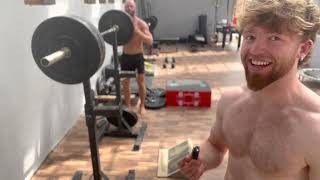
Coach Keegan and rugby athlete Kevin Elwood work through back squats and Nordic curls at a Montenegro camp. They discuss whether to build mass for rugby or stay light for speed, and Keegan shares a nutrition protocol his team uses for rapid weight gain.
Chapters
So we've got special guest Kevin Elwood in today. We're likely to test the 10D one on the back squat here, warm it up, see how we go. Kevin weighed in 75 kilos today, day one of the camp. I think he might add some mass while we're here. We'll see how we go. Yeah, we'll be showing a little bit of what it's like training with the uncommon system. And yeah, you'll meet Kevin as well. He mostly likes to speak in Spanish and Portuguese at the moment, but. Yeah, maybe you can introduce yourself. Kev.
How's it going, guys? Kevin from Ireland, first or second day in Montenegro? Village day. And I think the POA today is back squats and we have Nordics.
Back squats. Nordics. I mean, playing around with some juggling. Yeah, we'll have to see how the sound goes when it's not close to the mic. I don't know. It's the first time. So this is experiment. So we did a bit longer warm up today than what I've usually been doing. Probably something I should be disciplined with around doing this squat every day. Kevin's background is playing a lot of sports. Irish guys generally play a bunch of different sports. He's thinking about rugby, he's thinking about sprinting. At the moment. He's got three ball juggling down. No four ball. We haven't tested the foot skills yet, but we will soon. Let's go to 60 kilos. Main thing we're talking about today is like, what do you actually want to achieve? Do you want to be heavier to be a better fit for rugby or do you want to maximize power to weight ratio for sprinting or do you want to just look good at the beach? It's important to know the objectives so you know how to train, how to eat. What is it, Kev?
Yeah. So me and Keegan were talking earlier. You posed a question. You know, where's yourself going? What's you know, what's more for telling for your future what you want to go with. And then I reckon it's the rugby route. That's where it's going to be. So, you know, objective, get some mass going on and then fix this. Rex from Morris will be the POA today and we'll see how squatting session goes as well.
Yeah. So at 179cm as a back generally, depending. Yep. If you're lightning fast and very skillful, then you know, maybe 85 kilos is heavy enough. Maybe, maybe 81, 82, but probably 75 76, 77, probably too light. You guys might tell me I'm more the rugby league background. Very rare now you see someone under 80 kilos, maybe as a half, like in the skill positions, but not as a winger or even fullback. I don't think you see that. James Tedesco, who I was talking about the other day, plays fullback, which is one of the key speed and skill positions. He's like 90, 97, 98 kilos. He's big, oversized for his position. And often in rugby league the best players are oversized for their position. So I did an analysis that. In 2010 I got the job to go to go to Catalan Dragons. I got my first role as like heading up the program. So I did a weight analysis for the whole league and national rugby league in Australia. I put the body weight of all the players, which ones were playing representative and which ones were playing for Australia. And I looked at the average weight in every position and across those different levels. And the guys who weren't likely to play were lighter than the guys who played who were actually top level players. And they were lighter than the representative players and they were lighter than the Australian players. So there was a trend towards being heavier for your position and there's an advantage for mass. You know, Sonny Bill Williams is the player that I've spoken about quite a lot that I had the chance to work with. He was 110 kilos and shredded. So he's got more muscle mass than everybody else. His muscle number was like 110 and 100 is usually where guys will work all their life to get to 100 muscle number lean. It's a tough thing to do. He was 110 and very skillful tall, so makes it very, very difficult to deal with a player like that. Same with James Tedesco. He's able to get around, get the job done, but he's also heavy, which makes it hard to hard to put him down as well. It's not the only way. There definitely are light players and skilled players and players that don't have much strength and power who do really well. But it's not an advantage to be that guy. You have to make up for it with reading the game with toughness, with lots of other things, you know. So what are your thoughts there, Kev? I'm going to squat, Tata.
Yeah, seems very doable at the adequate. What that's seven kilos or so and then, you know, we'll see how it goes as food. Food here is, has been top notch unreal tastes lovely. And then alongside this. Yeah. And was that like a predetermined, like metric that the. Each club would track if people were coming on to a team or getting scared for a team, like they'd have to, you know.
Yeah, coaches, coaches always, coaches ask about, you know, well, coaches want to know the weight of the player. And sometimes a coach will say, like with Satilli Tupanua, I've talked about this a few times, but coach said, did you do that already or not? I don't think you did. Coach said, you need to be 110 kilos or you're not going to play. And he hadn't played yet at that stage and I believe he was off contract at the end of that season. And it's like, you probably better play or you're probably going to get recruited somewhere else. And so that was. The challenge was about 103 kilos at the time. And so we did the emergency mass sort of protocol, something that we have within uncommon success. Basically it's a lot of rice cream and butter as well as hitting your. Your meat target for the day. So you have a meat target and then you have a lot of fat and you have carbs. So this is emergency mass. If you add in with that honey, if you add in with that berries, berries just for flavor. But you add it, you can add a lot of mass quickly in that way. And he did have that mass. He got to 110 kilos about six weeks later. Played just after that, got a new contract. Still playing at the same club. He's played representative footy. It's not necessarily that that made the difference. Maybe it would have happened anyway, but probably not. And he hit the target, you know, he hit the target that he needed to hit that the coach set for him. So it is quite common for, for coaches and clubs, especially with guys who aren't quite there to set targets of, okay, yeah, you need to be. You need to be heavier or sometimes it's. They need to be leaner. You know, that's a big target. But rugby league is probably the most physical team sport. It has a bit more contact and somewhere between sevens and 15 aside, you know, it's similar to those sports. They're very physically demanding. If you have a physical advantage, it's a huge advantage. There's a skill component to the game, but it's not like basketball or soccer where the skill component is the biggest component. The physicality is a huge component. There's guys who aren't very skillful at all who are great players because they're physically dominant. Usually they're quite skillful, at least with their feet, even if they're not with their hands or with their vision. But yeah, there's. I wouldn't say clubs are doing like the muscle number, but they generally. I think coaches inherently know and strength coaches kind of know. This is where we need to go to. For me, the muscle number was a way to quantify that, so it was clearer what change needed to happen. And that's. Yeah, it was, it was a good thing to have with the Roosters. Like, they, I showed them what their muscle numbers were and, you know, we were testing their body fats and I would say we were probably the most bodybuilding focused team in the league. And that's what Poliquin was the best bodybuilding coach ever to work in sports. And he coached more Olympic champions, he coached more champion athletes than anyone else. If you can optimize body composition, you're a decent part of the way there. For some sports, not for all sports, but for some sports, that's a big competitive advantage. If you can optimize body competition, it. Not used to these long rests, warming up, talking too much, someone else to talk to as well. I, I like. I'm. I'm on the bottom one today. It's more like a normal squat. I did three, but just trying to feel warm. All right, let's go 100. Tell us, tell us a bit about your journey into being an athlete. What you've been through so far. What, what, what, what systems have you been in, what teams you've been in. Have they had athletic development programs? Give us a bit of the story.
Yeah. So as a. All start when I was younger, if you ever see the Incredibles, you know, dash, speed, person, very fast kid. So I always want to be like that. Oh, I really want to run the Olympics. I really want to go, you know, you know, be as fast as I can. And I love running. And then throughout, like childhood, I would do multiple sports. So as Keegan was saying earlier, like in Ireland, you're doing goodman sports effort and Santa. So scalic and hurling, which are national sports. Then we have rugby. Now you're swimming. Never did like athletics when I was younger, but I always wanted to do it. And then hit around 15, 16, kind of get Charles for the Dublin team, which is like the capital of Ireland, for Gaelic, and then post that would have played for development squads for our development squad for Leinster, it's kind of like Midlands teams. And then you have development squads that come true prior to this, when it came to injuries and let it was. I was always suffered with osteoscleridosis.
Yeah.
In my kneecap.
And then Osgood Schlatters.
Oscar Schlatters. Yeah. Then after that I'd hit just one sec.
Yeah. Squat this first. Solid. Nice. So yeah, you had odds good sliders for how long did you have that for?
5Th class of what year? Like 10 years old then. So I'll just try to go training like I was training about foreign. I'd say close to eight, ten times a week between going from straight to rugby to hurling and I was doing a sport. So it was obviously a lot of activity. And then this issue just persistent, persistent, persistent. And it was like, oh, to do your. Your grown pains and you're growing and that's what you're gonna have. And then other injuries I would have had was everything's right side, so right ankle, right knee. And then I turn hip flexor, which is. I'll get his way. That's some depth. That's what's looking like that little hole there ripped. Now it's operation get that fixed and then get. Get going on the ruby scene or bats running as high speeds is what really, you know, messes that up at the moment.
By operation fix that, you mean work on what's going to fix it more so than you probably couldn't get surgery on that now anyway. Hey, it's the old scarred up and balled up. I've had another player have the same injury and he still had a really good career after that.
What's his name again?
Remy Casty. Strong kid. Solid 120. I don't know. We'll see how this goes. Yeah, a lot of young athletes have overuse injuries or they're not necessarily overuse injuries. They're like misuse or just not knowing how to recuperate the tissues basically. And the thing of, oh yeah, it's because you're growing like it is partly because you're growing. But what would be the solution to that? If the thing is that, okay, there's too much tension, there's too much resting tension and it's pulling on the bone and the bone is deforming and getting sore because of that, then you either need to figure out how to make the bones stronger through nutritional intervention or how do you ease off some of that tension so that you don't have as much pulling on that structure. And training the long range is a way to be able to spread the force and to be Able to lengthen the tissue so that you don't have as much of that. That pulling. We have lots and lots of guys who get over their issues through a lot of short range for circulation and then the long range for readjusting the tissues and strengthening connective tissues. What. Yeah. What ended up happening with the. I guess that tension in your hip flexor? There's probably a big part of what the oval sliders was. But then it's probably partly why you end up tearing the rectus femoris as well. Like it's related to each other. Did the Osgood sliders go away before you had the hip flexor tear or no?
I'd say I had a Osgood colliders. I don't know. I haven't ran so much that, you know, maybe comes back. I don't know if it would. But activity wise, I haven't been pushing that. So I wouldn't know. It's only been twice a week. Three times a week running.
I put those pins down yesterday. It's actually the right height now. Been battling in and out. Heavy. Barber probably would have made it. Probably would have made it. But there's not really much point maxing out on first session here or maybe getting into a position that's not ideal. So I reckon we go back to 110. We'll get some reps on the minute now. Two is probably a good number. See how it feels for one for you.
You're conscious.
Yeah, I think I'll do twos. Solid. I'll do. Yeah. Keep it smooth. We want these workouts to be repeatable weights that we feel pretty confident with. Comes around fast. The one minutes. All right. Let's see. Let's do at least five. Working to keep the weight on the quads rather than just standing up as fast as possible. Feels alright. Here we go. Strong rep. All right. I went a bit early there, did I? I think I heard the beep go halfway through, though. Better than being the other way where you feel like you need a bit of extra rest. Come on, Speed. All right, we'll do this. We'll do five of these for you and then we'll drop it and go higher reps. How's that feeling for you if you were training yourself at home?
Yeah. Be honest. This feels heavier than it should. Don't know if it's a past few days traveling here or if just lots bit away. But we'll get the numbers back up pretty soon as we're. We're in the Mecca Montenegro, so we're the house of gains, maybe. Don't know what the coined term is for here. I'm assuming they can have it all painted up, you know.
How many is that? That's five. A five for me, four for you?
Yeah, this all right.
No, this. This was. This is your fifth, isn't it?
Oh, you mean Seth sir.
Yeah, There we go. That's better. When it's at that sort of way, like, it's very unlikely you'd miss it, but if you don't really focus, it can be a bit slow and then you kind of get a shock like, well, it's not going very fast, but stand up. All right, let's drop it back.
It's a weird experience, scrubbing your feet rather than shoes or vivos.
Oh, yeah, he used to wear shoes, man.
Yeah, exactly.
Yeah. So we've got 80 now. So we got 5.5D. Two would be the terminology. 5. Two reps on the minute for five minutes, 110 for me. Singles, It's. No, I think we lost a bit of. We lost a bit of speed with the transition, baby. Five. Yeah.
Three.
That's the one. Boom. Good. Solid.
Feel so much better.
Let's get him.
Let's get it.
Straight in.
Straight in.
That's 1, 2, 3, 4, 5. Solid. Decent bar speed on these. Three of them. Yep, sure. Oh, yep. Good. It. Some company. Getting some company. 5, 5, 81st. You did twos at 110. Boom. Strong.
Yep.
That feels. Activity completed. I'm just feeling through this sticking point. Yeah, This is a good way to get more practice. Really feel confident in the difficult part. Lift rather than kind of blasting through it, rushing through it. It's good to do fast concentric work where you. You work through as fast as you can. But it's also good to get some work done where you can really control and dominate the weight, whether that's for speed or building up the weaker positions. So that was the squats. We'll go into Nordics now, see how we. So we've got a bit of a funky setup here. I've been able to do the Nordics on some of the other benches, but this one I haven't been able to. This is the freak Athlete Nordic Bench, their first prototype. So we set up on a bit of an incline. Pretty. Put another pad, see how we go. So, yeah, this setup will allow me to get some. Get some work done. The angles make quite a big difference. If it's sort of like pointing down, Give him a fresh sweat spot. The first one I put my hands Down. Get a bit of a feel for it, but you have a go. Lay down. Yeah. Put your hands down by your side. Down on the plates. Yeah. And then fire them back and fire yourself back at the same time. Don't push down on the plates. Lift your arms up like a jump in reverse. That's it.
Yeah.
Yeah. You pushed off with your hands. See if you can get one. Nice. That's the way. It's not Olympic standard because we don't really know this setup, but at least we're getting some work done.
What's the difference, Tina? Like people that go straight down like that versus.
The different joint angles where you put the tension. And ultimately, we're only doing Nordics as a tool to help other lifts. So it's not. If you're putting a lot of tension through the hamstrings. Yeah. So there's that way of doing them where the butt kind of comes back, and then there's the other way of doing them where you lead with the shoulders coming up. Marcel sort of showed us. So it's tricky with this setup, but ultimately, if you're getting a lot of tension through the hamstrings, like, it doesn't matter. You don't need Nordic police to say, this is. This is the one only way, and the other ways are all bad. It doesn't work like that if you're getting a lot of tension through the tissues and you're getting adaptation. It's just a tool to help with sprinting, to help with running, to make stronger hamstrings. If you get the tension there, then it's going to work. So. So the other way to look at it is pulling the shoulders up first. So you're thinking about. First thing to do is this. I'm not getting them all the way up, but that's what I'm thinking about. It's like arch first. Should feel a bit warmer this set. Those. Those pads are pretty brutal as well. This is the. This is the prototype version that the bench from Freak Athlete got better and better. There we go. That's the one. Nice. There's a lot of tension there. There's no way that that's not a good exercise because of xyz, because of the pelvic position or because of whatever. There's an element of, you know, let's get the motor patterns perfect. If you look at kind of the Franz Bosch and a lot of the flow on perspective in that way of thinking is like looking to get perfect movement patterns, but then you've got the other Side of Charles Poliquin and Joe Defranco of like, you can't flex bone. Is this going to make those muscles stronger? If it is going to make those muscles stronger, then you at least have the hardware there to go and do other things. So that's what we're getting here with, with this variation of the Nordic. Yes, you can do single leg stuff, you can do all sorts of other ways to develop the hamstrings, but ultimately, if the tissues are getting stronger, if they're able to tolerate explosive maximal efforts, then you're in a good position for sprinting. I haven't done any sprinting in a long time and then when I went and sprinted in the States, I did some barefoot sprinting with the barefoot sprinter Graham Tuttle. And then I did some some sprinting with Ben Patrick in LA and in Florida. And I wasn't concerned about my hamstrings at all. They didn't get sore. There was no chance, they didn't feel like there was any chance that I was going to pull the hamstrings. And I could also do Nordics. I haven't actually been training the Nordics that much. I don't really credit the Nordic, but I credit is the long range hamstring work. So maybe we'll show a little bit of that to finish off this video, but I'll see if I can get some more reps here. Last set. Nice. Eccentric. It feels like it's warmed up a bit. So it's not very standardized. It's not really going to compare to anything that you guys do at home because we have got on a bit of an angle. But then it's also the bench is set up as a bit of a deficit. It's not a black and white thing. Ideally we're on the same equipment and then you can compare and see exactly where you're at. But yeah, you can see for Kevin, that's a significant improvement just over three sets. We have got two AB mats there as well. You might have noticed two ABmats under the knees. It's also working to take out the deficit effect because the foot pads up really higher compared to the pad and the softer pad also makes it easier to get reps. So on the some of the other brands, the Atlantis, the Soren X1, the pad's really soft and that helps you to get more reps as well. So. So I recommend setting it up so that you can actually get reps. So go more on an incline. You can. You do the banded variation as well. I Would prefer to see people do long range work so that they don't feel like they're going to blow out the tendons and then go after these. Because I like these with the explosive nature of getting out of the bottom. I think the explosive part of getting out of the bottom is a lot of the magic. So the Martin St. Louis variation I'm a big fan of, whereas when you do the banded version, it's probably more of a bodybuilding type approach that doesn't have the impulse of sprinting. We want that. That impulse effect from the sprinting, that's going to carry over to sprinting. So when you go on super explosive at the bottom, that's the impulse that I'm talking about. So we'll finish this up with some long range. You grab one of those black mat. That black mat as well. So the long range, we want to be going for head to shin. And I like to go for 10 to 20 reps on these. Generally when these get really strong, you can get really sore off these. So I do believe they've made their way into the ATG0 program, at least as one of the variations instead of the elephant walks. The elephant walks are cool, but they don't actually really strengthen the tissues in the same way that you'll find you get really sore from these. And they'll also carry over very well to your Nordics. So I'm a. I'm a big fan. You can then take these into doing them on the slant foot up. Same deal. This other foot, I'm only on the big toe here and it's just making. So balance is not the limiting factor, keeping the weight on the front foot. From there, we can either go into double leg variations for more load. And the double leg variation will emphasize the back. The single leg variation emphasizes the hamstring, which will help more for the Nordic. And so then we can go into single leg weighted on these as well. That's really the movement that I think has helped me to be able to. To get the Nordic. So we'll see how Kev does on these and we'll finish out the video in this way. Straight leg. Yeah. You would start. Just start with the flat ground. No weight. Yep. Just flat ground. Yep. Just the first one I was doing. Yeah. One foot plus big toe on the other foot. Like this. Just the big toe. Look at my back foot.
Yeah.
Yep. Keep that front leg locked. Lock the quad. Lock the quad. Yep, that's it. So on 20 of them, by the time he's done 20 of them, he'll have sore hamstrings tomorrow. But as someone with a sprinting background, I can already see just from these that he's got explosive hamstrings, strong hamstrings. Getting a little bit more length into them will make them a little bit more resilient and would give him carryover to kicking, to splits, to all those kinds of movements. All right, So I hope that helped. I'd love to hear questions, thoughts, comments. A bit of a different style here with having Kevin in on the video. Manu, just be quiet for a second. Having Kevin here on the video for the last one, bit of an insight into his world and how this kind of training can help athletes. If you've got any questions for me or for Kev, Kev will be in the comments as well. If you like this style content, let me know. If it's too long and you didn't like it as much, you can let me know as well. And yeah, feel free to send through any questions that are relevant to yourself or things that you'd like us to cover over the next few days. I think Kev's going to be here for a couple of weeks. We'll follow his journey, see if he puts on some mass, see if he gets some more strength. Let's put this to the test. Put Kevin to the test over the next couple of weeks. Till next time.










