Pancake Pronto | Chest To Floor Pancake In Less Than 20 Sessions.
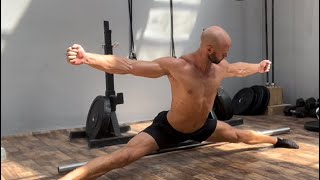
A practical YouTube coaching tutorial on achieving the pancake (chest-to-floor) stretch. The instructor frames pancake success as primarily a function of adductor length plus forward-fold ability, but stresses that weakness in stretched positions (not pure flexibility) is often the limiting factor. Progressions covered include single-leg forward folds, wide-stance squats/deadlifts for adductor strength, pulsing/rear-support variations, elevated-hip forward bends, and gradual barbell loading (example: coach Fabien demonstrating up to 55 kg). Programming advice: start once/week, progress to twice/week, touch positions daily if tolerated; higher reps are safer for long-range stretched work. Safety guidance emphasizes tissue tolerance, spine precautions, and building foundational strength before heavy weighted variations.
Chapters
All right, pancake, how are we going to do it? This is the sacrifice. As I make for you guys, I'm drenched. There's no T shirt here. Let's see if this works, if it stays on. So pancake stretch shouldn't really be a mystery. What we need is length in the adductors and we need forward bend. If we have that, then the pancake will be there. Okay, so the best place to start with pancake isn't actually working on the pancake, it's working on forward fold. So are you able to get your palms to the floor? I like working on single leg because it's going to put a lot more emphasis on the hamstring. So you've got your whole weight of your upper body on one hamstring instead of two. Now, a lot of people when they do this, they put a lot of weight on the back leg because tightness is a lack of stretch. Strength, strength. We simply need to become stronger and we will have the ranges. You can do a lot of fancy activation patterns and, you know, work on the hip flexors and the abs and all those things. But I have chosen not to go down that path because the stress strength is just a side product. It's not my main thing that I'm after. It's a tool. So we need to work on this. Sets of 20 is really good. And aim for an extra little bit of bend on each rep. Getting towards the point where you can get your elbow on your foot is a good goal. We can use the slant on this as well. Okay. So if we elevate the toes, want to be able to get that elbow to toe on both sides. Okay. If you don't have good forward bend mobility, it's going to be very unlikely that you're going to have a good pancake. Okay. So adding to that, we want adductor mobility. So the first thing I like to work on with long range adductor work is wide squats or deadlifts. So this is actually another reason why powerlifters can be surprisingly mobile and why powerlifting can be a decent background for getting into strength training with stretch strength. So they're actually doing building a foundation for side split over the years using these deadlift movements or super wide stance squats. So even just with body weight, that can be quite taxing. That is quite taxing for most people. And again, it's an issue of strength, not flexibility. So it's simply that the muscles are weak in those positions. If you can handle lots and lots of weight under Stretch, then you can say, okay, yeah, I'm tight. But if you're not using lots and lots of weight, then it's means it's just. It's an issue of weakness. So as we become stronger, then more positions will open up. So once that wide stance, wide stance, squat or deadlift is warmed up, the next variation that I really like is it's a bit like pulsing the stretch on and off. So this actually looks a bit like a pancake. I like to work. So yours might look a little bit more like this or like this. Initially, it's fine, whatever it is. Okay, we let the feet slide out, but what we're doing with the arms is actually taking a big percentage of the weight. Again, because the issue is strength, it's not flexibility. So if we've got this forward position, I also like to work on rear support. And initially that might look like this for you. That's okay. Whatever it is. You can go from sitting down, push throughs. You might have to use blocks or hands behind other tricks to get yourself in the game with this. But it won't take long if you work on these variations to be able to at least get started with the pancake. Then I like to elevate the hips a little bit. So we elevate the hips. That's going to help us get leverage on the muscles that we want leverage on. We're also going to add some weight to help us get leverage where we want leverage. So firstly, I like focusing mostly on bending to the sides. Again, what that's going to do is open up the hamstring, and it's also going to open up like the quadratic lumborum or the sides of the back. And they can be things that limit us. So again, I like sort of five to 20 repetitions, whatever, wherever you feel comfortable there. Generally, the higher reps is safer. And then we're going to go forward bending. It's going to be further to the floor now with the butt elevated, but this is a movement anyone can get into. Floor. Okay, that's going to build some tissue tolerance, the foundation for our strength. We want that tissue tolerance. As the tissue tolerance progresses, we're going to be able to add more weight. So that's the next step, simply adding more load. I might be able to cut in here some of the clips from Fabien, one of our top coaches from France. He's got over 50,000 followers and he's just shown them his pancake with weight all the way up to 55 kilos. Now generally it's going to be these adductor muscles that are going to cause issues. Or sometimes the insertions of the hamstring will be the biggest limiting factor. Like with all strength training, treat this like a heavy squat. Listen to what's going on with your body. Just because you can do the movement doesn't mean that you, you should or that you should add more weight. Okay? So with the barbell, I like to progress another centimeter or two each repetition. You see the back starts to arch. Maybe you won't see from that angle, but touching the chin to the floor, the back arching, I don't really mind because what it means is as I'm getting further down, I am still shifting more weight into my legs and so I can feel that I'm getting more adaptation stimulus that I want into the movement. Now, if you haven't done any Jefferson curls with weight, if you haven't done the foundation work, this might be an unsafe movement. If you do push it too hard, then you want to focus on short range movements to make things healthy again. You don't want to mess with it. If it's your spine, you don't want to mess with your adductors or your hamstring insertions either. But it is simply a question of getting the reps done. 2, 3. Every set and every rep, the body starts to accept more that this is what's going to happen. And the body is your servant, the mind is the boss. If you continually go back to something, the body will find a way to get it done. The body will tell you don't do it in certain ways. To some degree you want to listen, but you also want to keep progressing. So. It's just a bit of chest to floor there. I need to get some little fractional plates and then I'll be able to add more weight to this. For me to go further with this safely is simply about more strength. I would recommend doing this routine once a week initially and then twice. There's going to be a lot of tissue remodeling. So generally with our long range work, which means training when the muscle is under full stretch, generally we want to do that less frequently. So yeah, about twice a week is quite good. Does that mean you can't do a little bit every day? It doesn't. You can definitely touch the positions each day and as you have more tissue tolerance, then you can do it more often. If you have more tissue tolerance, you could be doing it every day. If it's not heavy for you, think of it like Squats like, can you squat 60 kilos every day? If you can squat 60 kilos every day, then why is it that you can squat 60 kilos every day? If you can squat up 200 kilos, then asking should I do that? Should I squat 60 kilos every day? Well, sure, if you want to. If you want to develop more strength, then you need to go to higher intensity. But when the goal is range of motion, you don't actually need those higher intensities. You don't need to be maxing it out. Just need to be giving that tissue some stimulus so that you can get stronger in the position. So just like you can squat 60 kilos every day, if your max is 200 kilos, you can do some pancake work every day. Once you build the strength into those tissues and once it's not heavy for you, if it still feels really heavy, then once or twice a week is good. Generally that's all you need anyway. Unless the goal is to be the most flexible person you know. If the goal is really to specialize in that, build your business around it, then yeah, you might want to train it more often to get it. But if your goal is more to be well rounded all round, athlete skills, speed and power, strength, stamina as well as stretch strength, then just touching on it once or twice a week is fine. And understanding that it's mostly weakness, that's the main issue. If we overcome the weakness, then we can access all the positions that we want. So I hope that makes a ton of sense. And I look forward to seeing your gains on the pancake, on the forward pike, on the side splits and yeah, step by step, brick by brick. Let's see. I'm going to just have a little go at the side splits because it should be fairly warm on it now. And this actually gave me the stall to press and tuck planche without training specifically for the short range ability that's needed for the stall to press. Okay, so almost there with calves on the floor, literally touch this position like once or twice a month, able to get down there. Maybe I should start to doing it twice a week, see what happens. It is the strength, The strength is the major concern. I need to build more strength in the adductors and then I'll be able to go down deeper. Like that's all that's holding it back is be stronger, be stronger, be stronger. Don't need any other tricks, don't need to do any other movements. If I need to warm the movement up, do some short range first. Bring some blood into the adductors. But since I've already squatted, I've already done some snatch as well, and I've done the pancake work. Then it's quite ready. But I really don't. I don't need to be doing a lot of volume on that position. Touching it like that with the push up variation and then one or two holds. I find that that's enough to get progress. Love to hear your questions, thoughts, experiences. Have you worked on the pancake yourself? What's happened? How's your forward bend, your standing pike? How's your adductor strength? Let's get to work on this. Let's take it to another level. Let's be capable of doing very rare, uncommon things. Combine them all together. See if life doesn't get better. See if your business doesn't get better. It does. Let's go.










