Posterior Chain Athletic Range
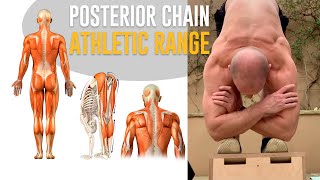
A coach walks through posterior chain exercises from neck to foot, showing progressions in range, weight, and speed. Work twice weekly for most athletes, with daily positional holds allowed. Includes Jefferson curls, single-leg hamstring work, slant-board calf stretches, and pistol squat variations.
Chapters
Okay, so lengthening the back of the body, the posterior chain. First step will be for the back of the neck. Okay, the back of the neck, the upper part of the posterior chain. There are different devices and things you can get, but generally you're going to be able to take a decent amount of weight with this position. Someone's very deconditioned. You could use just the way ahead. Or if you want to use higher repetitions, That's more of a strengthening exercise because that bottom part is going to be very easy. So just using your hands for assistance. Now, the next one, the Jefferson curl, can be manipulated to give us more upper back. Okay. So rather than going all the way to the floor, if we just use that top portion, then we're getting that upper back rounding. You will find some people are hypermobile on this already, but you'll find others who are very tight between the shoulder blades. So you can have a look at the range in this movement and then decide if it needs more work. Now, for the lumbar spine, we're just simply going to progress the range with this. I like the Jefferson Zercher variation because we don't have to stand on any boxes, play around with anything. Very accessible to everyone who has a barbell. Okay. So we want to go piece by piece, slowly. Again, progressing with low is one option, with speed is another. We can integrate the whole posterior chain by elevating the toes. As far as isolating out the hamstring a little bit more. Working on our single leg variations, we'll switch a lot more of the load to the hamstring. So relative to the weight we have on the back, the hamstring will have double because you got both sides of the back working for one side of the hamstring. With these, I like still using a fuller range of motion. You don't necessarily have to stand all the way back up, but you're going to strengthen the hamstring significantly. Again, we can progress in terms of weight, progress in terms of distance. There's one finger just got the contact there. So this will isolate the hamstring more and we can progress through every repetition. The body just lets go a little bit more. 3, 4, 5. The slightest of grazes. I don't think you'll catch that on the camera, but okay. So that will isolate the hamstring a little bit further. Now, if we want to bring the calf into it as a focus, we would go for a higher slant. Okay. And again, we would go for. For the single leg progression to begin with, you can Jack up the other slant board as well. You don't have to have one of these ones. Okay. Double leg, you should find, is not enough of a stretch. You probably will find. Not that you should, but. So then if we take it into single leg variation, Again, we're getting that full fascial stretch by bending over. We've got tension on the hamstring, on the lower back, regressing this movement. You can have the hands up higher, you can have less slant, and obviously you can go bilaterally. So we've done upper neck, mid back, lower back. The glute area is actually going to come a lot through the split squat, which was there in the posterior chain sequence. Not being able to rest in the bottom of the squat. Rest in the bottom of the squat. In a pistol, if you don't have the hamstring flexibility for this, simply stand up higher. But again, because we're going unilateral, we're just increasing the relative load so we're going to really find that bottom position. Okay, and our last one then, if we've done the hips, we've done the hamstrings, done the calves, our last one then will be the plantar fascia and the big toe. Okay, so this is probably the best position. Toes tucked under, again, we can progress to unilateral, decrease the range of motion, increase the range of motion. We can take it through all the way deep into the ankle. If you want to go bilaterally and just working through from the toes to the squat, you'll notice when you do go unilateral with this, it's much more intense. You see, Kato Zianni loves these sorts of movements. You could add extra weight, but you might find by this point that you've. You've got pretty good range there. My plantar fascia. Plantar fascia has been an issue in the past. It's not at all anymore since I started doing this sort of work. Again, the outer range, if the outer range is giving you any pain, if you're not quite ready for it, then the focus would go to the inner range. And then working very, very lightly after the workout, after you've done a lot of work to go into the lengthen range, the long range movements. So we always want to focus best do this work straight after you've finished your main strength work, or if length is really the issue for your strength training, then you might want to incorporate some of these movements in between your sets as well. But yes, there's no magic prescription for how long, how much Load you can tolerate with this, it's like strength training. Can you tolerate 10 sets of 10 or is one set of 10 enough for you to get started? You need to know the tissue tolerance, the amount of practice that you've done initially. Generally you want to work with this stuff in, you know, like twice a week. You want to develop it. At most other days you can definitely get into these positions. There's nothing wrong with getting into these positions. Every day we're going to go through the tension scale and you'll understand between one and five where you're at. Okay, so. And then you'll understand how to use these movements. All right, so there is no magic prescription, magic program to follow. What you will find is that if you can identify your weaknesses within these movements, then you can focus on them. Rolling through them as a sequence will work really well. A little bit deeper on the flat front split just after following that sequence. Usually we want to use three to five sets progressing the load. It really does depend on the individual how much you want to progress the load versus sometimes it might be better to progress with speed. You want to progress with speed? With more speed athletes, you aren't going to deal with high forces. For rugby players, yeah, you want to be able to handle a lot of load in these end positions because they may have two or three people on their back when they get into one of these positions. For tennis, they may fall into these positions very quickly. You'll see them in splits on the court. So they want to have access, fast access to these positions. Same for soccer. So as a coach, you're going to understand and know how to use and manipulate these tools as required. What you will notice is that all your active inner range stuff will progress with this. The ability to bring the knee to the chest. Things like this will progress much faster by focusing on the long range positions than by focusing on inner range work. And the long range positions will improve fastest with load and with speed versus static stretching, especially for strong people. The very, very low intensity stretching just simply doesn't pack enough punch to cause a change in the tissues. If you enough time or if you're just skinny, you don't have a lot of muscle mass, then that low end stretching will be much more effective. So understanding these qualities, these philosophies are the key to getting the results that you want. Let's not look for a magic formula as coaches. Let's look for the principles and the skills to be able to get it right for each person that we work with. That's the art of ATG for coaches. Enjoy.










