Press Your New Personal Best
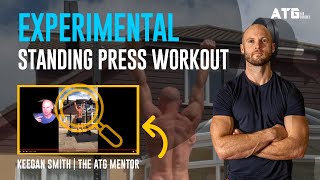
A single-presenter YouTube coaching video by Keegan Smith that walks through an experimental standing-press session. The presenter demonstrates warm-ups and progressive sets (noting working reps at ~50–100 kg), emphasizes producing tension and accelerating through the bottom to overcome sticking points, uses on-the-minute sets and waves (1→2→3), and supplements practice with isometrics and partials. He references other coaches (France Bosch, DB Hammer) and mentions personal history (best recorded vertical ~34 in at Catalan Dragons, ~2011–2012).
Chapters
So I'm gonna take you through today's training session. And it was a good one. Some days you don't get that much done or you don't really feel it, or it's hard to get yourself out there. Don't sleep that well. Whatever. Today was a good day. Today was the other. I felt like getting it done. So I'm gonna show you exactly what I did and speak through why I'm doing what I'm doing. So this is an experimental, so standing press workout. So that's 50 kilos and I'm going as fast as I can. I only want to get the bar just above my head. So I actually did empty barbell before this. I did 30 kilos before this. 40 kilos before this. Now, in the past, I wouldn't have used those sorts of weights. But what I'm interested in at the moment is tension. More so than weight or load. What really matters is tension. What really matters is the amount of force that are being produced. Don't worry about my daugh down there. She was just being a lizard, soaking up some of the heat that was absorbed into those mats. So, yeah, I did some of these before I did the 50 kilo ones. Since I had to load up to the 60s, I thought I'd show you what I did. And I did some behind the neck. Okay. So being able to go fast in that behind the neck position, definitely not something I would have been able to do in the past. And something that I've been working on, you know, the ability to get more comfortable there. You can check out the shoulder rebuild video if you want to understand more about that behind the network. But yeah, basically by going so fast with the bar, there's actually a lot more force there. Like, if I want to break someone's nose with 100 kilos and I have to hold on to it, it's actually kind of going to be difficult, right? Like, it's. Well, maybe it's not that difficult, but the idea of, like putting something through a wall, the heavier it is, the slower it's going to go. If it's a 1 kilo object, then you can create massive speed with it. And therefore there's a lot of force created a lot of tension. So when it's too light here, that's not going to create enough tension to really do anything special. But as I'm going up here in the weights, it does become more, more tension, and therefore it's going to give a bigger result. Okay, so now I'm going to the 60 kilos. I'm going on the minute with these. So I was waiting for the beep every time it comes around. Yeah, the kids are out here enjoying with me, so I still want to go really, really fast on these early preparation repetitions. So CC 60 kilos. I've kind of lost that pop that I had with the 50, but I'm still able to get it up kind of to the sticking point or a little bit higher. If I can get acceleration out of the bottom, then I'm probably going to finish the rep. So the faster the bar is moving when it hits that sticking point, the more likelihood of blasting through the sticking point. So there are different ways to kind of bring up your max. One of them is to, like, pause at the sticking point to get super strong there at that sticking point. But another one is to, you know, to have more acceleration when you're getting to it. So you could see I could use bands for this as well, but, you know, do I really need bands when I'm dropping and catching that, that kind of weight? Probably. Probably not. Okay, so get up to 70 kilos here. I got this for three later in the workout. Spoiler alert. But, yeah, you can see now it's not really just a weight that I can throw around. It's not. It's not just popping like the. Like the 50 kilos was. So 50 kilos are kind of the sweet spot for these reps to. To go fast and to really feel like I can. I can drive the bar, but I'm going to continue to go up. So I'm potentiating. I'm getting strong in the bottom. I'm getting that feeling of pushing something. I'm supporting the weight body's getting used to all of. All of this process. So I kept going up with these today. Here we go. So you see, I'm only just getting to the chin with. With the 80 kilos. But even just having in the hands and not being intimidated by the weight is a big part. Like, when you unrack the weight, sometimes you already know that you might be going to. You might be going to lose before. Before you even try and press the weight. And to be honest, I wasn't too sure if I would make the top weight of this session. But now we go with 90 kilos. This one's not going to move all that much. I know. Carrying the quad board across. Here we go. So this is really, like. I don't know if this is going to move at all. I don't know if I'm wasting My time with this. And you can see, look, I'm. I'm not getting a lot done, but there's an exposure here. There's a concept, there's an idea on submaximal rest. Lots of sets. All of this is going on the minute, right? So there is some level of accumulation of fatigue. There's also potentiation. But if I can move that 90 kilos a little bit, then when I go back to 70 kilos, I go back to 60 kilos, then it should feel like a paperweight. And that. That is the idea of potentiation. Some people are more potentiated by super maximal efforts. 100 kilos. So 100 kilos, just. Just kind of bubbles a little bit. It doesn't really go anywhere, but I felt the weight, you know, and that was all I really wanted to do. To not be crushed by 100 kilos, like holding it off the body, it's not the same as just supporting it in the front squat. There is definitely a big active component, stabilizing shoulders, you know, getting ready to press, etc. So, yeah, now the idea is to do some full reps. Okay. So I've done. I've potentiated the body and I've got a lot of practice about getting out of the bottom. And now let's see if that transfers to getting out of the bottom in some other reps. I'm doing some isometrics here, holding my arms above my head just to make sure my shoulders are going to be happy. And they know where that finishing position is that they're about to go to. France Bosch talks a lot about your. Your finishing position. Here we go. So 61st one's a little bit tentative. Second one's okay, that's fine. Like, okay. Probably trying to save a little bit at this stage because. Done a lot of sets by this time. None of the sets are maximal, but it still accumulates. It's still. Especially when I'm going for maximal tension there with, you know, it looks like I'm not doing much, but it's still maximal tension up. Going to close that door. Don't let anyone tell you you can't have a home business because you got kids. All right? So I love having him out there with me training. It's. It's the best. So 70. I was like, it was okay, but didn't really feel that confident with it. So I was like, the idea is to go on the minute for one and then on the minute for two and then for three. So like a wave. And I didn't know if I would be able to do that. At this point I'm just thinking, yeah, two would be nice. Let's see how two goes. Step it over a little. One. The chances of me dropping that weight, one in a gazillion. For those who are very, very safety minded. Yep. So two is actually better than one. And often playing with my, laughing at my own jokes, I'm saying strong like bull. So if I'm strong out of the bottom, then by getting the bar on the way down, sometimes the second reps actually easier than the first on the standing press because the first one is like a dead start. So it's like a dead start bench press. Usually you can't dead start bench press the same weight as you can go down and up with. And dead start bench presses a great exercise. Dinosaur strength. Brooks Cubic, he was someone that Charles Poliquin had a lot of respect for. He was a huge fan of bottom up bench press. And yeah, so basically when we're standing press, we're doing like a bottom up bench press, which is maybe part of the reason why it does help bench press and you know why some of the big lifters. All right, so this is the one I wasn't too sure about. Second rep, grind it out. Third rep, yuck. I don't really like doing many reps like that where I'm sort of like, it's almost gonna stop. It just uses too much of the biological battery. Especially when you're training on the minute. There's. There's just a little bit too much. But I was pretty happy with it. Anyway. I'm telling my Armstrong like a ball anyway, with my cloak of voice. So load up to 80 kilos. Since I got the 70 for three, I'm thinking, yeah, there's probably 80. I've probably only pressed 80. I would say maybe four, five times, three times, something like that in my life. And so actually wasn't very confident about it. I was thinking like, this is probably actually silly. I've just had a really good session. I don't want to finish it on a missed lift. You know, these, these kind of thoughts are going through my head. I like to, I don't like to fail lifts. I like to build success on success. You can see doing those partials and whatnot, like they are kind of like failed reps. But it's the thing of kind of grinding a rep and also just putting a limit, like establishing a limit in your mind is not a healthy thing. So the less you establish limits, the better. In my mind, like there are people who go at. At things in different ways. You know, some people train fail all the time and, you know, they're still super strong. They just keep going back snatches and things like that. I've, I've actually missed, like, I've hit snatches on my 20th attempt because it's more of a skill thing. Here we go. All right. So it actually moved fairly well. You see him leaning back slightly. Although I'm not, I'm not too worried about the, the kind of technique police. I kind of like the looser form standing presses as well. This isn't super loose form. Some of the guys with great thoracic mobility will really lean back and, and vertical press it. Little pauses on the way down, basically just to show the weight that I've dominated it, get some extra work with that weight. So you'll see the place that I've paused the weight here pretty much where the bar started to go really slowly. So if I can get a little bit of isometric there, then maybe next time I'm going to hit a little bit easier. So maybe I was very potentiated by the work that I did, or maybe I was a little fatigued because this was like set 20. Now, even though this video is only 30 minutes long, I did a bunch of sets before I got to the 50. Granted, they weren't very fatiguing sets because I was just moving the bars as fast as I could. But yeah, I've never pressed 85 kilos. I think 82 might be the best over press. 82 and a half, something like that. And it's probably last year. So good signs that there might be a best ever. And, you know, I'm only 38. Most people do hit their best strength numbers, like slow strength numbers in their 40s, so, you know, no excuses with that. What would be more surprising and more impressive would be to hit some best jumps in my 40s. And, you know, we'll see how we go with that. I've hit 34 on the just Jump map before. I used to get reasonably consistent 32 inches on the Just Jump. People say the Just Jump algorithm isn't, you know, it's not right and whatnot. But yeah, that doesn't really bother me too much. It's, it's, it's standardized against itself and it is accurate from that perspective. So that's probably the big one for me. That'll probably mean more to me than getting to 85 or, you know, even 90 kilos on the standing press. I think is, is, is very Doable and would be nice. But if I can jump that, that would probably mean more to me if I can beat my, my jumps. So the 34 inches was while I was at Catalan Dragons. So2011 I'd say that was. Or 2012 would have hit my my best ever vertical jumps. And that wasn't when I was hitting my best ever squats. And I was power snatching around 80 kilos at that time, which tends to correlate quite well. But yes, let's put it to the test. That's the fun of it. So I hope you enjoyed your training today. After this one, I went into chin ups and I did two different variations alternating on the minutes. If you want to check that one out, drop a comment and let me know that you want to check that out. And I can do another video explaining a bit more about that. I also made another video about my assistance work after that. So presses and rows. I did a lot of different variations and had a bit of a conversation with that one as well. So that one should go up at some stage in the not too distant future. So yeah, some of you will look at this and go like, you know, what the hell is he doing? Like why, why would you train like this? But if you know sports performance and athleticism, then you know that actually being able to go fast with things is really positive. Now the thing is we can sometimes lose track of the physics when we start to train like this. And it really does matter what weight you're using. Sometimes things get a little bit too abstract from, you know, my perspective. But yeah, these are, these are pretty clean and clear. And yeah, they do make me feel athletic. They do provide that stimulus to the nervous system of going as fast as possible possible. So inspiration for this sort of work pre comes from DB Hammer, Dietrich Buchenholt. Apparently it's a real person, but he's not. No one knows where he is or what he does these days. He had Innosport website way back in the Day, innosport.net and his book was really interesting. That website was super interesting. So yeah, check out DB Hammer. You probably can't find anything about him online, but yeah, he won't be on my Kindle either. Anyway, I hope you really enjoyed this video. I hope you're enjoying your training and I'm going to go back to the kids.










