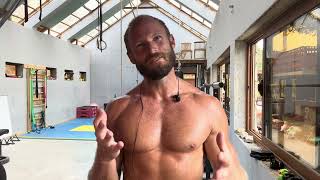
In this monologue, the speaker argues that the squat is the cornerstone of athleticism and physique development, describing how deep, heavy squats translate to power, acceleration, and overall performance. He recounts his own evolution from teenage curiosity to a lifelong quest for a double‑body‑weight full‑depth back squat, citing influences such as Dan John, Charles Poliquin, Tom Platts, and Matthew Perryman. He details his experiments with daily squatting, ATG training with Ben Patrick, and the impact of knee pain and back imbalances on his progress. The speaker shares recent training activities—running, hill sprints, jump landings—and reflects on whether to resume intensive squat work, inviting the audience to share their squat targets and join him on the journey toward a more athletic, multi‑sport capable body. The narrative blends personal anecdotes, training philosophy, and a call to community‑focused athletic development.
Chapters
You can't squat heavy enough to have the physique that you want. I can't squat heavy enough to have the physique that I want. Squat is a foundational movement for performance, for athleticism. When we take the squat to the next level, it's easy for the physique to go to the next level as well. It's easy to be good at weightlifting, it's easy to be decent at strongman. You've got the ability to sit in a squat position for a long time, like a Chinaman. There's a foundational thing. It even helps to go to the toilet better. We need this squat. The consequences of not being able to squat is not being athletic, not being extremely powerful off the mark. Acceleration, deceleration, squat is our potential for all these things. Now we need to do other things to be able to express that potential fully. But the squat is the foundation. When you look at Dunkers and you look at how much they're able to squat when they work hard on the squat, there's a few that don't work hard on the squat, but those who do, they have extremely high relative strength on the squats. So we need this squat movement to be able to have the athletic ability that we want. Now, I've wanted to be able to squat a lot of weight since I was in my teens, late teens. I read Dan John articles about the need to squat to full depth, and I started to squat to full depth. When I was first taught the squat, they told me, don't go all the way down. It's bad for your knees, bad for your back, don't go all the way down. I remember being taught the squat as if it was some really complex movement and they were kind of giving us the okay to squat. 20 kilos, 40 kilos, and with the Illawarra Academy of Sport, and they were doing the best they could with what they knew. But to be able to get this squat to the level that we want, Something different needs to happen. So I was reading these Dan John articles about, okay, we need to be able to squat all the way down. Charles Poliquin used to say, you squat, it should leave a stain. If we have the foundational elements in the squat, we've got so much more for everything else. So Tom Platts is the master of the squat. He says, my knees never hurt squat, never gave me trouble with my knees. He was squatting all the way down. He was squatting for high reps. He wasn't focusing on one rep maxes, but he got extremely Strong with huge legs. Now, undoubtedly there's some ergogenic aids in the picture there, some steroids, but the message is still there. If you're able to squat for a lot of repetitions with a lot of weight, you're going to have a phenomenal physique. When I really first got into the squat, my knees would always hurt and I accepted when I got up to 150, 155 kilo squat. I started doing squat every day. A few times I read Matthew Perryman, I think he's the name, his Squat Everyday book. Got inspired, started squatting every day. My knees were sore all the time. It was painful going up and down stairs. But I got up to squatting 155. I got up to squatting 115 kilos, 120 kilos for 20 reps, the breathing squat style, and I just accepted, okay, my knees are gonna hurt when I do this. I was also able to when I was around that 150 kilo squat was when I snatched 100 kilos. Really, I was only able to squat 140, 145 on any given day when I could snatch 100 kilos, which is fairly efficient on the snatch and fairly weak in the quads. Sometimes it's getting pinned in the bottom of the snatches, so I'd have the weight overhead, I'd be in the bottom, but I couldn't stand up. And even though I could squat a lot more than that, 80 to 90 kilos, I was getting pinned by. I couldn't squat it with the quads. My quads were really weak. I was squatting only using the back, really and using the quads as little as possible. So the journey continues. I've never really got to a solid double body weight, full depth back squat. A lot of people tell you they've got huge squat numbers, but if you look at it, then they're getting to there and then standing back up. It's good to be able to get to there and stand back up with triple body weight, but it's not the same as squatting that weight. This is a squat, So the path is still continuing the journey, still continuing to squatting. A legit double body weight back squat. Being able to do that while being able to snatch, while being able to run once a week, being able to jump, doing it without the knees causing me a lot of trouble, still be a beautiful thing. I've kind of given up on it. What is your squat goal? What's your best squat so far? I Kind of gave up on that double body weight because I've tried it so many times. I've gotten close. I've gotten to 1.9, but I've never gotten the legit 160 something weighing 80. Squatted 150 with no belt shoes. At ATG headquarters with Ben Patrick in 2020, just after I did the training camp with Sonny Bill Williams where we did ATG method, we did quads twice a week, posterior chain twice a week, did upper body twice a week. Similar to what I'm doing at the moment. Over the last year, I haven't really been able to squat. When I was somewhere during those travels, carrying a lot of suitcases and not doing compound lifts, my back started to get sore, imbalanced. Kept getting a pinching my right side. I haven't even been able to squat. Feeling like an old man. It's nice. It hasn't been bothering me. It's stopped bothering me. I've been doing a lot of side flexion work as well as normal glute back work and my back's been feeling good again. What do you think? Should I go after this double body weight again? Are you coming with me on the journey to double body weight? It does feel like something worthy. If I want to be squatting, if want to be snatching that 100 kilos smarter to be squatting 160. Plus it's cutting it too fine to be only squatting 145 or something. Trying to snatch 100 kilos. Better to have a bit more horsepower, have a bit more muscle mass in reserve. It's Sunday here, which means Sunday run day. I went for around about four or five kilometers, Did a couple of speed laps of the track here. See if I could do it a bit faster than I did it last week. A couple of easy laps and then I did mostly hills. Then I did some jump landings. So it's just a little bonus tomorrow, squat day. Just feeling into the movement a bit. Thinking about going back to squatting every day for a little bit. Squatting easy most days. Maybe squat hard once a week, but maybe I won't. I'm not sure. I'm just playing around with the idea at this stage. Train's been going really well, staying fresh. So that's what a rest day on squats looks like. Getting comfortable again, Being able to stand up can feel. Posturally, I'm working, legs are working, getting used to it again. How far do we need to take it? Well, let's see, let's see. Keen to hear about your targets on the squat. We're building the most athletic, undisputed, most athletic, all rounded athletes. We know that multi sport athletes are more likely to be extremely successful. They're more likely to make it to the pros. So in one year, I can make you, anyone, a multisport athlete. Build a bigger base. Skiers and surfers been standing on Swiss balls consistently for the last 30, 40 years. I don't know when the Swiss ball started, but at least 20 years skiers have been standing on these things, jumping onto them. It's unlikely it's going to turn you into a terrible athlete. It's probable that's going to make you more balanced, more confident. You work the feet, work the adductors. This is the big one. Just pumped it up a little bit more today. It's a little bit trickier to stand on than the other two. I think the small ones are meant to be harder, but some reason so far, maybe it's just the height, but this goes with my squat training. Building up this bigger base, being able to balance my feet continue developing in all directions, all dimensions. Skill, speed, stamina, strength, stretch. Let's build ourselves into better athletes. Encourage others to the same. Enjoy the journey. Leverage that journey to make change, Build villages, visit villages. Be the kind of person others want to travel around the world to go and train with. If you need some help, support to do that, I'd love to support you to do that Squat day tomorrow.