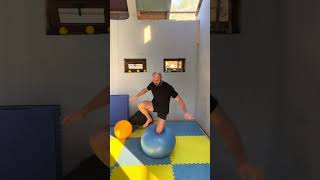
In this instructional video Keegan Smith presents the Swiss ball as a highly versatile, low‑cost tool for developing athletic skill, balance, and rapid neural adaptation. He contrasts small (45 cm) and large (75 cm) balls, explaining how size changes the learning effect. The talk covers a wide range of progressions—from kneeling, crawling, and plank variations to hand‑stand‑push‑up and back‑bridge work—emphasising gradual skill acquisition, safety, and the value of “chaos” training over pure maximal strength. Smith repeatedly argues that speed and neural responsiveness cultivated on the ball outweigh static strength gains, especially for athletes such as wrestlers, gymnasts, and break‑dancers. He details specific movement cues, muscle‑targeting benefits (e.g., adductor work, quad stretch, lower‑back activation), and the mental confidence that comes from mastering balance and rapid re‑balancing. The video ends with a call to make Swiss‑ball training mainstream, suggesting that widespread adoption could raise overall athleticism.
Chapters
Swiss ball is probably one of the most versatile tools in the gym. I love having the smallest one here, the 45 centimeter. Such a huge difference between 45 and the 75. As we discussed with the differential learning, you do the same thing on these different balls and you get a very different learning effect. So you're going to become much more skillful faster. There's so much stuff that we can do on these balls. Working between that kneeling position and sitting, working from the sitting into the crawling back to the sitting. All those little falls as well are valuable for just regaining your balance and dealing with some faster movement. Once you're starting to get up on top of the ball, your whole body on top of the ball, there definitely is more risk. You don't need to rush into just standing on it. You know, most of the younger guys do, and they generally fall a bunch of times, and I haven't seen anyone get injured from that. But if you go full kamikaze style, then, yeah, you might hit the ground hard enough to do some sort of damage. But if you just work to get one hand off the ball, get onto the ball with all fours, and then in that position, you can play so much, you test towards your edges, then you can build a lot of skill without going for that all or nothing. Can I stand on the ball? Can you stand on the ball? Is just, you know, only one. One element of using the ball. Being able to kneel on the ball, one leg is a nice ability. Within that, you can be doing it in a lower. A lower kneeling position, like a kneeling squat bottom position. You're working your quads quite hard with these. The physics of it is that there's still a decent amount of force being produced, but you're building much more of a base for chaos, for anything that might go wrong in life. If I could choose between being strong and balanced on the Swiss ball or being strong and balanced with the barbell at 80, I would choose the Swiss ball because it means that my brain is reacting fast to chaos and re. Rebalancing. That means I'm skillful. That means my brain is still fast and sharp. Where you could be strong with the barbell, there's people who are strong with the Barbell in their 30s, and they're still far from athletic. They wouldn't be able to deal with. With any degree of chaos in an athletic sense, even though they can grind a weight. I would always take speed over strength in the modern time as well, because an athlete who's fast is able to deal with Big forces, they're able to produce a lot of force. They might not have specifically learned to brace or the things that are required for snatches and deadlifts, but they're still producing a lot of force. If you're fast, you are producing a lot of force. It might just be instantaneous. It might not be that good at producing force for multiple seconds, 2, 3, 4 seconds or as good. But that instantaneous force is more valuable. Then we can go. I really like the kind of the plank variations. I was trying to transition down without touching the ground, but it didn't make it. Plank variations on the stomach, then you can bounce, you can move side to side. I really like this one. Getting a pump into lower back. And then the scorpion variation as well. Big arch. It's a bit like a handstand push up. Foundational athleticism, being able to handle more positions. Something that is undervalued in the world of sport. Also, the cost is so low of learning all of this stuff because it's not super high force. The cost is low in terms of the energy you're going to spend, how much fatigue you're going to accumulate. There's some work being done. If you were to do it for an hour, you probably would be pretty tired and get some soreness the next day. But yeah, a lot less than the heavy lifting. These dynamic transitions from the kneeling to half kneeling, something started working on. And then crawling backwards. Easier than crawling forwards. Shuffling. I haven't actually tried it with no hands yet, but I've seen it on Instagram. Start working on that. There's a wrestling coach. The best use of the Swiss ball is in wrestling. The best Swiss ball athletes are wrestlers. And it's no surprise. Like the. It's easy to make the argument that wrestlers are the best athletes because they're able to do acrobatic stuff like a gymnast. Plus they're able to deal with the chaos of an opponent. And they're the ones who see the sense in the Swiss ball. They're using it for flips as well. Another use for the ball. It's a great feeling going around on the ball. If you want to have a go at this one, I think about putting the head as far this side as possible. If you've got break dancing background, you can use it to spring off and land on your feet. If you get over the ball more, then you come off faster onto the feet. More of a bounce. When I first did these a few months ago, I did it first in Australia. It was terrifying. But you Do a few reps, you realize you're okay. Starts to get smoother. Also, using the Swiss ball for the adductors is a good one. So having the knees further apart on the ball, you're going to get strong contractions in the adductors. At long duration contraction, it's not a lot of stretch, but it's enough to build more strength and endurance into the adductor muscles. Also thinking about being able to do a handstand on the Swiss ball can be done. Handstand push ups on the Swiss ball, I've seen it done. I'm not close to it, but you start to work towards it by these four point positions and then taking more and more of the weight on the hands. I'm very light on the ball with the feet there. I was almost fallen off. That's going to feed into upper body strength and resilience in the shoulders. It's going to feed into handstand push ups. Because you're taking almost all your body weight on the upper body at the same time. You've got the complexity of the ball added to it, so you're going to become more skillful at the same time. Again, if I could choose a handstand push up on the floor or handstand push up on the Swiss ball, I would take it on the Swiss ball. Obviously that's a lot harder. So why then if the handstand push up on the Swiss ball is more valuable and more challenging, you know, more, it's much less likely that someone's going to achieve it. Then why would we not value the squats? Squatting on the Swiss ball, I understand it's not a replacement for a standard squat, but there is value in it. Jumping up onto the ball. Is a good one too. Dynamically feeling the weight, transitioning, small ball, big ball, a small ball, you're much more lower to get down off. If you do need to get down all those little movements. As someone in my 40s, I can tell you it's already you have that old man thing of I don't know if I can handle this, I don't know if my body can handle this and my mind can handle this. It's a beautiful thing when you go from feeling like, I don't know how to get down off this thing fast to I can get down off this thing fast with zero fear. This style of training is going to transform you, your mind, how you think about athleticism and anyone you invite to experience it with you. You can see it doesn't start with Jumping up and down off the ball. I can get a lot better. This is something I've only really been working on the last year. I don't do it every day. I don't do it that often. But it's getting better. If it was more mainstream, the world would be a much more athletic place. This is like a pike mobility exercise. Talk about usable flexibility. This gives you strength and skill stimulus. Inside of the pike position. Also really good. The opposite way. Open it up across the ball. Ball's a great tool for the back bridge. Great assistance for the handstand. Push up. Back bridge, push up. Another one that I didn't share that I really like is the squat on the ball. Working towards knees to floor. Can let it fall down all the way onto the floor. It's going to be okay. Spending some time in that full quad stretch on the load. Then with. With some skill as well. The skill of the balance you could add in juggling in this position. Once you're comfortable there, Really feel that. Straighten the vmos. Little bounces. Getting some more force. Because it's more like a trampoline. It does the force slower. So it's not impulse. It's a more gentle style. Even when you go for more explosive movements. Have a look at bridge over the big one. It's. If you're interested in backflips, back handsprings, any of that acrobatic type stuff, then this would be a good exercise for you. If you've already worked on the reverse plank type movements, then it's not going to be as foreign to have that time where your arms and legs aren't on the ball. It all feeds together. Feeling to the floor without looking at the floor. Tracing your eyes around the path from looking in front to looking behind. All part of the acrobatic journey. Getting some stimulus into stretched position. Shoulders very open. Good for straightening out your handstands. All of this stuff plays together. It's not just about the Swiss ball and becoming a Swiss ball athlete. Although I do think that that would be a good trend in the athletic world if someone was to really take on the Swiss ball and take it as far as they could. Haven't really seen anyone do that. There's people who can do some little tricks, but no one who's really taking it all on. It's another way you can use it. Supporting back bridge work. It's an example of how you might prepare for a session with some Swiss ball. By no means is it everything. I'm not the best at it. I do think you'll find benefit. And you won't regret becoming capable as a coach or athlete with a Swiss ball.