The 2 Fastest Ways To Increase Your Athleticism
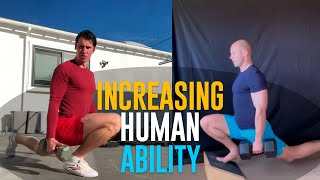
A single-speaker YouTube instructional video ('The 2 Fastest Ways To Increase Your Athleticism') presenting two primary, fast methods to boost athleticism: (1) improve power-to-weight—particularly positional power-to-weight—primarily by dropping body fat quickly; (2) increase usable range of motion/strength in extreme joint positions. The speaker references Charles Poliquin and Vince Gironda, contrasts ATG and Poliquin approaches, and demonstrates multiple ATG split-squat variations (standard, slant-board for quad/ankle emphasis, back-weighted/hip-flexor emphasis) with coaching cues and target populations (athletes, elderly, children).
Chapters
ATG coaches. I've got a couple of key messages here for you today. The fastest way. What is the fastest way to improve the athleticism of anyone that comes to you, whether they be aged, young, old, whatever they are, Professional athlete. What comes to mind in terms of the fastest ways to improve athleticism? One of the things that might come up is improved power to weight ratio. The addition that I would make to that is positional power to weight ratio. It matters in which ranges that strength can be produced. It matters how big the safety range of an athlete is. What positions can they get to before they feel like they're going to break, or before they actually break? But that range specific strength, power to weight ratio takes a little bit longer to work on the stuff in the gym. Yes, you can make big changes inside a week, a month. You can make huge changes with the right movements. Especially if you are able to identify exactly where the strength deficits are, where the weaknesses are in the system and start to rebalance things, you can make big changes really quickly. That was really the foundation of the structural balance system of Charles Poliquin. Taking it a step further, if we can identify within the muscle which ranges need work. So within the extreme range system, is the very shortest range really weak, or is the very longest range really weak? But let's put that aside for a second because that's not the topic for discussion in today's video. The number one way to improve someone's power to weight ratio quickly is to drop body fat. Okay? So if you can quickly drop body fat, then within the period of a week, within the period of two weeks, you can make a significant change in someone's athleticism. Generally, those adaptations will come even faster than strength training adaptations. The method that Charles Polligran followed, which was kind of derived from some of the diets of people like Vince Gironda, who understood ancestral nutrition as well as bodybuilding nutrition was two licks of a dry prune. Okay? So you get to live on lean protein until the point where the triceps skin fold is equivalent to the penis skin fold. Right? That was the measure, not being crude, that was the measure that Charles Poliquin recommended for males. So he wanted that triceps skin fold to be very lean. And that's a sign also of good hormonal balance, high testosterone. Okay? So that was the fastest way to make a change in athletic performance. And it's still very effective. If you have people who have excess body fat, that that will be the fastest way. Now, that doesn't mean that it's easy to do. That doesn't mean that everybody is ready to go on these Vince Duranda, Charles Poliquin type diets to make a massive quick change. But if the willingness is there and if the coach's motivation is there, and if you understand how to change baseline insulin and impact hormones with nutrition, then that's a really fast way to make improvement in athleticism. The second one is to improve range of motion. Okay? So by increasing the range, you're going to increase athleticism much faster than getting someone stronger. If you can increase their stride length just slightly, then you can make a big improvement in athleticism or a significant improvement in athleticism. We're only looking for 3 to 5%, right? Usain Bolt was 3 to 5% better. Maybe you guys have got the numbers, if you've got the numbers exactly of how much better he was on average in his races, but he was significantly better to the point where he didn't have to put 100% effort in or at least, yeah, he was able to, you know, ease up just before the finish line, etc in most of his races. So he was that much better. 3 to 5% is generally what it takes to create a dynasty, what it takes to be a standout, what it takes to be an all star, what it takes to be a top earner in any field. If you're 3 to 5% better than the rest, then you have that. So if we can improve range of motion or range of strength, range of ability, usable positions that we can produce force in extreme range, then we can increase athleticism. So we're going to go through a few variations because it's highly misunderstood the value of the split spot. Okay? So if we look at this split spot position, we want to be able to get this knee as far forward as we can. The heel can be just off the ground. We want to be able to slide a credit card, something else under there and then we want to have that back knee off the floor. So this ATG variation of the split squat is slightly different to the Poliquin variation of the split squat. Let's get some weights. It actually feels a little bit better sometimes with a little bit of weight. Okay, so the ATG split squat has an extra, extra emphasis on range of motion. Now, the Polik and split squat was also long range, but it wasn't placing as much emphasis from my understanding at least. And tell me if I'm wrong in the comments on that back hip flexor. So this is why this is not just an assistance exercise. The Way I learned the PICP1 and 2 system back in 2011 12, there wasn't a real emphasis placed on this movement. It was seen as a preparatory movement to be able to full squat. Now I could already full squat, so I dismissed the value of the ATG split squat. Worst mistake of my career. Worst mistake of my career. Okay, so you'll hear people speaking about that the split squat is being misused within the ATG system. I'm not here to fight with anyone. This is not about debating, it's just presenting another perspective and then you know, you ultimately will make your decision with your own training, with the people that you're working with. If you're a coach. Right, so split squat variations then if the goal is to be able to open these hips up because that's going to be the fastest way to improve their athleticism and improve glute activation, things like that as well. Variation of this, I think this might be the Ziani variation, but don't quote me on that. Into the slant board. What you're going to find with this variation, it's absolutely beautiful for that quad in the front leg, quad activation. Okay, so this variation would be really useful if the athlete has had calf Achilles injuries issues if you really need to strengthen from the ground up. Okay, so a top heavy athlete. I tended to be a bit top heavy. Tend to be a bit top heavy. This is really good for me. I've had issues with Achilles. I jumped into too much plyometric training. Same story as Ben and lots of people out there. I was doing a lot of pogo jumps, doing the warm ups of Joe DeFranco because I was the coach. I would do three of them and then I would stand around in between. I flared up my Achilles and then I thought, you know, it'll be fine. And I didn't understand what to do next. And it's been a niggling factor over a long time after that. So for someone with that sort of issue, this is really an exercise. If you look at the range that we're going through in that ankle, all the pressure into the forefoot, it's going to be a great builder for the foot. You can really push through the big toe, lower leg strength. Okay, the third variation here, I want you to tell me which one of these variations you love most. I believe this one comes from one of the ATG coaches, Isaac Ray. Basically a hack variation. You would use a barbell. I'm just going to demonstrate it. So flat ground, but we put the weight on the back on the hips. Now, if the biggest emphasis, rather than being on that front ankle, rather than being on the quad, if we wanted to put the major emphasis on the hip flexor, that this could be the variation that we go for, we can take that even further. The heavy bag. Take that even further by elevating that back leg. Squeeze the glute to start with and really fight to just keep that back leg straight. Yeah, really fighting. Working hard to get the pelvis tucked. Getting a lot of loading into that hip flexor. Okay, so three variations of the ATG split squat that can be used and manipulated depending on whether the goal is to strengthen the foot, the ankle complex, the calf, where the emphasis is to strengthen the quadricep. The first variation is really a balance variation where you get a bit of both. And the last one, if the hip flexor needs more work. So I'm just going to run through those again once more. It. All right, so I want you to test these out for yourself. Get the sensation, get the feeling. Let me know what you think. Should I really be just focusing on back squats, or is this a completely different beast for a completely different purpose? That addresses one of the most common issues in athletic development, hip flexor strength and range. So we're getting hip flexor strength in the extreme lengthened position. So that real long position of the hip flexor that's going to be the most anabolic anabolism. Having a big hip flexor is one of the prerequisites to having extremely strong hip flexors. So it's good to do these shortened positions and the ability to get the knee up, touching to the chest, very important. But this is more neurological. It's not anabolic. So the reason why the Poliquin system was so powerful is because he understood how to use anabolic movements and how to use neurological movements. This is how we're going to change the game of athletic development, create a new generation of resilient athletes. But the cool thing is it works for anyone, any walk of life, equally for elderly people, for kids. A lot of it can be done. You know, the zero system, the rebuild system, doesn't require any equipment, can be done by anyone. So really keen to hear how you understand what I've spoken about today and give me your opinion on back squat versus the ATG split squat and how they fit together.










