The Path To Pressing Bodyweight Using Dense Strength
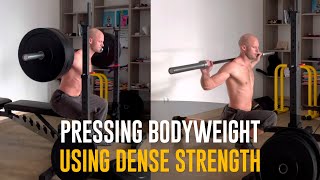
A dense-strength session building pressing power through short, frequent sets and progressive loading. The speaker works press variations, dead presses, good mornings, and box squats, emphasizing slow eccentrics and pauses. Long-term targets include a 200 kg back squat and snatching 80 kg at age 80.
Chapters
I love dense strength. I love knowing, okay, that's what I did today. Come back again. If I beat that, I'm in a new place. I love the fact that it's five minutes of work. Yes, you can do double blocks, but at the base it's about five minutes. Today was 60kg and the challenge was to do that for three reps five times. It's nothing. Nothing crazy, but that's the way that you build momentum on this system. That's the way that you build confidence. When I'm doing six by five on this, I'm going to be confidently getting 70 kilos for singles, probably for doubles, and just work away brick by brick, building confidence. After I completed this block, you get that sense of achievement. You need to give yourself that sense of achievement. I decided to work on slower, eccentric, controlling the weight, building strength at the sticking point. So coming down more slowly, feeling all the positions, pausing in front of the eyes. If you're able to pause the bar in front of the eyes, then chances are you can really, really dominate that weight. So this is all giving me confidence for dominating 70 kilos on these in the near future. Once I'm getting 70 for these same threes, I know that 80 kilos is going to be comfortable and it'll be time for a new best. It's maybe a month away. I love knowing that it's working, knowing that I'm on track, knowing that. Okay, yeah, these are the numbers progressing in reps. I don't have any small plates at the moment, so it has to be this way. And next I did some dead press from in front of the eyes. So these give you the similar sort of stimulus to the pause, but they're teaching you to accelerate. So if the bar does slow down at that point around the forehead, that's around where the sticking point usually would be. Then I'm able to drive through that. I'm getting comfortable, you know, pressing out of this squat stands as well. Something a bit different. Trying to find the. Make sure I find the rack each time, but I enjoyed doing these. Something a little bit different and I went to 70 kilos. There's no momentum from the body with these. Tried it, tried it. Took a little bit longer rest, pressed. Wasn't actually that heavy. I definitely had it. Just getting used to it. So these look like nothing, but it's quite a strong stretch. You can get a decent amount of work into the muscle, decent amount of muscle damage. Suppose you're getting a pretty good pump just working this behind the neck, something like A French press. You can do it where the elbows stay higher or you can let them come down a little bit more, almost like front rack. If you have trouble with front rack mobility, this is a good exercise. So you see this one? I'm keeping the elbows up higher, the triceps getting stronger. Triceps being resilient is a really key factor in being able to press more weight, especially overhead presses. This is a nice assistance exercise if the overhead press is the priority city. Good Morning then. So I'd done quite a bit of press work by that stage. That was really enough. It was like 15 minutes, but that was enough work. I wanted to make the back feel good, make the legs feel good, and see what would happen after that if I wanted to do something else. Then I go into some squats. I have been squatting every day, so I didn't know if I was going to squat. I just thought, let's, let's open up a bit. So here's a nice Good Morning variation. Chest to the bench and then stand up from that position. These are really good for activating the glutes. And I'm working on getting my back really strong. I want my back to feel rock solid on these sorts of movements. And then I have a lot less concern or risk about the weight bending me forward on a squat or on a deadlift. I want that strength in the lower back. So the Good Morning Louis Simmons talks about being one of the three key exercises together with sleds and wheelbarrows. The Good Morning is like the. The next big exercise. Now, he wasn't thinking about running and jumping so much. He was thinking about powerlifting. But you don't want the Good Morning to be an exercise that you can't do or that feels really scary or risky. So a little bit of weight on these now. Also great for opening up the hips. They are like an assistance exercise for the pancake. Depending on where your restriction is, they can really help you to get the pancake if the restrictions are in the lower back or the hips. If it's more in the adductors, then you might need some other movements. But this will definitely help towards pancake stretch. And it's just a really good mobility exercise to open. Open the body up. Feel good. Lift well. Lift smooth. Can never get too much press. Right. The good thing is I feel like there's any concern pressing behind the neck. I can sort of do it anytime you want that cold mobility, confidence in the positions. So box squat. Now, it's been a very long time Since I've played with this movement, but since I was doing the good mornings and had me thinking a little bit more about glutes, about adductors, I have had some weakness in the adductors. And, yeah, I'm just sort of nursing them back to feeling good. And that was part of the motivation for playing around with some box squats also. Just because I can, because I like to. Because I've done a lot of movements over the years and it's, it's not a bad thing to be able to do different movements. You can see I haven't got any, you know, any sort of significant weight on there, but just feeling and letting the body get used to the bar again. Yeah. So you see with these, like you have almost vertical shin, you're using the posterior chain a lot more. So using the hamstrings and the glutes to stand up. The back and the core are bracing, but there's a lot less quad involvement. Swimming up to like 80 kilos here. And yeah, just getting confidence in the position in the bench, moving things around. It's important that you know everything's gonna work well for you. And yeah, they felt good. I really, I enjoyed them and I wasn't expecting to enjoy them, but I did and I think it's probably still a really good idea. You know, Paul Anderson used to use quarter squats and half squats. And, you know, he's still one of the best squatters of all time. He was able to squat like 1100 pounds raw. He squatted phenomenal weights. Like, he was really the first guy to kind of take the squat to another level. He'd squat every second day. Heavy weights, no warm up. But he learned that off Bob. Peoples and these guys, they knew to train top position, mid position, bottom position. Paul Anderson set all sorts of world records and new standards for the world in strength. Now what's changed is they train off the blocks and they train. They still train. The Chinese weightlifters still train, you know, top, middle, bottom, and it still has its place. So there's no range that you want to be really weak in. There's no position that you want to be really weak in. So, yeah, this is part of me just reacquainting myself with the bar and with my body in strength training. So 90 kilos here. Again, it's also just good for the core and for the system to realize. Okay, yeah, well, there's okay 100 kilos on the bar now, and it feels smooth and it feels like, okay, this is, this is no big deal. This is no big effort. I can, I can do this. It takes away some of that feeling of like, I'm not sure how I'm going to go lifting this. When you're going into full squats, if you felt that weight, then it helps. And that's a key principle of all time lifting is to. To feel the weights. And that's partly why bands and chains became pop. It's just less messing around when you use bands and chains relative to, you know, doing a lot of quarter repetitions and half repetitions in the rack. Now, at some point, if you only care about one, one range, one movement, then you might want to specialize more. But for someone who's interested in overall strength, it makes sense to develop strength in all positions. So you don't necessarily need to do box squats to be able to do box squats. But yeah, we want strength in, in all positions, and it was good to feel that. And I went straight from that into 60 kilos, where I've been starting with the empty bar all the time. So that was again, like another mental thing. And then a good experience of like, yeah, okay, I can just jump straight into 60 kilos now. Where on the first day, like even 20 kilos didn't feel comfortable. 40 kilos felt heavy. So it's. My body is accepting this is only, you know, two and a bit weeks in to the journey. Singles going up, just feeling some weight for the day. It's not. It's upper body day, upper body focus today, but I went up to 120, And I want that to be a weight that I can hit any day, anytime. They're pretty similar. I think this is the one. Yeah, you can see it challenges me a little bit more, but it's not nowhere near maximal and nothing's hurting. So life's good. Then in some split squats as a stretch, I try to get myself into this position multiple times a week. As I said in some of my earlier videos, I had an issue with my pubic symphysis. Something. Something weird in my pelvis that's really uncomfortable. Even laying on my side and walking around coughing, all sorts of things like something wasn't right. Osteitis pubis, I guess, is the. The clinical name that you would give it. But, you know, it's just something that came on really quickly, flared up, and then it came back a couple of times. So I've just been really cautious about adductor work and shearing forces on the pelvis since then. But I also Want to get myself back into it. So if it is shearing force that's causing an issue, and if there is shearing force on split squat, then that's good. I just want to get just enough that my body has to adapt, but not so much that it gets in the way of then doing other stuff in training. So as you see, since it is upper body day, I want to get lots of sets of these and it just accumulates. It might look like it's too light, but it doesn't feel like that. I think because of the stretch as well. Like I think there's still significant damage, significant work being done and we'll see. The proof will be in the presses. If I'm dense pressing 70 pretty soon, then it's working again like confidence that this. These are starting to feel more solid. Playing around with doing them more tight arch, keeping the whole lower back arched and switched on as assistance work for weightlifting, the plan is still to snatch 100 kilos on consecutive days. Since that morphed into the 200 kilo back squat goal, it should make the snatch relatively comfortable. If I do some snatch practice along the way, I was able to snatch 100 kilos with a back squat at 150 with a belt. So if I'm able to back squat 200 and I've done some snatch technique work, then it shouldn't, it shouldn't be too much of an issue. Obviously I'll have to train for it specifically, but I guess I'm aiming to make those old numbers obsolete and teach myself the lesson that it's all about strength. You know, it's not about technique, it's not about speed, it's about strength. If I can squat 200 kilos, then 100 kilos on the snatch is not going to be a big deal where it was a very big deal. With 150 kilo back squat, you have to have pretty good efficiency to be snatching 66% of your belted eyes bulging back squat probably didn't even go to the same depth. But yeah, I do think these good mornings are doing something really good for me. I can feel my glutes working much better, especially the right glute. The right leg just seems to get lazy whenever I am not lifting consistently and I just focus on staying symmetrical and I can feel the right side is improved a lot. And yeah, it's feeling smooth. We're building a base. I'm happy with progress. You know, progress is sacred. Progress is key. Whileever you're making progress, you know, Respect that. Yes. You know, there, there's no, there's no world records here. There's nothing that's even close to, to my bests. But there's progress and progress is sacred. Progress is key. If you're making progress, keep going, you know, keep going. Because if you can keep making progress, then eventually you know you're the best because that's, that's the only thing that holds you back is, is if you're not going forward, eventually you get there. It might be by the time I'm 80, but I could have the best snatch in the world at 80 if I'm able to maintain consistency. I need to snatch 80 kilos at 80 years of age. That's what I'm working towards. Why not, why not now? It's difficult to work out. Okay, well, yeah, is this, is this too much for today? Is it not enough? You know, is my, my back and everything? You know, do I, do I need to go much lighter or is it going to adapt? I've definitely, I can tell you that training every day, my body feels better, my joints feel better for the most part than before. I have had some real stiff muscles and some, some Frankenstein walks first thing in the morning. But yeah, my body will start to get used to it. I'm not always going to be pushing it to that limit. So these are some sort of just rack pulls again, just feeling weight like I need to get comfortable with feeling weight to feel like I can explosively lift weight to my chest. Just a little bit of assistance work feeling the glutes, feeling posture positions. Not trying to break any world records, but you can see I played around with more of an arched version versus somewhat rounded version for weightlifting. I need more of this kind of posture for powerlifting type deadlift. I can be a bit more rounded, just connect the abs into the, into the ribs, into the pelvis. But yeah, it's adding more weight each set there. It felt nice. Nothing special. I was going to play around with some deadlifts, but kind of by this time it had been about an hour and 10 minutes. So I've played you almost everything, just moving. You can see out of that hour and 10 minutes. There wasn't much messing around time in this and it's nearly a 20 minute video. So my training is fairly dense. There's not too much sitting around time. There are a lot of sets there. There's a decent amount of tonnage. That's how I like to train and yeah, building momentum. Upper body day. We're on track for the press and for the squat. See you tomorrow.










