The Secret I Forgot To Squatting BETTER Everyday, Handstand Secrets & F. Squats | Squat Everyday 7
The creator realized he'd been skipping long-range work in his daily squats. Building tension from short to long range strengthens connective tissue, reduces tendon pain, and lets you train harder. He uses the same approach for deficit handstand push-ups and shares specific protocols like 20 reps on the minute.
Chapters
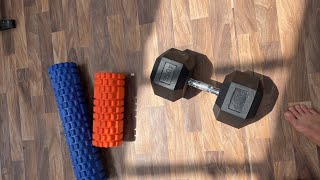
I've been doing this squat every day, but I've been missing something really stupid. And I'd like to fill you in about what I've been missing and why it's so important. And maybe it'll help you to avoid making the same mistake. Right, so it's a bit later today, but the biggest breakthrough I think that I've seen in training in my lifetime, having researched a lot of old time strength stuff, Poliquin, west side Barbell, Edo Portal, hundreds of other coaches, I love exploring. I don't have perhaps the greatest academic mind, but I do have the inquisitive nature to go and study and figure out what is it that we're doing, why were they doing it that way? I've studied pretty much every system in strength and every, every style of strength, from arm wrestling to focused grip training to strongman. The most important breakthrough in strength of our lifetime is the realization that we have to progress tension. And through progressing from short to long range, we can heal and overcome issues, to recover much faster, to have a lot less tendon issues. Now the silly thing that I've been doing is not applying that with my squat every day, right? So I'm doing these squats, but I've been doing zero long range work. And yeah, my knees are fine. Like I'm not getting any knee pain, but they're not great. I don't feel like I'm getting younger with each day and I think if I do the long range work, I will actually feel younger as I go. I've got a freestanding handstand push up today. Deficit freestanding handstand push up. My son asked me, how long did it take you to learn to do that? And I said 10 years. Because I started wanting to do it before I even could do a handstand. And it seemed like a pipe dream. It seemed like a really long journey and tough thing to be able to do a handstand. And it was took me about three years to learn handstands because it was a silly method. The focus was a lot about keeping your body tight and straight and long. First of all, I just messed around and thought I'll just be able to do it if I just keep trying. And I was just playing around, walking on my hands. Common mistake. A lot of people do that. They'll sort of walk around on their hands and they'll think they're getting closer to a handstand. Walking on the hands isn't very useful for getting a static handstand. There is some base there and if you're amazing at walking on your hands, for sure you'll be able to stop. But it's not a good place to start. And even until recently, a lot of the way that handstand being taught it goes back to gymnastics training or circus hand balances and they're just not thinking about how to get an adult in the game fast. So their methods are quite poor. So the best way to get your handstands is to work on things like frog sits, shoulder stands, bent arm lower variations, even L sits closing the eyes, moving the head, getting that proprioception going between the hands and the rest of the body. You don't need to learn exactly how to point your toes and get your feet in certain positions and, and where your legs are. Those things don't really matter that much if the goal is to get to a one arm handstand, which is probably how Edo portals handstands were focused. And also his system was probably to weed out the people who weren't going to train for four hours a day. So they had a very simple, brutal method of learning handstands, but doesn't mean it's an effective way to get a two hand handstand. Not that many people actually really want to get a one arm handstand. It's cool thing if you want to do it and a lot of people got there through the IDO system. But it's not the only, it's not the only way. And taking the longer path to a handstand doesn't make that much sense. Now he also had a lot of low gate stuff and a lot of things that were kind of built on what I'm talking about here as well and just other ways of getting on the hands. But yeah, I got that freestanding handstand push up today. My current standing press would be at about 90. I pressed 80 the other day. I missed 83, weighing 84, 85. So I'm around about 95%. I think you want to be over 90% of body weight on a standing press. If you want deficit handstand push ups, that's probably a good level to aim for. So just work away on your 5, 5d, 5, 10d, 5, 10d 3, 10d 1. When I say that, I mean 10 sets of 1 on the minute or 10 sets of 5 on the minute. I get sick of riding the long version. That's why we put the D in. Just means dance. Dance means it's on the minute. We generally do 10, but sometimes we do five or 20s. I think 20 sets of one is a great way to break through a plateau as well. Do 20 sets of one at like 80 of your best press and then five days later do 20 sets of one at 82 or 85%. Five days later, 90%. Five days later you probably get it at 95%. And by that time you will have. You'll be ready for a new personal best. Simple way to break through if you got a decent sort of strength base. Even if you don't. I really love singles. A lot of people don't like singles, but I love singles. I built the Roosters program around singles. When we set the records, beat everybody, shocked everybody. Weird singles all year, maximal singles, different movements pretty much each session. I wanted the players to be movement geniuses. And they were. And a lot of people talk about athletes as if they're movement morons, but rugby players are movement geniuses. So getting back to the story, I can do handstand push ups because I don't get sore elbows and shoulders anymore. You know, touch wood. But it's been a while. I feel like I could practice now. My deficit. Freestanding handstand push up. I think I could do that every day and it'll be fine. It didn't feel like there's any challenge for the connective tissues. And a big reason why that's happened is because I've added in this long range. I used to always get tendinitis in the front of the shoulders when I was trying to bench 100 kilos when I was 20 years old. It was a big struggle to try and get to 100 kilo bench press. And my shoulders would always annoy me. If not then the tricep tendon. There was always something that played up. It gave me trouble. Pain in the back of the shoulder. A couple times I was getting close to the freestanding handstand push up. Now everything's rock solid. Because of the long range work. The joints just work better. Everything sits better in the joint. The connective tissues are stronger. I don't get those niggles like before. But so the goal, the goal. With the freestanding handstand push up, I need five of them. A deficit. Five of them. Five ball juggling for five minutes, snatching 101 kilos. That's three of my five big feats. I want to be in a position where I know that no one in the world can match me on those five feats. Now it's cheating to make it a five event competition and you choose the five events. But I Think it's a good mark. If every man went after that, we'd be in a better place. It'd be a better world. So with the squats, I need to get myself to that, that place now. I had a fracture in my fibula last year from messing around playing soccer. Fractured my fibula. Set back my squat plans. But I need to get that resilience, that same kind of feeling that I have with the freestanding handstand push up where I can do decent level singles each day and no concern, everything feels good. And I think the key for that one is I need to stay disciplined with doing some short range first. And two is I need to do some long range after. And it can literally be like three to five minutes, just continuous stuff. With the long range, it can be one set. I know it's just such a little amount of work that's kind of ridiculous to not do it. But I can tell you I haven't been doing it. I'll show you something else. I'll show you what I got today. I've got foam rollers and I love them for opening up the thoracic spine. We've also been walking on them and having little races walking on them. And also got some pads to lift off and some other weights and stuff over there. They'll. They'll emerge in the coming videos. Also, really happy to see that some people have taken on the pancake pancake pronto challenge. 20 sessions to get your pancake. Let's run the experiment. Stay safe, but follow the sequence there, see what happens. I've given you the principles rather than, you know, do two. Two of these and four of those. I want you to be intelligent enough and aware enough of your body of like, okay, this is, this is what I feel. This is what's going on. Start very moderately. You've got 20 sessions. For your first five sessions, you just feel out all the movements. Happy days. But I want to empower you that you don't actually need to have someone dictate everything that you do. You should be able to train yourself based on knowing the principles, knowing what you want to achieve. Very high heel elevation. In some ways it's stupid. Racking the bar and re racking the bar this way. But again, if I don't have the skill to do this, I should quit. I did struggle with that one. So maybe there's a message from the lifting gods. Probably just need to go onto my toes a little bit more. But yeah, we're going to do a little bit long range. This might be last set. I don't want it to get disgusting. Front squats can easily get very ugly. Need to be front squatting140. If I'm serious about myself, serious about life, I need one more 20 on there. But today's not the day. Today's day seven squatting every day. Yesterday I didn't post a video, but I did 12 repetitions at 100 kilos. After the day before I did, I think it was the day before I did 10 at 100 kilos. After Paul's single at 130. So around about 85% is normal ratio between front squat and back squat. And I'm somewhere near there at the moment. I'll get this, maybe a couple. This really higher heel elevation doesn't really suit me either. Front squats don't really suit me either. They're more quad dominant. Traditionally be more of a good morning squat kind of guy. Stronger in the back, The re rack. All right, so yeah, that's about it. 110 would be ugly. And doing my best to discipline myself to not take ugly reps. So going to put these beautiful new lifting platform, lifting dump pads, blocks to lift off. I'm getting a full set of these. So well, I got four of these, but I'm getting the other ones that stack up to super high. So you can lift off any height. But also the dream and goal is that all the guys in uncommon success should be able to jump down from at least body height. And I'm nowhere near there at the moment. So I need to set an example with that. I'm getting myself set up with the equipment to be able to get in that game. So a simple way to get a bit more of a longer range. You notice like I've got the knee joint fully closed and it's when the femur is parallel to the floor, that's when the movement's going to be harder. If I'm curling, this is the hardest point, but if I lean forward, this is going to be the hardest point. So this spider curl is more of a short range exercise where there's less stretch on the muscle. And that means that the muscle is going to be less for remodeling. So we generally go higher reps and it's more neurological rather than structural. Whereas if I was to lean back, this is where my forearms are parallel to the floor. This morning I was doing 10 kilos, 15 kilo curls laying back like this, all the way back, holding that bottom position. And so that's very structural. That really wants to snap the tendon. So the tendon's going to adapt to that and get stronger. You can see the same thing going on with these. My femur's pretty much parallel to the floor. So Louis Simmons would have his. I know that his. His female squatter, his best lifter was able to squat. I think it's 150 kilos. It's 3, 300 and yeah, 350 pounds, something like that. I don't know. 150, 330. But it was somewhere around there she was kneeling squatting that I wouldn't comfortably kneeling squat that. I don't know she was comfortable either. But that's a good place to start with this stuff. And then we do want to be able to get into these deeper positions. The issue that I've sometimes had with getting into the the full sort of reverse Nordic game has been more so with my lower back that I've pinched my lower back a couple of times playing around with these. My knees have been fine. But I know a lot of people have hurt their knees also playing around with the reverse Nordics. So I would recommend gently getting into kneeling squats. And then you notice if I just lean back a little bit, there's a lot more tension on the quads. So we want to be able to use these positions. If this is basically like a double leg cat stretch. So as I can push with my feet into the floor. So I'm getting some contractions of the quads. This would be extreme long range. Extreme long range probably looks a bit funny, but it's extreme extreme long range records. And this will lengthen things back out so I don't just get all bound up doing these squats. And I'm happy enough just getting out of the position like that. At the moment I can't really do the. The full one. You can do it playing around with weights and stuff. It's cool to be able to do. There's nothing wrong with it, but it's mostly a party trick. The functionality that you're looking for is that long range strength. So you can get it with the. So with the couch stretch. Let's have a look, see if I can get a nice couch stretch here. To be honest, I haven't really used the couch stretch and I. And I should have. Instead of playing around so much with the reverse Nordic and jamming my back up, I believe there's a knee pad coming out from ATG that will help people with this one. But we want to be able to get all the way back, head to the wall, everything on the wall. Stretch that position. Yep. Up tall. Yep. It's quite fascial, quite strong. I believe that if I add in this long range work, I'll increase my work capacity and my tolerance to the really high tension style repetitions. So being able to keep doing the singles is the big goal. You can come in finishing up here. So that is the story. Long range squats, 100 kilo front squats, unremarkable. But we'll see where we get to another week. We'll see where we get to another two weeks. First week of squat every day down. Everything going well? Hope you're doing well. Love to hear your questions. Questions about freestanding handstand push ups. If you'd like to see a tutorial on that, let me know. I can lay out all the progressions, other standards as well as that 92, 95% body weight standing press and the 20 by 1 protocol to help you get that up. I explained the dents as well and then yeah, we really want to get this long range work in to lengthen out the tissues, increase the tolerance to training. The goal here is that we develop the strongest, most athletic, well rounded network of people in the world. We leverage this to build businesses, to buy farms, to have land. That's the vision of uncommon success. Athletic, richer, smarter. I'm focusing on the athletic side of things here, but that's what it means to me. If we can build a relationship around getting to the best place you've ever been to with your body, then maybe we can also open up some other questions about what are you doing with your life? What would you do if you weren't scared? What's your dream project? These are the conversations that I really enjoy having as well as these training conversations. So let's get after it. We'll speak soon.










